How Many Solar Panels Are Required for 3 kW?
How many solar panels required for 3kW: six 550 W panels is the standard build in India. Panel count by wattage, roof area, generation and cost after the ₹78,000 subsidy.


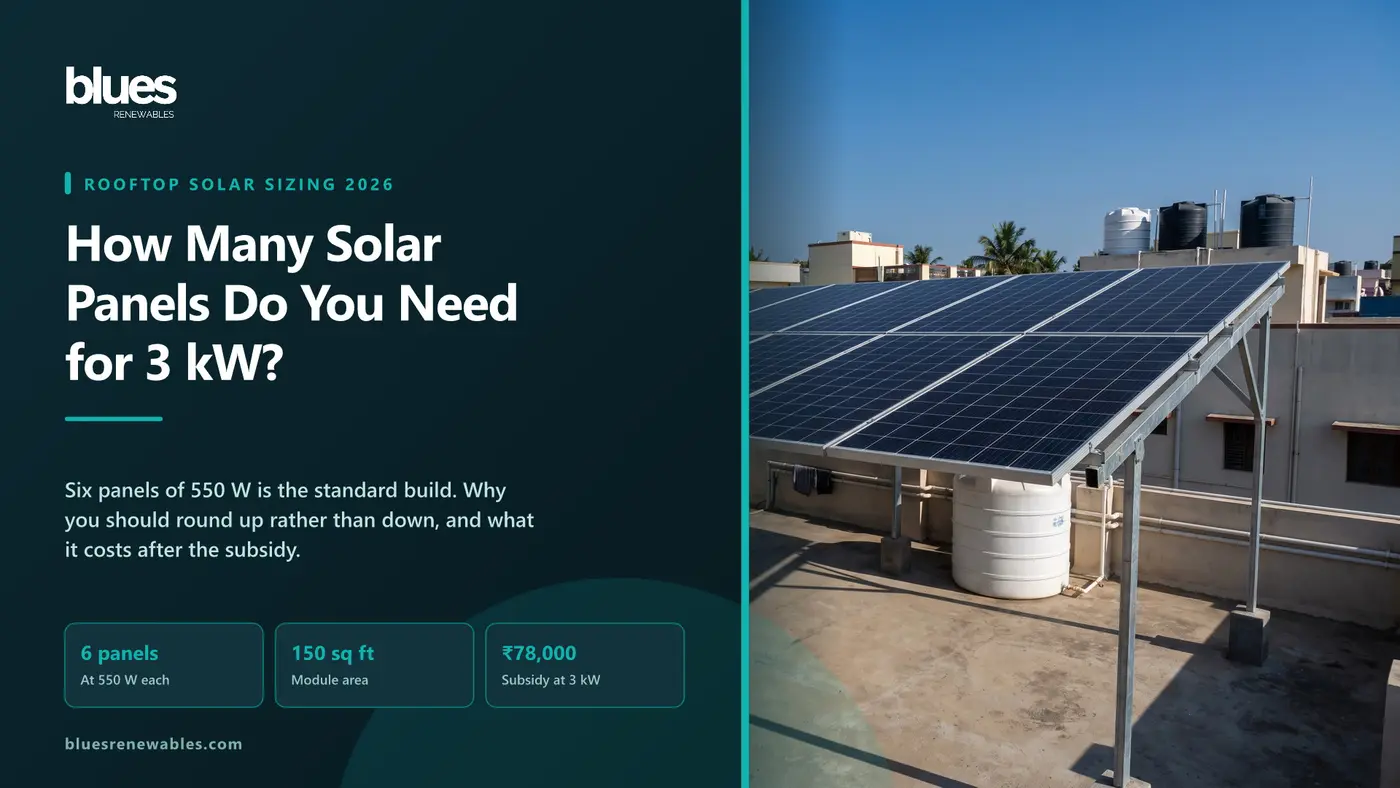
Six panels. That is the answer for almost every 3 kW system quoted in India today, and it was nine or ten only five years ago. Nothing about the kilowatts changed. The panels did.
The useful part of this question is not the count itself but what sits behind it, because 3,000 watts almost never divides evenly into a real panel size. You end up choosing between a system slightly under 3 kW and one slightly over, and in India that choice is worth about ₹4,500 in subsidy plus a permanent difference in generation. This guide gives the count for every common panel rating, shows why you should round up, and covers the roof area, output and cost that follow from it.
Key takeaways
- Six panels of 550 W is the standard 3 kW build in India in 2026, giving 3.30 kW of actual capacity. Five years ago the same system took nine or ten panels of 330 W.
- You can rarely land on exactly 3.00 kW. Six 550 W panels give 3.30 kW, five give 2.75 kW. Which side you land on matters more than the panel count.
- Round up, not down. A 2.75 kW system claims about ₹73,500 of subsidy, while 3.30 kW claims the full ₹78,000 ceiling. The sixth panel returns ₹4,500 of that immediately and around 79 extra units a month for 25 years.
- The glass needs about 150 to 167 sq ft. The array footprint including the gap between rows is closer to 250 sq ft, and on a raised structure the terrace underneath stays usable.
- A 3 kW system generates roughly 14 to 16 units a day in Chennai, about 430 to 475 units a month, which covers a typical 2 to 3 BHK home including one air conditioner used moderately.
- The system costs about ₹2,10,000 in Chennai, with ₹78,000 coming back as PM Surya Ghar subsidy after commissioning, so the net is around ₹1,32,000.
- Panel count is the easy part of comparing quotes. The module model, ALMM listing, inverter rating and structure specification are where two "3 kW" quotations actually differ.
How many solar panels are required for 3 kW
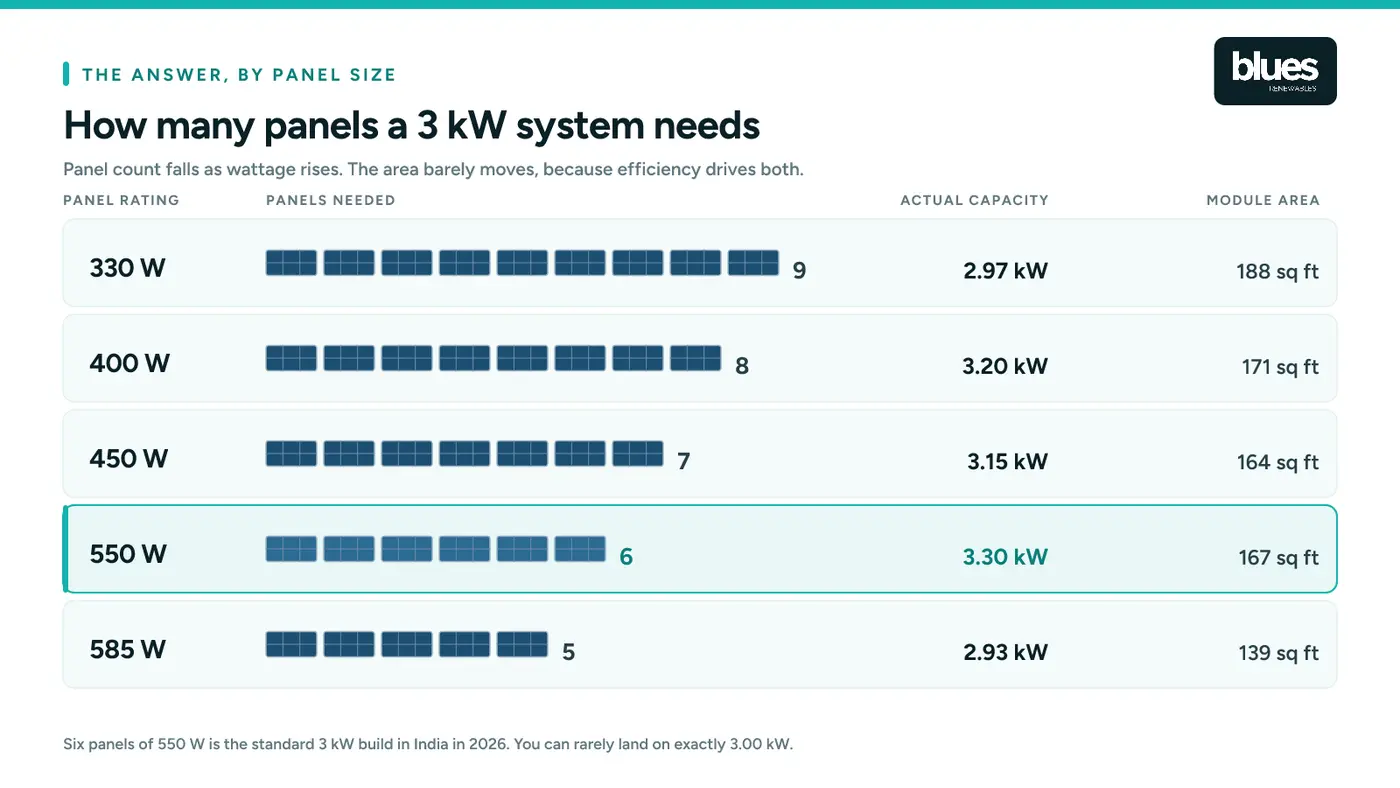
A 3 kW solar system requires six panels of 550 W, which is the standard configuration in India in 2026 and gives 3.30 kW of actual capacity. The count depends entirely on panel wattage: seven panels at 450 W, eight at 400 W, or nine to ten at 330 W. Divide 3,000 by the panel rating and round up.
Step 1: Divide 3,000 watts by the panel wattage
The arithmetic is simple. A "3 kW system" means 3,000 watts of module capacity, so:
Number of panels = 3,000 ÷ panel wattage
At 550 W that is 5.45 panels. At 450 W it is 6.67. At 330 W it is 9.09. Since you cannot buy part of a panel, the real question is which way to round, and that is Step 2.
Two things are worth knowing before you do the sum. First, the wattage on the datasheet is the peak rating under standard test conditions, 1,000 W/m² of irradiance at a 25 degree cell temperature. Your roof rarely sees those conditions together, which is why a 3 kW array does not produce 3 kW for most of the day. Second, Indian residential installations in 2026 overwhelmingly use 540 W to 600 W mono PERC or TOPCon modules, so 550 W is the sensible default assumption unless a quotation says otherwise.
Step 2: Round up rather than down
Six 550 W panels give 3.30 kW. Five give 2.75 kW. Most homeowners assume the smaller one is the sensible, cheaper choice. Under PM Surya Ghar it is usually the wrong one.
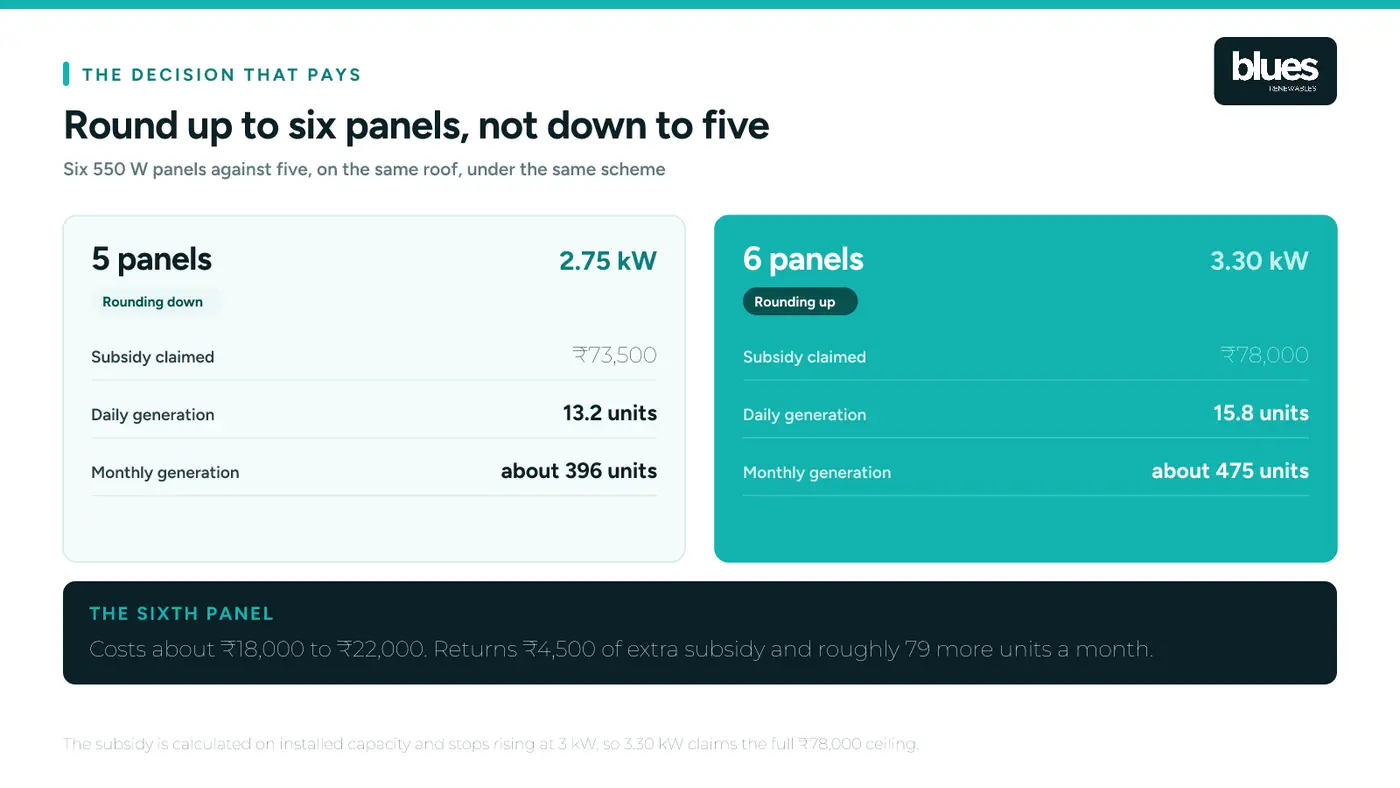
The subsidy is calculated on installed capacity in two slabs: ₹30,000 per kW for the first 2 kW, then ₹18,000 per kW for the third, capped at ₹78,000. So:
- 2.75 kW claims ₹60,000 plus ₹13,500, which is ₹73,500
- 3.30 kW claims the full ₹78,000, because the ceiling is reached at 3 kW and capacity above it is unsubsidised
That sixth panel costs roughly ₹18,000 to ₹22,000 installed. It returns ₹4,500 of extra subsidy straight away, and it adds about 2.6 units a day, close to 79 units a month, for the life of the system. At Chennai's upper domestic slab rates that alone is worth several hundred rupees a month. The panel pays for itself considerably faster than the system as a whole does.
There is one condition. Rounding up only works if your sanctioned load covers the larger system and your roof has the space, which are Steps 3 and 5.
Step 3: Check the roof area six panels need
A 550 W module measures roughly 2,278 mm by 1,134 mm, which is 2.58 m² or about 27.8 sq ft, and weighs around 29 kg. Six of them come to 167 sq ft of glass and about 174 kg before the structure.
The commonly quoted Indian rule is 50 sq ft per kW, which puts 3 kW at 150 sq ft. That rule describes the module area at modern panel efficiency and it is accurate for that. It is not the terrace area you need to keep clear.
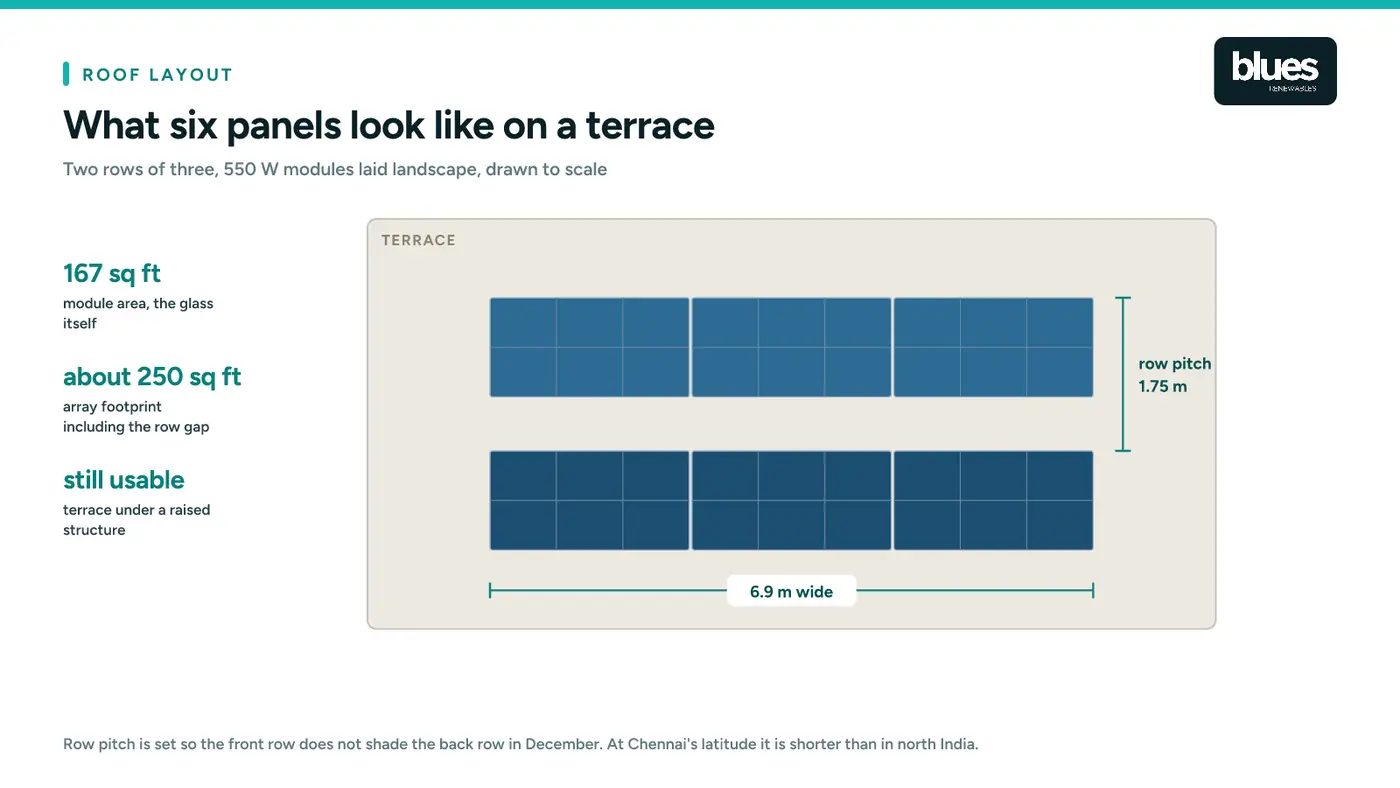
Laid out as two rows of three in landscape orientation, the array measures about 6.9 m wide by 2.9 m deep, or roughly 250 sq ft of terrace footprint once the gap between the rows is included. That gap exists so the front row does not shade the back row in December, and at Chennai's latitude it is shorter than it would be in north India, because the winter sun sits higher here.
The important qualification: on a raised structure of four to nine feet, the terrace underneath remains usable. Drying lines, water tanks and the sump inlet all stay accessible, which is why raised structures are the norm on independent houses in Chennai rather than an upsell.
Step 4: Match the inverter to the array
A 3.30 kW array normally runs on a 3 kW inverter. That is a DC to AC ratio of 1.1, which is deliberate and correct. The array only reaches its peak rating for a short window each day, so a slightly oversized DC side fills out the morning and evening shoulders without wasting inverter capacity.
What you should check is that the ratio is sensible in both directions. A 3.3 kW array on a 2 kW inverter is undersized and will clip output through the middle of the day. A 3.3 kW array on a 5 kW inverter is money spent on capacity that never gets used.
Also confirm the string fits the inverter's voltage window. Six panels wired in one series string at roughly 50 V open-circuit each gives about 300 V, comfortably inside the MPPT range of a typical residential string inverter. This is normally the installer's job, but it is worth seeing the single-line diagram rather than taking it on trust.
Step 5: Confirm the sanctioned load covers it
Your system capacity cannot exceed the sanctioned load on your electricity connection. This is the most common reason net metering applications get held up, and it catches people who size the array purely from their consumption.
Check the sanctioned load printed on your bill before you finalise the panel count. If it is below the system size you want, a load enhancement application should go in at the same time as the solar application rather than after one gets rejected. The TANGEDCO net metering process covers what that file involves.
Panel count by wattage
- 330 W - Panels needed: 9, Actual capacity: 2.97 kW, Module area: 188 sq ft
- 400 W - Panels needed: 8, Actual capacity: 3.20 kW, Module area: 171 sq ft
- 450 W - Panels needed: 7, Actual capacity: 3.15 kW, Module area: 164 sq ft
- 550 W - Panels needed: 6, Actual capacity: 3.30 kW, Module area: 167 sq ft
- 585 W - Panels needed: 5, Actual capacity: 2.93 kW, Module area: 139 sq ft
Two patterns are worth noticing. The panel count falls sharply with wattage, from nine down to five across the range. The module area barely moves, because higher wattage in the same physical frame comes from higher cell efficiency, and area is set by efficiency rather than by watts.
This is why older content saying "a 3 kW system needs 10 panels and 300 sq ft" is doubly out of date. The count is wrong and the area is roughly 40 percent too generous.
How much roof space 3 kW needs
Three numbers, and they describe different things:
- 150 to 167 sq ft is the module area, the glass itself
- About 250 sq ft is the array footprint including the gap between rows
- Still usable is the terrace under a raised structure
Beyond raw area, what actually decides whether your roof takes 3 kW is shadow. The area needs to be clear of shading between roughly 9 am and 4 pm, and overhead tanks, staircase headrooms, parapet walls and the neighbour's upper floor all subtract from usable space. Shading is not proportional either: with a single string inverter, one shaded module can pull down the output of the entire string.
If you want to check your own roof against a specific capacity, the solar panel size calculator works from available area rather than from a rule of thumb.
What a 3 kW system generates and runs
In Chennai a rooftop system generates about 4.8 units per kW per day across roughly 5.3 peak sun hours. So:
- A 3.00 kW system produces about 14.4 units a day, roughly 430 units a month
- A 3.30 kW system produces about 15.8 units a day, roughly 475 units a month
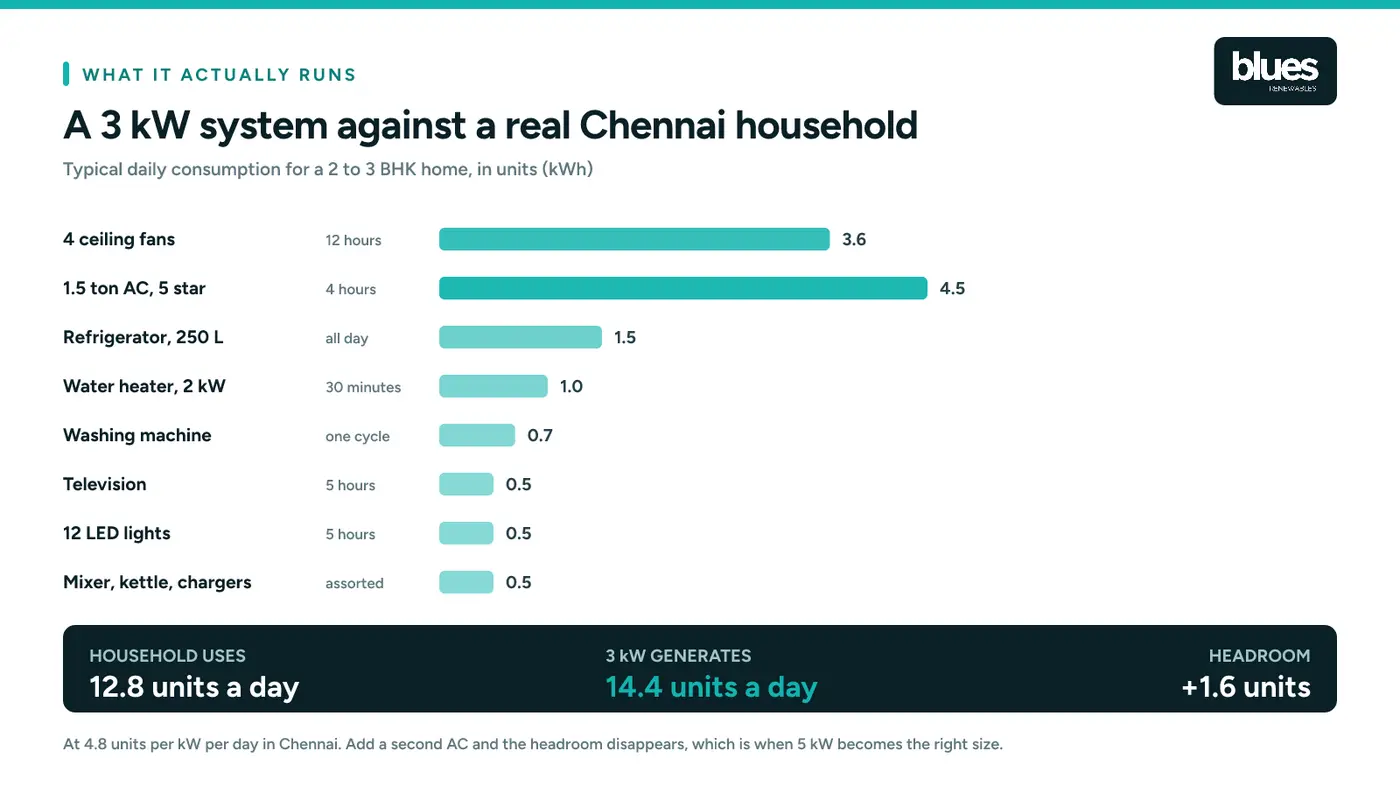
Against a typical Chennai 2 to 3 BHK household, that is comfortable but not unlimited. Four ceiling fans running twelve hours take about 3.6 units. A 5 star 1.5 ton air conditioner for four hours takes about 4.5. A refrigerator takes 1.5, a water heater half an hour takes 1.0, and lights, television, washing machine and small appliances add roughly 2.2 between them. That comes to around 12.8 units a day, leaving useful headroom against 14.4.
Add a second air conditioner and the headroom disappears. That is the point at which 5 kW becomes the right size, not 3 kW, and it is worth being honest about before you install rather than after.
Generation also varies through the year. Output peaks in the clear months and dips through the northeast monsoon from October to December, so judge a system on annual units rather than on any single bill.
What about 3.3 kW and 3.7 kW systems
Panel wattages rarely divide neatly into 3,000 watts, so real quotations often land a little above the nominal size. Six 550 W panels make 3.3 kW. Six 620 W panels make 3.72 kW. Both are still called a 3 kW system in conversation, and generation scales with the actual capacity rather than the label:
- A 3 kW system produces about 14.4 units a day, roughly 430 a month
- A 3.3 kW system produces about 15.8 units a day, roughly 475 a month
- A 3.7 kW system produces about 17.8 units a day, roughly 535 a month
All three rest on the same 4.8 units per kW per day that Chennai's 5.3 peak sun hours support after real world losses.
Two things to check if a quotation comes back at 3.3 kW rather than 3 kW. The PM Surya Ghar subsidy is capped at Rs 78,000 from 3 kW upward, so the extra 300 watts adds cost without adding subsidy. And the sanctioned load still has to cover the inverter, which is the check in step 5.
What 3 kW costs after the subsidy
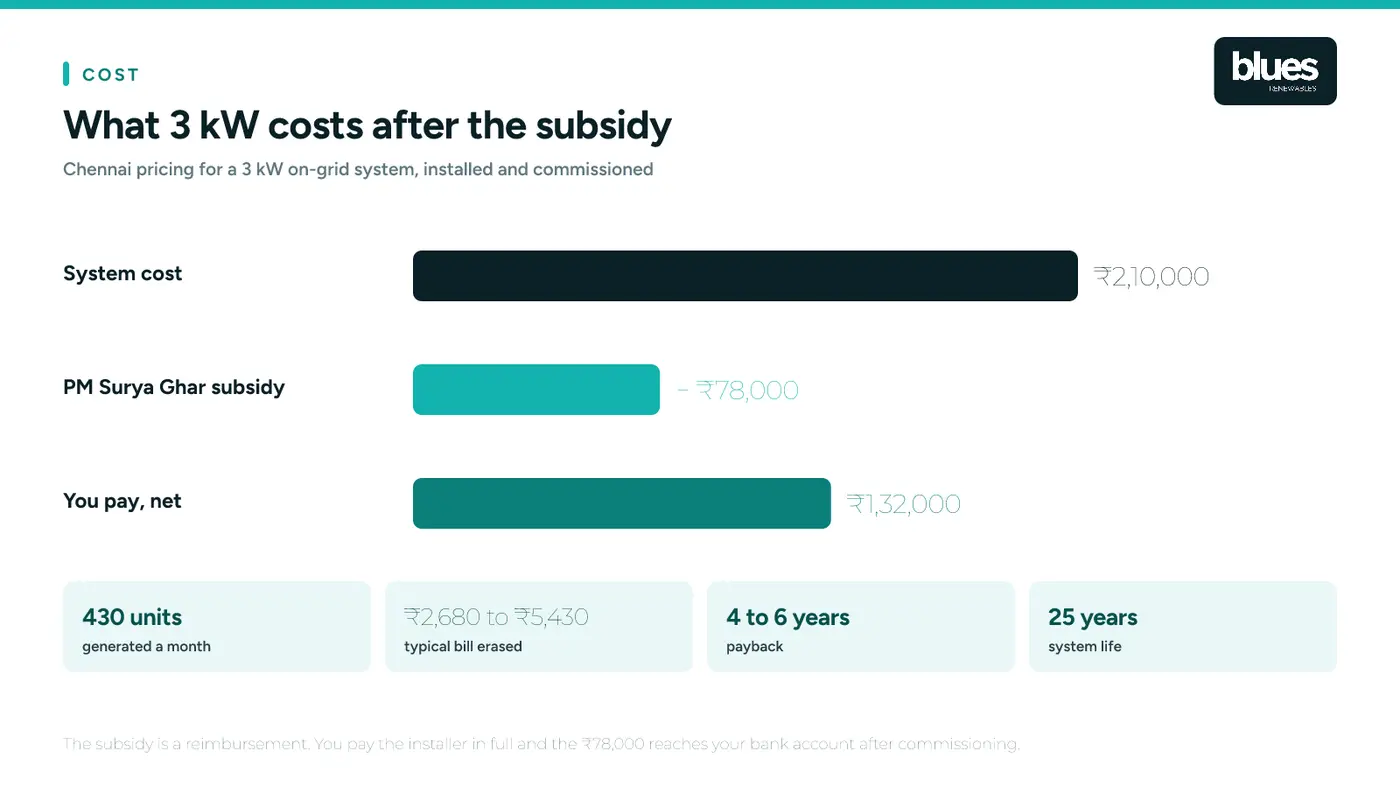
A 3 kW on-grid system in Chennai runs about ₹2,10,000 installed and commissioned. The PM Surya Ghar subsidy at 3 kW and above is ₹78,000, so the net cost is around ₹1,32,000.
One thing to plan for: the subsidy is a reimbursement, not a discount. You pay the installer the full ₹2,10,000 and the ₹78,000 reaches your bank account roughly 30 to 45 days after commissioning. Anyone budgeting on the net figure from day one will be caught short.
Final pricing moves with panel technology, inverter brand, structure height and roof condition, which is why a real number follows a site survey rather than a phone call. Most Chennai homeowners recover the investment through bill savings in four to six years, on a system built to run for 25. The 3 kW solar panel price breakdown sets out what each line in a quotation covers.
Why 3 kW is the most installed size in India
This is not a coincidence of demand. It is where the subsidy stops.
PM Surya Ghar pays ₹30,000 per kW for the first 2 kW and ₹18,000 for the third, reaching ₹78,000 at 3 kW. Above that the amount does not increase, whatever the system size. A 5 kW system and a 10 kW system both claim ₹78,000.
That makes 3 kW the point of maximum subsidy per rupee spent. At 3 kW you are recovering about ₹26,000 per kW installed. At 5 kW that falls to ₹15,600 per kW, and at 10 kW to ₹7,800.
Going larger is still often correct. It is simply a decision about how much of your bill you want to erase, not about how much support you can claim. A household consuming 700 units a month will not have its bill covered by 3 kW no matter how efficient the subsidy is at that size. The full slab structure and the application sequence are covered in the PM Surya Ghar subsidy guide.
Six lines to check on a 3 kW quotation
Two quotations both headed "3 kW" can differ by ₹40,000 and by half a kilowatt of real capacity. These are the lines where.
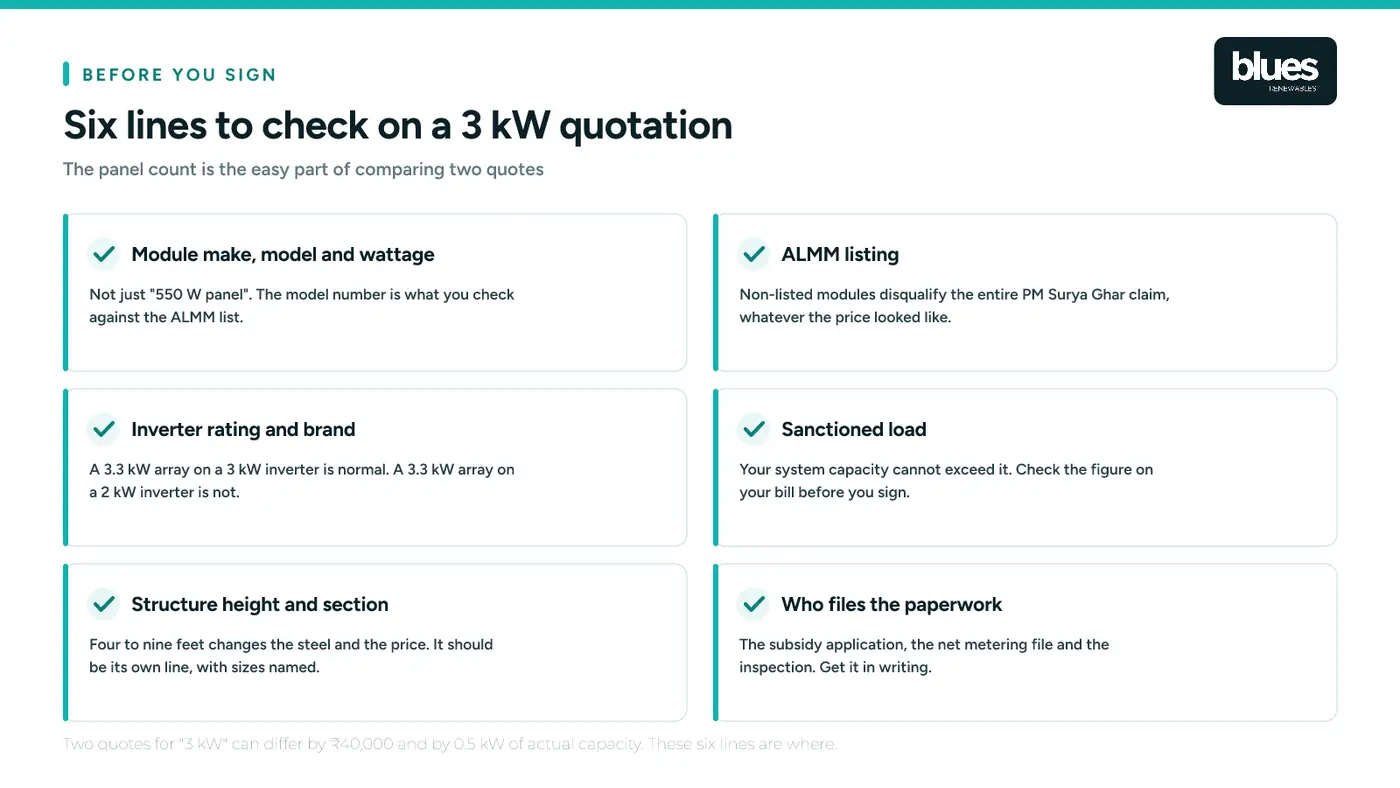
Module make, model and wattage. Not just "550 W panel". The model number is what you check against the ALMM list, and it is what determines whether you are getting mono PERC or TOPCon, monofacial or bifacial.
ALMM listing. Modules must appear on the Approved List of Models and Manufacturers. Non-listed modules disqualify the entire PM Surya Ghar claim regardless of how good the price looked or how well the panel performs.
Inverter rating and brand. Confirm the DC to AC ratio makes sense and check the warranty term. The inverter is the component most likely to need replacement inside 25 years.
Sanctioned load. Verify it against your bill before signing, and get the load enhancement filed in parallel if it is short.
Structure height and section sizes. Four feet against nine feet changes the steel, the foundations and the price materially. It should appear as its own line with the section sizes named, not folded into a lump sum. In Chennai the structure should be designed to the site's wind loading under IS 875 Part 3, since the city sits in a 50 m/s basic wind speed zone.
Who files the paperwork. The subsidy application, the net metering file, the DISCOM inspection and the follow-up on disbursal. Get the answer in writing, because this is where the cheapest quotations usually turn out to be incomplete.
Frequently asked questions
How many solar panels are required for 3 kW? Six panels of 550 W, which is the standard build in India in 2026 and gives 3.30 kW of actual capacity. With other ratings it is seven panels at 450 W, eight at 400 W, or nine to ten at 330 W. Divide 3,000 by the panel wattage and round up.
How many units does a 3 kW solar system generate per day? About 14.4 units a day for a 3.00 kW system in Chennai, and about 15.8 units for a 3.30 kW system, based on 4.8 units per kW per day. Over a month that is roughly 430 to 475 units. Output is higher in the clear months and lower through the northeast monsoon.
How much area is required for a 3 kW solar system? About 150 to 167 sq ft of module area, and roughly 250 sq ft of terrace footprint once the gap between the two rows is included. The area must be free of shadow between about 9 am and 4 pm. On a raised structure the terrace underneath stays usable.
What is the size of a 3 kW solar panel system in feet? The modules themselves occupy about 150 to 167 sq ft. Allowing for the gaps between rows, the array footprint is around 250 sq ft. Six 550 W panels each measure roughly 7.5 ft by 3.7 ft, which is where those totals come from.
What is the price of a 3 kW solar system in India? About ₹2,10,000 installed in Chennai, with ₹78,000 returned as PM Surya Ghar subsidy after commissioning, so the net is around ₹1,32,000. Pricing varies with panel technology, inverter brand, structure height and roof condition.
Is 3 kW enough for a house? For a typical 2 to 3 BHK home in Chennai, yes. At around 430 to 475 units a month it covers fans, lights, a refrigerator, a television, a washing machine, a water heater and one air conditioner used moderately, which comes to roughly 12.8 units a day. Add a second air conditioner and 5 kW becomes the better size.
Can I install 5 panels instead of 6 for a 3 kW system? You can, but it is usually a false economy. Five 550 W panels give 2.75 kW, which claims about ₹73,500 of subsidy against the ₹78,000 available at 3 kW, and generates roughly 79 fewer units a month permanently. The sixth panel pays for itself well before the rest of the system does.
How much does one 550 W solar panel cost? Roughly ₹18,000 to ₹22,000 installed as part of a system, which includes its share of the structure, cabling and labour. A panel bought on its own costs less but is not comparable, since most of an installed system's cost sits outside the module.
What size inverter do I need for a 3 kW system? A 3 kW inverter for a 3.30 kW array, which is a DC to AC ratio of 1.1 and is standard practice. Oversizing the DC side slightly captures more energy in the morning and evening without wasting inverter capacity.
How much does a 3 kW solar panel weigh on the roof? Six 550 W modules weigh about 174 kg, plus the mounting structure. Spread across the array footprint that is a modest load, and a reinforced concrete terrace carries it comfortably. Asbestos sheets and older tiled roofs usually need assessment first.
Does a 3 kW system work during a power cut? Not if it is an on-grid system, which most 3 kW residential installations are. It shuts down automatically during an outage as a safety requirement. Backup during cuts needs a hybrid system with a battery, which costs more and is not eligible for subsidy on the battery portion.
How long does a 3 kW solar system last? Modules typically carry a 25 to 30 year performance warranty with degradation around 0.5 percent a year. The inverter is the shorter-lived component and usually needs replacing once in that period, commonly between years 10 and 15.
Getting a 3 kW system installed
The panel count is settled in a sentence. What decides whether a 3 kW system is a good one is everything the count does not tell you: whether the modules are ALMM listed, whether the structure is designed for a coastal wind zone, whether the sanctioned load covers the capacity, and whether anyone is going to follow the subsidy through to your bank account.
Blues Renewables has been installing rooftop solar in Chennai since 2020, across homes, schools, businesses and factories. We survey the roof, size the system against your actual consumption rather than a rule of thumb, file the PM Surya Ghar application and the net metering file, attend the inspection, and track the subsidy to disbursal. Every installation includes two years of free maintenance.
See what a residential installation involves end to end on the solar panel for home in Chennai page, or call +91 98841 07170 for a free site assessment.
Sources
- PM Surya Ghar Muft Bijli Yojana subsidy structure and Central Financial Assistance slabs, Ministry of New and Renewable Energy
- Manufacturer datasheets for 550 W and 585 W mono PERC and TOPCon modules, for dimensions, weight and efficiency
- Approved List of Models and Manufacturers (ALMM) eligibility requirements for subsidy claims
- IS 875 Part 3 wind load design standard, for mounting structure specification in coastal zones