






Solar Panel Installation in Tirupur
Tirupur runs on two things that solar interacts with directly: enormous process electricity loads in dyeing and effluent treatment, and export customers who increasingly want renewable energy use documented. Those two facts make this one of the strongest industrial solar markets in Tamil Nadu.
Installing across Tamil Nadu since 2020
Two years free maintenance included
Subsidy and TANGEDCO paperwork filed by us
Free site survey and energy audit, no obligation
What changes where
Pick what applies to your site
Garment unit
Machine load through shift hours, generally strong coverage on a single shift operation.
Six of the things that change a design in Tirupur. We confirm which apply at the survey.
The short answer
Solar installation in Tirupur
Blues Renewables delivers commercial and industrial solar EPC and solar lighting across Tirupur. The district’s knitwear units, dyeing houses, zero liquid discharge plants and garment factories carry heavy and often continuous electrical loads, and export customers increasingly require renewable energy use to be documented. Every project begins with a twelve month load profile analysis rather than a roof measurement. For a residential benchmark, the solar panel price in Chennai lists installed costs from 3 kW to 10 kW, and our solar panel installation in Chennai page shows the survey-first process we also bring to Tirupur.
The local picture
Process loads and buyer requirements
Tirupur’s electricity consumption is dominated by process loads rather than lighting and cooling. Dyeing, effluent treatment and zero liquid discharge plants run pumps, blowers and evaporation systems that draw heavily and often continuously, and garment units run large numbers of machines during shift hours. The load profile therefore determines what solar can offset far more than roof area does.
What applies commercially across the cluster
Non-domestic consumers are generally on net feed-in
So exported units earn well below the tariff paid on imports. Size to daytime self-consumption.
Solar reduces the energy charge, not the demand charge
Which on a dyeing unit’s HT connection is a substantial part of the bill.
Accelerated depreciation requires taxable profit
To offset, which for units running thin margins may make an OPEX structure the better route.
Roof condition on older sheds
Determines whether the roof is dealt with before or after the array.
Where it matters most
The zero liquid discharge point
ZLD systems are among the most electricity-intensive parts of a dyeing operation, and their load is a large share of the total bill. Because that load frequently runs beyond daylight hours, rooftop solar addresses part of it rather than the whole, and any proposal presenting total ZLD consumption as offsettable is overstating what it will do.
Genuine, and growing
The buyer requirement dimension
International apparel brands sourcing from Tirupur increasingly ask suppliers to document energy use and renewable energy share as part of sustainability programmes and audits. On-site generation is straightforward, auditable evidence backed by metered data rather than estimates or certificates purchased elsewhere. For many units here that requirement now weighs alongside the electricity saving, and a system sized and metered so its output can be reported cleanly is worth more than one sized purely on payback.
Our work
What we do in Tirupur
Quick estimate
What size system does your bill suggest?
System size
5.5 kW
Indicative cost
₹2.90 L to ₹3.33 L
PM Surya Ghar subsidy
₹78,000
Monthly saving
₹5,400
Simple payback
3.5 yrs
Indicative only, at roughly 4.2 units per kW per day and a blended domestic tariff. The state rooftop calculator run by TNGECL uses about 1,720 units per kW a year for Tiruppur, about 4.7 a day. Your roof, shading and sanctioned load set the real figure.
Get the real number →Knitwear and garment units
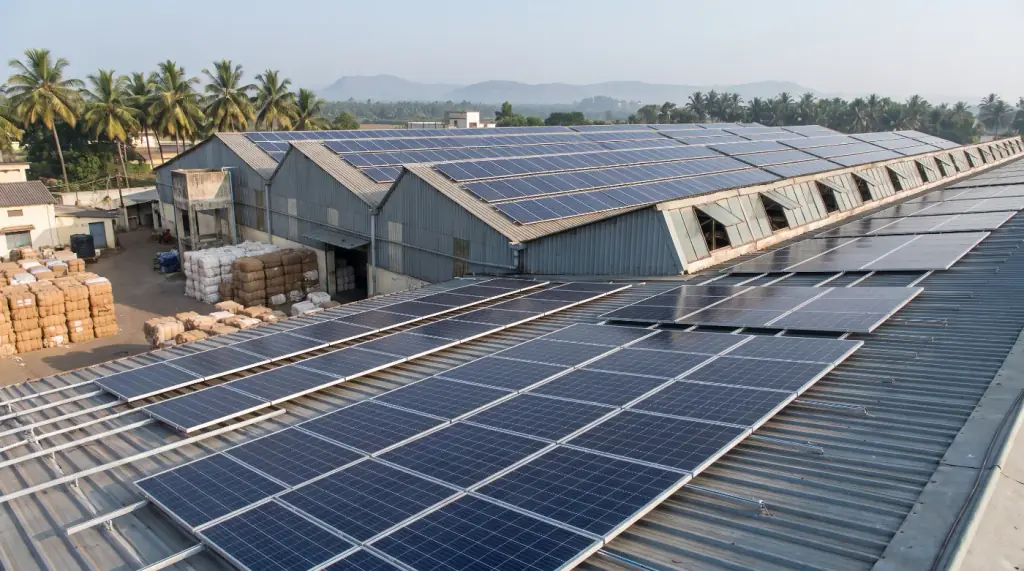
Machine loads through shift hours, generally a strong solar match on single shift operations. Sheet roofs where purlin capacity and sheeting condition determine the design.
Dyeing houses and processing units
Heavy process load, often multi shift. Sized to the daytime portion, with an honest statement of what proportion of the bill that represents.
ZLD and effluent treatment plants
Among the most electricity-intensive loads in the cluster, and frequently continuous. Solar addresses part of it, and the load profile study says how much.
Documentation for buyer audits
Metered generation data that can be reported cleanly to customers requiring renewable energy evidence, which is part of what commissioning and monitoring should deliver.
Solar lighting
Industrial estates, factory perimeters and campuses across the district. Projects from 50 units.
What we install
Services and guides
Looking for a different district? See everywhere we work across Tamil Nadu.
Free, no obligation
Book a free assessment in Tirupur
Send us your last twelve months of electricity bills. For a business or industrial site we will run a load profile analysis first, because that determines what solar can actually offset and your roof only constrains it.
Common questions
Solar in Tirupur, common questions
How much of a dyeing unit’s bill can solar cover?
The daytime portion of the energy charge, which depends on your shift pattern and how much of your process load runs beyond daylight hours. ZLD and effluent systems in particular often run continuously, so solar addresses part of that load rather than all of it. A twelve month load profile study gives the honest figure.
Can solar help with export customer sustainability requirements?
On-site generation is straightforward and auditable evidence of renewable energy use, backed by metered data rather than estimates. For many Tirupur units that documentation requirement now weighs alongside the electricity saving, and a system metered so its output reports cleanly is worth more than one sized purely on payback.
Will solar reduce our demand charges?
No. Demand charges are levied on contract or recorded maximum demand, which on a dyeing unit can peak at any point in the process cycle regardless of what the array is doing. Solar reduces the energy charge on units generated during daylight hours, which on an HT connection is still substantial.
Is CAPEX or OPEX better for a Tirupur unit?
It depends on your tax position more than your capital. Accelerated depreciation is only valuable to a business with taxable profit to offset, so a unit running thin margins gains little from ownership. In that case an OPEX arrangement with no upfront cost and payment per unit consumed often compares better. Check with your auditor.
Do you work on garment factory roofs?
Yes. Most are profiled sheet over steel purlins, where purlin spacing and section determine where the mounting can fix, and skylights constrain the usable layout. Sheeting condition and remaining life are assessed at the roof survey, since replacing sheets under an installed array is expensive and disruptive twice.
Do you install residential solar in Tirupur?
Residential rooftop installation is concentrated around Chennai. Our work in Tirupur is commercial and industrial EPC and solar lighting projects. For a household enquiry we will say honestly whether we can serve you properly.