





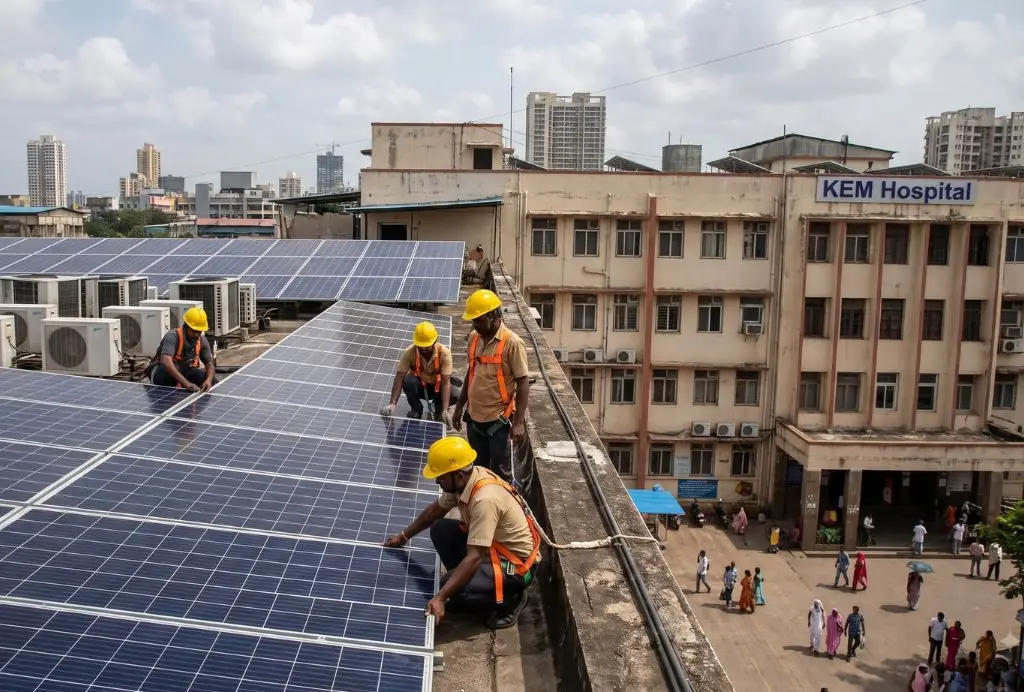

Industrial Solar in Chennai
For a Chennai factory, the useful question is not whether solar works but how much of your load a roof can realistically carry, and what to do about the rest.
Our starting position
We start with an energy audit of your actual consumption and demand profile, then tell you what rooftop will and will not solve. Sometimes that means a smaller system than you expected, and occasionally a different structure entirely.
Energy audit before design
HT and LT connections
Installation around your production schedule
Installing in Chennai since 2020
Speak to the industrial team
+91 98841 07170What most proposals will not tell you
For a substantial factory, rooftop usually cannot cover the full load. The roof is finite and the demand is not. That makes it one part of an energy strategy, not the whole of it.
The difference
Why factory solar is not just bigger commercial solar
Industrial consumers in Tamil Nadu are typically on HT connections with contract demand measured in kVA, where the bill combines an energy charge per unit with a demand charge on sanctioned or recorded maximum demand, plus power factor incentives or penalties and time-of-day variation. Rooftop solar reduces the energy charge on units generated during daylight hours. It does not reliably reduce demand charges, and on a multi-shift operation it addresses only the portion of consumption that falls in generating hours.
01
Demand charges are not displaced
Your demand charge is levied on contract demand or recorded maximum demand, and maximum demand can occur at night, during a shift change, or on a cloudy afternoon. Solar reduces what you pay per unit, not what you pay for the right to draw power.
02
Multi-shift operations consume outside generating hours
A single-shift day operation is close to an ideal solar match. A two or three shift plant draws heavily at night, when the array produces nothing. Self-consumption during the day may be excellent while total annual coverage remains modest, and both facts need to be in the model.
03
The roof is finite, the load is not
A factory drawing several hundred kVA cannot be served from its own roof, however large the shed. The right response is to size rooftop to what it genuinely offsets and consider other structures for the balance.
If your premises is an office, shop, clinic or school rather than a plant, the solar EPC page for commercial premises is the right starting point.
The honest number
How much of a factory's load can rooftop solar cover?
The share of a Chennai factory's electricity that rooftop solar can cover depends on three things: usable roof area against connected load, how much consumption falls within generating hours, and the ratio of energy charges to demand charges in the bill. Single-shift operations with large sheds and modest loads can offset a substantial proportion. Continuous-process plants with high demand relative to roof area will offset considerably less, and the honest number comes from an audit rather than a rule of thumb.
What is your shift pattern?
Single shift, day operation
Best case for rooftop
Close to an ideal solar match. Consumption sits squarely in generating hours, so most of what the array produces is self-consumed at the full tariff rather than exported at a feed-in rate.
Here the binding constraint is usually roof area against connected load, not the load pattern. If the shed is large relative to the load, rooftop can offset a substantial share of the energy charge.
What we measure before designing anything
Twelve months of consumption
Not one bill — to capture seasonality and production cycles.
Load profile across the day
So daytime self-consumption is estimated rather than assumed.
Contract demand and recorded maximum demand
To separate what solar can and cannot address.
Shift pattern
Including weekend and shutdown periods.
Power factor and ToD exposure
Which affect where the savings actually sit.
Usable roof area
After purlin layout, skylights, extractors, ducting and walkways.
On export treatment
Non-domestic consumers in Tamil Nadu are generally on net feed-in rather than one-for-one net metering, so exported units earn a feed-in tariff well below the tariff you pay on imports. For an industrial site this reinforces the same conclusion: size to self-consumption. Surplus sold back returns a fraction of what it saves when consumed on site.
Network or grid-support charges
These also apply to prosumers and belong in the model. They are levied per unit and reduce net savings, and any proposal that omits them overstates the return. More on TANGEDCO approvals explained.
We confirm current feed-in tariff and network charge rates against the prevailing TNERC order at proposal stage. Both are revised periodically, which is why they belong in the financial model rather than on a website.
Get a load profile analysisDesign principle
Self-consumption first, and when zero export applies
For a factory, the value of a solar unit depends almost entirely on whether you consume it or export it. A self-consumed unit displaces the full landed cost of grid power — energy charge, applicable demand-linked components and the charges that ride on them. An exported unit earns whatever feed-in rate applies to your category, which is materially lower. That single asymmetry is why we size industrial arrays to the plant's daytime baseline load rather than to the roof area available.
A unit you consume
Displaces grid power at your effective landed rate. Nothing is metered out, nothing is settled later, and no feed-in tariff or banking rule applies to it. This is the unit that carries the project.
A unit you export
Earns the feed-in rate for your consumer category, subject to the prevailing TNERC order, settlement period and any applicable network or grid-support charges. Worth having, but never worth designing around.
Zero export
When the system must not push a single unit into the grid
Some industrial connections are sanctioned on a no-export basis — the plant may generate and consume as much as it likes, but nothing may flow back through the point of common coupling. This is handled by an export control system, not by guesswork about load.
When it applies
Where the connection is sanctioned without export, where feeder or transformer conditions constrain injection, or where you would simply rather avoid feed-in settlement and banking altogether. Which of these applies to your service connection is confirmed with TANGEDCO at approval stage, not assumed at proposal stage.
What it costs you, honestly
Nothing, while your daytime baseline stays above generation. The moment generation exceeds it, the inverters curtail and those units are never produced. On a single-shift plant with weekend shutdowns that loss is real, so we size against the measured baseline and shutdown pattern — not the connected load on your bill.
None of this is decided from a bill. We log a week of interval data at the incomer first — baseline load, shift pattern and weekend shutdown are what set the array size, and what determine whether export control changes the answer at all. That logging is part of the energy audit.
The roof
Metal sheet roofs, purlins and load capacity
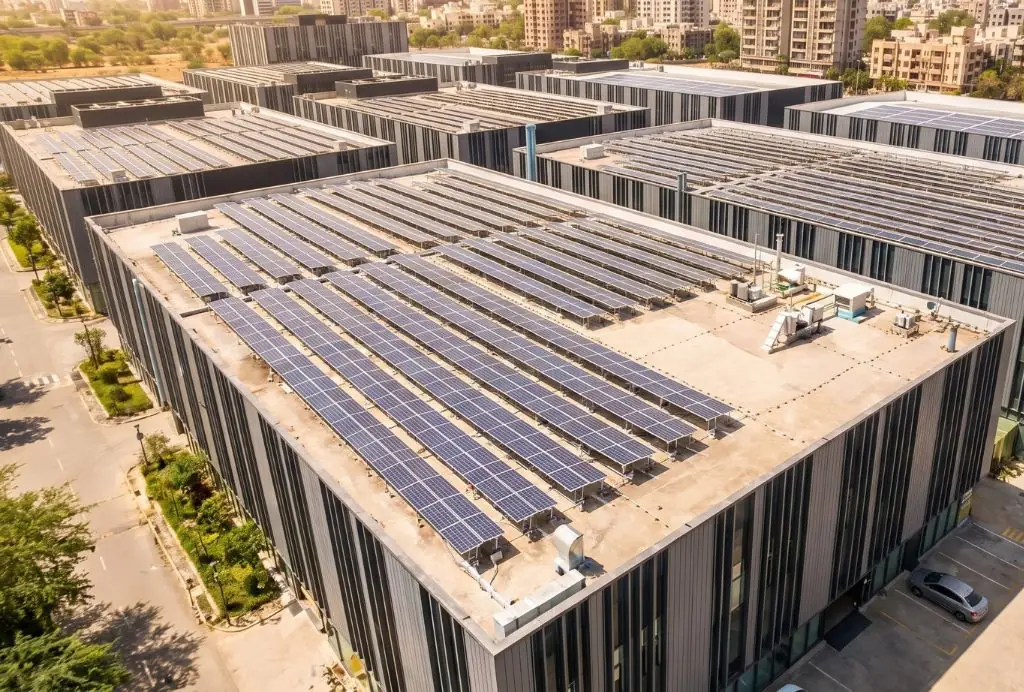
Most Chennai industrial roofs are profiled metal sheet over steel purlins, and the constraint on a solar array is usually structural rather than spatial. What matters is purlin spacing and section, the load capacity of the existing structure, the condition and remaining life of the sheeting, and how the array is fixed without compromising the roof's weather performance.
| Check | Why it decides the design |
|---|---|
| Purlin spacing and section | Determines fixing points and whether the array needs a secondary structure |
| Structural load capacity | Additional dead load and wind uplift must be within the frame's capacity |
| Sheet condition and remaining life | A 25-year asset should not sit on sheeting with ten years left |
| Sheet profile and gauge | Determines the clamp or fastener system |
| Skylights, extractors, ducting | Reduce usable area and complicate layout |
| Existing services on the roof | Cable trays, gas lines, HVAC plant |
| Access and walkway provision | Maintenance access must be designed in, not improvised |
Fixing without compromising the roof
On standing seam profiles, non-penetrative clamps can fix the array without piercing the sheet, which preserves the roof warranty and avoids introducing leak paths. On trapezoidal profiles, fixings usually penetrate and must be properly sealed at every point. Ask any contractor which system they intend to use, why, and what warranty covers the weatherproofing as distinct from the structure.
The question to settle before anything else
If your sheeting is approaching the end of its life, deal with it first. Replacing roof sheets under an installed array is expensive, and on a working factory it means disrupting production twice instead of once. We assess sheet condition at the survey and will tell you plainly if the roof should be addressed before the solar.
Installation
Working around your production schedule
Industrial solar installation happens above an operating plant, which makes sequencing and safety as important as engineering. Work is scheduled around production, using weekends, planned shutdowns or shift gaps where the line cannot be interrupted, and the electrical tie-in is planned for a window agreed in advance rather than assumed.
When rooftop is not enough
Captive, group captive and open access
Where a factory's demand substantially exceeds what its roof can serve, the alternatives are ground-mounted captive generation on the company's own land, a group captive arrangement where the consumer holds equity in a generating company and consumes a required share of its output, or open access procurement of power from a third-party generator wheeled through the grid. Each involves different regulatory approvals, wheeling and banking arrangements, and commercial structures, and each suits a different scale and balance sheet.
| Rooftop | Ground-mount captive | Group captive | Open access | |
|---|---|---|---|---|
| Where it sits | Your roof | Your land | A shared generating company | Third-party generator |
| Capital required | Moderate | High | Equity stake | None, a procurement contract |
| Typical scale | Up to a few hundred kW | Hundreds of kW upward | MW scale | MW scale |
| Regulatory complexity | Lowest | Moderate | High | High |
| Main cost factors | Equipment and structure | Land, equipment, evacuation | Equity, wheeling, banking | Tariff, wheeling, banking, surcharges |
| Suits | Most factories, partially | Sites with spare land | Large consumers wanting captive benefits without full ownership | Large consumers preserving capital |
Group captive, briefly
Under the captive generation framework, a consumer holding the required minimum equity in a generating company and consuming the required proportion of its generation is treated as a captive user, which changes the applicable charges compared with ordinary third-party procurement. The equity and consumption thresholds are set by the Electricity Rules and compliance is assessed annually, so the structure needs proper legal and financial advice rather than a solar vendor's summary.
What we will tell you honestly
Blues Renewables delivers rooftop and ground-mount solar. If your load genuinely calls for a group captive or open access structure, we will say so rather than sizing a rooftop system that leaves most of your bill untouched.
In many cases the right answer is both: rooftop for the daytime baseline you can serve on site, and a separate arrangement for the balance.
Wheeling charges, banking arrangements, cross-subsidy surcharge and additional surcharge vary by consumer category, voltage level and scale, and are revised periodically. Any comparison of these routes needs project-specific modelling against current orders.
Finance and compliance
Depreciation, GST credit and buyer requirements
Industrial solar in India qualifies for accelerated depreciation of up to 40% on the asset value in the first year under the Income Tax Act, plus GST input tax credit for registered businesses, which together convert a substantial share of the capital cost into a first-year tax benefit. For manufacturers supplying export markets, documented renewable generation is increasingly a commercial requirement as well as a cost measure.
The tax position
Accelerated depreciation front-loads the deduction, so a profitable plant recovers a meaningful share of the investment through reduced tax liability in year one. The benefit depends on having taxable profit to offset, which is precisely when an OPEX or RESCO structure becomes the better route for a business that cannot use it.
Your accountant should model this, not your solar contractor. We provide the asset value, classification and invoice structure your finance team needs.
Supplier and export requirements
Chennai's automotive, auto-component, textile, leather and electronics exporters are increasingly being asked to document renewable energy use by their customers' sustainability programmes. On-site generation is among the simplest and most defensible reductions to evidence, and green audit certification is appearing in tender documents and supplier onboarding.
For plants supplying into markets with carbon border measures, the reporting burden is rising rather than falling. Treat this as a real and growing commercial factor, and get proper advice on which specific requirements apply to your products and markets rather than relying on a general claim.
Carbon credits
Where solar sits in the Indian Carbon Market
Carbon credits are the most oversold line in industrial solar proposals. Here is what is actually true for a Chennai plant, and what we will not put in your financial model.
Solar cuts the number the scheme actually measures
India's Carbon Credit Trading Scheme, notified in 2023 and administered by the Bureau of Energy Efficiency, sets greenhouse gas intensity targets per unit of output on a gate-to-gate basis — covering purchased electricity, not just fuel burnt on site. Self-consumed rooftop generation lowers that measured intensity directly.
Roughly 0.7 tonnes of CO₂ avoided per MWh
Using the Central Electricity Authority grid emission factor, each megawatt-hour you generate and consume displaces on the order of 0.7 tonnes of CO₂ from the grid. We design to 4.8 units per kW per day for Chennai, so a 500 kW plant is about 8.8 lakh units and roughly 610 tonnes avoided in a year. Shed orientation, soiling and any export curtailment pull the realised figure below the design basis, which is why the number we certify comes from metered generation once the plant is running. The CEA factor is revised periodically, so we state the version used.
If you are an obligated entity
Nine energy-intensive sectors — including textiles, cement, aluminium, chlor-alkali, pulp and paper — now carry binding intensity targets for compliance years 2025-26 and 2026-27. Beating your target earns tradable Carbon Credit Certificates, one per tonne of CO₂e. Missing it means buying them. Solar moves you in the right direction on that ledger.
If you are not, be realistic
The voluntary Offset Mechanism lets non-obligated entities register projects and earn certificates, but offsets cannot currently be surrendered against compliance targets, and registration, monitoring and third-party verification carry real cost. For most single-site rooftop plants the credit revenue does not justify the process on its own. Treat it as a possible extra, never as part of the payback case.
The reporting value is the reliable part
A verifiable on-site renewable share is what customer sustainability programmes, tender pre-qualification and carbon border reporting actually ask for. That benefit lands the day the system is commissioned, with no market, registry or price risk attached to it.
Where this stands today
The compliance market is still coming into force — the first verified emissions reports fall due in 2026 and certificate trading on the power exchanges is expected to follow. Rules, sector coverage and prices are all moving. We will give you the avoided-tonnes figure and the emission factor behind it; your sustainability or tax advisor should decide what, if anything, to do with it commercially.
Coverage
Industrial solar across the Chennai belt
Cost drivers
What determines the cost of an industrial installation
| What varies | Effect |
|---|---|
| Scale | Lower per kW as system size increases |
| Metal sheet roof in good condition | Lower per kW, simpler mounting |
| Secondary structure for purlin spacing | Higher |
| Sheet replacement required first | Additional, and best done before |
| Non-penetrative clamp system | Varies by profile, often worth it for warranty reasons |
| HT connection and metering | Different approval route and equipment |
| Distribution transformer feasibility | Required above 10 kW, extends timeline |
| Installation around production | Weekend or shutdown working carries a premium |
| Crane and access requirements | Higher on constrained sites |
| Coastal location, Ennore and Manali belt | Salt mist certified modules, corrosion-resistant structures |
| Ground-mount instead of rooftop | Land preparation, civil work, evacuation |
Why we do not publish industrial pricing: the spread between a straightforward sheet roof and a constrained site needing secondary structure, sheet replacement and shutdown working is very wide. A figure on a webpage would be wrong for almost every plant reading it. We audit, then quote, itemised. More on what drives solar prices in Chennai.
As a guide, a factory rooftop in Tamil Nadu runs about ₹41 to ₹47 a watt at 100 kW and ₹37 to ₹42 a watt at 500 kW, including GST. See the 100 kW, 200 to 250 kW and 500 kW solar plant cost pages, or commercial solar cost per kW for every size.
Book a site assessmentThe process
How an industrial project runs
Assess
Before anything is designed
STEP 01
Energy audit
Twelve months of bills, load profile, contract demand, recorded maximum demand, power factor, shift pattern and ToD exposure.
STEP 02
Roof and structural survey
Purlin layout and section, load capacity, sheet condition and remaining life, obstructions, access.
STEP 03
Feasibility and options
What rooftop realistically offsets, and where a different structure should be considered for the balance.
Design and approve
Paper before steel
STEP 04
Proposal
System size, itemised bill of materials, electrical and structural design basis, generation estimate, and a savings model that separates energy charges from demand charges and includes network charges.
STEP 05
Approvals
TANGEDCO application, distribution transformer feasibility for systems above 10 kW, connection or demand work where required.
Build and run
Around your production
STEP 06
Installation
Scheduled around production, with the tie-in in an agreed window.
STEP 07
Commissioning and handover
As-built drawings, test reports, commissioning documentation, monitoring configured for your maintenance team.
STEP 08
Operations and maintenance
Two years included, AMC thereafter.
Free, no obligation
Get an industrial energy audit
Send us twelve months of electricity bills for the plant. We will analyse your consumption and demand profile, survey the roof structure, and return a proposal that states plainly what rooftop will offset, what it will not, and whether a different structure should be considered for the balance.
What you receive
- Load profile analysis across a full year, including shift and seasonal variation
- Contract demand and maximum demand assessed separately from energy consumption
- Roof structural survey covering purlins, load capacity and sheet condition
- A system size based on daytime self-consumption
- Itemised bill of materials and design basis
- A savings model separating energy charges from demand charges, with network charges included
- CAPEX and OPEX options, with the depreciation position set out
- An honest view on whether rooftop alone addresses your problem
Common questions
Industrial solar in Chennai, common questions
How much of a factory's electricity can rooftop solar cover?
It depends on usable roof area against connected load, how much consumption falls in generating hours, and the ratio of energy charges to demand charges. Single-shift plants with large sheds and moderate loads can offset a substantial share. Continuous-process plants with high demand relative to roof area offset considerably less. The honest figure comes from a load profile analysis rather than a rule of thumb.
Does solar reduce demand charges on an HT connection?
Not reliably. Demand charges are levied on contract demand or recorded maximum demand, and maximum demand can occur at night, at a shift change or on a cloudy afternoon. Rooftop solar reduces the energy charge on units generated during daylight hours. Any proposal implying that solar eliminates an HT bill is not modelling demand charges properly.
Can solar be installed on a metal sheet industrial roof?
Yes, and it is among the most common industrial installations. The constraints are structural rather than spatial: purlin spacing and section, the frame's load capacity, and the condition and remaining life of the sheeting. On standing seam profiles, non-penetrative clamps can fix the array without piercing the sheet.
Will installation disrupt production?
It should not, if it is planned properly. Work is scheduled around your production calendar, using weekends, planned shutdowns or shift gaps, and the electrical tie-in is planned for an agreed outage window. Ask any contractor about their experience on live production sites, method statements for work at height above operations, and insurance cover.
Should I replace my roof sheeting before installing solar?
If the sheeting has significantly less life left than the solar system's 25-year design life, yes. Replacing sheets under an installed array is expensive and disrupts production twice rather than once. Sheet condition should be assessed at the survey and dealt with beforehand where necessary.
What is group captive solar, and is it worth considering?
Group captive is a structure where a consumer holds a minimum equity stake in a generating company and consumes a required proportion of its output, which changes the charges applicable compared with ordinary third-party procurement. It suits large industrial consumers whose demand far exceeds on-site potential. Equity and consumption thresholds are set by the Electricity Rules and compliance is assessed annually, so it needs legal and financial advice rather than a vendor's summary.
Do industrial consumers get net metering in Tamil Nadu?
Non-domestic consumers are generally on net feed-in rather than the one-for-one net metering available to domestic consumers, meaning exports are compensated at a feed-in tariff below the tariff paid on imports. For an industrial site this reinforces sizing to self-consumption, since surplus sold back returns a fraction of what it saves when used on site.
What tax benefits apply to industrial solar?
Accelerated depreciation of up to 40% on the asset value in the first year under the Income Tax Act, plus normal depreciation thereafter, and GST input tax credit for registered businesses. The depreciation benefit depends on having taxable profit to offset, which is when an OPEX or RESCO structure becomes the better route for a plant that cannot use it.
What approvals does industrial solar need in Chennai?
A TANGEDCO application and metering arrangement appropriate to the connection type, plus connection or demand work where the system exceeds existing sanction. Systems above 10 kW involve an assessment of distribution transformer capacity, which extends the timeline compared with small systems.
Is ground-mount better than rooftop for a factory?
It depends on the site. Ground-mount suits plants with spare land whose roof cannot take additional load, whose sheeting is near end of life, or whose roof area is heavily obstructed. It allows optimal tilt and orientation and easier maintenance access, at the cost of land use, civil work and a more involved approval process.
What network charge does a factory pay on rooftop solar in Tamil Nadu?
In 2026-27 the network charge is ₹1.60 a unit of generation on LT, of which an LT industrial (LT IIIB) consumer pays ₹0.80 because the state pays half, and ₹1.04 a unit on HT. It is levied on total generation under net feed-in and is under challenge in the Madras High Court.
What does rooftop solar cost for a factory in Chennai?
₹22 to ₹25 lakh for 50 kW, ₹41 to ₹47 lakh for 100 kW, ₹78 to ₹88 lakh for 200 kW and ₹1.85 to ₹2.1 crore for 500 kW in 2026, including 8.9% GST that a registered factory claims back. A 100 kW plant on LT IIIB saves about ₹11.1 lakh a year; a 200 kW plant on HT I about ₹19.3 lakh, a payback of roughly four years before 40% accelerated depreciation.