






Solar for Warehouses and Godowns in Tamil Nadu
Every other building on this site has the same problem: not enough roof for the load. A warehouse has the opposite problem, and it is the more interesting one.
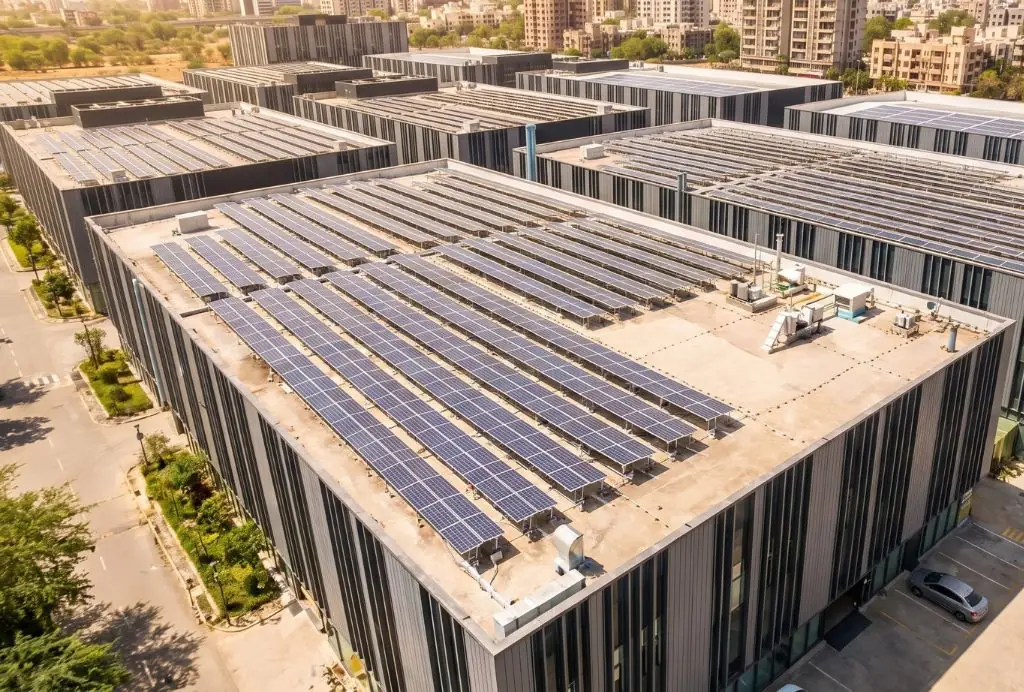
A godown can have a hundred thousand square feet of unshaded roof and an electrical load of lighting, a few dock levellers and an office. Fill that roof with solar and you would export almost all of it, at a credit well below any tariff you might have avoided.
Get an itemised proposalWhat decides the answer here
- Roof area is not the constraint here. Your own consumption is.
- Sizing to the roof is the expensive mistake. Exported units earn a credit, not the tariff.
- Sanctioned load caps you anyway in Tamil Nadu, usually well below what the roof would hold.
- The roof has three possible uses, and the right one depends on whether you want to spend capital or earn from an asset.
- A cold store inside the warehouse changes everything, because it turns a low load into a continuous one.
Three things you can do with a warehouse roof
1. Size to your own load
The conservative answer, and the right one for most single-owner godowns. Cover lighting, dock equipment, the office and any refrigeration, consume almost all of it, and stop there. Small system, best possible return per rupee, no complications.
2. Let a developer use the roof
If the roof is far larger than the load, its value is as a site rather than as a bill reduction. Under the OPEX model a developer funds and owns the plant and sells you units at an agreed tariff; where your own consumption cannot absorb the output, the structure extends to supplying other consumers through open access solar. You are effectively monetising roof area you were never going to use.
3. Group captive, if you are part of a larger group
Where the warehouse belongs to a business with heavier loads elsewhere, group captive lets the generation serve those loads while avoiding the cross subsidy surcharge, subject to the 26 percent ownership and 51 percent consumption tests.
The mistake is doing option one at the scale of option two: a large self-owned array on a low-consumption building, sold on the roof area rather than on the bill.
What a warehouse actually consumes
- High bay lighting, the main load in most godowns, and increasingly LED, which has already cut it.
- Dock levellers, shutters and material handling charging, intermittent.
- Office and security, small and continuous.
- Refrigeration or a cold room, which if present usually exceeds everything above combined.
That last line is the one to check first. A warehouse with a cold store is a different proposition entirely, closer to a processing unit than a godown, with a continuous daytime load that solar matches well.
The roof itself
Warehouse roofs are the easiest surfaces to work on in this whole list: large, unshaded, on regular purlin grids, and usually recent.
- Purlin capacity still needs verifying, but modern PEB sheds are generally designed with some margin.
- Non-penetrative clamp fixing on standing seam or trapezoidal sheet avoids penetrations over stored goods, which matters more here than almost anywhere.
- Access and safety for cleaning and maintenance should be designed in, because these roofs are large and walking them is a genuine fall risk.
The tax side, which is not the residential subsidy
The PM Surya Ghar subsidy does not apply here. It is a residential scheme, and any proposal that deducts it from a commercial quotation is deducting money the business will not receive.
What a business gets instead is accelerated depreciation. Solar power generating systems sit in a 40 percent depreciation block under Appendix I of the Income Tax Rules, claimed under Section 32, against an ordinary building at 10 percent and general plant and machinery at 15 percent.
The timing decides the first year. A system commissioned and put to use for 180 days or more in the financial year takes the full 40 percent; commissioned later and the first year is halved to 20 percent, with the balance carried forward. Our guide to how to calculate it works through the arithmetic on a real invoice.
GST on a turnkey installation works out near 8.9 percent under the 70:30 composite supply rule, with the module and system portion at 5 percent. That input is creditable for a GST-registered business, which residential buyers cannot do.
Frequently asked questions
Should I fill my warehouse roof with solar panels?
Usually not. A warehouse has far more roof than electrical load, so a roof-sized array exports most of its output at a credit well below the tariff it might have avoided. Size to your own consumption, or bring in a developer who can use the surplus.
Can I rent out my warehouse roof for solar?
Effectively yes, through an OPEX or third-party arrangement where a developer funds and owns the plant. Where your own consumption cannot absorb the output, open access lets that generation serve other consumers.
What limits solar capacity on a warehouse?
In Tamil Nadu, the sanctioned load rather than the roof. Permitted solar capacity is capped at sanctioned load or contracted demand, which on a low-consumption godown is usually far below what the roof would hold.
Does a cold storage inside the warehouse change the answer?
Substantially. Refrigeration turns a low intermittent load into a continuous daytime one, which is the profile solar suits best. A warehouse with a cold room is worth sizing much more generously than one without.
Can solar be installed on a PEB warehouse roof?
Yes, and they are among the easier roofs to work with. Purlin capacity still needs verifying, and non-penetrative clamp fixing avoids penetrations above stored goods.
Tell us the load before the roof area
The first question is not how big the roof is. It is how many units the building uses and when. Send twelve months of bills and your sanctioned load, and tell us whether there is any refrigeration on site.
If the honest answer is that your roof is worth more to a developer than to your own bill, we will tell you that.
Call +91 98841 07170Sources
Tamil Nadu Electricity Regulatory Commission tariff orders, for LT and HT consumer categories and energy charges
Blues Renewables generation records, Tamil Nadu rooftops, for the figure of about 4.8 units per kW per day
Income Tax Act 1961 Section 32 and Appendix I of the Income Tax Rules, for the 40 percent depreciation block and the 180-day rule
GST notifications on solar photovoltaic modules and solar power generating systems, effective 22 September 2025
Electricity Rules 2005, for the group captive ownership and consumption tests