






Land reference · national
Land Required for a 1 MW Solar Plant
Last reviewed August 2026 · acres per MW, classification, site screening and lease economics
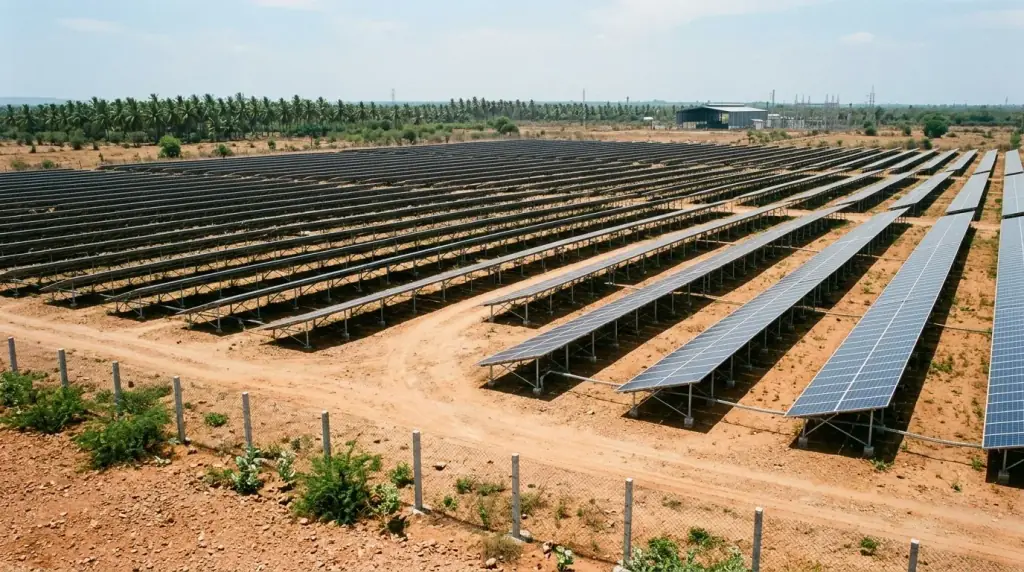
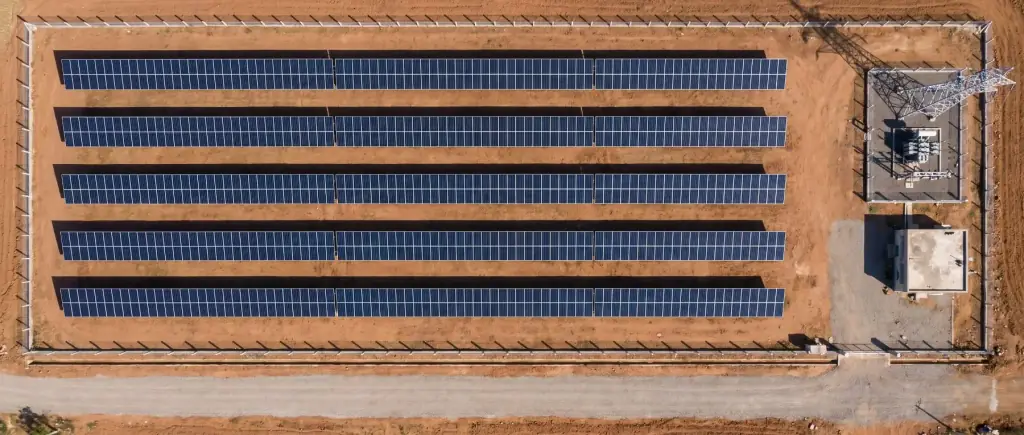
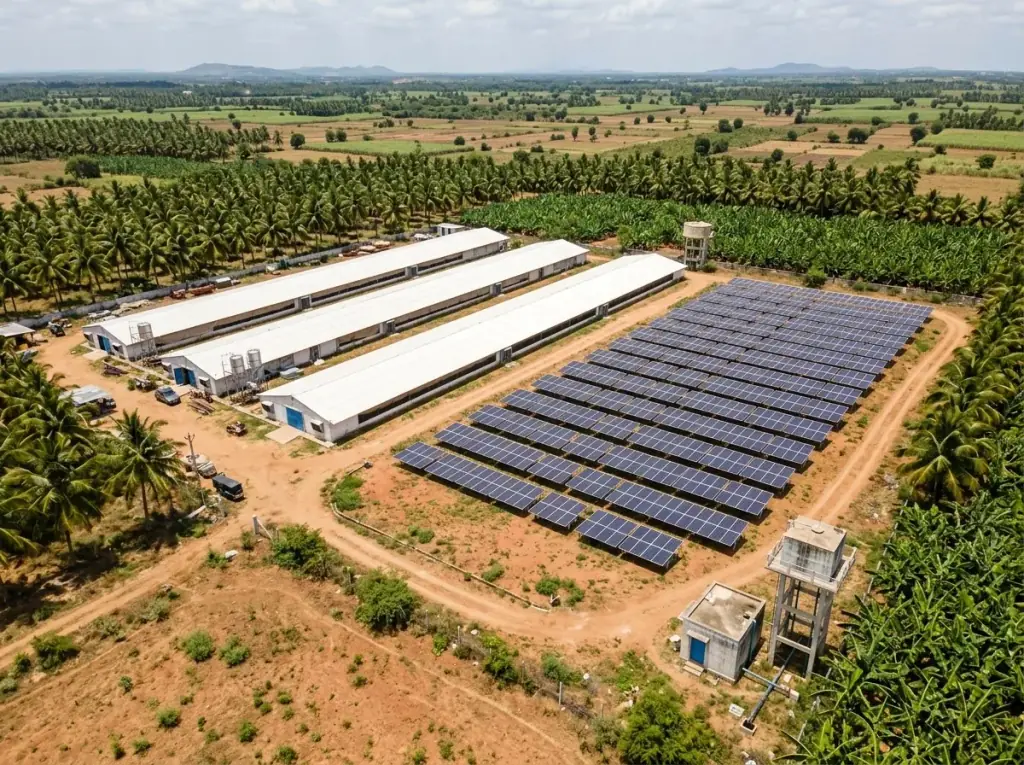
A 1 MW solar power plant requires 4 to 5 acres of land, or about 1.6 to 2.0 hectares. The range exists because only about a third of the area sits under module: the rest is the gap between rows that stops one row shading the next on the shortest day of the year, plus internal roads, inverter stations, the switchyard and the boundary setback. Mounting type changes the answer more than anything else.
The extent is the easy question. Classification, title and the route distance to a substation are what actually decide whether a plot can carry a plant, and all three are cheap to check before money moves.
The short version
4–5 acres per MW fixed tilt. 5–6 seasonal tilt. 6–8 single-axis tracker. 5–7 stilt-mounted over crops. Add nothing for capacity, multiply linearly.
Get a free feasibility read for your 1 MW site
Send the survey number and we will run the site checks on this page against your plot: classification, substation distance and the hard blockers.
Acres per MW
Where the other two thirds of the land goes
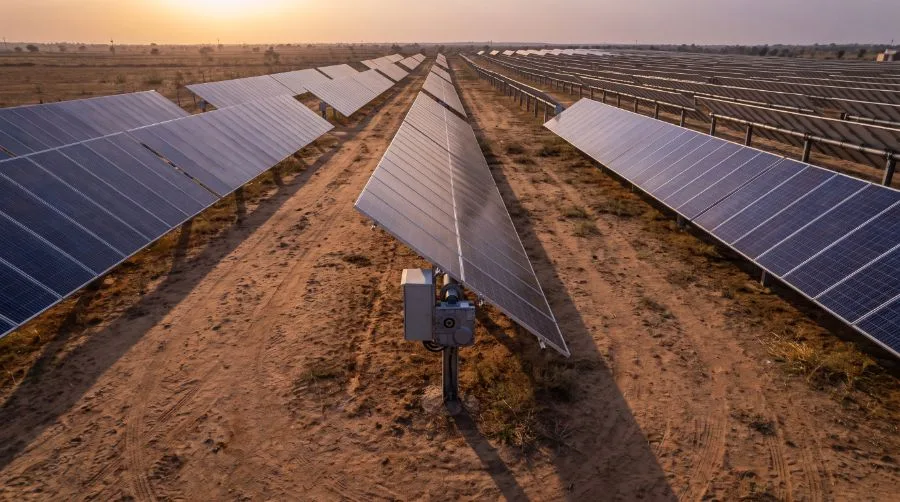
A megawatt of modules occupies roughly 1.3 to 1.6 acres of actual panel area. The reason a 1 MW plant needs 4 to 5 acres is that rows have to be far enough apart that the row in front does not cast a shadow on the row behind at nine in the morning in late December, when the sun is at its lowest. Compress the pitch and you lose generation for twenty-five years to save land once.
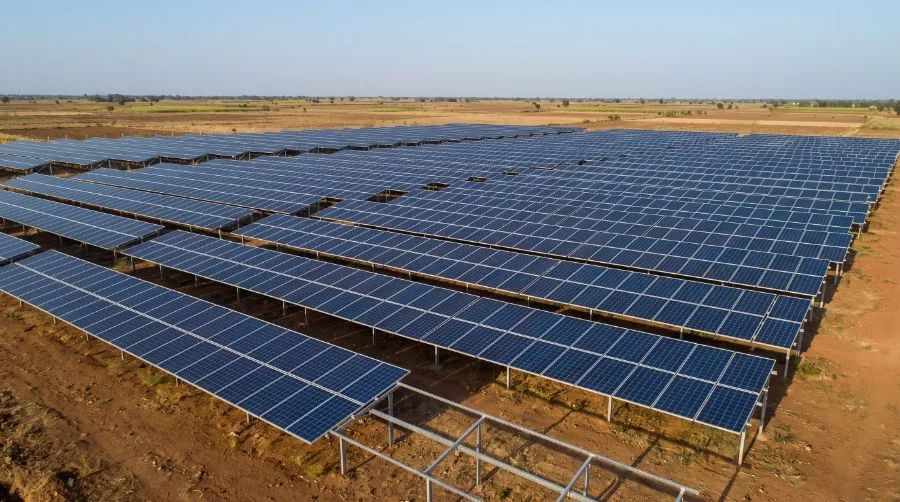
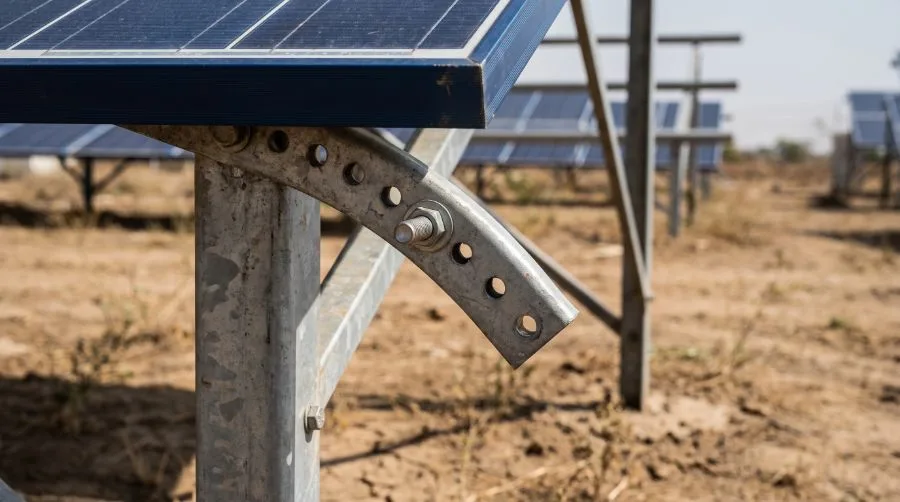
One megawatt on five acres, labelled
Land by capacity
It scales linearly, all the way up
Unlike cost, land does not benefit from scale. A 10 MW plant needs ten times the land of a 1 MW plant, because row pitch is set by the sun rather than by the size of the project. The only saving at scale is proportional: roads, the switchyard and setbacks become a slightly smaller share of the total.
| Capacity | Land | Hectares | Square feet |
|---|---|---|---|
| 1 MW | 4–5 acres | 1.6–2.0 ha | 1.74–2.18 lakh sq ft |
| 2 MW | 8–10 acres | 3.2–4.0 ha | 3.5–4.4 lakh sq ft |
| 5 MW | 20–25 acres | 8.1–10.1 ha | 8.7–10.9 lakh sq ft |
| 10 MW | 40–50 acres | 16.2–20.2 ha | 17.4–21.8 lakh sq ft |
| 100 MW | 400–500 acres | 162–202 ha | 1.74–2.18 crore sq ft |
One acre is 43,560 square feet or 0.4047 hectares. A ground for a 1 MW plant is therefore roughly the footprint of three football pitches, which is a useful sanity check when someone offers you two acres for a megawatt.
Classification and conversion
What the revenue record says matters more than what the land looks like
A plot that is visibly dry scrub can still be classified as wet land in the revenue record, and that classification, not the vegetation, is what a DISCOM and a lender read. Establish the classification from the patta and the adangal before agreeing a price, because conversion is a process with a timeline and sometimes a refusal.
Easiest
Barren, fallow, cultivable wasteland
The classifications PM-KUSUM Component A is written around, and the ones a DISCOM is used to seeing. Usually the shortest route to a connectivity approval.
Workable, with a process
Dry agricultural land
Generally needs a land use conversion, and the requirement and timeline vary by state. Budget one to six months and confirm the requirement in writing before purchase.
Stop and take advice
Wet land, water body, forest, poramboke
These do not delay a project, they end it. A price that looks too good for the district is very often one of these classifications.
Regardless of classification
Title and consent
A thirteen-year encumbrance certificate, and written consent from every co-owner on an inherited holding. A single absent co-owner can stall a commissioned plant.
The three failures that cost six to eighteen months
Wrong land classification. A substation distance measured across a map rather than along the route the line will physically take. And missing consent from a co-owner nobody mentioned. Each of these is discovered late, after money has been spent on a project report, and each is nearly free to check first.
Everything in the screening test below exists because one of these three went wrong on somebody's project.
Site screening
Ten checks before you pay for a project report
Run these against the plot before you commission a feasibility study, sign an advance or pay a consultant. Four of the ten are hard blockers: if any of those four fails, nothing downstream matters and the money you spend on a report is wasted.
5 km
radius to the nearest EB substation — the figure to screen a plot against
How close does the EB substation have to be?
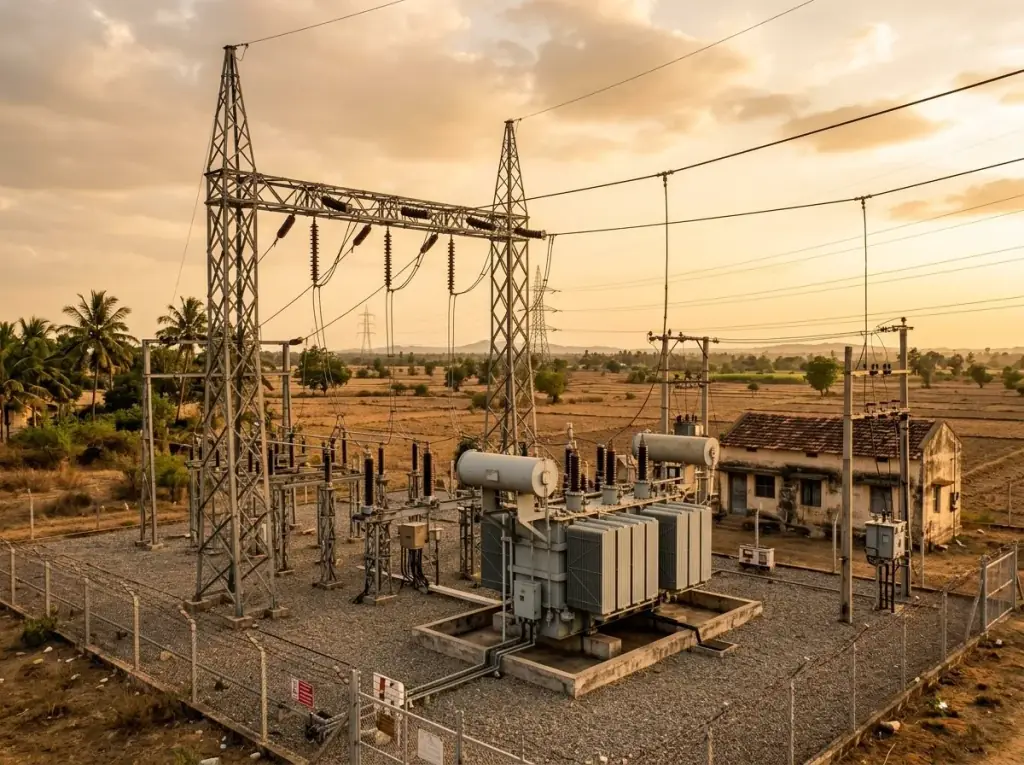
Nothing forbids a longer line — you can evacuate from further away if you are willing to pay for the line. The five kilometre figure is a scheme condition, not physics: under PM-KUSUM Component A, MNRE asks that the plant be installed preferably within a five kilometre radius of the substation, specifically to avoid the high cost of sub-transmission lines and to reduce transmission losses. Component A covers 500 kW to 2 MW plants, which is exactly the 1 MW case, so it is the right yardstick to screen a plot with.
- Radial distance screens the plot; route length is what you pay for. The line follows roads, field boundaries and whoever gives right of way. A plot 4 km away as the crow flies is regularly 7 km of pole line.
- The substation also has to have room. Under MNRE's guidelines for decentralised solar plants the DISCOM notifies how much solar can be injected at each substation, and may itself set the radius for connecting to it. A substation 2 km away with no spare capacity is a worse site than one 6 km away with headroom.
- Past about five kilometres the line becomes its own project. Poles, conductor, a DISCOM-approved estimate you fund, and right-of-way consent from every landowner on the route — the last of which is the part that slips, not the construction.
Basis: MNRE, PM-KUSUM Component A scheme guidelines, and MNRE's Guidelines for Development of Decentralised Solar Power Plants. Both are national documents; the radius and the injectable capacity that actually apply to your plot are set by your own DISCOM circle, so confirm them there before you buy land.
Lease or buy
Compare it over 25 years, not over one
A lease keeps capital in the plant. A purchase converts a 25-year obligation into a one-time cost and leaves you holding an appreciating asset at the end of it. Which wins is a district-level question, because land in Ramanathapuram and land outside Sriperumbudur are two different investments carrying the same generation.
Comparator
Set the three numbers you actually know
Genuinely close
The lease matches the purchase price around year 16. Within this range the decision is made on other things: whether the capital is better used in the plant, whether the lessor's title will hold for 25 years, and what you think the land will be worth at the end.
Lease, 25 years
₹93.8 lakh
₹3.8 lakh a year, before escalation
Purchase, one time
₹60 lakh
plus registration and stamp duty
Break-even
year 16
when cumulative rent passes the purchase price
Purchase as % of a plant
13%
against ₹4 crore per MW of capex at 1.1 MW
What this comparison leaves out
Lease escalation, typically five per cent every three years. The time value of money, which favours leasing. Land appreciation over 25 years, which favours buying. Stamp duty and registration. And the risk that a lessor's heirs dispute the arrangement in year twelve, which is why a registered long-term lease matters more than a favourable rate.
If you own the land and not the project
Leasing to a developer pays ₹60,000 to ₹1,00,000 an acre a year
For 25 years, with no capital outlay and no operating responsibility. The qualifying condition is usually four or more acres of barren, fallow or cultivable wasteland within five kilometres of a DISCOM substation, with clear title and every co-owner consenting in writing.
It is the lowest-risk way to earn from land that is not currently earning. It is also the lowest return, because you are selling the certainty and keeping none of the upside.
If you want to build it yourself
Self-installation runs ₹3.5 to ₹4 crore per MW with a 10 to 12 year payback
Selling to the DISCOM at a feed-in tariff, currently discovered in the ₹2.80 to ₹3.40 range under the reverse-auction framework. Under PM-KUSUM Component A the capacity ceiling is 2 MW and concessional financing is available.
Substantially more return than leasing, and substantially more work, risk and paperwork. The full 1 MW economics.
Agrivoltaics
Keeping the land in cultivation
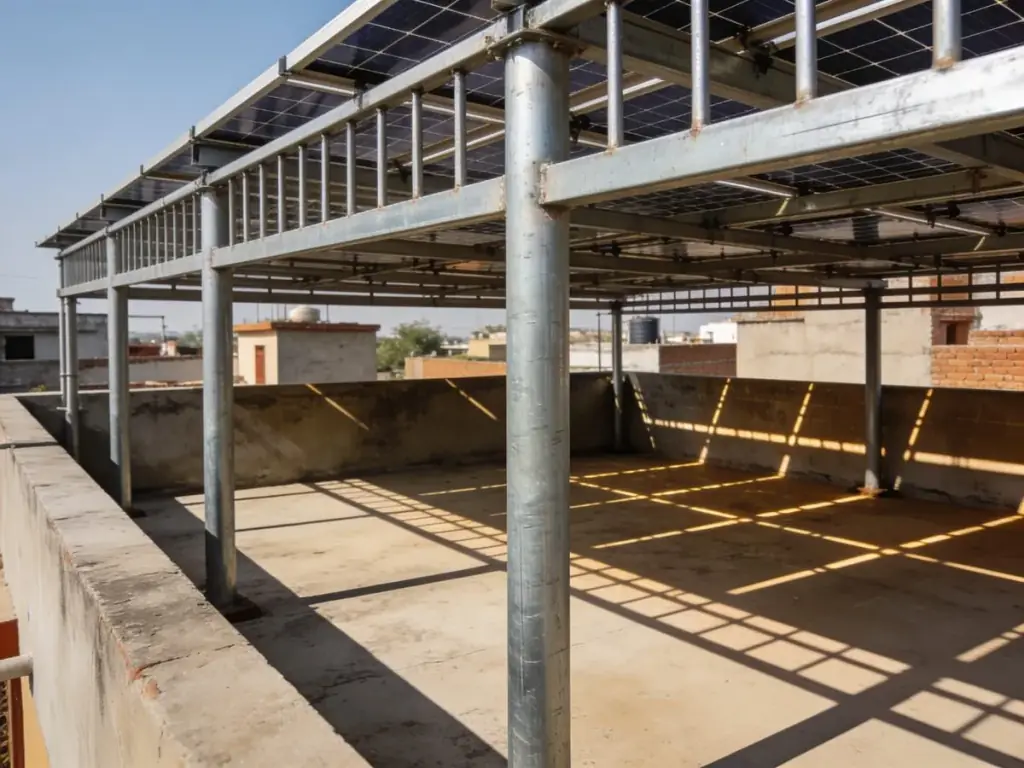
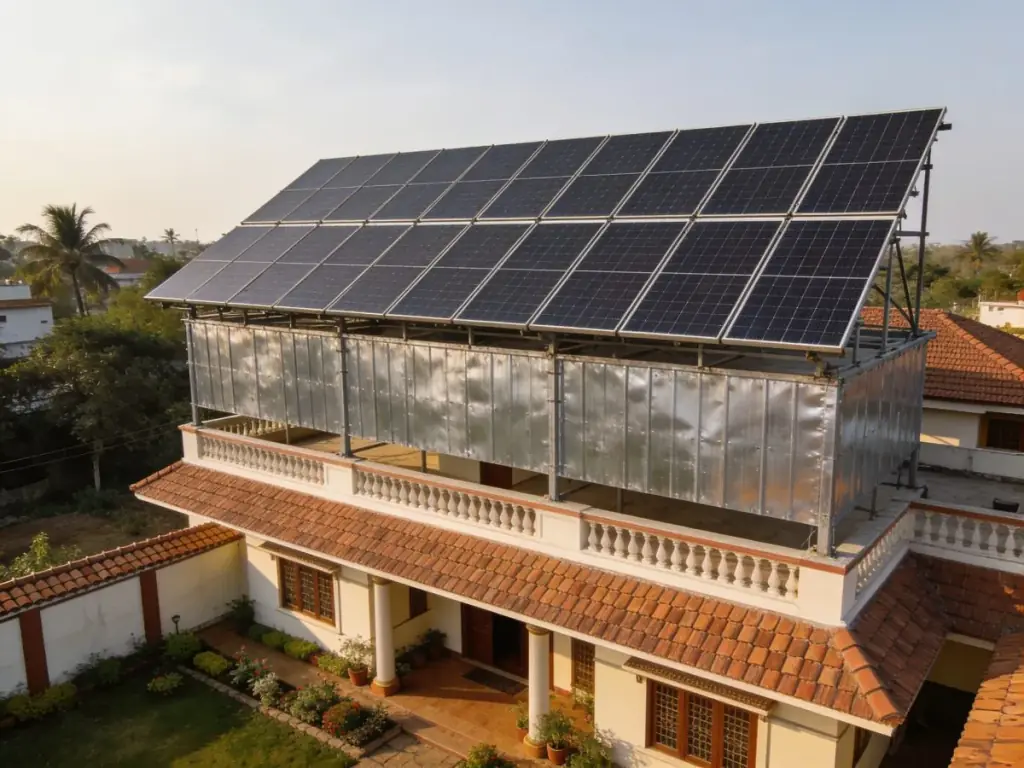
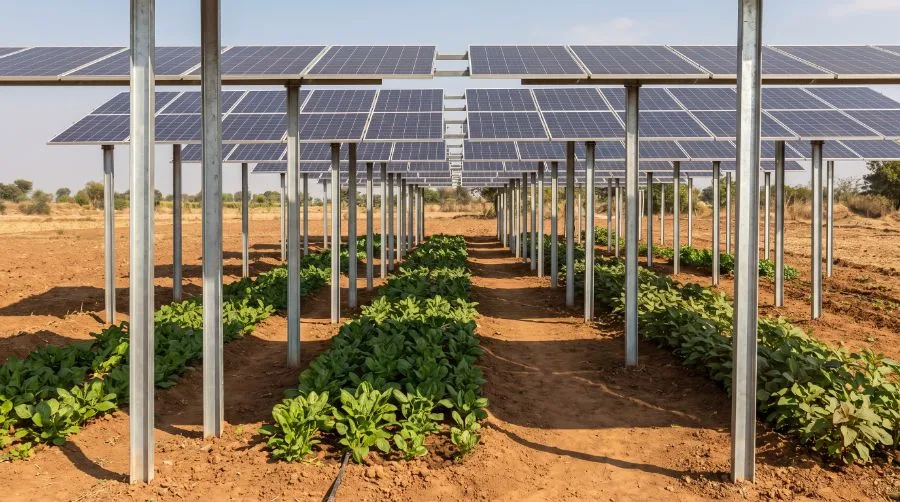
A stilt-mounted layout raises the modules high enough that shade-tolerant crops continue underneath and between the rows. It needs 5 to 7 acres per MW, costs more per MW because the structure carries more steel at greater height, and generates slightly less than a conventional layout because the geometry is compromised.
It is the right structure in two situations: where the land has real agricultural value that you are unwilling to give up for 25 years, and where retaining cultivation matters for the land's classification or for the community around it. PM-KUSUM Component A explicitly contemplates stilt mounting for exactly this reason.
It is the wrong structure if the only motivation is that it sounds better. The extra capex is real and the extra generation is negative.
What we can check for you
Send the survey number, we will screen the site
Blues Renewables is a solar contractor, not a land aggregator and not a MW-scale developer. What we can do quickly and at no cost is run the ten checks above against a specific plot: classification from the record, route distance to the nearest substation with spare capacity, slope and access, and whether the extent supports the capacity you have in mind.
If any of the four hard blockers fails, we will tell you before you spend anything on a project report. That is the useful thing we can do at this stage, and it costs us an afternoon.
Work it out for your own site
How to calculate the land for a 1 MW solar plant, in six steps
The 4 to 5 acres figure is an answer, not a method. These six steps show where it comes from, so you can check any developer's number against your own site.
Step 1: Decide whether you mean 1 MW AC or 1 MWp DC
This is the single biggest reason quoted figures disagree, and almost nobody states which one they mean.
MWp DC is the sum of the nameplate ratings of every module on the site. It is what module datasheets, EPC contracts and construction scopes talk about. MW AC is what the inverters can actually push onto the grid. It is what power purchase agreements, tenders and DISCOM connection approvals mean.
Modern plants deliberately install more DC than the inverters can pass, because the array only hits its rated output for a few hours a year and a slightly oversized array fills out the shoulders of the day. That ratio, the DC overload, is typically 1.2 to 1.3 in India today. So a 1 MW AC project carries 1,200 to 1,300 kWp of modules, and therefore 20 to 30 percent more land than a 1 MWp DC project.
On a 1 MW project the difference is close to a full extra acre. Ask which one a developer is quoting before you compare two proposals.
Step 2: Work out the module area
This part is pure arithmetic and it surprises people, because the panels themselves take up far less room than expected.
A module's area is set by its efficiency. A panel converting 22 percent of the 1,000 W/m² standard test irradiance produces 220 W per square metre, so:
Module area per MWp = 1,000,000 W ÷ (1,000 W/m² × efficiency)
At 22 percent that is 4,545 m², which is about 1.1 acres. At 19 percent it is 5,263 m². At 23 percent it is 4,348 m². Every two percentage points of efficiency cuts the module area by roughly 9 percent.
In module counts, 1 MWp is about 1,725 panels of 580 Wp, or around 1,430 panels if you specify 700 Wp modules. Indian utility procurement in 2026 commonly specifies 540 Wp to 700 Wp mono PERC or TOPCon modules at 21 to 23 percent cell efficiency.
So if panels only need 1.1 acres, why does the plant need four? Because of the next step.
Step 3: Divide by the ground coverage ratio
Solar rows cannot be packed edge to edge. Each row casts a shadow on the one behind it, and the row spacing is set so that the array is shadow-free through the design window, conventionally 9 am to 3 pm on 21 December, the day the sun sits lowest.
The ground coverage ratio (GCR) is the collector width divided by the row pitch. A GCR of 0.40 means modules cover 40 percent of the ground and 60 percent is the gap that keeps them unshaded.
Typical values:
| Ground coverage ratio | Where it is used |
|---|---|
| 0.25 to 0.30 | Single-axis trackers, higher latitudes |
| 0.35 to 0.42 | Standard fixed-tilt utility scale |
| 0.45 to 0.50 | Dense commercial and land-constrained sites |
| 0.55 to 0.65 | Carports and tight agrivoltaic layouts |
At 22 percent efficiency and a GCR of 0.35, the array field becomes 4,545 ÷ 0.35 = 12,986 m². Push the GCR to 0.45 on a land-constrained site and the field drops to 10,100 m², but you pay for it in shading losses in the winter months. That trade, land cost against energy yield, is a real design decision rather than a fixed rule.
Step 4: Add roads, inverters, substation and setbacks
The array field is not the site. On top of it you need internal access roads wide enough for a module trailer, a perimeter road, inverter pads, a switchyard, drainage, and a setback from the boundary fence.
| Component | Area per MWp |
|---|---|
| Internal access roads | 0.10 to 0.20 ha |
| Perimeter road | 0.02 to 0.05 ha |
| Substation and switchyard | 0.01 to 0.03 ha |
| Inverter pads | 0.01 to 0.02 ha |
| Perimeter setbacks | 0.05 to 0.15 ha |
| Drainage and detention | 0.02 to 0.05 ha |
Together this adds 10 to 25 percent to the array field, and 15 percent is the figure most designers carry at the feasibility stage. For a small plant the substation is a bigger share than the table suggests: a 1 MWp to 5 MWp project connecting at 11 kV to 33 kV typically needs 0.1 to 0.3 hectares just for the switchyard, which on a single-megawatt site is not a rounding error.
Applying 15 percent to our 12,986 m² gives 14,934 m², or 3.7 acres.
Step 5: Adjust for tilt and latitude
Tilt angle pulls in two directions. A steeper tilt catches more energy but stands taller, casts a longer shadow, and forces the rows further apart.
| Tilt | Annual yield | Land needed |
|---|---|---|
| 15 degrees | 97% | Lowest |
| 20 degrees | 99% | Low |
| 25 degrees | 100% | Standard |
| 30 degrees | 99% | Higher |
| 35 degrees | 97% | Highest |
Optimal tilt tracks latitude, and this is where southern India has a structural advantage. Chennai sits at about 13 degrees north, so arrays there are typically set at 10 to 15 degrees. A plant in Rajasthan at 26 degrees north wants roughly twice that tilt, stands higher off the ground, and needs wider row spacing to stay shadow-free in December.
The practical consequence: the same 1 MWp, same modules, same GCR target, will fit on noticeably less land in Tamil Nadu than in the north. If you are working from a national rule of thumb, you are probably over-allocating land for a southern site.
Step 6: Add roughly 50 percent if you are using trackers
Single-axis trackers rotate the modules east to west through the day and typically lift annual yield by 15 to 25 percent. They also need much wider rows, because the panels have to clear each other at the extremes of rotation rather than just at one fixed angle.
Tracker layouts run at a GCR of about 0.25 to 0.35, which puts them at 2.2 to 2.8 hectares, or 5.4 to 6.9 acres per MWp. If land is cheap and plentiful the extra yield usually justifies it. If land is expensive, contested, or simply not available in one piece, fixed tilt at a higher GCR often wins on cost per unit delivered even though it generates less.
Land per MW by mounting technology
| Configuration | Hectares per MWp | Acres per MWp |
|---|---|---|
| Fixed tilt, 21% to 23% modules | 1.5 to 1.8 | 3.7 to 4.4 |
| Fixed tilt, 19% to 20% modules | 1.8 to 2.2 | 4.5 to 5.4 |
| Single-axis tracker | 2.2 to 2.8 | 5.4 to 6.9 |
| Elevated agrivoltaics | 2.5 to 4.0 | 6.2 to 9.9 |
Agrivoltaics, where the array is raised high enough to farm underneath, is the outlier. It needs the most land per MW of any configuration, but the land keeps producing a crop, so the comparison is not really land against land.
Why the old five acres per MW figure is now too high
The 4 to 5 acres per MW rule that circulates in Indian solar has a real origin. It reflects MNRE's long-standing planning figure, and it was accurate when utility projects were built with 250 W to 350 W polycrystalline modules at 15 to 17 percent efficiency.
Module efficiency has moved a long way since. At 16 percent, a megawatt of modules covers 6,250 m². At 22 percent it covers 4,545 m², which is 27 percent less glass for the same capacity, and the row spacing scales down with it. More recent central planning guidance reflects this, putting the minimum nearer 3 acres per MW.
Two caveats before you plan a site at 3.5 acres per MW. First, the tight number assumes high-efficiency modules and a disciplined layout, and it leaves nothing spare. Second, land is bought or leased once and the plant runs for 25 years, so a parcel with no room for a future inverter replacement, a wider road, or a second phase is a false economy. In practice, budgeting 4 to 4.5 acres per MW for a fixed-tilt project in Tamil Nadu is realistic without being wasteful.
Mistakes that waste land or stall the project
Comparing a DC quote to an AC quote. The most common and the most expensive. Establish which basis each proposal uses before you compare acreage, cost per watt, or generation.
Buying land before checking evacuation. The grid connection point, the available feeder capacity and the distance to it should be confirmed before any land transaction. A parcel with no feasible connection is not a solar site regardless of its size or price.
Treating the module area as the land area. Several widely read guides quote around 100,000 sq ft, about 2.3 acres, as the land needed for 1 MW. That figure is close to the array field for older modules, and it is well below the buildable site area once row spacing and infrastructure are included. Planning a purchase on it will leave you short.
Starting land conversion late. Agricultural to non-agricultural conversion is a sequential approval that does not compress. It should begin in parallel with the connection application, not after it.
Assuming a national rule of thumb fits a southern site. Tilt at 13 degrees north is much shallower than at 26 degrees north, and the row spacing follows. A layout designed properly for Tamil Nadu will use less land than the national average suggests.
Ignoring the second phase. If there is any chance of expanding, the time to secure the adjoining parcel is before the first plant is announced, not after the land value has moved.
Land for solar plants, answered
How much land is required for a 1 MW solar power plant?
Four to five acres, or about 1.6 to 2.0 hectares, for a fixed-tilt ground-mounted plant. Only around a third of that area sits under module. The rest is the spacing between rows that prevents one row shading the next in December, plus internal roads, inverter station plinths, the switchyard and the boundary setback.
How many acres are needed per MW of solar?
Four to five acres per MW on fixed tilt, 5 to 6 on seasonal tilt, and 6 to 8 on single-axis trackers. Trackers need more land because the rows must be further apart to avoid shading each other as they rotate, which is why a tracker plant needs both more capex and more land for the same nameplate capacity.
Can a solar plant be built on agricultural land?
Usually yes, but it generally requires a land use conversion, and the requirement varies by state. Barren, fallow and cultivable wasteland classifications are the simplest route and are what PM-KUSUM Component A is written around. Wet land, water body and forest classifications are the ones that stop a project outright rather than delay it.
How far can a solar plant be from a substation?
Technically as far as you are willing to pay for line, practically as close as possible. PM-KUSUM Component A asks for a DISCOM substation within five kilometres. Beyond about two kilometres the evacuation line starts to dominate the cost difference between two otherwise identical sites, at roughly ₹14 lakh per additional kilometre.
Is it better to lease land or buy it for a solar plant?
Leasing keeps capital in the plant and costs roughly ₹60,000 to ₹1,00,000 per acre per year over 25 years. Buying converts that into a one-time cost and leaves you with an appreciating asset at the end. Which wins depends almost entirely on the district land price, and the honest comparison is a 25-year one, not a first-year one.
How much can I earn by leasing land for a solar plant?
Roughly ₹60,000 to ₹1,00,000 per acre per year on a 25-year lease, with no capital outlay and no operating responsibility. The qualifying conditions are usually four or more acres of barren, fallow or cultivable wasteland within five kilometres of a DISCOM substation, clear title, and written consent from every co-owner.
Can farming continue under a solar plant?
On a stilt-mounted or agrivoltaic layout, yes, with shade-tolerant crops between and beneath the rows. It costs more per MW, needs 5 to 7 acres per MW, and generates slightly less than a conventional layout. It is the right structure where the land has real agricultural value or where retaining cultivation matters legally.
What land problems delay solar projects most often?
Wrong land classification, substation distance measured across a map rather than along the route the line will take, and missing consent from a co-owner. Each of the three commonly delays a project by six to eighteen months, and all three are cheap to check before money is committed.