

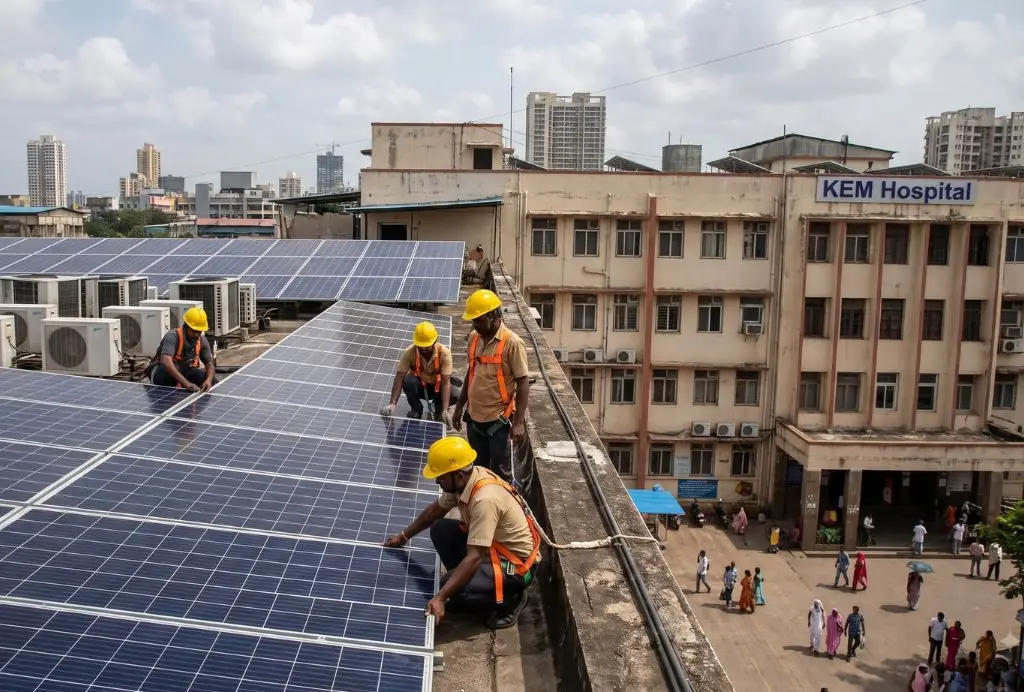

Solar for Marriage Halls and Kalyana Mandapams in Tamil Nadu
A kalyana mandapam pays commercial tariffs on a load that barely exists for most of the year and then, on the day of a wedding, runs every air conditioner, every light and a full kitchen at once.
That shape is what makes a hall different from a factory, and it is why the sizing question here is not "how much roof do we have". It is "how much of what we generate will we actually use ourselves".
Get an itemised proposalWhat decides the answer here
- Halls bill under LT-3 or HT-2A, roughly ₹7 to ₹8.50 a unit depending on category and demand, which is where the saving comes from.
- The load is spiky, not continuous. Thirty to eighty event days a year against a small daily baseline changes which units are worth most.
- Sizing to the event-day peak is the expensive mistake. On the other three hundred days that capacity exports at a credit well below the tariff it could have avoided.
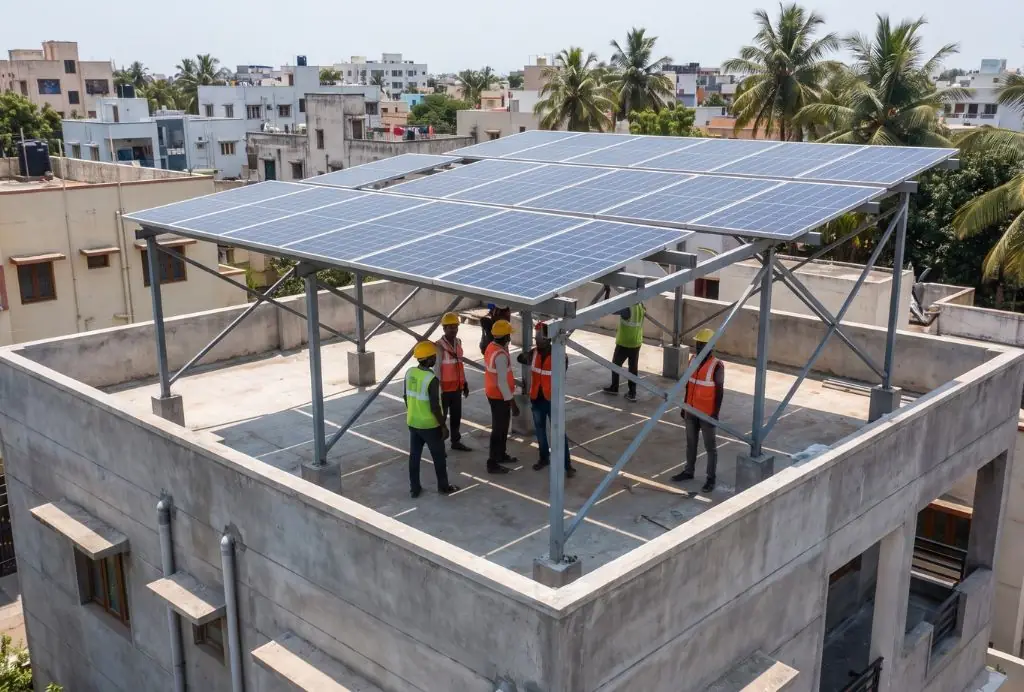
- The terrace is usually the venue too. An elevated structure keeps it usable, and costs more steel than a flush mount.
- No PM Surya Ghar here. A hall claims 40 percent accelerated depreciation instead.
What a hall actually pays for
Two loads sit on the same connection and they behave nothing alike.
The baseline, which runs every day
Security and approach lighting, the office, water pumps filling overhead tanks, a cold room if the kitchen has one, and the borewell. Modest, predictable, and running in daylight for most of it.
The event load, which runs on booking days
Air conditioning across the main hall and dining area, stage and decorative lighting, the commercial kitchen, exhaust, and often a hired generator on standby. This can be ten to twenty times the baseline for eight to fourteen hours.
A rooftop array covers the first comfortably. It covers a share of the second, because weddings in Tamil Nadu run through the middle of the day as often as the evening, and the muhurtham season is the hottest part of the year when generation is at its best.
Why self-consumption decides the payback
A unit generated and consumed on site avoids the full commercial tariff. A unit exported earns a credit set by the tariff order, which is materially lower. For a business that consumes everything it makes, the difference barely matters. For a hall, it is the whole calculation.
Work it from the booking calendar rather than the connected load. Count the event days, estimate consumption on one, add the daily baseline across the year, and size so that the array is mostly self-consumed. A hall with sixty bookings a year and a 40 kW baseline profile is a different system from one with two hundred.
Generation uses 4.8 units per kW per day, the figure this site uses throughout for Tamil Nadu. Costs fall per watt as the system grows; what rooftop solar costs sets out the band and audit it per watt shows how to check a proposal against it.
The roof is also the venue
Most halls use the terrace. Some run an open-air reception on it, many dry and store there, almost all have overhead tanks and lift machine rooms in the middle of the usable area.
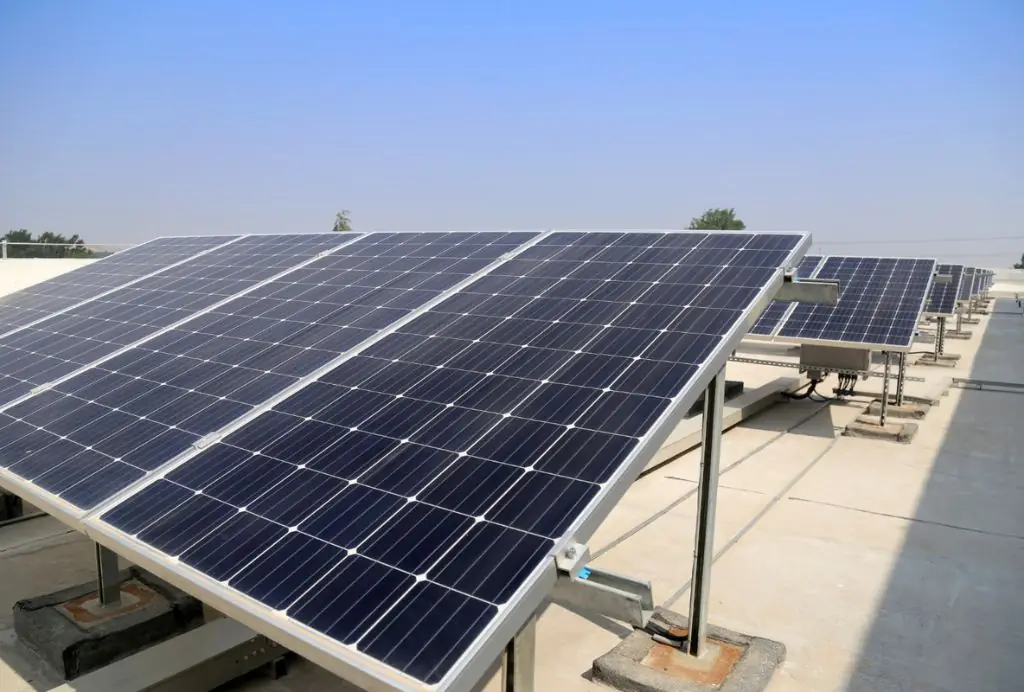
- An elevated structure on a frame keeps the terrace walkable underneath. It uses more steel and costs more than a low flush mount, and on a hall it is usually the right answer.
- Shading from tanks, parapets and the stair headroom takes more area out than owners expect, and a single shaded module can pull a whole string down on a string inverter.
- Cyclone-rated wind design is not optional on this coast. It is also the first thing a cheap quotation removes.
The tax side, which is not the residential subsidy
The PM Surya Ghar subsidy does not apply here. It is a residential scheme, and any proposal that deducts it from a commercial quotation is deducting money the business will not receive.
What a business gets instead is accelerated depreciation. Solar power generating systems sit in a 40 percent depreciation block under Appendix I of the Income Tax Rules, claimed under Section 32, against an ordinary building at 10 percent and general plant and machinery at 15 percent.
The timing decides the first year. A system commissioned and put to use for 180 days or more in the financial year takes the full 40 percent; commissioned later and the first year is halved to 20 percent, with the balance carried forward. Our guide to how to calculate it works through the arithmetic on a real invoice.
GST on a turnkey installation works out near 8.9 percent under the 70:30 composite supply rule, with the module and system portion at 5 percent. That input is creditable for a GST-registered business, which residential buyers cannot do.
Frequently asked questions
Is solar worth it for a marriage hall that only runs on weekends?
Yes, but size it to the baseline plus a share of the event load rather than to the event-day peak. Capacity that only earns its keep on booking days spends the rest of the year exporting at a credit below the tariff it could have avoided.
What tariff do kalyana mandapams pay in Tamil Nadu?
Halls bill as commercial consumers, under LT-3 or HT-2A depending on connected load and demand, which runs roughly ₹7 to ₹8.50 a unit. That high per-unit cost is what makes the saving worthwhile.
Can a marriage hall claim the PM Surya Ghar subsidy?
No. PM Surya Ghar is residential. A hall claims accelerated depreciation at 40 percent instead, and a GST-registered business can also take input credit on the installation.
Will solar run the air conditioning during a wedding?
It will offset a large part of it during daylight hours. A grid-connected system without storage contributes nothing after sunset, so an evening reception still draws from the grid.
Can we still use the terrace after installing solar?
On an elevated structure, yes. The array sits on a frame high enough to walk under, which is why most halls choose it despite the extra steel.
How much roof does a 50 kW system need?
Roughly 4,000 to 4,500 sq ft of shade-free area for the array footprint, including the gaps between rows. Tanks, stair headrooms and parapet shadows reduce what is usable.
Size it from your booking calendar
Send us twelve months of electricity bills and a rough count of event days. We will size the system against how the hall is actually used, tell you what share of generation you would consume yourself, and put the rest in as export at the applicable credit.
Every proposal names the make and model of each component, the structure specification and the design wind speed, and lists what is excluded. appointing an EPC contractor covers what the contract should say, and how to verify a solar company covers the checks you can run on us before paying anything.
Call +91 98841 07170Sources
Tamil Nadu Electricity Regulatory Commission tariff orders, for LT and HT consumer categories and energy charges
Blues Renewables generation records, Tamil Nadu rooftops, for the figure of about 4.8 units per kW per day
Income Tax Act 1961 Section 32 and Appendix I of the Income Tax Rules, for the 40 percent depreciation block and the 180-day rule
GST notifications on solar photovoltaic modules and solar power generating systems, effective 22 September 2025
TANGEDCO commercial tariff categories LT-3 and HT-2A, per the prevailing TNERC tariff order