

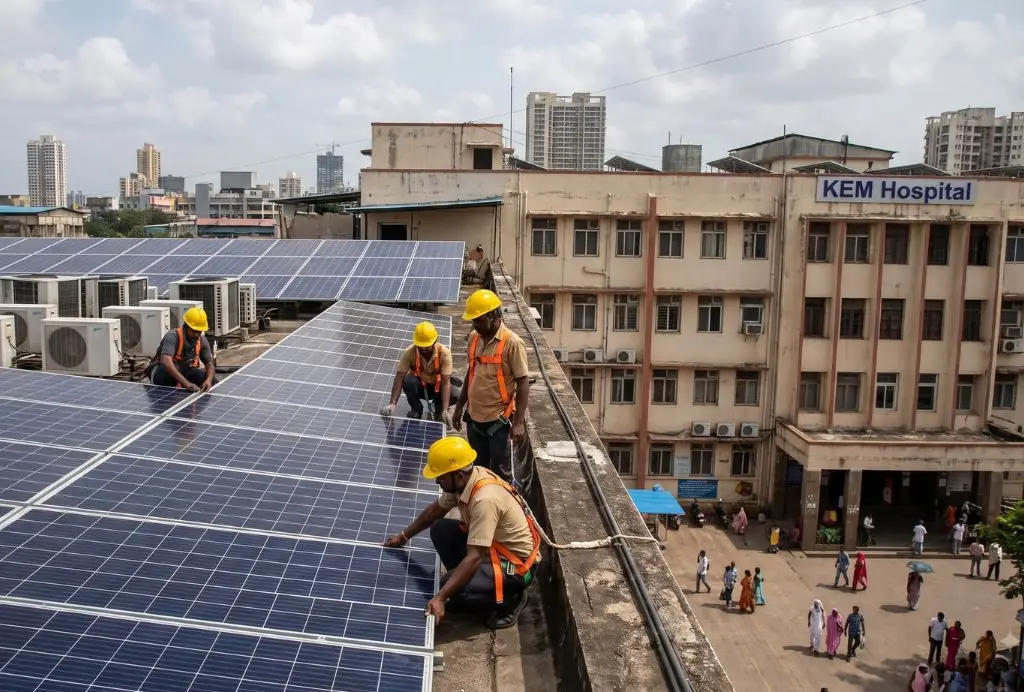

On-Grid Solar Systems in Chennai
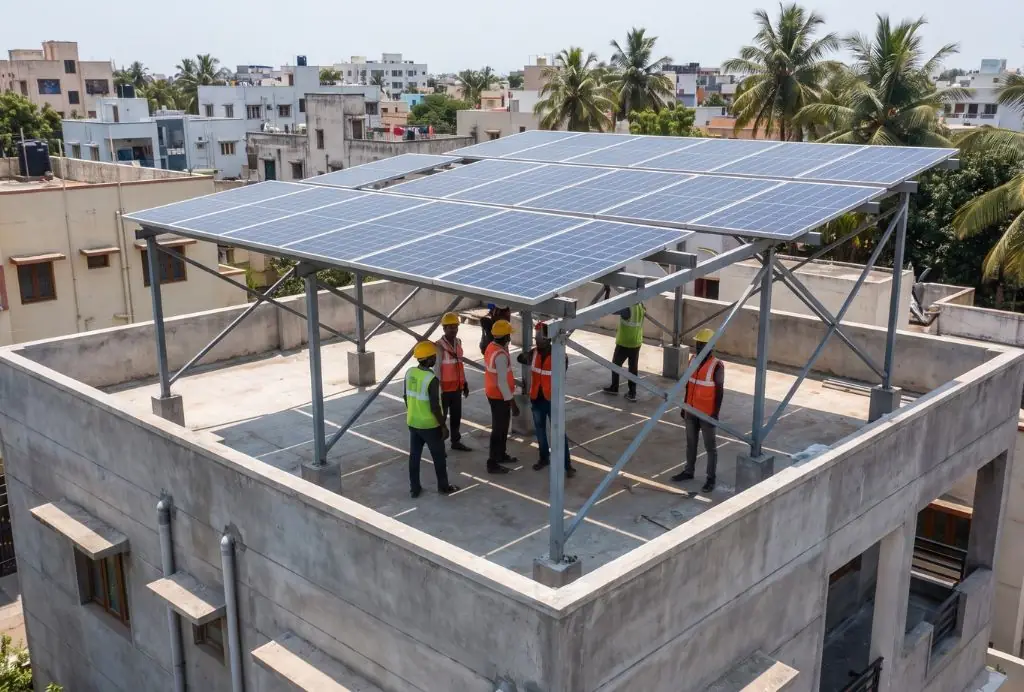
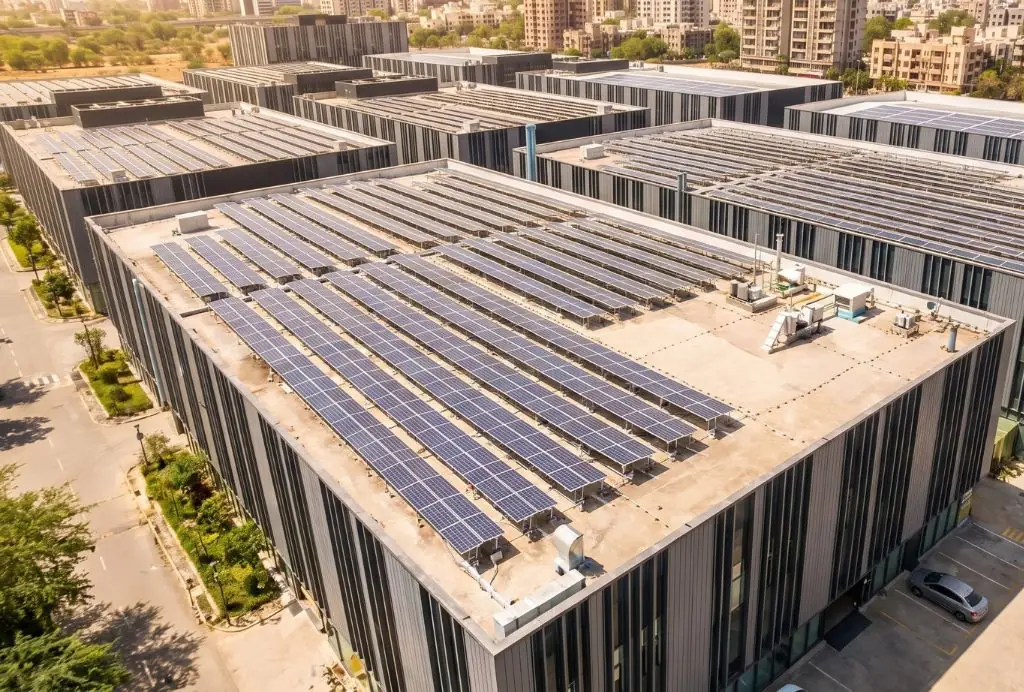
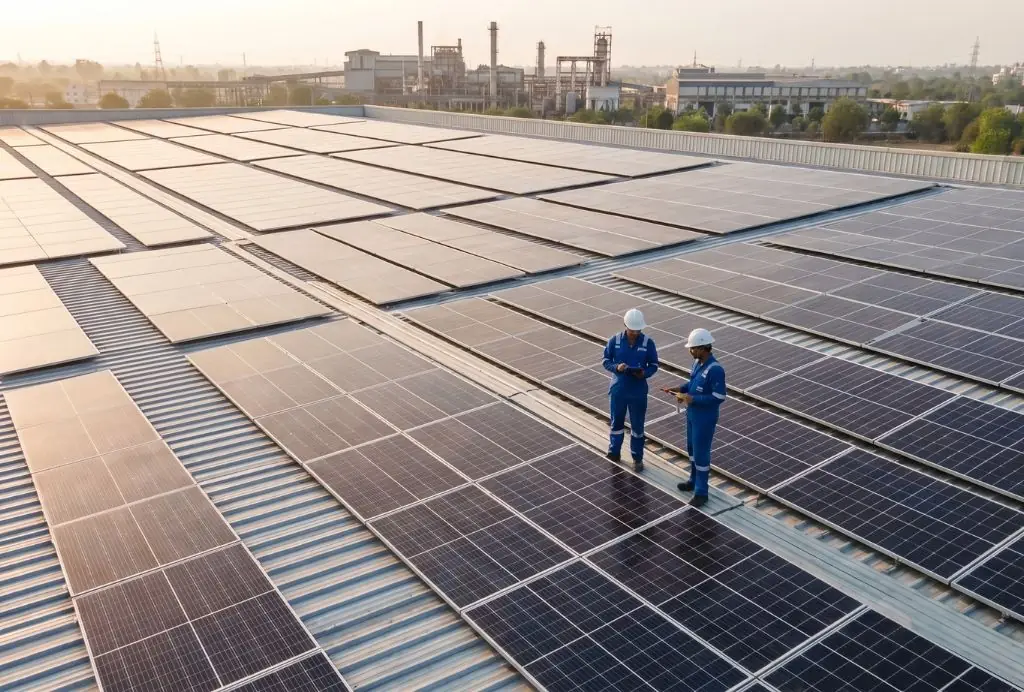
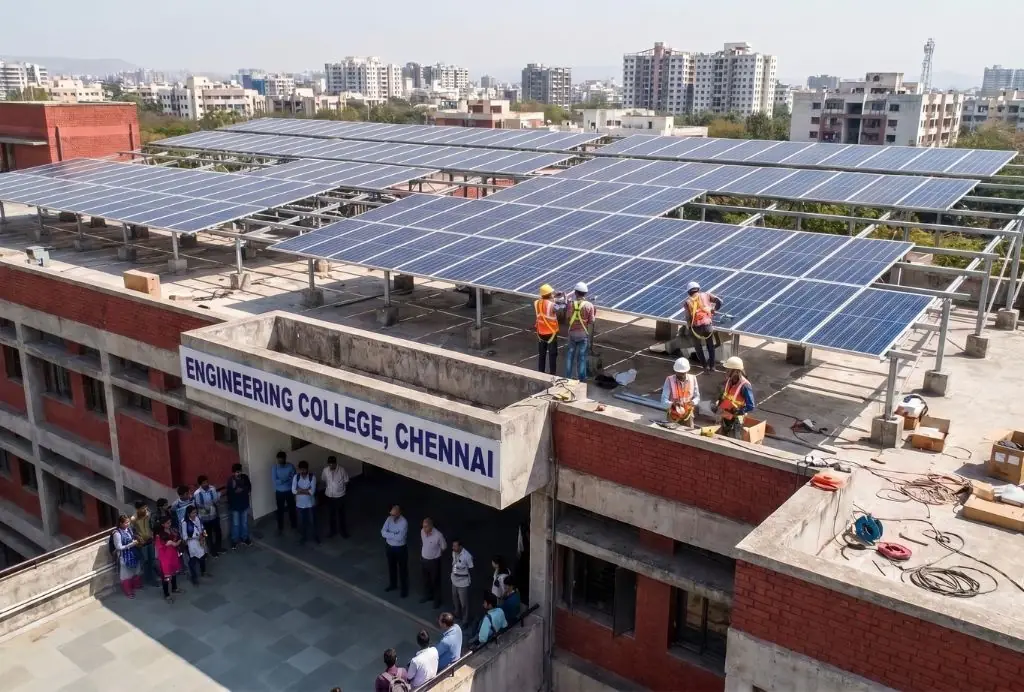
The standard rooftop system, and the right choice for most Chennai homes and businesses. It connects to the TANGEDCO grid, powers your property through the day, exports the surplus for credit, and draws from the grid when it needs to. No batteries, the lowest cost per kW, and full eligibility for the ₹78,000 PM Surya Ghar subsidy.
ALMM-listed DCR panels
Net metering and subsidy filed by us
Two years free maintenance
Installing in Chennai since 2020
The basics
What is an on-grid solar system?
An on-grid solar system is a rooftop installation connected directly to the TANGEDCO grid, with no battery storage. Solar panels generate DC power, an inverter converts it to AC, and that power supplies your property first. Surplus is exported to the grid and credited against your consumption under net metering, while any shortfall is drawn from the grid as normal. It is the lowest-cost and most common configuration in Tamil Nadu.
Why it is the default choice here
Urban Chennai has generally reliable supply, so the grid functions as a dependable backstop. Net metering credits your daytime exports against evening consumption, which solves the timing problem financially without a battery. And on-grid is fully eligible for the PM Surya Ghar subsidy. Lowest cost, best supported, fewest components to maintain.
The one limitation
An on-grid system shuts down during a power cut, for safety reasons. If backup matters to you, that changes the answer. See on-grid vs off-grid vs hybrid.
A day in the life
Where does the power actually go?
An on-grid solar system always supplies your own property first. Whatever your building is consuming at that moment is served by the panels, and only the surplus goes to the grid. When generation falls short of consumption, the balance is drawn from the grid automatically. There is no switching, no changeover and nothing for you to operate.
| Time | What happens |
|---|---|
| Before sunrise | No generation. The property runs entirely on grid supply, as it always did |
| Early morning | Generation begins and rises. Fans, lights and the fridge are increasingly served by solar rather than the grid |
| Late morning to afternoon | Peak generation. Your own consumption is served first, and the surplus is exported to the grid and credited |
| Hot afternoon | Generation is at its highest, and so is air conditioning load. Much of the output is consumed on site rather than exported |
| Evening | Generation falls away as the sun drops. The property returns to grid supply, offset by the credits banked earlier |
| Night | No generation. Grid supply, with your bill reduced by the day's exports |
The important consequence: solar does not need to run your house at night to save you money. The units you exported at noon are credited against the units you import at 9pm, within the same billing cycle. That is what net metering does, and it is why a battery is unnecessary for financial purposes.
Components
What the system is made of
An on-grid rooftop system comprises solar panels, a mounting structure, a grid-tied inverter, DC and AC distribution boxes with protection equipment, earthing and lightning protection, cabling, and metering. In Tamil Nadu the metering is a bi-directional net meter, plus a separate solar generation meter for systems above 10 kW.
| Component | What it does | What to check |
|---|---|---|
| Solar panels | Convert sunlight to DC power | ALMM-listed and DCR-compliant, mandatory for the subsidy. TOPCon or Mono PERC. IEC 61701 salt mist certification near the coast |
| Mounting structure | Holds the array against wind and weather | Hot dip galvanised or aluminium, designed for Chennai's 50 m/s wind zone. Not painted mild steel |
| Grid-tied inverter | Converts DC to AC and synchronises with the grid | Brand, warranty term, MPPT count if the roof faces more than one direction |
| DCDB and ACDB | Isolation and protection on both sides of the inverter | Surge protection devices, proper breaker ratings |
| Earthing and lightning arrestor | Protects equipment and people | Often thinned out in cheap quotes. Ask for the specification |
| Cabling | Carries power from array to inverter to meter | DC cable sizing and UV-rated insulation for the roof run |
| Bi-directional net meter | Records import and export | Installed by TANGEDCO |
| Solar generation meter (above 10 kW) | Records total generation separately | Required in Tamil Nadu, see below |
| Monitoring | Reports generation and faults | Configured at handover so you can see performance |
The components cheap quotes cut. Structure, protection equipment and cable sizing are invisible on a quotation total and are where price differences usually hide. All three determine whether the system is still sound in year twelve.
Metering
The net meter, and when you also need a generation meter
Every on-grid system in Tamil Nadu needs a bi-directional net meter, recording what you import from and export to the grid. A separate solar generation meter, recording total generation from the array, is mandatory above 10 kW under TNERC Order 8 of 2021. Up to 10 kW it is optional: TNPDCL takes generation as the lower of 21% CUF or the inverter reading.
Meter 1 of 2
The bi-directional net meter
Replaces your existing meter. It records import and export separately, and your bill is calculated on the difference.
Meter 2 of 2
The solar generation meter (above 10 kW)
Sits between the inverter and the connection point and records everything the system produces, consumed or exported. It is what tells you the system's true output.
How net metering settles in Tamil Nadu
TANGEDCO reads domestic meters on a bi-monthly cycle. If you exported more than you imported in that cycle, the surplus carries forward as credit. Any credit still unused on 31 March lapses unpaid.
This is why sizing to your own consumption matters, and why oversizing does not pay.
Which treatment applies
Residential, up to sanctioned load
Net metering, one-for-one credit.
Non-domestic
Generally net feed-in, below retail.
Benchmarks
How many units should an on-grid system produce in Chennai?
A well-installed on-grid system in Chennai generates roughly 4.5 units per kW per day averaged across the year, or about 1,640 units per kW annually, based on approximately 5.3 peak sun hours a day. Output is not constant: it peaks in the clear, hot months and dips through the northeast monsoon from October to December.
Check a size
The seasonal pattern in Chennai
Expect your best months in the clear pre-monsoon and post-monsoon periods, and your weakest through the northeast monsoon in October, November and December, when cloud cover is persistent. A drop in those months is normal and not a fault. A drop in February is not normal.
How to tell if your system is underperforming
- Compare month to the same month last year, not to last month. Seasonal variation will otherwise mislead you.
- Check the inverter or generation meter, not just the app. The meter is the authoritative record.
- Look for a sudden step down rather than a gradual decline. A step usually means a fault, a tripped string or shading from something new. Gradual decline is normal degradation.
- Common causes of real underperformance: soiling from dust and coastal grit, new shading from a neighbouring construction or a grown tree, a failed string or connection, or an inverter fault.
Cleaning matters more in Chennai than most places. Construction dust, coastal grit and the long dry spell before the monsoon all build soiling, and heavily soiled panels lose meaningful output. This is why cleaning is scheduled around the dry season and the post-monsoon period rather than at fixed intervals.
Stated plainly
What an on-grid system does not do
It does not work during a power cut
The system shuts down automatically when the grid goes down, even in full sun. This is a mandatory safety function protecting line workers.
It does not store energy
There is no battery. Evening consumption comes from the grid, offset financially by daytime exports.
It does not reduce fixed charges
Solar reduces the units you are billed for, not the fixed charges on your connection.
It does not eliminate your bill entirely
Not in most cases, though a correctly sized system on a suitable tariff can reduce it substantially.
If the first point matters to you, hybrid is the configuration to look at. See on-grid vs off-grid vs hybrid.
Sizing
What size on-grid system do you need?
An on-grid system should be sized against twelve months of your actual consumption, not against available roof area or budget. Because unused annual net metering credit is settled below the retail tariff, capacity that exports more than it offsets does not pay back the way self-consumed capacity does.
| Bill per bi-monthly cycle | Likely size | Note |
|---|---|---|
| ₹2,700 to ₹5,400 | 3 kW → | Smallest system we install |
| ₹5,400 to ₹8,600 | 4 kW → | — |
| ₹8,600 to ₹11,900 | 5 kW → | Last size on full subsidy value |
| ₹11,900 to ₹18,500 | 6 to 7 kW → | — |
| Above ₹18,500 | 8 kW and up → | Check sanctioned load first |
Bands are per bi-monthly TANGEDCO cycle, which is how domestic meters are read. We do not install below 3 kW. The ₹78,000 subsidy is the same on every system of 3 kW and above.
Two limits worth knowing: system capacity cannot exceed your sanctioned load, and the subsidy stops increasing at 3 kW. Above 4,000 watts of connected load, TANGEDCO supplies three phase, so systems from 5 kW usually involve a phase conversion. More on what solar costs in Chennai.
Subsidy and approvals
What the process involves
An on-grid residential system qualifies for the PM Surya Ghar subsidy of up to ₹78,000, requires a TANGEDCO net metering approval, and must use DCR-compliant panels built from ALMM List-II certified Indian cells. Blues Renewables files both the subsidy application and the net metering application and follows them through to disbursal and meter installation.
Subsidy
₹78,000 at 3 kW and above
Credited straight to your bank account after commissioning, usually within about 15 days of DISCOM approval, once you redeem it on the portal. The amount is flat above 3 kW.
Applications
Filed by us, both of them
The subsidy on pmsuryaghar.gov.in and the net metering application with TANGEDCO. You sign, we file and follow through.
Load and phase work
Filed in parallel, not afterwards
Sanctioned load enhancement and three-phase conversion where needed, running them alongside saves weeks.
Typical timeline
Six to ten weeks
From survey to a live system. TANGEDCO approval is the main variable, and the one nobody controls.
Lifespan
How long does an on-grid system last?
Solar panels carry performance warranties of around 25 years and degrade slowly, typically losing a fraction of a percent of output annually, so a panel still produces the large majority of its original output after two decades. The inverter is the component most likely to need replacing during the system's life, since its service life is shorter than the panels'.
| Component | Expectation |
|---|---|
| Panels | 25 year performance warranty, gradual annual degradation, no moving parts |
| Inverter | Shorter service life than the panels. Budget for a replacement |
| Mounting structure | Should last the system's life if correctly specified. Galvanised or aluminium in Chennai, and hot dip galvanised near the coast |
| Cabling and protection | Periodic inspection, occasional replacement of protection devices |
| Batteries | None. This is a real advantage of on-grid over the alternatives |
The maintenance an on-grid system actually needs
Periodic cleaning, an annual check of connections, earthing and structure fasteners, and generation monitoring. That is all. There is no battery to maintain, no water to top up, and no consumables.
Every Blues Renewables installation includes two years of free maintenance from commissioning, with an optional AMC afterwards.
Free, no obligation
Find out what your roof can carry
Send us your area and your last EB bill. We will measure your shade-free roof area, check your sanctioned load and connection, and come back with a system size based on twelve months of your actual consumption, an itemised price, and what you pay after subsidy.
Faster route
WhatsApp a photo of your latest EB bill to 98841 07170.
Common questions
On-grid solar, common questions
How does an on-grid solar system work?
Panels generate DC power, an inverter converts it to AC, and that power supplies your property first. Surplus is exported to the TANGEDCO grid and credited against your consumption under net metering, and any shortfall is drawn from the grid automatically. There is no switching or changeover, and nothing for you to operate.
Does an on-grid solar system work during a power cut?
No. It shuts down automatically when the grid goes down, even in full sunshine, as a mandatory safety function called anti-islanding that protects line workers. Backup during outages requires a hybrid system with battery storage.
How many units should my on-grid system generate in Chennai?
Roughly 4.5 units per kW per day averaged across the year, or about 1,640 to 1,600 units per kW annually. A 3 kW system typically produces 12 to 13 units a day and around 4,500 units a year. Output peaks in the clear hot months and dips through the northeast monsoon from October to December.
Do I need two meters for solar in Tamil Nadu?
Every system needs a bi-directional net meter, which records what you import from and export to the grid and determines your bill. A separate solar generation meter, which records the system's true output, is mandatory only above 10 kW; up to 10 kW TNPDCL takes generation as the lower of 21% CUF or the inverter reading.
Do I need a battery with an on-grid system?
No, and for financial purposes it is unnecessary. Net metering credits the units you export during the day against the units you import at night within the same billing cycle, which achieves the same effect as storage without the cost. A battery is only needed if you want power during outages.
Is an on-grid system eligible for the government subsidy?
Yes. On-grid residential systems qualify for the PM Surya Ghar subsidy of up to ₹78,000, provided the panels are DCR-compliant and built from ALMM List-II certified Indian cells, and the application goes through the national portal with TANGEDCO as the DISCOM.
What maintenance does an on-grid system need?
Periodic panel cleaning, an annual check of connections, earthing and structure fasteners, and generation monitoring. There is no battery, no water to top up and no consumables. Cleaning frequency is higher in Chennai than in less dusty regions, particularly through the dry months before the monsoon.
What is the lifespan of an on-grid solar system?
Panels carry performance warranties of around 25 years and degrade slowly, so they still produce the large majority of their original output after two decades. The inverter has a shorter service life and is the component most likely to need replacing during the system's life, which should be budgeted for.
How do I know if my solar system is underperforming?
Compare each month against the same month a year earlier rather than against the previous month, since seasonal variation will otherwise mislead you, and check the inverter or generation meter rather than only the app. A sudden step down usually indicates a fault, a tripped string or new shading, while a gradual decline is normal degradation.
Can I add more panels to an on-grid system later?
Sometimes, depending on your inverter capacity, your sanctioned load and your existing approval. Expansion means a fresh net metering application, so if you expect consumption to rise it is cheaper to plan the inverter and structure for the eventual size at the outset than to retrofit.