



Solar for Schools and Colleges in Chennai
A campus has one of the best solar load profiles there is: consumption sits squarely in daylight hours when the array is producing.
And one problem no other segment shares
Generation peaks during the long vacation, when the buildings are empty. Getting the size right means designing around the academic calendar, not around the roof. For price and payback at a common campus size, see the 50 kW solar plant cost.
Campus energy audit before design
Installation scheduled in vacation
Trust and society structures understood
Installing in Chennai since 2020
Speak to us
+91 98841 07170A timetable is a load profile
Teaching hours run roughly 8am to 4pm, almost exactly when a solar array generates. Predictable consumption is the campus advantage.
Why a campus, specifically
Two things solar fixes that only a campus feels
Every segment saves money on solar. These two are particular to schools and colleges, and neither of them usually appears in a solar quotation.
The cashflow mismatch
Fees arrive three times a year. The electricity bill arrives six.
Money in · fee collection
3 × a year
Money out · TANGEDCO bill
6 × a year
A campus collects revenue in two or three instalments an academic year, then pays electricity every second month — including through the vacation, when no fee is coming in. It is one of the few recurring outflows on the books that has no matching inflow beside it.
Solar converts that outflow into a single capital decision you can time to a collection cycle, or into a fixed per-unit rate under OPEX with no capital at all. Either way the bi-monthly number comes down for the next twenty-five years, on a bill that otherwise only moves upward.
It is the only line in the campus budget you pay for once and then largely stop paying.
The documentation problem
Green audit, with something real to put in it
Colleges are increasingly asked to produce a green audit or environmental audit as part of accreditation and institutional reporting. Most of what goes into one is behavioural — signage, tree cover, waste segregation, awareness drives — and hard to evidence in numbers.
Metered, not asserted
The generation meter is an independent, dated record of units produced. It is a measurement, not a claim.
Convertible to emissions avoided
Units generated translate directly into avoided grid emissions using the published grid factor — the simplest defensible line in the report.
Visible on campus
A live generation display in the lobby turns the installation into teaching material for the very students being audited over.
We provide the commissioning documentation, generation data and system specification in the form your audit committee needs, at no extra cost. Carbon credits are a separate conversation and rarely worth chasing at campus scale — we will say so plainly.
Put together
A campus gets a daytime load that matches generation almost exactly, a recurring outflow it can convert into a one-time decision, and a compliance document it can evidence with a meter reading. Very few buildings in Chennai have all three at once.
Request a campus auditThe fit
Why schools and colleges suit rooftop solar
Educational institutions have one of the strongest load matches for rooftop solar in Chennai, because teaching hours run from roughly 8am to 4pm, which is almost exactly when a solar array generates. Classroom fans and lighting, laboratory equipment, computer rooms, air-conditioned auditoriums, administrative offices and water pumps all draw during generating hours, so a well-sized campus system consumes nearly everything it produces rather than exporting it.
A school day against a solar day
Term time, typical clear day.
Array generates
6am – 6pm
Campus consumes
8am – 4pm
Almost every teaching hour falls inside a generating hour, which is why a campus self-consumes what a household would export.
The calendar problem
Why the vacation changes how a campus should be sized
Solar generation in Chennai peaks through the clear, hot months from roughly March to June, which is precisely when schools and colleges close for the summer vacation. During that period a campus generates at its annual best while consuming almost nothing. Because educational institutions are non-domestic consumers, generally on net feed-in rather than the one-for-one net metering available to households, that surplus is compensated at a feed-in tariff substantially below the tariff the campus pays on imported power for the rest of the year.
| Household | School or college | |
|---|---|---|
| Export mechanism | Net metering, one for one | Net feed-in, below retail |
| Surplus in low-consumption months | Banked as credit at full value | Sold at feed-in tariff |
| Peak generation period | Consumed or credited | Largely exported during vacation |
For a household, surplus generated in a low-use month is credited against a high-use month later. For a campus on net feed-in, the vacation surplus is simply sold cheaply. The capacity that produced it does not pay back the way capacity consumed during term time does.
What this means for sizing
Size the system to term-time daytime load, not to annual average consumption and not to available roof area. A campus with 30,000 square feet of unshaded roof and a modest term-time load should install what the timetable consumes, not what the roof could carry.
How we model it
We take twelve months of bills and separate them into term months, examination periods, and vacation months, then build the design around consumption in the months the campus is actually running. Averaging across the year, which is what a generic proposal does, systematically oversizes an educational installation.
Two things that soften it
Hostels, residential staff or summer programmes continue consuming through vacation, sometimes substantially.
Offices, servers, security, pumps and campus lighting often continue at reduced levels. That baseline matters and should be measured rather than assumed to be zero.
Opening with "your generation will peak when your campus is closed, so let's size for term time" is not a sales line. It is the reason most campus proposals are oversized. More on how TANGEDCO approvals work.
Get a term-time load analysisCampus type
Schools, colleges and hostels
A day school and a residential college have fundamentally different load profiles and should not be designed the same way. A day school consumes almost entirely within generating hours and drops to near zero during vacation. A campus with hostels consumes through the evening and night, continues consuming during much of the vacation period, and typically carries a far higher baseline from kitchens, water heating, pumps and lighting.
Which describes your campus?
Sizing basis
Term-time daytime load
A day school is the cleanest case and the one most at risk of being oversized. Consumption drops to near zero across the summer vacation, exactly when generation peaks, so annual-average sizing produces a system that exports its best months at a feed-in tariff.
Measure the vacation baseline anyway — offices, servers, security and pumps rarely fall to zero, and that residue is worth including.
| Day school | College with hostels | |
|---|---|---|
| Load pattern | 8am to 4pm, term time only | Continuous, day and night |
| Vacation consumption | Minimal | Substantial, often continuous |
| Solar self-consumption | Very high during term | High, though night load cannot be served |
| Battery relevance | Rarely justified | Sometimes worth evaluating |
| Sizing basis | Term-time daytime load | Annual load, night portion excluded from solar coverage |
Trusts and societies
What educational trusts should know before comparing quotes
Most schools and colleges in Chennai operate as trusts or societies rather than as profit-making companies, and accelerated depreciation is only valuable to an entity with taxable income to offset. A proposal that presents 40% first-year depreciation as a core part of the financial case may be describing a benefit the institution cannot actually use. Where that is so, the comparison between CAPEX and an OPEX or RESCO arrangement changes materially.
What to check with your auditor
- Does the institution have taxable income against which depreciation could be claimed?
- Is the institution GST registered, and can it claim input tax credit on the installation? Many are not, which makes the GST a real cost rather than a recoverable one.
- How is capital expenditure treated under the trust's accounts and its regulatory position?
- Are there restrictions on the use of corpus or fee income for capital projects?
Why this points some institutions toward OPEX
Where depreciation and input credit are unavailable, the tax advantages of ownership largely disappear, and a RESCO arrangement can compare favourably. It also avoids a capital approval process that in many institutions is slower than the project itself.
Where CAPEX still wins
Institutions with the funds available and a long horizon generally do better owning the asset outright, because the lifetime saving is larger and there is no PPA counterparty to manage for two decades. See commercial solar EPC in Chennai for the general comparison.
We present both, with the depreciation position stated honestly rather than assumed. This is a conversation for your auditor, and we provide the asset value and invoice structure they need rather than offering tax advice.
Installation
Installation without disrupting teaching
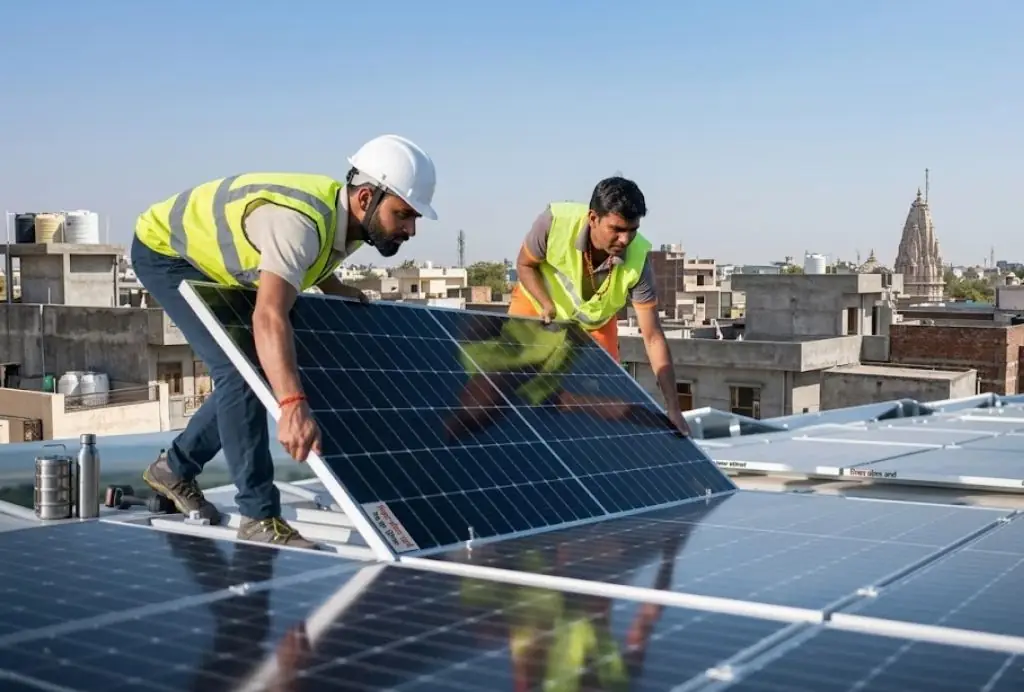
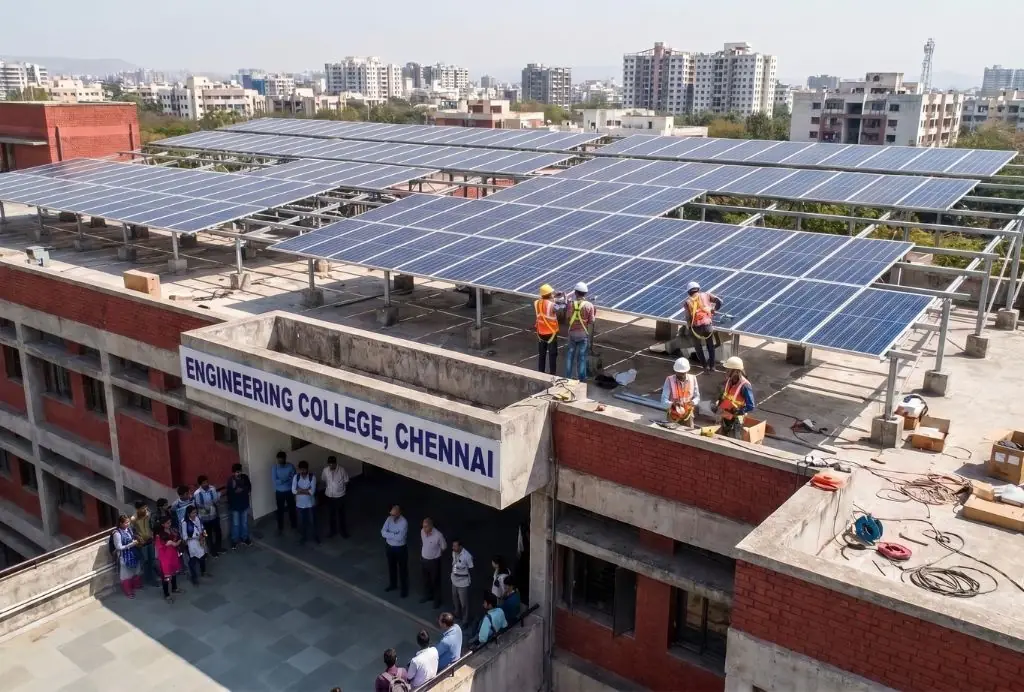
The summer vacation is the ideal window for installing solar on a Chennai campus, since work can proceed continuously with no disruption to teaching and no students on site. Where installation must happen during term, work is sequenced block by block with hoarding, exclusion zones and access routes agreed with the institution in advance, and material movement scheduled outside teaching hours.
The scheduling implication
Working backwards from the vacation
Approval is the long pole
Deciding in November leaves room for approvals and procurement, and installs comfortably that summer.
Deciding in April usually misses that summer — TANGEDCO net metering alone commonly runs four to eight weeks, plus any connection work.
Why the vacation window is worth planning for
No disruption to teaching
Classes, examinations and laboratory schedules run untouched.
No safeguarding overlap
No contractors working near students, so no induction or supervision burden.
Continuous working
The project completes faster with no stop-start around the timetable.
Noise and crane movement
Happen on an empty campus rather than over occupied classrooms.
Live when term resumes
The system is generating from the first day back, on the new academic year.
If work must happen during term
Five questions to put to any contractor
Their safeguarding approach, contractor background checks, whether workers will be inducted to your campus policies, edge protection above areas students use, and how material is moved. A contractor who has not thought about this on a school site has not done many.
Beyond the bill
What a campus gets beyond the electricity bill
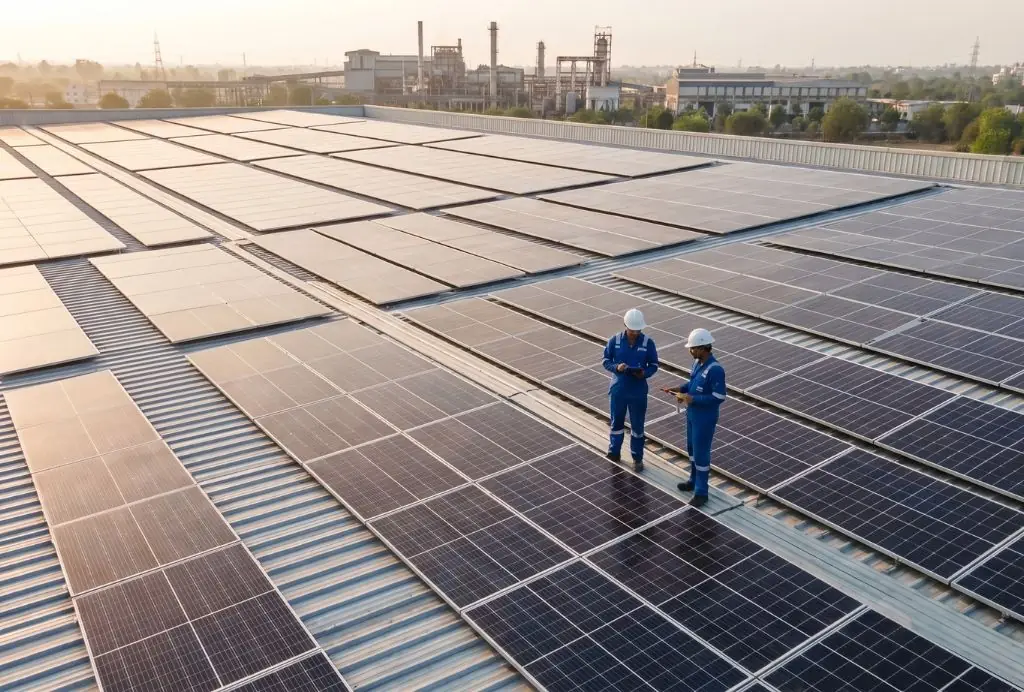
A rooftop solar installation on a school or college campus provides a working demonstration of energy generation that can be used in physics, environmental science and engineering teaching, with live generation data available from the monitoring system. Many institutions display real-time output in a lobby or corridor, and use the installation for project work, energy audits by students, and sustainability reporting.
A live display
In reception or a corridor showing current generation and cumulative units, visible to parents and visitors as well as students.
Curriculum integration
In physics, environmental studies and engineering, using real data from the campus rather than textbook figures.
Student projects
Energy audits, efficiency studies and monitoring analysis.
Green school certification
Where documented renewable generation supports the application, and accreditation criteria referencing sustainability.
Communication to parents and donors
Which for private institutions is a genuine consideration.
We configure monitoring for the institution's use and will set up a display feed if you want one. It costs little and it is the part of the project students actually notice.
Campus roofs
Multiple blocks, multiple roofs, multiple connections
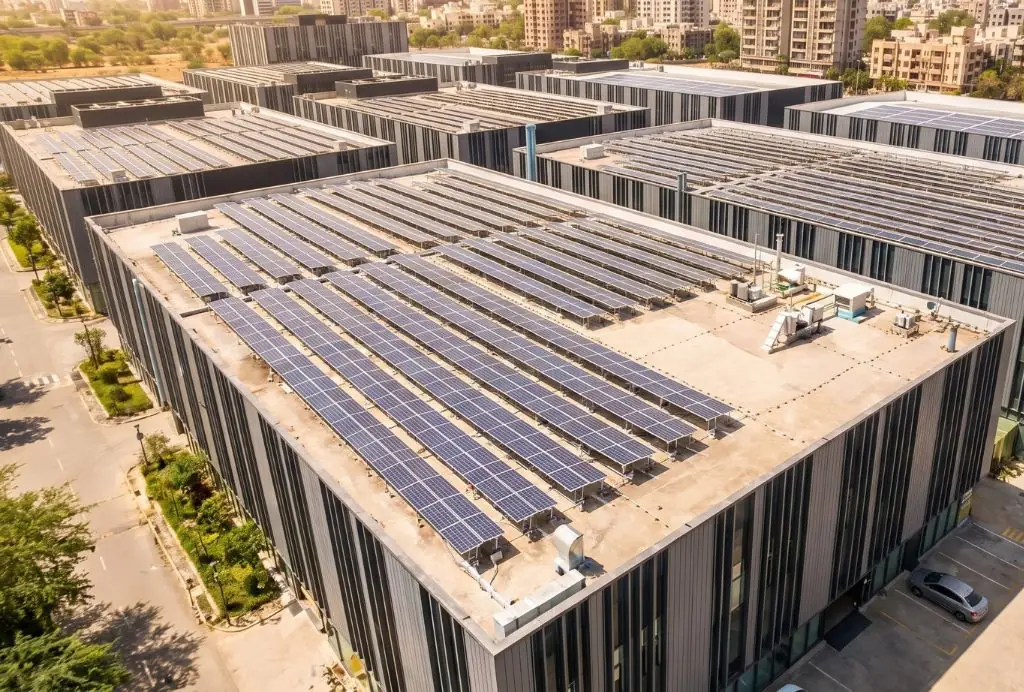
A campus typically comprises several buildings of different ages and roof types, and may hold more than one electricity service connection. Both facts shape the design, because a solar system is tied to a specific service connection and its capacity cannot exceed that connection's sanctioned load.
How many service connections the campus holds, and which buildings sit on which
Sanctioned load or contract demand on each, since the system size is bound by it
Roof types across blocks, commonly ranging from old RCC to newer slabs to metal sheet over halls and workshops
Structural condition and load capacity, particularly on older academic blocks
Shading between blocks, which is common on dense urban campuses
Cable routing between blocks, which can be a significant cost on a spread-out campus
The multi-connection question matters
If the campus has separate connections for the school block, the hostel and the administrative building, a single large array cannot simply serve all three. The design has to be structured around the connections, and this is exactly the kind of thing that surfaces late in a poorly surveyed project.
Elevated structures
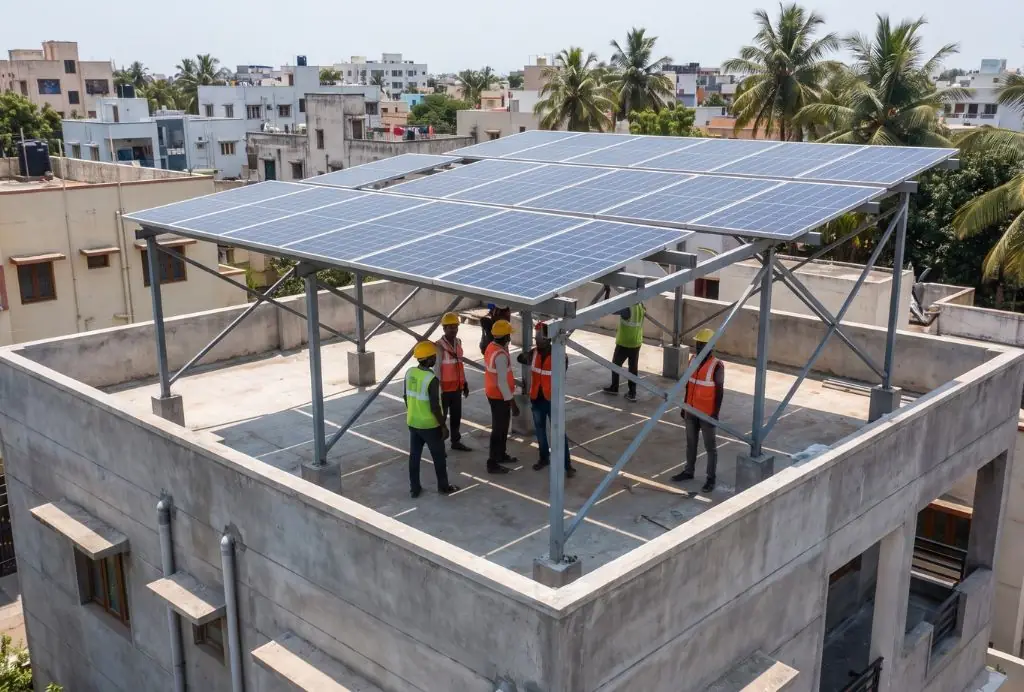
Worth considering on campus roofs where the terrace is used, or where an array over a covered assembly area or parking bay is more useful than one flat on a roof. Elevated structures explained.
Cost drivers
What determines the cost of a campus installation
We audit the campus before quoting, because the number of blocks and connections changes the answer more than the total roof area does. More on what drives solar prices in Chennai.
Book a campus surveyThe process
How a campus project runs
STEP 01
Campus energy audit
Twelve months of bills separated into term, examination and vacation periods, across every service connection.
STEP 02
Survey of all roofs
Structural condition, load capacity, shading between blocks, cable routes, existing plant.
STEP 03
Design
Sized to term-time daytime load, structured around the campus's service connections.
STEP 04
Proposal for the management or trust board
System size, itemised bill of materials, generation estimate, savings model, CAPEX and OPEX options, and the tax position stated honestly.
STEP 05 · LONGEST
Approval
Management committee, trust board or governing body. Usually the longest step, so allow for it in the vacation timing.
STEP 06
Applications
TANGEDCO net metering and any sanctioned load work, filed in parallel.
STEP 07
Installation
Scheduled in the vacation wherever possible, so teaching is never interrupted.
STEP 08
Commissioning, monitoring setup and handover
Including a live generation display feed for the lobby if wanted.
STEP 09
Two years of maintenance included
AMC thereafter, with performance reviewed against the generation meter.
Free, no obligation
Get a campus energy audit
Send us twelve months of electricity bills for the campus, including every service connection. We will separate term-time from vacation consumption, survey the roofs across your blocks, and return a proposal sized to what your campus actually uses while running — with the tax position set out for your auditor rather than assumed.
What your management receives
- Consumption analysis separated into term, examination and vacation periods
- Roof survey across all blocks, with structural notes
- A system size based on term-time daytime load
- Itemised bill of materials and design basis
- Savings model with the export treatment stated honestly
- CAPEX and OPEX options, with the depreciation position clarified for a trust or society
- A proposed installation window aligned to your academic calendar
What happens next
We call to confirm
Within one working day, to agree a survey slot that suits your calendar.
Bills and roof survey
Twelve months of bills analysed while we survey every block.
Proposal to your board
Sized to term-time load, with the tax position set out for your auditor.
Common questions
Campus solar in Chennai, common questions
Is solar worth it for a school in Chennai?
For most institutions, yes, provided the system is sized correctly. Teaching hours match generating hours almost exactly, so a well-sized campus system consumes nearly everything it produces during term. The complication is the long vacation, when generation peaks and consumption falls away, which is why a campus should be sized to term-time daytime load rather than to annual average or to available roof area.
What happens to solar generation during school vacations?
It is exported to the grid. Educational institutions are non-domestic consumers and are generally on net feed-in rather than the one-for-one net metering available to households, so exported units are compensated at a feed-in tariff well below the tariff the campus pays on imports. This is why sizing to term-time load matters more for a school than for almost any other kind of building.
Should a school size its system to its roof area?
No. A campus with a large unshaded roof and a modest term-time load will produce far more than it consumes, and the surplus is sold cheaply rather than banked. The correct basis is consumption during the months the campus is actually running, measured from twelve months of bills separated into term and vacation periods.
Can an educational trust claim accelerated depreciation on solar?
Only if it has taxable income to offset. Most schools and colleges operate as trusts or societies, and depreciation is worth nothing to an entity without a tax liability. A proposal presenting 40% first-year depreciation as central to the financial case may be describing a benefit your institution cannot use, so check with your auditor. Where depreciation and GST input credit are unavailable, an OPEX or RESCO arrangement often compares better than ownership.
When should solar be installed on a campus?
During a vacation, ideally the summer break, so there is no disruption to teaching and no safeguarding considerations around contractors working near students. Because TANGEDCO approvals commonly take four to eight weeks or more before installation can proceed, the audit and design need to start months ahead. An institution deciding in April will usually not install that summer.
How is a college with hostels different from a day school?
Completely. A day school consumes almost entirely within generating hours and drops to near zero in vacation. A residential campus consumes through the evening and night, continues consuming during much of the vacation, and carries a much higher baseline from kitchens, water heating and pumps. Night load cannot be served by solar without storage, so a hostel campus's total consumption is not all addressable by a rooftop system.
Can solar be used for teaching?
Yes, and many institutions do. Live generation data from the monitoring system supports physics, environmental science and engineering teaching, student energy audit projects and sustainability reporting. A display in reception showing current output and cumulative units is inexpensive to set up and is the part of the installation students actually engage with.
Our campus has several buildings. Does that complicate things?
It affects the design rather than preventing it. A solar system is tied to a specific electricity service connection and cannot exceed that connection's sanctioned load, so a campus holding separate connections for the school block, hostel and administration may need to be designed as more than one system. Cable routing between blocks can also be a meaningful cost on a spread-out campus.
Will installation disturb classes?
Not if it is scheduled in a vacation, which is the strong recommendation. Where work must happen during term, it should be sequenced block by block with exclusion zones, agreed access routes and material movement outside teaching hours. Ask any contractor about safeguarding, worker induction to campus policies and edge protection above areas students use.
Does solar help with green school certification?
It supports it. Documented on-site renewable generation is among the most straightforward evidence an institution can provide for green campus certification, sustainability reporting and accreditation criteria that reference environmental performance.
What does solar cost for a school or college in Chennai?
Most campuses fall between 30 kW and 200 kW: ₹13.8 to ₹15.6 lakh for 30 kW, ₹22 to ₹25 lakh for 50 kW, ₹41 to ₹47 lakh for 100 kW and ₹78 to ₹88 lakh for 200 kW, including GST, which a trust usually cannot claim back. Each unit used on site saves ₹9.40 on the LT IIB tariff or ₹8.25 on HT IIB, less the network charge of ₹1.60 (LT) or ₹1.04 (HT).