


How to Apply for the PM Surya Ghar Subsidy in Tamil Nadu
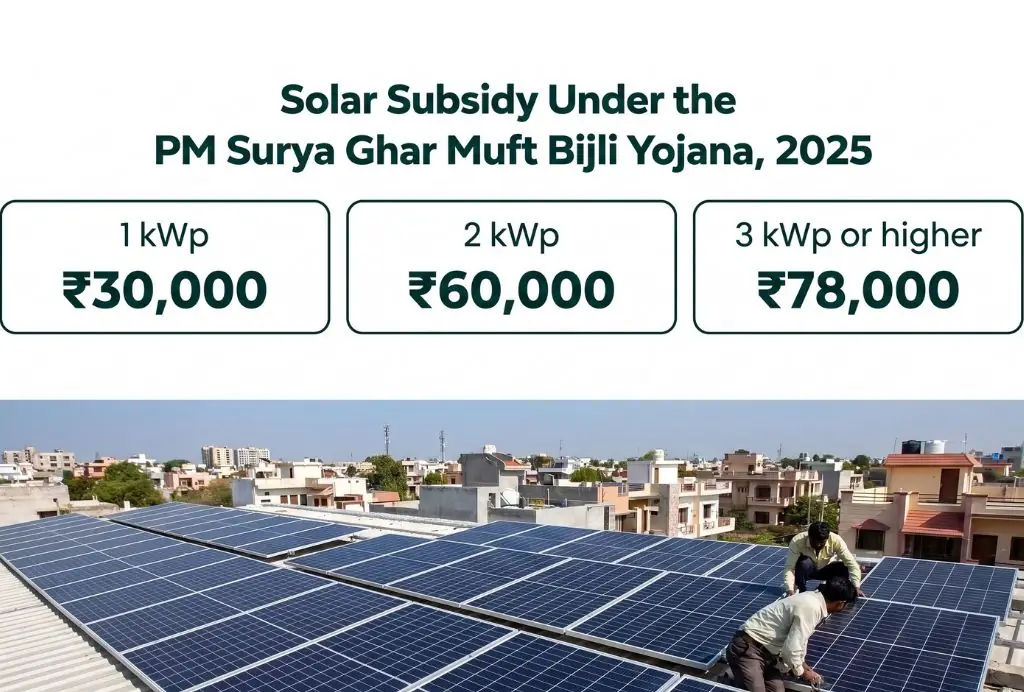
The PM Surya Ghar Muft Bijli Yojana pays Tamil Nadu households ₹30,000 for a 1 kW rooftop solar system, ₹60,000 for 2 kW, and ₹78,000 for 3 kW and above, capped at ₹78,000 regardless of system size. Applications go through the national portal at pmsuryaghar.gov.in with TANGEDCO as the implementing DISCOM. The subsidy is transferred directly to the applicant's bank account after the system is commissioned.
You pay first
The installer is paid in full and the subsidy arrives afterwards as a reimbursement.
DCR panels or no claim
Non-compliant modules disqualify the whole claim. Why that happens.
The amount
PM Surya Ghar subsidy amounts
The subsidy is calculated on system capacity in two slabs: ₹30,000 per kW for the first 2 kW, and ₹18,000 per kW for capacity beyond that up to 3 kW, giving a total of ₹78,000 at 3 kW. Above 3 kW the amount does not increase. Residential Central Financial Assistance is available for systems up to 10 kW.
Drag to see where the ceiling bites
Subsidy you receive
₹78,000
Which works out at
₹26,000
per kW installed
What that means
The ceiling, and the most installed residential size in Chennai. Every kilowatt beyond this one is unsubsidised, which is why 3 kW is the default rather than a coincidence.
What this means for sizing
Three kilowatts is where the subsidy reaches its ceiling, which is why it is the most installed residential size in Chennai. Going larger is a decision about how much electricity you consume, not about how much support you can claim. For choosing a size against your consumption, see solar panel prices in Chennai.
Eligibility
Who can claim PM Surya Ghar in Tamil Nadu
The scheme is open to residential electricity consumers in Tamil Nadu who own the property or have documented rights to the roof, hold a valid domestic electricity connection in their own name, and install a grid-connected rooftop system using DCR-compliant panels through the national portal. The connection name is the requirement most applicants overlook. Our guide to PM Surya Ghar eligibility covers tenants, second homes, SC/ST households and businesses.
You can claim if
- You have a valid domestic electricity connection with TANGEDCO
- The connection is in your own name
- You own the roof, or hold documented rights to use it
- The system is grid-connected with net metering
- The panels are DCR-compliant, built from cells on ALMM List-II
- You have not already claimed a subsidy for solar at that connection
You cannot claim if
- The property is billed under a commercial or industrial tariff
- The system is off-grid
- You are an individual flat owner applying against a shared society address. The association applies instead
- The connection is in someone else's name and has not been transferred
The connection name problem, which stops more applications than anything else
Many Chennai homes still have the electricity connection in a parent's, grandparent's or previous owner's name long after the property changed hands. The subsidy application and the net metering application are both tied to that service connection, and the applicant's name must match.
Fix it before you apply. A name transfer at your local section office is inexpensive and usually takes a week or two. Discovering the mismatch midway through is what turns a straightforward project into a frustrating one. We check this at the site survey for exactly this reason.
The core of the page
How to apply, step by step
Applying for PM Surya Ghar involves eight stages: registering on the national portal, submitting the application, receiving DISCOM feasibility approval, installing the system through a registered vendor, submitting plant details and applying for the net meter, DISCOM inspection, generation of the commissioning certificate, and submission of bank details for the subsidy transfer.
The national portal is the National Portal for Rooftop Solar at pmsuryaghar.gov.in, run by the Ministry of New and Renewable Energy. It is where you register, log in with your mobile number and an OTP (there is no password), pick a registered vendor, accept the vendor agreement, track the application and, after commissioning, submit your bank details. TNPDCL's own steps, the reference number, photo upload and inspection, run on a separate state site; our guide to the TNEB solar portal walks through it.
STEP 01
Register on the national portal
At pmsuryaghar.gov.in, selecting Tamil Nadu as the state and TANGEDCO as the DISCOM, with your electricity consumer number, mobile number and email address. The consumer number is on your electricity bill.
STEP 02
Submit the rooftop solar application
Using your consumer number and mobile, complete the application form with the proposed system capacity and your details.
STEP 03 · DO NOT SKIP
Wait for feasibility approval
TANGEDCO assesses whether the connection and the local network can support the proposed system. Nothing should be installed before this approval arrives. Applications commonly stall here when the proposed capacity exceeds the sanctioned load.
STEP 04
Install through a registered vendor
Once feasibility is approved, the system is installed by a vendor registered with the DISCOM, using DCR-compliant, ALMM-listed panels. This is where the choice of installer determines whether the claim clears later. Our guide to the PM Surya Ghar vendor list shows how to check one, and the model agreement what to sign.
STEP 05
Submit plant details and apply for the net meter
After installation, the plant details are submitted through the portal and the net metering application is made. In Tamil Nadu this is the bi-directional meter, plus a separate solar generation meter for systems above 10 kW.
STEP 06 · LONGEST STAGE
DISCOM inspection and meter installation
TANGEDCO inspects the installation and installs the meters. This is usually the longest stage, and the one no installer controls.
STEP 07
Commissioning certificate
Once inspection and metering are complete, the commissioning certificate is generated through the portal. This is the document that unlocks the subsidy.
STEP 08
Submit bank details and receive the subsidy
Bank account details and a cancelled cheque are submitted through the portal, and the subsidy is transferred directly to that account.
The critical sequencing point: do not install before feasibility approval. A system installed ahead of approval risks the claim entirely, and no reputable installer will proceed without it.
Documents you will needNobody else sets this out
What you do, what your installer does, what TANGEDCO does
| Stage | You | Your installer | TANGEDCO |
|---|---|---|---|
| Portal registration | Register, or authorise the installer to assist | Can guide and assist | — |
| Application submission | Sign and submit | Prepares capacity and technical details | — |
| Feasibility | Wait | Follows up | Assesses and approves |
| Load enhancement, if needed | Sign | Files it | Processes |
| Installation | Provide access | Installs and commissions | — |
| Net meter application | Sign | Files it | Processes |
| Inspection | Provide access | Attends and supports | Inspects |
| Meter installation | — | Coordinates | Installs the net meter |
| Commissioning certificate | — | Ensures generated on the portal | Confirms |
| Bank details | Provide account details and cancelled cheque | Uploads | — |
| Subsidy transfer | Receive it | Follows up if delayed | — |
What this means in practice
Your role is to sign, provide access and supply bank details. Everything else can be handled by the installer, and with a competent one it is.
If an installer tells you the paperwork is your responsibility, that is a choice they are making rather than a requirement of the scheme.
Timelines
Realistic timelines, stage by stage
A complete PM Surya Ghar project in urban Chennai typically runs six to ten weeks from application to a commissioned system, with the subsidy arriving about 15 days after DISCOM approval and your redemption request. The DISCOM inspection and meter installation stage is usually the longest and the most variable, commonly taking four to eight weeks on its own.
Where the weeks go
Typical urban Chennai project.
Application and approval
1 – 2 weeks
Installation
2 – 3 days
DISCOM inspection and metering
4 – 8 weeks
Subsidy credited
30 – 45 days after
The metering stage is the one no installer controls. Filing complete is the only thing that shortens it.
| Stage | Typical duration |
|---|---|
| Portal registration and application | Same day |
| Feasibility approval | Days to a few weeks, variable |
| Load enhancement or phase conversion, where required | Filed in parallel, adds to the critical path if filed late |
| Installation | 1 to 3 days for a residential system |
| Net meter application and DISCOM inspection | 4 to 8 weeks, the main variable |
| Commissioning certificate | Days after inspection |
| Bank details submission | Same day |
| Subsidy transfer | about 15 days after DISCOM approval and your redemption request |
The single biggest determinant of your timeline
Whether connection work such as load enhancement or three-phase conversion was identified at the survey and filed alongside the net metering application, or discovered later and filed afterwards. Filed together, they run in parallel. Filed sequentially, a six-week project becomes twelve.
Rural and outlying circles generally take longer than urban Chennai. Plan accordingly rather than assuming metro timelines apply everywhere in Tamil Nadu.
Disbursal
How the money reaches you, and how to track it
The PM Surya Ghar subsidy is paid by direct bank transfer to the account submitted through the national portal, typically within about 15 days of DISCOM approval, once you submit the redemption request on the portal. It is a reimbursement rather than a discount, so the full system cost is paid to the installer first and the subsidy arrives afterwards.
Plan the cash flow for this. A household installing a 3 kW system pays the installer the full amount, then receives ₹78,000 back some weeks after commissioning. Anyone budgeting on the net figure from day one will be caught short.
How to check your application status
Log in to the national portal with your consumer number and registered mobile. The application status is visible there at every stage, from feasibility through to subsidy disbursal. If it stops moving, our guide to raising a PM Surya Ghar complaint explains where each problem goes.
What holds disbursal up
- Bank details not submitted, or submitted with an error. The most common cause, and entirely avoidable
- Name mismatch between the bank account, the electricity connection and the application
- Commissioning certificate not generated, usually because inspection or metering is incomplete
- Documentation queries raised on the portal and not noticed, since notifications are easy to miss
- DCR compliance questions on the installed hardware
If disbursal is delayed: check the portal status, then confirm the commissioning certificate has been generated, then verify the bank details as submitted. Most delays resolve at one of those three points. We track this for our customers through to the money arriving, rather than treating handover as the end of the job.
Local specifics
TANGEDCO and the Tamil Nadu process
The PM Surya Ghar scheme is national, but implementation runs through the state DISCOM, which in Tamil Nadu is TANGEDCO. Two Tamil Nadu specifics affect the process: systems above 10 kW need a separate solar generation meter in addition to the bi-directional net meter, and system capacity cannot exceed the sanctioned load on the connection, which frequently triggers a load enhancement or a three-phase conversion before commissioning is possible.
01
One net meter, and a second above 10 kW
A bi-directional net meter records import and export. A separate solar generation meter, which records total output, is mandatory only above 10 kW.
02
Sanctioned load limits your system size
Capacity cannot exceed sanctioned load. Many Chennai domestic connections are sanctioned well below what the household actually uses, so enhancement is often required.
03
Above 4,000 watts, TANGEDCO supplies three-phase
Systems of 5 kW and above therefore usually involve a phase conversion, which is a separate application and should be filed in parallel.
04
The section office is where connection matters are settled
Name transfers, load enhancement and phase conversion all go through your local section office, and getting these done before or alongside the application is what keeps the project on schedule.
Timing, without the sales pressure
How long will the subsidy be available?
PM Surya Ghar is a national scheme with a defined budget allocation and a target of one crore households, running to the 2026-27 financial year. It is not open-ended. As of mid-2026 a substantial number of households across India had already been solarised under it, and the scheme continues to operate. For the end date, the extension reports and the latest figures, see PM Surya Ghar last date.
What this means for timing, stated without exaggeration
The scheme is running against a target and an allocation rather than continuing indefinitely, and rooftop prices have been rising through 2026 as the ALMM List-II domestic cell mandate feeds through into module costs. Neither fact means the subsidy disappears next month.
Anyone telling you the subsidy disappears next month is applying pressure rather than information.
What it does mean is that the argument for waiting is weaker than it was. Prices are trending up rather than down in the near term, and the support is finite. If you were going to do it in the next year or two, doing it sooner is the better side of that bet.
Check the current scheme status on pmsuryaghar.gov.in. This page is reviewed quarterly, but the portal is the authority.
You sign, we file
Get the subsidy claimed properly
Blues Renewables files the PM Surya Ghar application and the TANGEDCO net metering application, follows the feasibility, attends the inspection, and tracks the subsidy through to the money reaching your account. We also check the connection name and sanctioned load at the site survey, and file any load enhancement in parallel rather than afterwards.
What we handle
- Portal registration and application
- Feasibility follow-up with TANGEDCO
- Connection name check, and load enhancement or phase conversion where needed
- DCR-compliant, ALMM-listed hardware, so the claim is never at risk from the equipment
- Installation, commissioning, and inspection support
- Commissioning certificate and bank details submission
- Tracking the subsidy through to disbursal
Common questions
PM Surya Ghar, common questions
How much subsidy do I get under PM Surya Ghar in Tamil Nadu?
₹30,000 for a 1 kW system, ₹60,000 for 2 kW and ₹78,000 for 3 kW and above. The amount is capped at ₹78,000 regardless of system size, and residential Central Financial Assistance is available for systems up to 10 kW.
How do I apply for the PM Surya Ghar subsidy?
Through the national portal at pmsuryaghar.gov.in, selecting Tamil Nadu and TANGEDCO, using your electricity consumer number and mobile. After the application, TANGEDCO issues feasibility approval, then the system is installed by a registered vendor, plant details and the net meter application are submitted, TANGEDCO inspects and installs the meters, the commissioning certificate is generated, and bank details are submitted for the transfer.
When will I receive the subsidy money?
By direct bank transfer to the account submitted on the portal, typically within about 15 days of DISCOM approval, once you submit the redemption request on the portal. It is a reimbursement rather than a discount, so you pay the installer in full first.
How long does the whole process take in Chennai?
Commonly six to ten weeks from application to a commissioned system, with the subsidy processed about 15 days after DISCOM approval and your redemption request. TANGEDCO inspection and meter installation is the longest and most variable stage, typically four to eight weeks. Outlying circles generally take longer than urban Chennai.
Can I apply if my electricity connection is in my father's name?
Not until the connection is transferred to your name. The application is tied to the service connection and the applicant's name must match. A name transfer at your local section office is inexpensive and usually takes a week or two, and it should be done before applying rather than discovered midway through.
Can I install the system before feasibility approval?
No. Installing before TANGEDCO grants feasibility approval risks the claim, and no reputable installer will proceed without it. The correct sequence is application, then feasibility approval, then installation.
How do I check my PM Surya Ghar application status?
Log in to the national portal with your consumer number and registered mobile. Status is visible at every stage, from feasibility through to subsidy disbursal. If disbursal is delayed, check that the commissioning certificate has been generated and that the bank details submitted are correct, since those are the two most common causes.
Does a bigger system get a bigger subsidy?
No. The subsidy is capped at ₹78,000 for all systems of 3 kW and above, so a 5 kW or 10 kW system receives the same amount as a 3 kW one. Size the system against your consumption rather than against the subsidy.
Do I have to use a particular installer?
The system must be installed by a vendor registered with the DISCOM, and the panels must be DCR-compliant and ALMM-listed. Beyond that the choice is yours. The installer's choice of hardware is what determines whether the claim clears, so this is not a decision to make on price alone.
Is the subsidy available for a hybrid system with a battery?
Yes. A hybrid system is grid-connected, so it remains eligible on the same terms. The subsidy applies to the solar installation rather than to the battery, so the battery portion is paid for in full. Off-grid systems are not eligible.
What happens if my claim is rejected?
The most common causes are non-DCR panels, a name mismatch on the connection, capacity exceeding the sanctioned load, or incomplete documentation. Most are avoidable and are best identified at the survey stage rather than after installation. The six reasons claims fail covers each in turn.
What is the National Portal for Rooftop Solar?
It is the Ministry of New and Renewable Energy website for PM Surya Ghar: Muft Bijli Yojana, at pmsuryaghar.gov.in. Homes register there with their state, DISCOM (TNPDCL in Tamil Nadu), electricity consumer number and mobile number, then log in with an OTP to apply, choose a registered vendor, track the application and submit bank details for the subsidy.
Is PM Surya Ghar the same as the PM solar yojana or the government solar panel scheme?
Yes. PM solar yojana, PM solar panel yojana and government solar panel scheme are the names people search for PM Surya Ghar: Muft Bijli Yojana, the central rooftop solar scheme for homes. It pays ₹30,000 for 1 kW, ₹60,000 for 2 kW and ₹78,000 for 3 kW and above, and Tamil Nadu adds up to ₹22,000 for homes registered from 5 August 2026. The solar pump scheme for farmers is a different one, PM-KUSUM.
Is there a free solar panel scheme from the government?
No scheme installs rooftop panels for free. PM Surya Ghar pays part of the cost back after installation: up to ₹78,000 from the Centre and up to ₹22,000 from Tamil Nadu. A 3 kW system at about ₹2,10,000 works out to about ₹1,10,000 after both. The free electricity in the scheme's name is the power your own panels produce.