


Solar Panel Price in Chennai, 2026 Rate List
3 kW from ₹1.32 lakh after the ₹78,000 subsidy, for the most common home size.
Solar panels in Chennai cost ₹18 to ₹35 per watt for the panel alone, depending on technology. A complete installed rooftop system runs from ₹70,000 per kW at 3 kW, easing to about ₹58,000 per kW at 10 kW before subsidy. A 3 kW home system, the most common residential size, starts at ₹2,10,000 installed, falling to ₹1,32,000 after the ₹78,000 PM Surya Ghar subsidy. Pricing a shop, office or factory instead? See commercial solar price per kW.
Every figure on this page is a Chennai market range, not a sales quote. What your roof costs depends on its size, shading, access and distance from the coast.
Size finder
Which size is right for your home?
Recommended size
3 kW
Suits a bi-monthly bill of ₹2,700 to ₹5,400.
- Installed
- from ₹2.1 lakh
- Subsidy
- ₹78,000
- After subsidy
- from ₹1.32 lakh
Panel rate
Solar panel price per watt in Chennai
Solar panel prices in India in 2026 run ₹18 to ₹26 per watt for Mono PERC, ₹20 to ₹28 per watt for TOPCon, and ₹24 to ₹35 per watt for bifacial modules. Chennai retail sits within these national bands, since panels are manufactured centrally and freight is a small share of module cost. The single largest price variable is not the brand but whether the panel is DCR compliant, which adds roughly ₹8 to ₹11 per watt and is mandatory if you want the government subsidy.
Buying a single panel rather than a system? Our guide to solar panel price by wattage covers 50 W to 600 W panels, and types of solar panels explains Mono PERC, TOPCon, HJT and bifacial.
| Panel technology | Price per watt | Efficiency | Best suited to |
|---|---|---|---|
| Mono PERC | ₹18 to ₹26 | 19 – 21% | Large unshaded terraces where budget leads |
| TOPCon (N-type) | ₹20 to ₹28 | 21 – 23% | Most Chennai homes, best balance in high heat |
| Bifacial / dual glass | ₹24 to ₹35 | 21 – 23% | Elevated structures, reflective roof surfaces |
| HJT (premium N-type) | ₹32 to ₹45 | 22 – 25% | Severely space-constrained roofs only |
| Polycrystalline | Largely discontinued | 15 – 17% | Avoid, being phased out of the market |
Why TOPCon usually wins in Chennai
The reason is heat, not headline efficiency. TOPCon modules have a temperature coefficient near −0.30% per °C against roughly −0.35% for Mono PERC, so they lose less output as roof temperatures climb. Over 25 years on a Chennai terrace, that difference compounds into a meaningful generation gap for a premium of a few rupees per watt.
A caution about per-watt shopping
A panel quoted at ₹18 per watt and a panel quoted at ₹28 per watt are frequently not the same product, the same warranty, or even the same subsidy eligibility. Per-watt price is the right way to compare two panels of the same class, and a misleading way to compare across classes.
System price
Solar system price in Chennai, 3 kW to 10 kW
A complete rooftop solar installation in Chennai costs from ₹70,000 per kW at 3 kW, easing to about ₹58,000 per kW at 10 kW before subsidy, covering panels, inverter, mounting structure, cabling, earthing, installation and commissioning. Smaller systems cost more per kW because fixed costs like net metering, documentation and site work do not scale down.
Pick a system size
Capped at the bill the system offsets. Tamil Nadu's free units already cover part of the bill and the network charge is billed on everything the system generates, so a system sized well beyond your own consumption does not keep saving in proportion.
5 kW in Chennai
Net cost to you
₹2.42L to ₹2.42L
Get my exact price| System size | Installed, before subsidy | Subsidy | Net cost to you | Daily generation | Bill per bi-monthly cycle |
|---|---|---|---|---|---|
| 3 kW | from ₹2.1L | ₹78,000 | from ₹1.32L | 14 units | ₹2,700 to ₹5,400 |
| 4 kW | from ₹2.65L | ₹78,000 | from ₹1.87L | 18 units | ₹5,400 to ₹8,600 |
| 5 kW | from ₹3.2L | ₹78,000 | from ₹2.42L | 23 units | ₹8,600 to ₹11,900 |
| 6 kW | from ₹3.72L | ₹78,000 | from ₹2.94L | 27 units | ₹11,900 to ₹15,300 |
| 8 kW | from ₹4.8L | ₹78,000 | from ₹4.02L | 36 units | ₹18,600 to ₹22,000 |
| 10 kW | from ₹5.8L | ₹78,000 | from ₹5.02L | 45 units | Above ₹22,000 |
Starting prices for a subsidy-eligible system, installed. A 3 kW system starts at ₹2,10,000 and a 5 kW at ₹3,20,000; larger systems ease slightly on a per kW basis. Generation at 4.5 units per kW per day. Bill bands are per bi-monthly TANGEDCO cycle. We do not install below 3 kW, and the ₹78,000 subsidy is the same on every system of 3 kW and above.
Prices are indicative installed cost before subsidy, at from ₹70,000 per kW at 3 kW, easing to about ₹58,000 per kW at 10 kW. Generation at 4.5 units per kW per day. Bill bands are per bi-monthly TANGEDCO cycle, on the LT-IA domestic slabs. We do not install below 3 kW, and the ₹78,000 subsidy is the same on every system of 3 kW and above.
The subsidy stops at ₹78,000
Every system of 3 kW and above receives the same ₹78,000, so the subsidy is not a reason to go bigger than 3 kW. Consumption is.
Residential support stops at 10 kW
Systems above 10 kW do not qualify for residential Central Financial Assistance under the scheme.
3 kW is the sweet spot
It captures the maximum subsidy while matching the consumption of a typical two to three bedroom household running air conditioning for part of the year.
Reality check
Some Chennai vendors are currently quoting up to ₹3 lakh for a 3 kW residential system. Most established installers start around ₹2,10,000 for a subsidy-eligible 3 kW system. If a quote sits far above that, ask specifically what justifies it. If it sits far below, read what a cheap quote leaves out before signing.
Where the money goes
What goes into the price of a solar system
Panels account for roughly half the cost of a rooftop solar installation in Chennai. The rest is the inverter, mounting structure, cabling and protection equipment, installation labour, and the net metering and subsidy paperwork. A quote that only names the panel brand is hiding the other half of what you are buying.
Compare six lines, not one total
Two quotes ₹40,000 apart usually differ on the structure and the inverter, which are exactly the two components that decide whether the system survives fifteen Chennai monsoons.
After subsidy
Solar panel price in Chennai after the PM Surya Ghar subsidy
The PM Surya Ghar Muft Bijli Yojana pays ₹30,000 for a 1 kW system, ₹60,000 for 2 kW, and ₹78,000 for 3 kW and above, transferred directly to your bank account after TANGEDCO inspects and commissions the installation and you submit the redemption request on the portal. The scheme guidelines set processing at 15 days from DISCOM approval. You pay the installer the full amount first, then receive the subsidy as a reimbursement.
Two conditions decide whether your claim clears
- The panels must be DCR compliant. This is not optional and it is a common reason claims are rejected. See DCR or non-DCR below.
- The application must go through the national portal at pmsuryaghar.gov.in, with TANGEDCO as the Chennai DISCOM. Applying directly to the DISCOM does not work.
- One thing to fix before installation day: the subsidy is paid by direct bank transfer, so the name on the account must match the name on your electricity bill. A name mismatch blocks the payment after everything else has gone right.
Tax
How much GST is charged on a solar installation?
GST on solar panels and solar power generating systems was reduced from 12% to 5% with effect from 22 September 2025. For a turnkey rooftop installation, the 70:30 composite supply rule applies: 70% of the contract value is treated as goods at 5% and 30% as services at 18%, giving an effective rate of about 8.9% on the total contract.
| How you buy | GST outcome |
|---|---|
| Complete system, single vendor, one invoice | 70:30 composite supply, about 8.9% effective |
| Components bought separately | Panels 5%, but standalone inverters, batteries, structures and cables commonly 18% |
| Business buyer, GST registered | Input tax credit available, making GST largely cost-neutral |
Buying the system as one package from one vendor is almost always cheaper after tax than assembling components yourself, before you even account for who carries the warranty when something fails.
Check this on your invoice
An effective 8.9% is a calculated outcome, not a rate that can be entered on an invoice. Invoices must show 5% on the goods portion and 18% on the services portion. Any vendor billing a flat 8.9%, or a flat 18% on a bundled residential contract, is invoicing incorrectly.
2026 price movement
Why solar prices went up in 2026
Rooftop solar prices in India rose by roughly ₹1 to ₹3 per watt during 2026, reversing a decade-long decline. The main driver is the ALMM List-II mandate, in force from 1 June 2026, which requires solar modules used in subsidised and net-metered projects to be built from domestically manufactured cells. Domestic cells cost more than imported ones, and that cost has passed through to rooftop buyers.
- From 1 June 2026, projects claiming PM Surya Ghar subsidy, PM-KUSUM support, or applying for net metering or open access must use modules made with ALMM List-II certified Indian cells.
- Compliant DCR modules run roughly ₹23 to ₹26 per watt against about ₹15 per watt for imported non-DCR modules, a gap of ₹8 to ₹11 per watt.
- India imported the majority of its solar cells before this, so the mandate reshaped procurement across the entire industry.
If you are waiting for prices to fall
That thesis no longer holds for the near term. Domestic cell capacity is still scaling, and the subsidy is running against a scheme target rather than indefinitely.
Waiting now carries cost risk on both sides of the equation rather than just one.
The 2026 decision
DCR or non-DCR panels, which should you buy?
For a Chennai home claiming the PM Surya Ghar subsidy, DCR panels are the only option and almost always the right financial choice. DCR modules cost roughly ₹8 to ₹11 per watt more than imported non-DCR panels, which on a 3 kW system is about ₹24,000 to ₹33,000 extra. The subsidy you would forfeit by choosing non-DCR is ₹78,000. The premium never comes close to the subsidy at residential scale.
| DCR panels | Non-DCR panels | |
|---|---|---|
| Made from | Indian cells on ALMM List-II | Typically imported cells |
| Price per watt | About ₹23 to ₹26 | About ₹15 |
| PM Surya Ghar subsidy | Eligible | Not eligible |
| Net metering after 1 June 2026 | Permitted | Only under the Give It Up route |
| Right for | Almost every Chennai home | Large private commercial projects with no subsidy claim |
The "Give It Up" option, and why it rarely suits a home
MNRE has allowed consumers who formally give up their subsidy claim and take net metering through the national portal to use non-ALMM List-II cells until 31 March 2027. The choice is permanent. Once an application is submitted under Give It Up without a DCR certificate, the subsidy cannot be claimed retroactively.
For a household, giving up ₹78,000 to save around ₹30,000 on hardware is a losing trade. The route exists for buyers with a specific reason to want imported high-efficiency modules, usually a severely space-constrained roof, and it should be a deliberate decision, not something a vendor slips past you because non-DCR panels are easier to source.
Ask any Chennai installer
"Give me the module make and model, and the DCR certificate." Then check the model against ALMM List-I yourself.
If a quote is unusually cheap, this is very often where the difference is hiding, and you will not discover it until your subsidy claim is rejected months later.
Comparing quotes
What a cheap solar quote in Chennai is usually leaving out
When two Chennai solar quotes differ by ₹40,000 or more on the same system size, the difference is almost always in one of seven places: non-DCR panels that void your subsidy, a painted mild steel structure instead of galvanised, a lower-grade inverter, undersized cabling and protection equipment, the net metering paperwork excluded, maintenance charged separately from day one, or roof access billed as an extra once the crew arrives.
Local factors
What makes solar cost more or less in Chennai
Chennai installations carry two cost factors that inland cities do not: salt mist corrosion resistant specification for coastal properties, and mounting structures designed for a 50 m/s wind zone with a cyclone factor applied within 60 km of the coast. Both add cost, and both are the difference between a system that lasts 25 years and one that fails at the fasteners.
| Factor | Direction | Why |
|---|---|---|
| Coastal location | Higher | ECR, Besant Nagar, Thiruvanmiyur, Neelankarai. IEC 61701 salt mist certified modules, galvanised or aluminium structure |
| Cyclone wind design | Higher | Heavier structure and anchoring than an inland site |
| Sloped tile roof | Higher | Older Mylapore and Triplicane properties. More complex mounting than a flat RCC terrace |
| High-rise or difficult access | Higher | Craneage, scaffolding, longer cable runs |
| Shading needing split arrays | Higher | Two roof levels or module-level optimisers |
| Sanctioned load enhancement | Higher | A TANGEDCO cost that lands before the system can be commissioned |
| Flat RCC terrace | Baseline | The cheapest and most common Chennai roof |
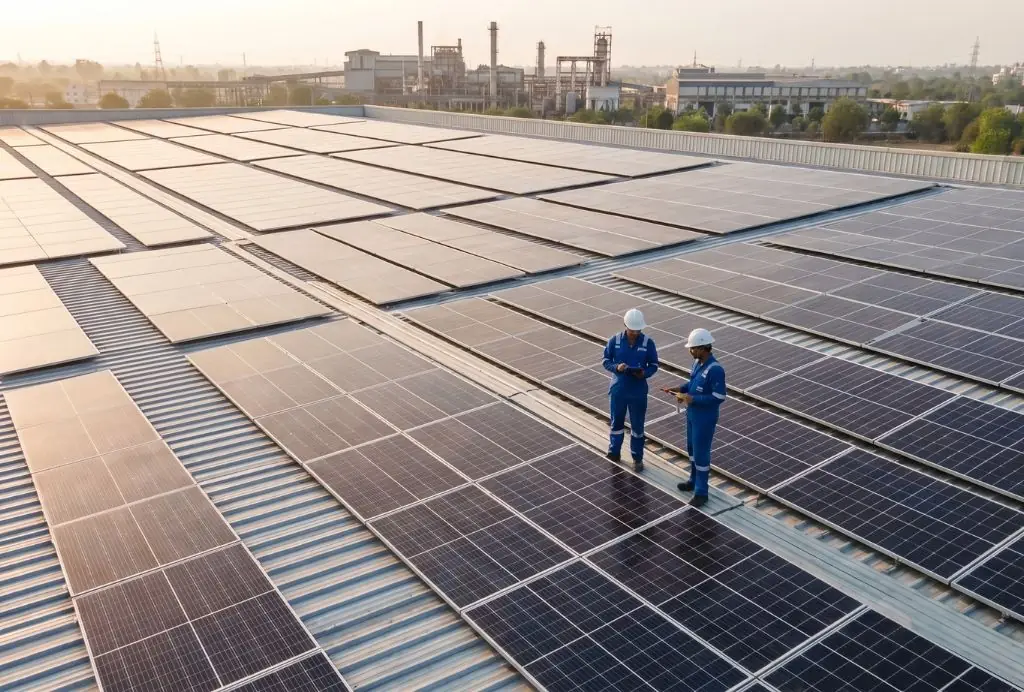
| Metal sheet industrial roof | Lower | Ambattur, Sriperumbudur. Simpler mounting and better economics per kW at scale |
Chennai's advantage is on the other side of the ledger. At roughly 5.3 peak sun hours a day, generation per kW here is better than most of northern India, so the same rupee of capital buys more units over the system's life.
Payback
How quickly does solar pay back in Chennai?
Most Chennai homes recover the post-subsidy cost of a rooftop solar system in four to six years, on panels warranted for 25. Payback is fastest for households consuming above 500 units per bi-monthly cycle, because Tamil Nadu's tariff is telescopic and those households receive only 100 free units instead of 200 while also paying higher slab rates.
Read more on how solar installation works in Chennai and TANGEDCO net metering explained.
The 500 unit threshold, in money terms
If your bi-monthly consumption sits just above 500 units, you are losing 100 free units and being repriced into higher slabs at the same time. A 3 kW system is often enough to pull you back under the threshold.
For those households the effective value of each generated unit is well above the headline tariff.
Send your bill, we will checkPaying for it
Financing a solar installation in Chennai
Rooftop solar for homes is eligible for collateral-free loans from public sector and private banks under the PM Surya Ghar framework, and the national portal lists participating lenders and current terms. For loan cases redeemed on or after 14 August 2026, the portal credits the subsidy straight into the loan account, so the balance falls by the subsidy amount without a separate prepayment. SBI asks for a 10% margin upfront and lends up to ten years.
Loan applications can be initiated through the PM Surya Ghar portal alongside the subsidy application.
Check the current interest rate and tenure directly on the portal or with your bank, as terms are revised periodically.
Businesses typically fund through working capital or equipment finance lines, and offset the cost against accelerated depreciation.
Business and industry
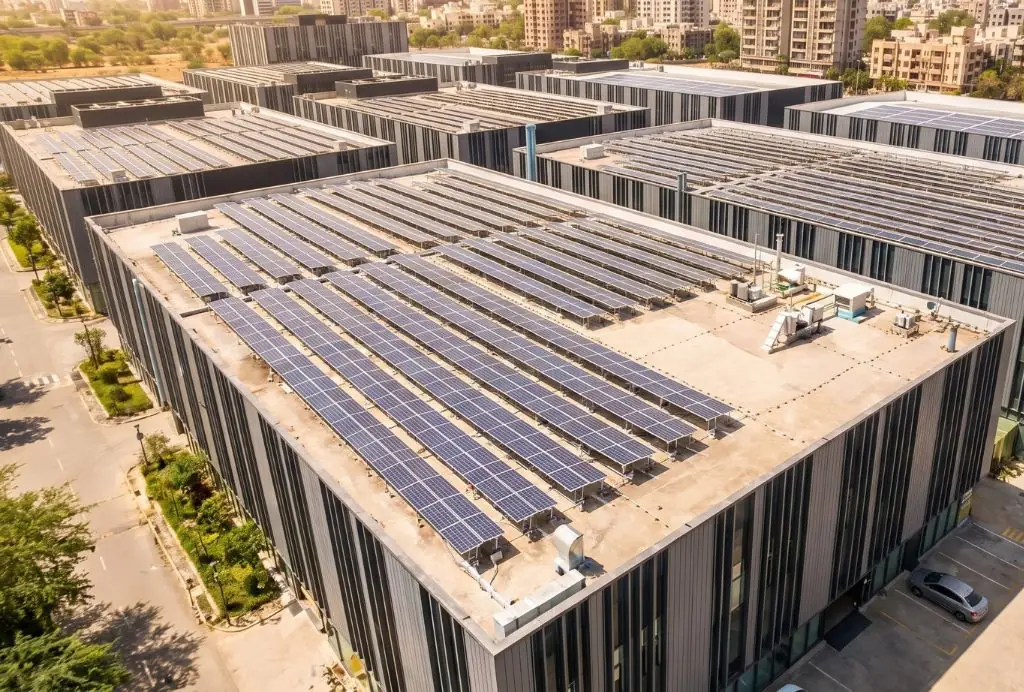
Solar panel price for businesses and factories in Chennai
Commercial and industrial rooftop solar in Chennai costs less per kW than residential, typically ₹40,000 to ₹60,000 per kW at scale, because larger arrays spread fixed costs and simplify mounting. Businesses do not receive the PM Surya Ghar subsidy, but they access three benefits homeowners cannot: accelerated depreciation of up to 40% in year one, GST input tax credit, and in some cases carbon credits.
| Residential | Commercial and industrial | |
|---|---|---|
| Cost per kW | ₹55,000 to ₹85,000 | ₹40,000 to ₹60,000 at scale |
| Central subsidy | Up to ₹78,000 | None |
| Accelerated depreciation | Not applicable | Up to 40% in year one |
| GST input credit | Not available | Available to GST-registered buyers |
| Typical payback | 4 to 6 years | Often 3 to 4 years |
Commercial payback is usually faster than residential despite the absence of a subsidy, because commercial tariffs are higher, consumption is concentrated in daylight hours when the system is generating, and the depreciation benefit lands in the first year. Zero-upfront OPEX and RESCO structures are also available, where you pay a fixed rate per unit consumed and the asset sits on someone else's balance sheet.
Get a commercial proposalFree roof assessment
Get your exact price
The ranges on this page are what the Chennai market charges. What your roof costs depends on its size, shading, access, distance from the coast and your sanctioned load. Send us your area and your last EB bill and we will come back with a system size, an itemised price, and what you pay after subsidy.
Common questions
Solar panel price in Chennai, common questions
What is the price of a 3 kW solar system in Chennai?
A 3 kW rooftop solar system in Chennai starts at ₹2,10,000 installed, before subsidy. After the ₹78,000 PM Surya Ghar subsidy the net cost is ₹1,32,000. It generates about 14 units a day and suits a household billed ₹2,700 to ₹5,400 per bi-monthly cycle.
What is the price of a 5 kW solar system in Chennai?
A 5 kW system in Chennai starts at about ₹3,20,000 installed. After the ₹78,000 PM Surya Ghar subsidy it is about ₹2,42,000, and about ₹2,20,000 if the ₹22,000 Tamil Nadu top-up applies. It generates roughly 22 to 23 units a day and needs about 400 to 450 square feet of shade-free roof.
What is the solar panel price per watt in Chennai?
Panels alone run ₹18 to ₹26 per watt for Mono PERC, ₹20 to ₹28 for TOPCon, and ₹24 to ₹35 for bifacial modules in 2026. DCR compliant panels, which are required for the government subsidy, sit at the upper end at roughly ₹23 to ₹26 per watt. Panels represent only about half of a complete installed system cost.
Why are solar prices higher in 2026 than last year?
Rooftop solar prices rose about ₹1 to ₹3 per watt during 2026, mainly because the ALMM List-II mandate came into force on 1 June 2026, requiring subsidised and net-metered projects to use modules built from domestically manufactured cells. Domestic cells cost more than imported ones and that difference has passed through to buyers.
Are cheaper non-DCR solar panels worth it in Chennai?
For a home claiming the subsidy, no. Non-DCR panels save roughly ₹8 to ₹11 per watt, about ₹30,000 on a 3 kW system, but they disqualify you from the ₹78,000 PM Surya Ghar subsidy. Non-DCR only makes financial sense for large private commercial projects that are not claiming any subsidy and not applying for net metering.
How much GST is charged on solar in Chennai?
GST on solar panels and solar power generating systems is 5%, reduced from 12% on 22 September 2025. For a complete turnkey installation the 70:30 composite supply rule applies, with 70% of the contract taxed at 5% and 30% at 18%, giving an effective rate of about 8.9%. Buying components separately can attract 18% on inverters, batteries and structures.
Is there any Tamil Nadu state subsidy on solar panel prices?
Yes. Since 21 September 2026, Tamil Nadu adds a state top-up of ₹5,000 for 1 kW, ₹10,000 for 2 kW and ₹22,000 for 3 kW and above on top of the central PM Surya Ghar subsidy of up to ₹78,000, so the combined maximum is ₹1,00,000. It covers homes registered on the PM Surya Ghar portal on or after 5 August 2026, TEDA pays it directly with no separate application, and it is limited to the first one lakh consumers, with ₹50 crore allocated this year. Be cautious about any quotation that still uses the older figure of around ₹20,000 per kW.
Does solar cost more in Chennai than in other Indian cities?
Marginally, for coastal properties. Homes near the sea need salt mist corrosion certified modules and galvanised or aluminium mounting, and all Chennai structures are designed for a 50 m/s wind zone with a cyclone factor. Against that, Chennai receives about 5.3 peak sun hours a day, so each kW generates more here than in most of northern India, which improves returns over the system's life.
Can I get a loan for solar panels in Chennai?
Yes. Collateral-free loans for residential rooftop solar are available from public sector and private banks under the PM Surya Ghar framework, and applications can be initiated through the national portal alongside the subsidy claim. Since the subsidy is reimbursed after commissioning rather than deducted upfront, many households finance the full amount and use the subsidy to prepay part of the loan.
What is the smallest system worth installing?
A 3 kW system, starting at ₹2,10,000 before the ₹78,000 PM Surya Ghar subsidy, is the smallest system we install, at ₹1,32,000 net. Smaller sizes exist on the market, but fixed costs like net metering, documentation and site work do not scale down, so the per kW cost climbs sharply below 3 kW and the subsidy is lower too. Below that size the payback rarely justifies the effort.
What is the solar panel rate per kW in Chennai?
A complete installed rooftop system costs from ₹70,000 per kW at 3 kW, easing to about ₹58,000 per kW at 10 kW, before subsidy. The panels alone cost about ₹20,000 to ₹28,000 per kW for TOPCon, or ₹23,000 to ₹26,000 per kW for the DCR panels the subsidy requires. The rest of the per kW rate is the inverter, structure, cabling, installation and net metering work.
How much does solar for a home cost in Chennai after both subsidies?
A 3 kW home system starts at ₹2,10,000 installed and a 5 kW at ₹3,20,000. After the ₹78,000 PM Surya Ghar subsidy and Tamil Nadu's ₹22,000 top-up, a 3 kW system costs about ₹1,10,000 and a 5 kW about ₹2,20,000. The state top-up covers the first one lakh homes registered on the PM Surya Ghar portal from 5 August 2026, so check eligibility before counting on it.
How much does one solar panel cost for a home?
A single 550 W panel costs about ₹12,650 to ₹14,300 if it is a DCR panel at ₹23 to ₹26 a watt, which is the kind the subsidy requires. An imported non-DCR panel of the same size costs about ₹8,250 at around ₹15 a watt, but it cannot claim the subsidy. A home needs about two such panels per kW, so a 3 kW system uses six. The panels are only about half of an installed system's cost; the rest is the inverter, structure, cabling and net metering work, and our guide to solar panel price by wattage lists 50 W to 600 W panels.
What is the EMI on a solar system in Chennai?
On SBI's PM Surya Ghar rooftop loan you pay a 10% margin and borrow the rest. A 3 kW system at ₹2,10,000 needs a loan of about ₹1,89,000, which falls in SBI's 5.75% band for loans up to ₹2 lakh, or about ₹2,100 a month over ten years. A 5 kW system at ₹3,20,000 needs about ₹2,88,000 at the 7.90% band above ₹2 lakh, or about ₹3,500 a month. For loan cases redeemed from 14 August 2026, the portal credits the ₹78,000 subsidy straight into the loan account, which cuts the balance. Rates are floating, so confirm the current figure with the bank.