Rooftop Solar Components: DC Cable, MC4 Connectors, Junction Box, ACDB, DCDB and Earthing
What each rooftop solar wiring part does: solar DC cable sizes, MC4 connectors, junction box, ACDB, DCDB, earthing and lightning arrester, with MNRE specs.

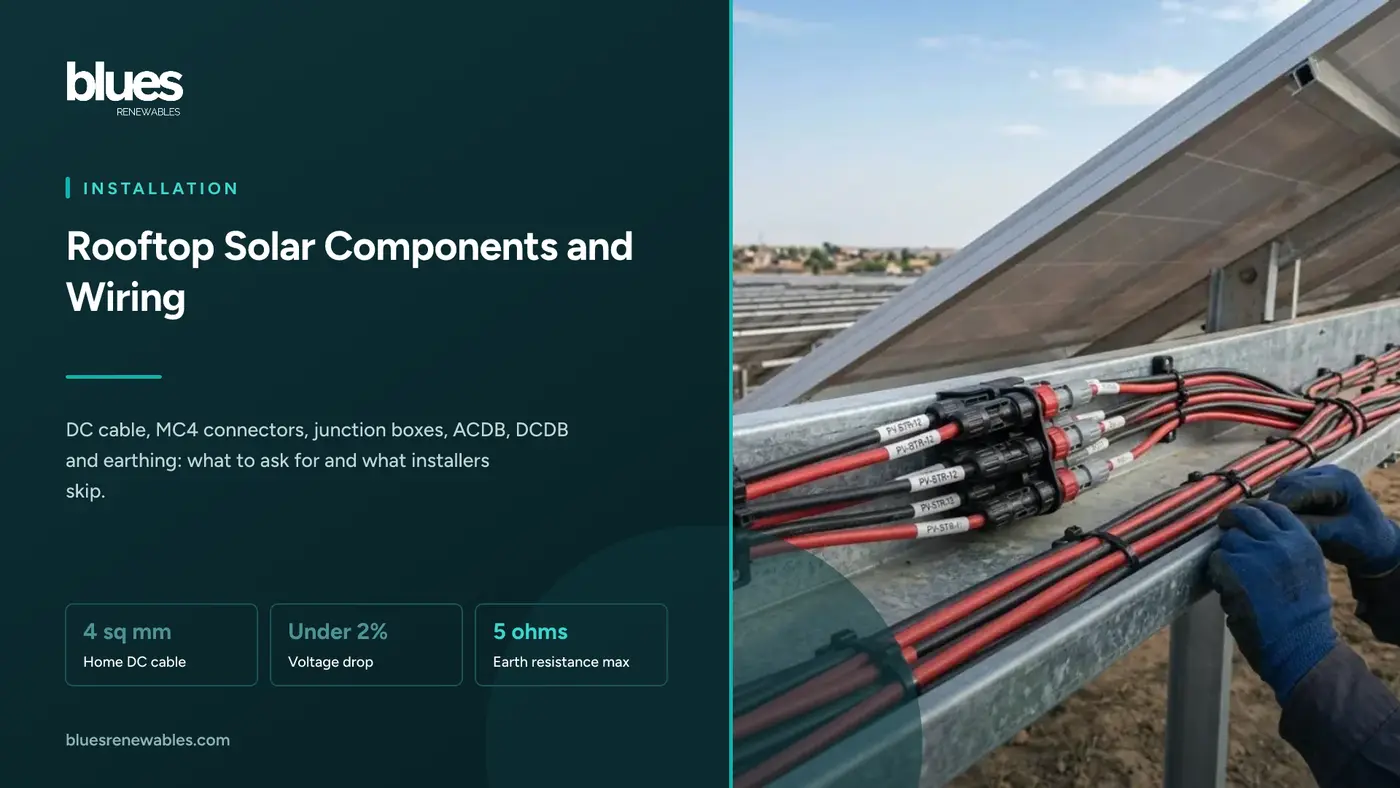
MNRE's indicative bill of materials for a standard rooftop solar package lists 50 metres of solar DC cable. At October 2026 prices, a branded 4 sq mm solar cable costs about ₹50 to ₹100 a metre, so the whole run comes to ₹2,500 to ₹5,000 on a system worth more than ₹2 lakh.
That small number is the problem. Cables, connectors, boxes and earth pits are the cheapest parts of a rooftop system, so a low quote finds its savings there. They also decide whether your system wastes power in the wires, trips in the first monsoon, or carries a fault safely to earth.
This guide covers the wiring of a home or small business system, from the panel's junction box to the AC board: what each part does, the specification to ask for, what it costs, and a handover checklist. For megawatt plants, see our solar power plant components page.
Key takeaways
- Solar DC cable is not house wire. Ask for single-core tinned copper cable to EN 50618 or IEC 62930, rated 1,500 V DC, sized so voltage drop stays under 2%, the MNRE limit.
- 4 sq mm suits most home strings; 6 sq mm suits long runs. On a 25 metre run, 2.5 sq mm cable breaks the 2% limit for a typical 3 kW string, while 4 sq mm stays near 1.4%.
- Never mix MC4 connector brands. IEC 60364-7-712 requires the male and female halves to be the same type from the same manufacturer.
- Every metal part must be earthed to IS 3043, with earth resistance never above 5 ohms. Systems of 10 kW and above need three separate pits: DC, AC and lightning arrester.
- A lightning arrester never goes on the panel structure. MNRE's specification forbids it, and its down conductor runs in its own pipe to its own pit.
Rooftop solar components, from panel to meter
Power in a rooftop system travels a fixed path. Each box along it has one job.
- Module junction box - Where it sits: Back of each panel, What it does: Holds bypass diodes and the panel's output leads, Specification to ask for: IP65 or better, MC4 or equivalent leads
- Solar DC cable - Where it sits: Panels to inverter, What it does: Carries DC from the strings, Specification to ask for: Single-core copper, EN 50618 or IEC 62930, under 2% drop
- MC4 connectors - Where it sits: Between panels and at cable joints, What it does: Weatherproof plug joints, Specification to ask for: Same brand on both halves, crimped with the right tool
- Array junction box (AJB) - Where it sits: On the structure, larger systems, What it does: Combines several strings, Specification to ask for: IP65, copper bus bars, cable glands
- DCDB - Where it sits: Before the inverter, What it does: Isolates and protects the DC side, Specification to ask for: IP65, DC MCB or fuse, DC SPD
- Inverter - Where it sits: Indoors or shaded wall, What it does: Converts DC to AC, Specification to ask for: See solar inverter price
- ACDB - Where it sits: After the inverter, What it does: Isolates and protects the AC side, Specification to ask for: MCB, AC SPD, RCCB if the inverter lacks one
- Earthing - Where it sits: Pits in the ground, What it does: Takes fault and surge current to earth, Specification to ask for: IS 3043, 5 ohms or less
- Lightning arrester - Where it sits: Highest point, off the structure, What it does: Intercepts strikes, Specification to ask for: IEC 62305 or NFC 17-102
The specifications come from MNRE's technical specification for rooftop plants under the simplified procedure, the rulebook behind PM Surya Ghar installations.
Solar DC cable: what to ask for
A solar DC cable lies in full sun for 25 years, which ordinary PVC house wire is not built for. A cable built to EN 50618 (or its IEC twin, IEC 62930) has a fine-stranded tinned copper conductor, cross-linked halogen-free insulation and sheath, and a 1,500 V DC rating. Polycab's datasheet lists a maximum conductor temperature of 120°C and resistance to UV, ozone and water.
MNRE adds its own rules for the DC side:
- Copper only, multi-strand, and single-core. Multi-core cable is not allowed on the DC side.
- Voltage drop under 2% on the DC run, and under 2% on the AC run.
- Cables in RPVC pipe or a covered GI cable tray, tagged with ferrules, and clamped at least every 50 cm.
- A cable life matching the panels, which is 25 years.
4 sq mm or 6 sq mm solar cable?
On a home system, voltage drop decides the size more than current rating does. Polycab's published data for EN 50618 cable:
- 2.5 sq mm - Current rating, single cable in free air: 41 A, Resistance at 20°C: 8.21 ohm per km
- 4 sq mm - Current rating, single cable in free air: 55 A, Resistance at 20°C: 5.09 ohm per km
- 6 sq mm - Current rating, single cable in free air: 70 A, Resistance at 20°C: 3.39 ohm per km
- 10 sq mm - Current rating, single cable in free air: 98 A, Resistance at 20°C: 1.95 ohm per km
The ratings assume 60°C ambient air. At 70°C you multiply by 0.92, which is worth remembering on a Chennai terrace in May.
A worked example. Take six 550 W panels in one string (3.3 kW). A 550 W panel works at around 41 V and 13.3 A, so the string runs at about 246 V and 13.3 A. Say the inverter is 25 metres from the array, so the cable loop, out and back, is 50 metres.
- 2.5 sq mm - Loop resistance: 0.41 ohm, Voltage drop: 5.5 V, Share of string voltage: 2.2%, Power lost at full sun: about 73 W
- 4 sq mm - Loop resistance: 0.25 ohm, Voltage drop: 3.4 V, Share of string voltage: 1.4%, Power lost at full sun: about 45 W
- 6 sq mm - Loop resistance: 0.17 ohm, Voltage drop: 2.3 V, Share of string voltage: 0.9%, Power lost at full sun: about 30 W
The 2.5 sq mm cable fails MNRE's 2% limit; 4 sq mm passes, and 6 sq mm cuts the loss by another third. Copper's resistance rises by roughly a fifth at 70°C, so terrace losses run a little higher. For short home runs, 4 sq mm is usual; for long runs or parallel strings, 6 sq mm earns its cost.
Solar cable price
Branded 4 sq mm EN 50618 cable ran at ₹47 to ₹73 a metre in bulk on one B2B marketplace in the three months to October 2026, and a 100 metre retail roll listed at ₹10,000. So the typical market range in October 2026 is about ₹50 to ₹100 a metre, depending on quantity. At those prices a 3 kW system's 50 metres costs ₹2,500 to ₹5,000 in all, which is small next to 25 years of losses in an undersized cable.
On the AC side, MNRE allows copper or FRLS aluminium, again within a 2% drop, with the neutral matching the phase size in three-phase systems.
MC4 connectors and Y connectors
Every panel leaves the factory with leads ending in MC4 or equivalent connectors, as MNRE requires. MC4 is Stäubli's original connector; the name is now used loosely for any look-alike.
That loose use causes real faults, because look-alike connectors are not necessarily compatible. The connector standard (EN 50521, now IEC 62852) tests a connector pair from one manufacturer, and the installation standard IEC 60364-7-712:2017 says the male and female halves must be the same type from the same manufacturer. Stäubli itself states it does not support mating its MC4 with third-party "MC4 compatible" parts. A mismatched joint can run hot, raise resistance and, in the worst case, start a fire.
What to ask for:
- One connector brand across the job, including any joint where a panel lead meets the field cable.
- Crimped, not soldered or twisted, using the crimp tool the connector maker specifies.
- Connectors clipped to the structure, not lying in water on the roof.
Y connectors (MC4 branch connectors) join two strings in parallel into one inverter input. Before you accept one on the drawing, ask to see the inverter's maximum input current per MPPT, and whether the design needs string fuses.
Generic MC4 pairs sell for under ₹50 a pair in bulk on B2B listings in October 2026. A connector is never where a quote should save money.
Solar junction box: two different boxes
The module junction box is the small sealed box on the back of each panel. It holds the bypass diodes that let current flow around a shaded or damaged cell group. MNRE requires IP65 or better, and suggests IP67 where the box could be briefly submerged and IP68 where it could stay underwater. A failed module junction box is a warranty claim, which our solar panel warranty claim guide explains.
The array junction box (AJB) is a box on the structure where several strings are combined before the long run to the inverter. MNRE asks for GRP, FRP or powder-coated aluminium, IP65 or better, copper bus bars or terminal blocks, cable glands at every entry, lugs on every termination, and ferrules for identification. It should be easy to reach and shaded from direct sun. A 3 kW to 5 kW home with one or two strings usually does not need an AJB; the strings run straight to the DCDB or inverter.
DCDB and ACDB: the two protection boards
DC distribution box (DCDB)
The DCDB sits between the array and the inverter, holding a DC MCB or fuse for each string, a DC surge protection device (SPD) and copper bus bars. MNRE asks for IP65 or better, an MCB for currents up to 63 A and an MCCB above that. The SPD should be type II, connected from the positive and the negative to earth, with a voltage rating above the string's open-circuit voltage.
MNRE notes that small plants may skip a separate DCDB if the inverter has a suitable arrangement built in. If yours has none, ask how the DC side is switched off before anyone opens the inverter.
AC distribution box (ACDB)
The ACDB takes the inverter's AC output to your main board. It carries an MCB, an AC SPD, and an RCCB if the inverter does not have its own residual current protection. MNRE asks for switchgear to IEC 60947, IP54 indoors and IP65 outdoors. MNRE also calls for a lockable isolator at the utility end for line staff.
ACDB and DCDB price
Two retailer listings put a single-phase ACDB for 1 kW to 7 kW (32 A MCB, 320 V SPD) at ₹1,750 and ₹2,037 in October 2026. One seller listed ACDB and DCDB combo boxes for up to 5 kW at ₹1,600 and ₹2,075, and one published list priced a single-string 600 V DCDB at ₹1,609. Judge the box by what is inside: MCB and SPD brands, IP rating, and an SPD rating that matches your string voltage.
Solar earthing and lightning protection
Earthing
MNRE requires every array structure, inverter, junction box and metal enclosure to be earthed to IS 3043:2018, with earth resistance as low as possible and never above 5 ohms. For systems of 10 kW and above, three separate earth pits are required: one for the DC side, one for the AC side, and one for the lightning arrester. Below 10 kW the document does not fix the number of pits, so ask your installer how many they will dig, what each one connects to, and to show you the resistance reading after installation.
Systems above 10 kW also need CEIG approval in Tamil Nadu; see our guide to CEIG approval for solar.
Solar earthing kit price. A kit is usually a copper-bonded electrode with earth-enhancing compound and a cover. TradeIndia listings in October 2026 priced 1 metre kits at ₹1,020 to ₹2,200, with copper coatings from 30 to 50 microns up to 250 microns. MNRE names the IEC 62561 series for these parts. Ask for the coating thickness in writing.
Lightning arrester
MNRE says lightning protection is provided "if required", meaning it follows a risk assessment under IEC 62305 or the French standard NFC 17-102. Three rules hold whenever one is fitted:
- Never on the mounting structure. The specification says so directly.
- A down conductor of at least 6 sq mm copper, 16 sq mm aluminium, or a 25 x 3 mm GI strip, run in its own separate pipe.
- Its own earth pit, kept apart from the equipment earth on systems of 10 kW and above.
Either a Franklin rod or an early streamer emission arrester is accepted.
What cheap installers skip
Each of these shortcuts saves a few hundred to a few thousand rupees on a quote.
- House wire or 2.5 sq mm cable on the DC side, which fails the 2% drop limit on longer runs and degrades in sun.
- Mixed connector brands, or connectors clamped with pliers instead of a crimp tool.
- Cables loose on the terrace, unclipped, with no pipe or tray, chafing on the parapet edge.
- No DC isolation you can reach, so the DC side stays live when someone opens the inverter.
- An SPD rated below the string's open-circuit voltage, or an SPD with no earth connection.
- One shared earth pit on a 10 kW or larger system, or any pit nobody tests.
- A lightning arrester bolted to the panel structure, which brings the strike to the panels.
- No drawing. MNRE requires electrical drawings and a manual with the plant.
On Chennai's coast, also ask whether the panels qualify to IEC 61701 salt mist testing, which MNRE requires for highly corrosive sites. Our post on whether your solar quote is too high shows how to read a quote that is suspiciously low as well.
Handover checklist
Ask for these before you sign the completion papers:
The DC cable's make, size and standard printed on the sheath (look for EN 50618 or IEC 62930).
The connector brand, and confirmation that every joint uses the same one.
All cable in RPVC pipe or covered tray, clamped and tagged.
The DCDB or inverter DC isolator, and the ACDB, each labelled.
SPD ratings on both DC and AC sides.
Earth resistance readings for each pit, in writing, at 5 ohms or less.
The lightning arrester's position, off the structure, if one is fitted.
The single-line drawing and the O&M manual.
Frequently asked questions
Which DC cable is best for solar panels?
A single-core tinned copper cable built to EN 50618 or IEC 62930 and rated 1,500 V DC. Size it so voltage drop stays under 2%; 4 sq mm suits most home strings and 6 sq mm suits longer runs.
What is a junction box in a solar panel?
The sealed box on the back of each panel that holds the bypass diodes and output leads, rated IP65 or better under MNRE rules. An array junction box is a separate, larger box that combines strings on bigger systems.
Can I use MC4 connectors from different brands?
No. IEC 60364-7-712 requires both halves of a connector to be the same type from the same manufacturer, and Stäubli does not support mating its MC4 with third-party parts. Mismatched joints can overheat.
What is the difference between ACDB and DCDB in solar?
The DCDB protects the DC side between panels and inverter, with an isolator or fuse and a DC surge protector. The ACDB protects the AC side between inverter and main board, with an MCB, AC surge protector and, where needed, an RCCB.
How many earth pits does a rooftop solar system need?
MNRE requires three separate pits for systems of 10 kW and above: DC, AC and lightning arrester. Below 10 kW the number is not fixed, but every pit must test at 5 ohms or less.
What is the price of solar DC cable?
About ₹50 to ₹100 a metre for branded 4 sq mm EN 50618 cable in October 2026, depending on quantity. A 3 kW home uses around 50 metres.
Is a lightning arrester compulsory for rooftop solar?
MNRE asks for one where a risk assessment under IEC 62305 or NFC 17-102 shows it is needed. When fitted, it must stand off the panel structure, with its own down conductor and earth.
Where this fits
For the structure the panels sit on, see solar panel mounting structure. For the full installation sequence, read how to install solar panels on your home, and to check an installer before you hire one, how to verify a solar company. If you plan battery backup, the solar battery price guide covers storage.
Blues Renewables has installed rooftop solar across Tamil Nadu from Guindy, Chennai, since 2020, for homes from 3 kW, apartments, businesses and factories. Every quote names the cable, connector, DCDB, ACDB and earthing parts by make and specification, and we hand over earth resistance readings and a single-line drawing with every system. Two years of free maintenance are included. Call +91 98841 07170.
Sources
- MNRE, indicative bill of materials, quality standards and technical specifications for rooftop solar plants installed under the simplified procedure (National Portal for Rooftop Solar help documents), viewed 4 October 2026: 50 m DC cable in the standard package, module and array junction box rules, DCDB and ACDB rules, MCB and MCCB thresholds, SPD type, earthing to IS 3043:2018 and 5 ohm limit, three pits at 10 kW and above, lightning arrester rules and down conductor sizes, cable rules including 2% drop, single-core copper DC, RPVC or GI tray, 50 cm clamping, IS 17293:2020, EN 50618, EN 50521, IEC 60947, IEC 61643-11, IEC 62561, IEC 61701, drawings and manual
- Polycab, Solar H1Z2Z2-K BS EN 50618 product specification, document 00519, 11 January 2024: 1,500 V DC rating, 120°C conductor temperature, tinned class 5 copper, current ratings, resistance values and temperature derating
- Stäubli Electrical Connectors, cross-connection statement, viewed 4 October 2026: the IEC 60364-7-712:2017 same-manufacturer rule and Stäubli's position on third-party connectors
- L&T SuFin listing and Apollo Universe listing for Polycab 4 sq mm solar DC cable, viewed 4 October 2026: ₹46.94 to ₹72.54 a metre bulk price trend and ₹10,000 for a 100 m roll
- Kenbrook Solar ACDB, DCDB and AJB price list, Vigood Solartek ACDB listing and Solar Shoppee product list, viewed 4 October 2026: ACDB, DCDB and combo box prices
- TradeIndia solar earthing kit listings, viewed 4 October 2026: ₹1,020 to ₹2,200 per kit and copper coating thickness
- TradeIndia and IndiaMART MC4 connector listings, viewed 4 October 2026: generic connector pairs under ₹50 in bulk
- Worked voltage drop figures are Blues calculations from Polycab's resistance data, with typical 550 W panel values