
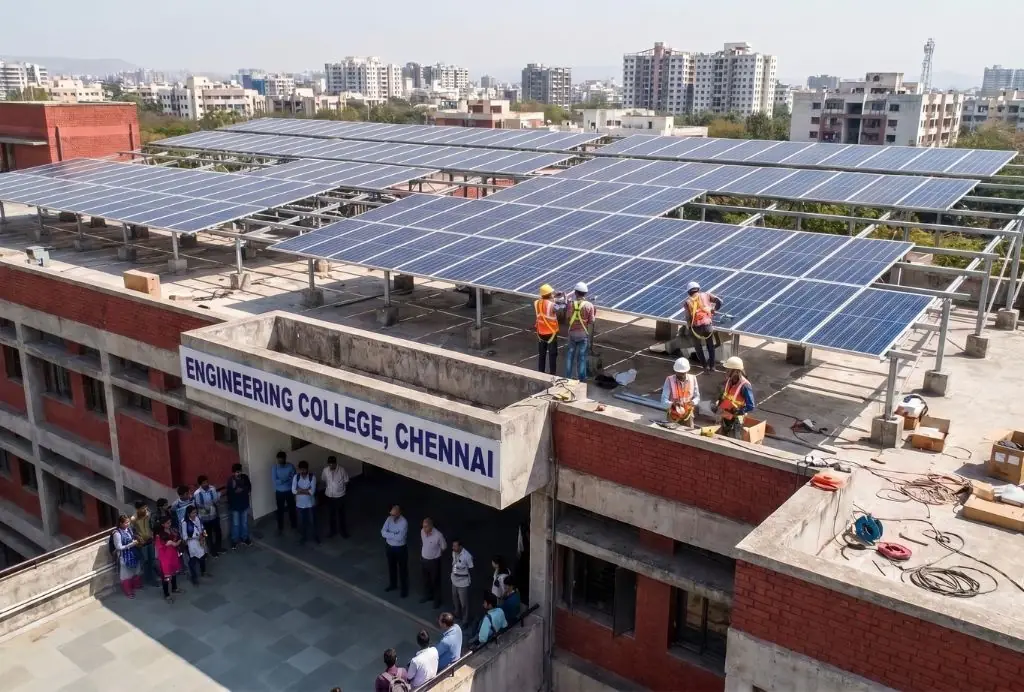
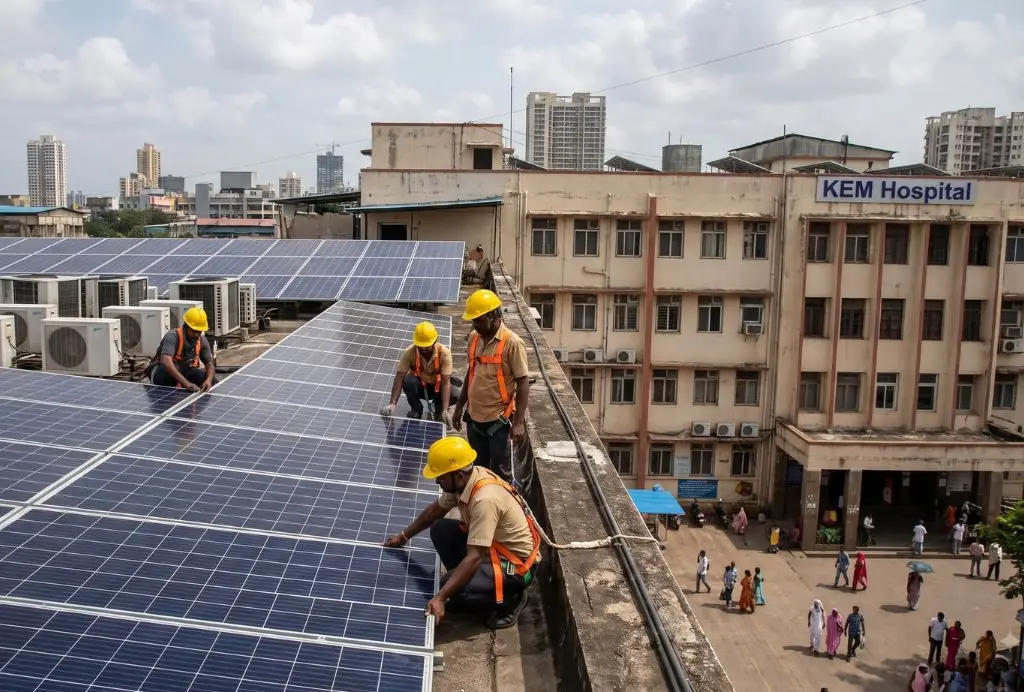

Solar for Apartments and Housing Societies in Chennai
Common-area solar cuts the bill your association pays for lifts, pumps, corridor lighting and the STP, which is funded from every resident's maintenance charge.
Societies claim per kilowatt, under PM Surya Ghar
Considerably more per kW than an individual household receives, and the loads run in daylight hours when the system is generating.
₹18,000
per kW, up to 500 kW · central scheme
Documentation prepared for your general body
PM Surya Ghar society subsidy filed by us
Elevated structures preserving terrace access
Two years free maintenance
The political argument
The saving reduces maintenance for every flat, not just a few. That is a far easier thing to carry through a general body meeting.
The short answer
Can apartments install solar in Chennai?
Apartments in Chennai install solar through the residents' association rather than individually, because the terrace is common property belonging to all owners collectively. The association applies for a common-area system covering lifts, pumps, corridor lighting and the STP, and claims subsidy at ₹18,000 per kW under PM Surya Ghar, up to 500 kW and subject to 3 kW per residential unit in the building.
The economics
Why common-area solar pays back faster than home solar
Apartment common services in Tamil Nadu are billed under a separate domestic tariff category for common facilities, charged at a flat per-unit rate with no free-unit allowance and none of the telescopic slab relief an individual household receives. An association therefore pays more per unit than the flats it serves, and every unit solar displaces is worth correspondingly more.
01
A worse tariff to displace
An individual household receives a free-unit allowance and telescopic slabs, so its first units are cheap. A society's common-services connection gets neither. Solar displaces expensive units from the first day rather than working through a subsidised band first.
02
Daytime load, matching generation
Lifts, water pumps, borewell motors and the sewage treatment plant run through the day, which is exactly when the array produces. Very little is exported, and self-consumed units are worth full value while exported ones only offset later imports.
03
A better subsidy per kilowatt
₹18,000 per kW for common facilities, against a flat ₹78,000 cap for an individual household regardless of size. At 10 kW a society claims ₹1,80,000 where a household claims ₹78,000.
And the political argument, which is what actually gets it approved
The saving lands in the society's common-area bill, funded from the maintenance charges every resident pays. That makes it a proposal that reduces costs for every flat rather than benefiting a few, which is a far easier thing to carry through a general body meeting than a scheme that advantages individual owners.
We confirm the current per-unit rate and fixed charge for the common services category against the prevailing TNERC tariff order before putting figures to an association. The structural point above is stable; the rate is not.
The subsidy
How much subsidy can a housing society claim?
Group Housing Societies and Resident Welfare Associations claim ₹18,000 per kW under PM Surya Ghar for common-area facilities, including common lighting, lifts, pumps and EV charging infrastructure, up to a maximum of 500 kW. The limit is set at 3 kW per residential unit in the building, and it is inclusive of any individual rooftop systems residents have already installed.
How many flats in your building?
Typical common-area system
7 kW to 15 kW
The most common band in Chennai. The ceiling is far beyond what common-area load requires, so consumption decides the size, not the rule.
The 3 kW per house arithmetic
Your ceiling is the number of residential units multiplied by 3 kW, less any individual systems residents have already installed. A 40-flat building has a nominal ceiling of 120 kW, far beyond what common-area load requires, so in practice this rarely binds. It matters mainly for very small buildings and for societies where several owners have already installed their own systems.
Conditions that decide whether the claim clears
- DCR compliant modules are mandatory. Since 1 June 2026, subsidised systems must use panels built from ALMM List-II certified Indian cells. Non-DCR panels are cheaper and disqualify the entire claim.
- The application goes through the association, not through individual owners, on the national portal at pmsuryaghar.gov.in. See the full subsidy process.
- The society's own service connection is what the system is tied to, and its sanctioned load must support the system size.
Individual flats
Can an individual flat owner install solar on the terrace?
Generally no. The terrace of an apartment building is common property belonging to all owners collectively, so an individual flat owner cannot install on it unilaterally, and applications submitted by individuals against a society address are typically rejected at the DISCOM feasibility stage. Installation requires a collective application through the resident welfare association or apartment owners association.
What about virtual net metering?
This is where a good deal of misinformation circulates. Several national articles suggest apartment residents can use virtual net metering to allocate solar generation to individual flats. That is not the position in Tamil Nadu.
Under the TNERC framework, virtual net metering is available to distribution licensees, government bodies and local authorities, not to private housing societies. Separately, group net metering has been introduced to allow surplus to be adjusted across multiple service connections belonging to the same consumer.
The practical route for a Chennai apartment therefore remains a common-area system on the society's own connection. If a vendor proposes allocating generation to individual flats through virtual net metering, ask them to show you the regulatory provision they are relying on.
TNERC has been revising the Grid Interactive Solar PV regulations and these mechanisms have appeared in draft form. Confirm the operative position before an association commits to a structure that depends on it.
What a flat owner can do
- Propose it to the association. Common-area solar benefits you through reduced maintenance charges.
- Ask for a load assessment. We prepare documentation an association can put to its general body, free of charge.
- If you have exclusive terrace rights documented in your sale deed, which is occasionally the case for top-floor units, an individual installation may be possible. Bring the documentation to the survey.
The load
What does apartment common-area solar power?
A common-area solar system in a Chennai apartment building typically covers lifts, water pumps, borewell motors, corridor and stairwell lighting, compound and gate lighting, the sewage treatment plant, and EV charging points where present. These are the loads billed to the association rather than to individual flats, and most of them run during daylight hours.
| Load | Pattern | Solar match |
|---|---|---|
| Lifts | Continuous standby plus daytime use | Good |
| Water pumps and borewell | Mostly daytime operation | Very good |
| Sewage treatment plant | Continuous, often the largest single load | Very good |
| Corridor and stairwell lighting | Evening and night | Offset via net metering credit |
| Compound and gate lighting | Night | Offset via credit |
| Gate motors, common fans | Continuous, minor | Good |
| EV charging points | Variable, explicitly covered by the subsidy provision | Good if daytime |
Sizing a system for a building
Sizing follows twelve months of the society's own bills, not the number of flats. As a rough orientation:
| Building size | Typical common-area system |
|---|---|
| Small block, up to 12 flats | 5 kW to 7 kW |
| Mid-sized, 12 to 40 flats | 7 kW to 15 kW |
| Larger complex, 40+ flats with STP and multiple lifts | 15 kW upward |
These are starting points only. A building with a large STP, a swimming pool pump or extensive landscape lighting consumes far more than flat count alone would suggest. We size against the actual bills. See also 10 kW systems.
The process
How a Chennai housing society goes solar
A housing society installs solar by passing a resolution at a general body meeting, applying through the association rather than through individual owners, and tying the system to the society's own service connection. The resolution is usually the longest step in the process, so it should be started before anything else.
What the committee will be asked by members
- What does it cost, and where does the money come from?
- How long until it pays back?
- What happens if it leaks?
- Who maintains it, and what does that cost after the free period?
- What if we need the terrace?
- What happens to it in a cyclone?
Prepare for these, because they come up at every general body meeting. The sections below answer the last four. We answer all six in the documentation.
The terrace
Access, water tanks and waterproofing
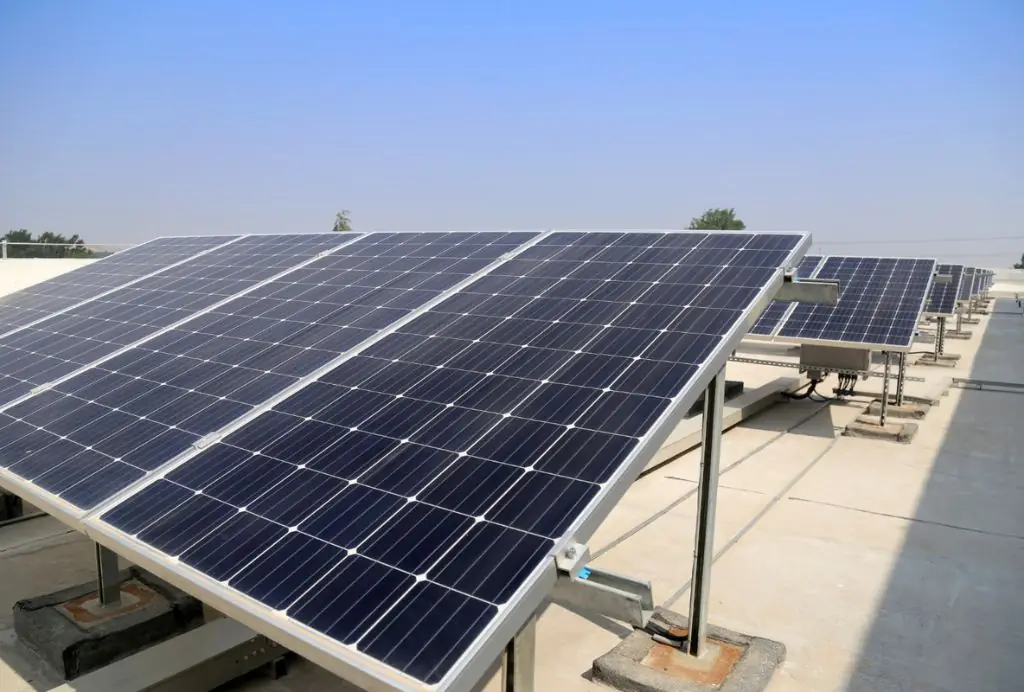
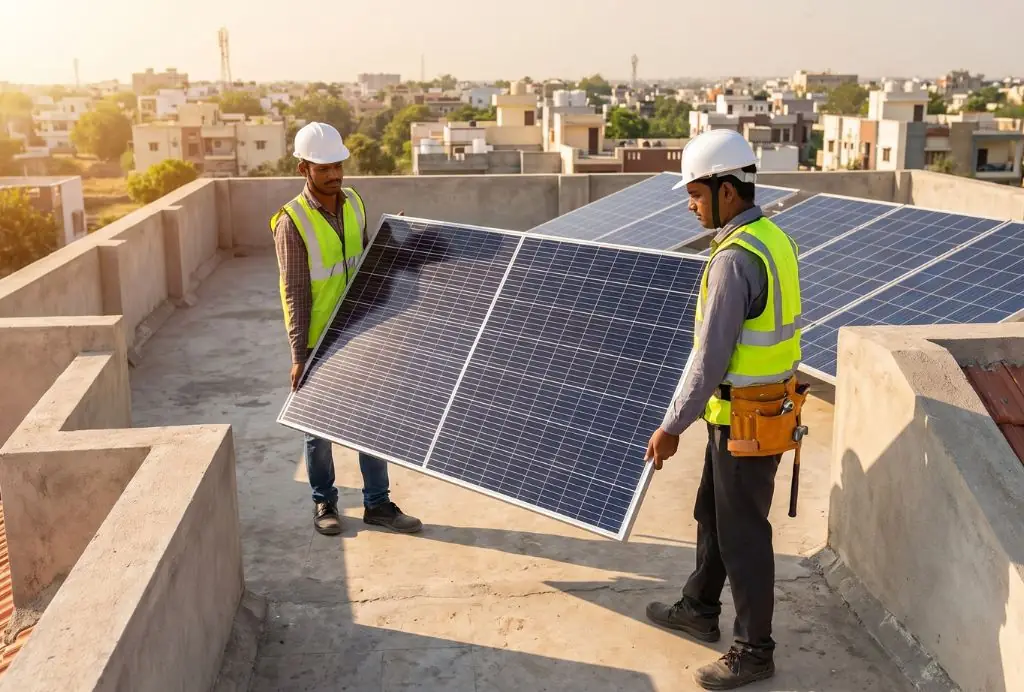
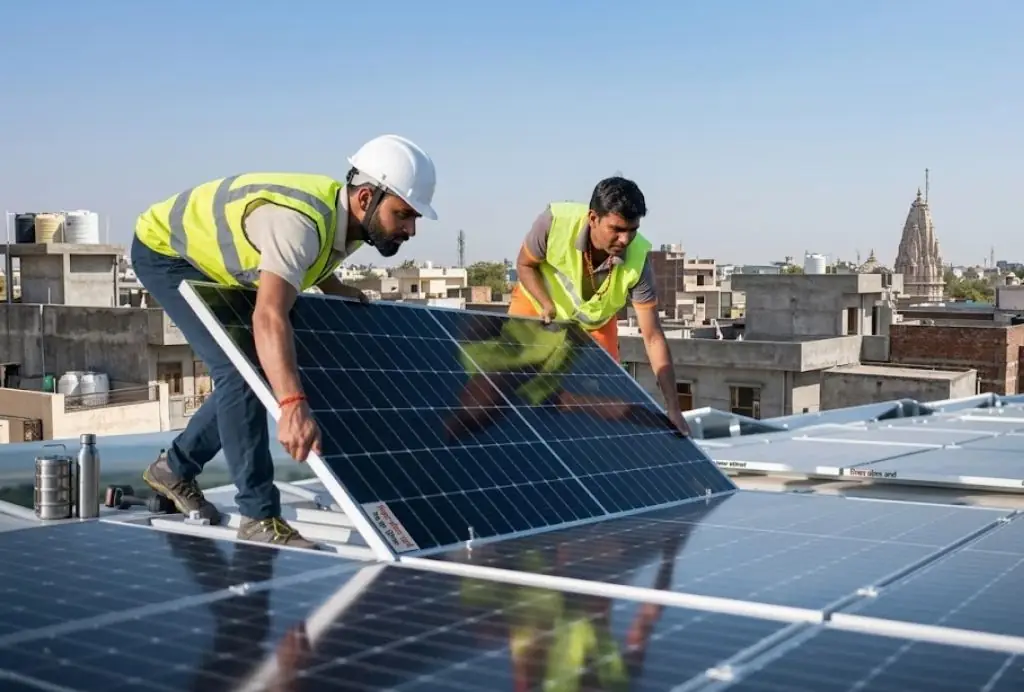
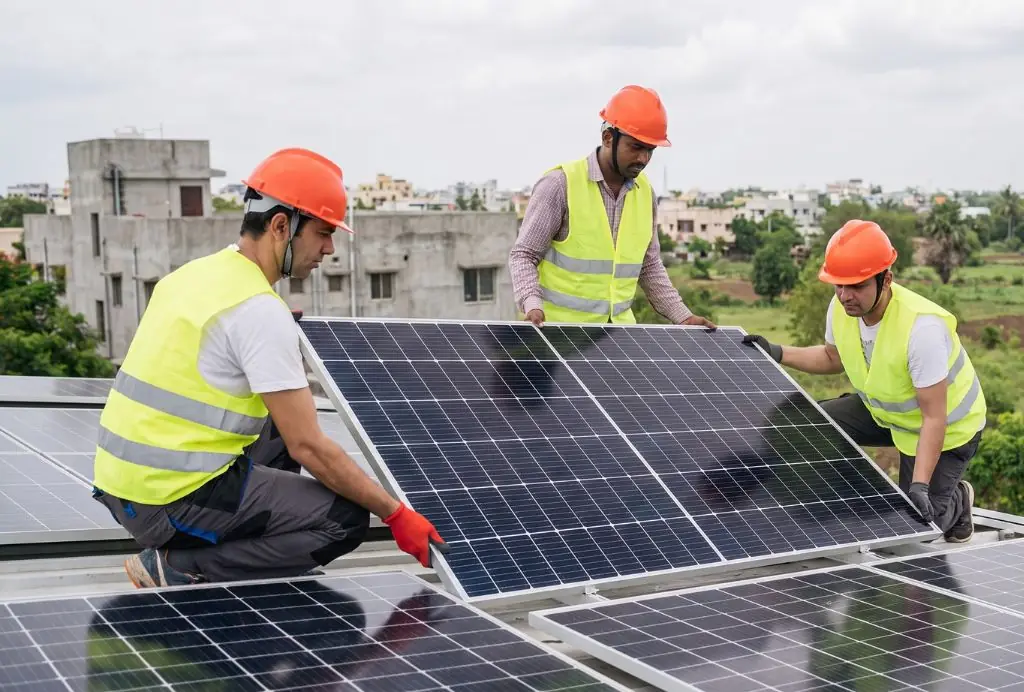
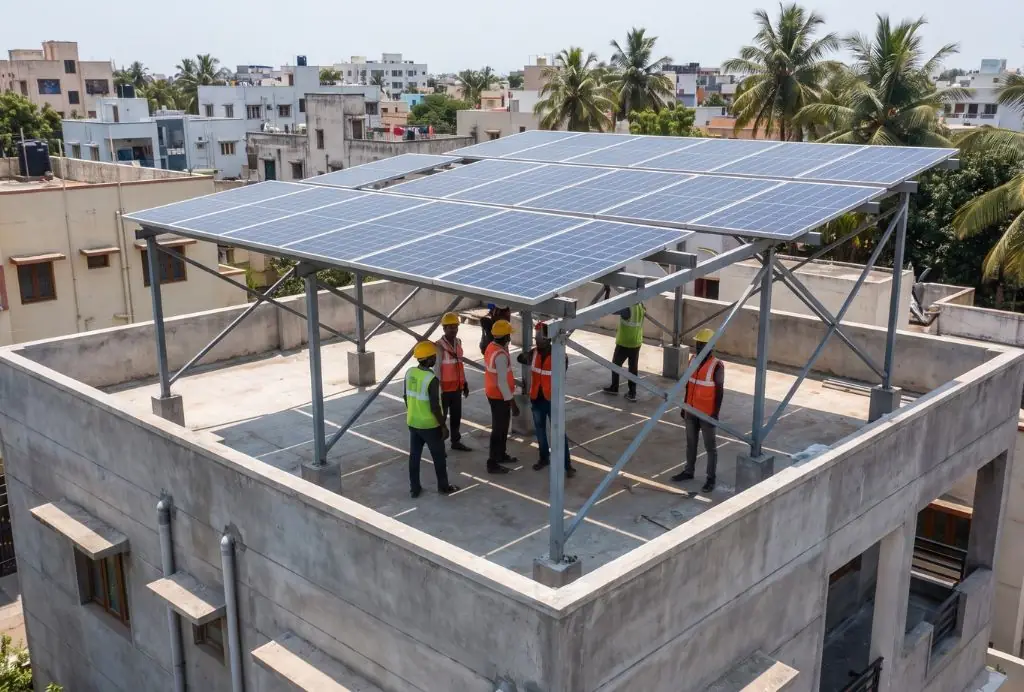
An apartment terrace is shared property that residents use and that carries water tanks, lift machine rooms and staircase headrooms, so an array has to be designed around access rather than simply laid across the roof. Blues Renewables builds elevated structures up to 9 feet, which keeps the terrace walkable and usable underneath while allowing the array to span above tanks and headrooms.
Why elevated mounting matters more on an apartment terrace than on a house
Residents keep using the terrace
Drying, walking, water tank access and maintenance all continue underneath.
The array can span obstructions
Rather than surrendering roof area to them, which usually allows a larger system on the same building.
Shade over the terrace
Makes a previously unusable afternoon space usable.
Cooler top-floor flats
Shading the roof slab reduces heat gain into the flats directly below. Worth raising at the general body, top-floor residents are often the ones most hesitant.
Better generation
From improved airflow beneath the panels in Chennai's heat.
Waterproofing, and why it matters more here
On a private house a roof leak is the owner's problem. On an apartment terrace it is a dispute involving every owner below the affected area, and it will be raised at the next general body meeting. Ask any installer specifically how they seal roof penetrations, what warranty covers the waterproofing as distinct from the structure, and whether the terrace waterproofing should be redone before installation.
If the terrace already leaks or the membrane is near the end of its life, fix it first. Removing an installed array to repair waterproofing costs far more than doing the work beforehand.
Wind loading at height
Chennai sits in a 50 m/s basic wind speed zone under IS 875 Part 3, with a cyclone factor applied within 60 km of the coast, and raising an array increases both wind load and overturning force. Elevated structures need heavier sections, deeper foundations and stronger anchoring, designed for the site rather than built to a template. On a multi-storey building this is a structural engineering question, and it is the right thing for a committee to ask about.
Funding
How associations pay for it
Most Chennai housing societies fund common-area solar from the maintenance fund, a corpus or sinking fund, or a one-time contribution from members, with the ₹18,000 per kW subsidy arriving afterwards as a reimbursement. Because the subsidy is credited after commissioning rather than deducted upfront, the association needs to fund the full amount initially.
On ownership
The system belongs to the association and stays with the building. It is not tied to any individual owner, and it does not transfer when a flat changes hands.
Timeline
How long does it take?
STAGE 01
Load assessment and survey
Typical duration
Same week as your enquiry
Common-area bills read, terrace measured, shading checked across the day.
STAGE 02
Documentation for the committee
Typical duration
3 to 5 days
Real numbers your committee can put to the members, not an estimate.
STAGE 03
General body resolution
Typical duration
Society-dependent · start first
The one step we cannot compress. Begin it while the survey is being written up.
STAGE 04
Design and itemised quotation
Typical duration
3 to 5 days
Sized to the common-area load, with the bill of materials itemised line by line.
STAGE 05
Applications filed, in parallel
Typical duration
On approval of the quote
Subsidy and TANGEDCO applications go together rather than one after the other.
STAGE 06
Installation
Typical duration
2 to 5 days depending on size
Terrace access and water tank routes kept working throughout.
STAGE 07
TANGEDCO inspection and metering
Typical duration
4 to 8 weeks · the main variable
The longest stretch, and the one no installer controls. We file complete to avoid re-work.
STAGE 08
Subsidy credited to the society
Typical duration
about 15 days after DISCOM approval and your redemption request
Paid directly into the association's bank account, not through us.
The sequencing advice that saves months
Get the survey and documentation done first, so the committee puts real numbers to the general body rather than an estimate. Passing a resolution on approximate figures and then discovering the design differs means going back to the members a second time, which in most associations costs a full quarter.
Free, no obligation
Get a free common-area assessment
Send us the society's last two EB bills for the common services connection, not a flat's bill, and we will prepare a load assessment, a proposed system size, the subsidy your association qualifies for, and a projected annual saving, in a format your secretary can present to the general body.
What your committee receives
- Usable terrace area measured, with shading assessed across the day
- A system size based on twelve months of the society's own consumption
- Subsidy entitlement calculated against your flat count
- Projected annual saving on the common-area bill
- An itemised price naming every component and brand
- A recommendation on elevated versus low mounting, with the terrace access implications set out
Common questions
Apartment solar in Chennai, common questions
Can apartments install solar panels in Chennai?
Yes, through the residents' association rather than individually. The terrace is common property belonging to all owners collectively, so the association applies for a common-area system covering lifts, pumps, corridor lighting and the STP, and claims subsidy at ₹18,000 per kW under PM Surya Ghar.
How much subsidy can a housing society claim for solar?
₹18,000 per kW for common facilities including common lighting, lifts, pumps and EV charging, up to a maximum of 500 kW, subject to a limit of 3 kW per residential unit in the building and inclusive of any individual systems residents have already installed. At 10 kW that is ₹1,80,000, against the ₹78,000 an individual household would receive.
Can an individual flat owner install solar on the building terrace?
Generally no, because the terrace is common property and individual applications against a society address are typically rejected at the feasibility stage. The exception is where a sale deed grants documented exclusive terrace rights, which occasionally applies to top-floor units. Otherwise the route is a collective application through the association.
Can virtual net metering allocate solar to individual flats in Tamil Nadu?
Not for private housing societies. Under the TNERC framework virtual net metering is available to distribution licensees, government bodies and local authorities rather than to private associations, and group net metering applies to adjusting surplus across connections of the same consumer. The practical route for a Chennai apartment remains a common-area system on the society's own connection.
Why does solar pay back faster for an apartment than for a house?
Because the tariff being displaced is worse and the load matches generation better. Common services in apartments are billed under a separate domestic category at a flat per-unit rate with no free-unit allowance and no telescopic slabs, so solar displaces expensive units from day one. And lifts, pumps and the STP run during daylight hours, so almost nothing is exported.
What does a common-area solar system power?
Lifts, water pumps, borewell motors, corridor and stairwell lighting, compound lighting, the sewage treatment plant, gate motors and EV charging points where present. These are the loads billed to the association rather than to individual flats.
What size system does an apartment building need?
It follows the society's own consumption rather than flat count. As orientation, small blocks of up to 12 flats commonly need 5 kW to 7 kW, mid-sized buildings 7 kW to 15 kW, and larger complexes with an STP and multiple lifts 15 kW upward. A building with a swimming pool pump or extensive landscape lighting will need considerably more than flat count suggests.
Is a housing society limited to 10kW of solar?
No. The 10 kW figure is a limit that applies to individual household systems. Societies are governed by the 500 kW ceiling and the 3 kW per residential unit limit instead. An installer applying a 10 kW cap to an association is using the wrong rule.
Can residents still use the terrace after solar is installed?
Yes, with an elevated structure. Blues Renewables builds raised structures up to 9 feet, which keeps the terrace walkable underneath and allows the array to span above water tanks and staircase headrooms. The terrace also becomes shaded, and shading the roof slab reduces heat gain into the top-floor flats directly below.
What happens if the terrace leaks after installation?
This is why waterproofing should be assessed before installation rather than after. On a shared terrace a leak affects owners below and becomes a general body matter, so ask any installer how penetrations are sealed and what warranty covers the waterproofing specifically, as distinct from the structure warranty. If the existing membrane is near the end of its life, redo it first.
How does an association pay for solar?
Most Chennai societies fund it from the maintenance or sinking fund, a one-time member contribution, or financing. Because the ₹18,000 per kW subsidy is credited after commissioning rather than deducted upfront, the association funds the full amount initially and receives the subsidy as a reimbursement.
What does a solar powered flat in Chennai actually mean?
In Chennai, apartment solar runs on the association's common service connection. It powers lifts, pumps, the STP and common lighting, and it lowers the maintenance charge every flat pays, not each flat's own EB bill. Virtual net metering is not open to private housing societies in Tamil Nadu, so generation cannot be split across individual flat meters. If you are buying a flat advertised as solar powered, ask the builder for the system size in kW, which connection it feeds, and whether the society subsidy has been claimed.
What does common-area solar cost for a Chennai apartment?
A 20 kW common-area system costs ₹9.6 to ₹10.8 lakh including GST in 2026. The society claims ₹18,000 per kW under PM Surya Ghar, ₹3,60,000 for 20 kW provided the building has at least seven flats (the 3 kW per house cap), so the association pays about ₹6 lakh to ₹7.2 lakh. A 10 kW system on a smaller block starts at ₹5.02 lakh before the ₹1,80,000 subsidy.