



On-Grid vs Off-Grid vs Hybrid Solar: Which One Do You Need?
On-grid solar connects to the TANGEDCO grid with no battery, costs the least per kW, and qualifies for the PM Surya Ghar subsidy, but it shuts down during a power cut. Off-grid runs entirely on batteries with no grid connection and gets no subsidy. Hybrid combines grid connection with a battery, so it keeps chosen circuits running during outages, at a higher cost. Most Chennai homes should install on-grid.
The question that actually decides it
Does solar work during a power cut?
No.
A standard on-grid solar system does not work during a power cut. When the grid goes down, the system shuts down automatically, even in bright sunshine. This is a mandatory safety function called anti-islanding, and it exists to protect line workers who may be repairing what they believe is a dead line. Only systems with battery storage, meaning hybrid or off-grid, continue supplying power during an outage.
This surprises almost everyone, and it is the single most useful thing to know before choosing. Many people buy solar expecting it to keep the lights on during a cut, and a standard rooftop system simply does not do that.
So the real question is not which system type is best. It is this
How much do power cuts actually affect you, and is that worth paying for a battery?
For a household in most parts of urban Chennai, where TANGEDCO supply is generally reliable and interruptions are short, the honest answer is usually no. The battery adds cost, adds a component that needs replacing, and sits idle most of the year. For a household running medical equipment, working from home without tolerance for downtime, or in a pocket with frequent extended cuts, the answer changes. The rest of this page follows from that one question.
Type one
On-grid solar, explained
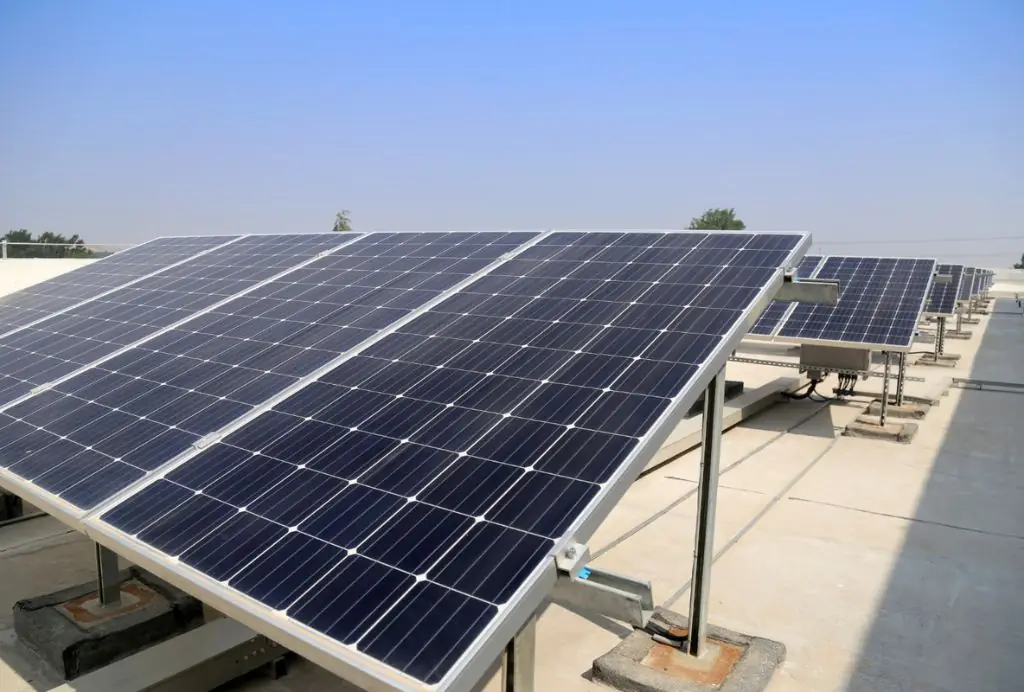
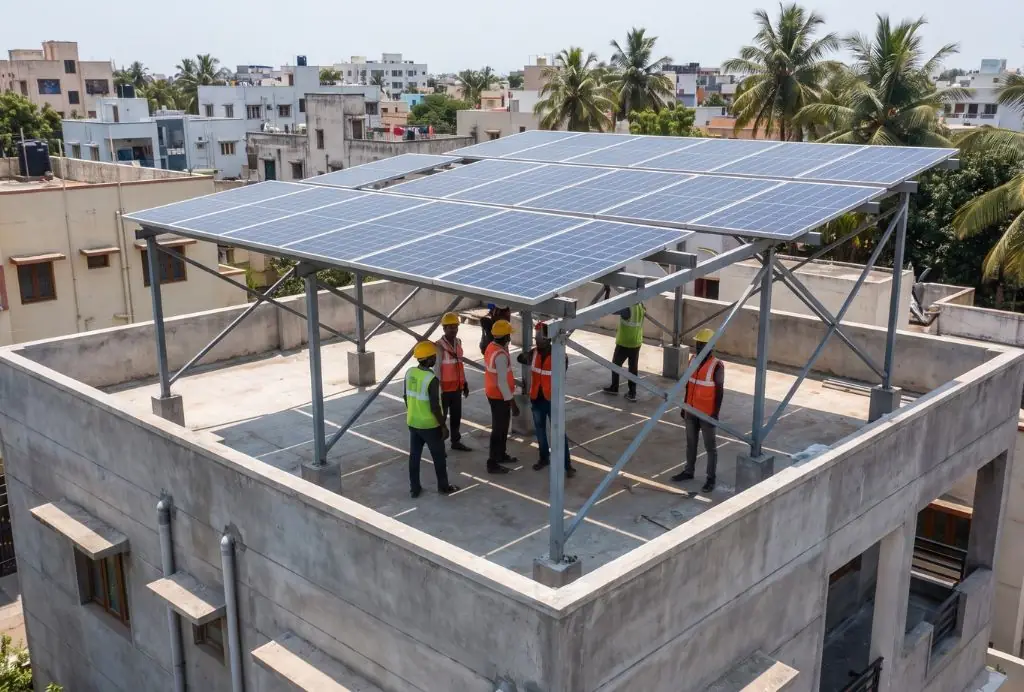
An on-grid solar system connects directly to the TANGEDCO grid with no battery storage. It powers the property during daylight hours, exports surplus to the grid for credit under net metering, and draws from the grid at night or whenever generation falls short. It is the lowest cost per kW of the three types, and it is the only configuration eligible for the PM Surya Ghar subsidy in its standard residential form.
Suits you if
- Your TANGEDCO supply is reasonably reliable
- Your priority is reducing your electricity bill
- You want the shortest payback and the lowest upfront cost
- You want the ₹78,000 subsidy
Limitations to accept
- No power during an outage
- No energy stored for evening use, though net metering credits achieve a similar financial effect
- Dependent on the grid being available
Why it suits most of Chennai. Urban Chennai supply is generally dependable, and net metering credits daytime exports against evening consumption, which addresses the timing problem financially without a battery. For the large majority of homes and businesses, on-grid delivers the best return per rupee.
On-grid solar systems in ChennaiType two
Off-grid solar, explained
An off-grid solar system operates entirely independently of the grid, using panels and battery storage to supply the property at all times with no utility connection at all. It is the most expensive of the three per unit of usable energy, because it must be sized for the worst conditions rather than the average, and it is not eligible for the PM Surya Ghar subsidy, which applies to grid-connected residential systems.
Genuinely suits
- Remote plots, farmhouses and land with no grid connection
- Construction sites and temporary installations
- Locations where obtaining a connection is impractical or prohibitively expensive
- Sites where the supply is so unreliable that it is effectively absent
Rarely suits
A home in urban Chennai with a working TANGEDCO connection. If you have a reliable supply, going off-grid means paying substantially more, forfeiting the subsidy, giving up net metering credit, and taking on battery replacement — in exchange for independence you were not lacking.
Why off-grid costs so much more. An off-grid system cannot rely on the grid to cover shortfalls, so it must be designed for the worst case: consecutive cloudy days during the northeast monsoon, with enough battery capacity for several days of autonomy and enough panel capacity to recharge after them. That typically means a considerably larger array and a much larger battery bank than a grid-connected system serving the same household.
Off-grid solar systems in ChennaiType three
Hybrid solar, explained
A hybrid solar system connects to the grid like an on-grid system but adds battery storage and a hybrid inverter, so selected circuits continue running during a power cut. It retains net metering and subsidy eligibility as a grid-connected system while providing genuine backup, at a higher cost than on-grid because of the battery and the more capable inverter.
Suits you if
- Outages genuinely disrupt you, through work, medical equipment or extended cuts in your area
- You want both bill reduction and backup, rather than choosing between them
- You are willing to pay for the battery and to replace it during the system's life
How to keep the cost sensible
Size the battery to your critical loads, not to your whole house. Lights, fans, router, refrigerator and a few sockets ride through an outage comfortably on a modest battery. Running air conditioning through a cut requires a far larger and more expensive system, and rarely justifies itself.
The decision to make even if you skip the battery now. If there is any chance you will want backup later, install a hybrid inverter at the outset. Retrofitting a battery to a standard string inverter means replacing the inverter, which costs far more than the modest premium for choosing hybrid-capable equipment on day one.
Hybrid solar systems in ChennaiSide by side
On-grid vs off-grid vs hybrid, side by side
| On-grid | Off-grid | Hybrid | |
|---|---|---|---|
| Grid connection | Required | None | Required |
| Battery | None | Essential, large | Yes, sized to critical loads |
| Works during a power cut | No | Yes | Yes, on backed-up circuits |
| PM Surya Ghar subsidy | Eligible | Not eligible | Eligible |
| Net metering credit | Yes | Not applicable | Yes |
| Cost per kW | Lowest | Highest | Between the two |
| System size for the same load | Smallest | Largest | Similar to on-grid, plus battery |
| Components needing replacement | Inverter | Inverter and battery bank | Inverter and battery |
| Maintenance | Lowest | Highest | Moderate |
| Payback | Fastest | Slowest, if measured against grid cost | Slower than on-grid |
| Best for | Most Chennai homes and businesses | Sites with no grid connection | Homes and premises where outages matter |
The largest financial factor
Which systems qualify for the ₹78,000 subsidy?
The PM Surya Ghar Muft Bijli Yojana subsidy applies to grid-connected residential rooftop systems, so on-grid and hybrid installations qualify while off-grid systems do not. For a 3 kW residential system the subsidy is ₹78,000, which is a substantial part of the cost and a decisive factor in favour of staying grid-connected wherever a connection is available.
| System type | Subsidy at 3 kW and above |
|---|---|
| On-grid | Up to ₹78,000 |
| Hybrid | Up to ₹78,000, as a grid-connected system |
| Off-grid | None |
Why this matters more than most comparisons acknowledge
Off-grid is already the most expensive option per unit of usable energy. Losing the subsidy on top of that widens the gap considerably. For any Chennai property with a usable grid connection, choosing off-grid is a decision to pay substantially more and receive substantially less support.
Two conditions apply to either grid-connected route
- DCR compliant panels are mandatory. Since 1 June 2026, subsidised and net-metered systems must use modules built from ALMM List-II certified Indian cells.
- The application goes through the national portal, with TANGEDCO as the Chennai DISCOM. See the PM Surya Ghar subsidy.
The hidden cost
What a battery really costs over 25 years
Panels are warranted to perform for around 25 years, but batteries are not. A battery bank will need replacing at least once, and often more than once, during the life of the solar system, and that replacement cost belongs in any honest comparison between on-grid and the battery-based options. It is the largest hidden cost in off-grid and hybrid systems.
| Battery type | Typical service life | Notes |
|---|---|---|
| Lead acid, including tubular | Shorter, a few years | Cheapest upfront, most frequent replacement, needs ventilation and maintenance |
| Lithium, including LFP | Considerably longer | Higher upfront cost, longer life, lower maintenance, usually better value over the system's life |
Ask for the warranty in writing, including whether it is stated in years, in charge cycles, or both, and what conditions apply. Cycle-rated warranties are the more meaningful measure, since a battery cycled daily ages faster than one cycled occasionally.
01
Replacement is a certainty, not a risk. Budget for it rather than being surprised by it.
02
Chennai heat shortens battery life. Batteries degrade faster at high ambient temperatures, so installation location and ventilation matter more here than in cooler regions.
03
Bigger is not better. A battery sized to the whole house rather than to critical loads costs far more, is replaced at that same higher cost, and spends most of its life doing nothing.
The honest conclusion: on-grid is the only one of the three with no battery to replace. That is a real and recurring advantage, and it is why on-grid wins for most households on economics alone.
Decision framework
Which one fits you
Answer two questions and the framework resolves to a likely system type. It is a starting point for the survey conversation, not a substitute for it.
Do you have a grid connection?
How much do power cuts affect you?
Likely answer
On-grid
A working connection and cuts that rarely bother you. On-grid is the right answer: lowest cost per kW, fastest payback, eligible for the full ₹78,000 subsidy, and the only one of the three with no battery to replace.
Net metering credits your daytime exports against evening consumption within the billing cycle, so a battery is unnecessary for financial purposes. Size the system to twelve months of your own consumption rather than to available roof area.
On-grid solar systems →Still unsure between on-grid and hybrid?
Install on-grid with a hybrid-capable inverter. You get the lower cost now and the option to add a battery later without replacing the inverter. For a household that is uncertain, this is usually the sensible middle path.
Mistakes
Five mistakes people make choosing a system type
Free, no obligation
Find out which system your property needs
Tell us where you are, roughly what you spend on electricity, and how often power cuts actually affect you. We will tell you which of the three fits your situation, and if that is the cheapest option, we will say so. The site survey is free and comes with no obligation.
Faster route
WhatsApp a photo of your latest EB bill to 98841 07170.
Common questions
System types, common questions
What is the difference between on-grid, off-grid and hybrid solar?
On-grid connects to the TANGEDCO grid with no battery, costs the least and qualifies for the subsidy, but shuts down during a power cut. Off-grid runs entirely on batteries with no grid connection and receives no subsidy. Hybrid connects to the grid and adds a battery, so selected circuits keep running during outages while retaining subsidy and net metering eligibility.
Does on-grid solar work during a power cut?
No. When the grid goes down, an on-grid system shuts off automatically even in full sunshine. This is a mandatory safety feature called anti-islanding, which protects line workers repairing the network. Backup during outages requires battery storage, meaning a hybrid or off-grid system.
Which solar system is best for a home in Chennai?
For most Chennai homes, on-grid. TANGEDCO supply in urban areas is generally reliable, on-grid costs the least per kW, it qualifies for the ₹78,000 PM Surya Ghar subsidy, and net metering credits daytime exports against evening consumption. Hybrid is the right choice where outages genuinely disrupt work, health needs or comfort.
Do off-grid solar systems get the government subsidy?
No. The PM Surya Ghar subsidy applies to grid-connected residential rooftop systems, so on-grid and hybrid installations qualify and off-grid does not. Since off-grid is already the most expensive option per unit of usable energy, losing the subsidy widens the gap considerably.
Is hybrid solar worth the extra cost?
It depends entirely on how much outages affect you. If you work from home without tolerance for downtime, depend on medical equipment, or live where cuts are frequent and extended, yes. If your supply is reliable and cuts are brief, the battery adds cost, needs replacing during the system's life, and sits idle most of the year.
How long do solar batteries last?
Considerably less than the panels, which are warranted for around 25 years. Lead acid batteries have a shorter service life and need more frequent replacement; lithium types such as LFP last substantially longer at a higher upfront cost. Chennai's heat shortens battery life, so location and ventilation matter. Ask for the warranty in writing, including whether it is stated in years, cycles or both.
Can I add a battery to my solar system later?
Only if a hybrid-capable inverter was installed at the outset. Adding a battery to a standard string inverter means replacing the inverter, which costs far more than the modest premium for choosing hybrid-capable equipment initially. If there is any chance you will want backup later, decide that at design stage.
Is off-grid solar a good idea in Chennai?
Rarely, for a property with a working connection. It costs substantially more, receives no subsidy, earns no net metering credit and requires a battery bank that will need replacing. Off-grid genuinely suits remote plots, farmhouses, construction sites and locations where a grid connection is impractical.
Why does an off-grid system need to be bigger?
Because it cannot rely on the grid to cover shortfalls, so it must be designed for the worst case rather than the average: consecutive cloudy days during the northeast monsoon, with enough battery capacity to carry through them and enough panel capacity to recharge afterwards. That means a larger array and a much larger battery bank than a grid-connected system serving the same household.
Should I size a hybrid battery for my whole house?
Usually not. Backing up lights, fans, router and refrigerator is affordable and covers what most households actually need during an outage. Backing up air conditioning requires a far larger and more expensive battery, is replaced at that same higher cost, and rarely justifies itself.