


Solar for Poultry Farms in Namakkal and Across Tamil Nadu
A poultry shed draws its heaviest load in the middle of a hot afternoon, because that is when the ventilation fans work hardest. A rooftop array generates its most in the same hours.
Very few buildings match generation to demand that closely. It is the reason solar suits poultry better than it suits most agricultural businesses, and the reason the Namakkal belt has taken to it.
Get an itemised proposalWhat decides the answer here
- Ventilation fans run 1 to 2 kW per 1,000 birds in hot weather, with lighting adding roughly 0.3 to 0.5 kW per 1,000.
- The load peaks when generation peaks. Summer afternoons are the worst of the tariff and the best of the roof.
- Shed roofs are long, low-pitch sheet or asbestos, which changes the structure and the fixing rather than ruling it out.
- A power cut in a closed shed is a mortality event, not an inconvenience, so backup is a genuine design question here.
- Sizing works from bird numbers, not from roof area, because the roof is almost always larger than the load.
Sizing from the flock, not the roof
Work forward from the birds. Ventilation is the dominant load and scales with flock size and shed type, so it gives a more reliable starting number than anything on the electricity bill, which averages a summer peak with a mild winter.
Ranges reflect open-sided versus environmentally controlled sheds, which are very different electrical animals. A controlled shed with tunnel ventilation and cooling pads sits at the top of each band and is the better solar case, because its load is both larger and more predictable.
Shed roofs
Poultry sheds are long, narrow and low, usually under profiled metal sheet, sometimes still under asbestos on older farms. None of that prevents an installation and all of it changes the design.
- Purlin capacity and spacing decide what the roof carries. Poultry sheds are built light, so this check matters more here than on an industrial shed.
- Asbestos sheeting can be worked with using clamp systems that avoid drilling, and it should be assessed rather than assumed. If it is brittle or near end of life, replace before installing.
- Dust and feather load on the glass is real. Generation falls faster here than on a domestic terrace, so cleaning frequency should be in the maintenance plan from the start.
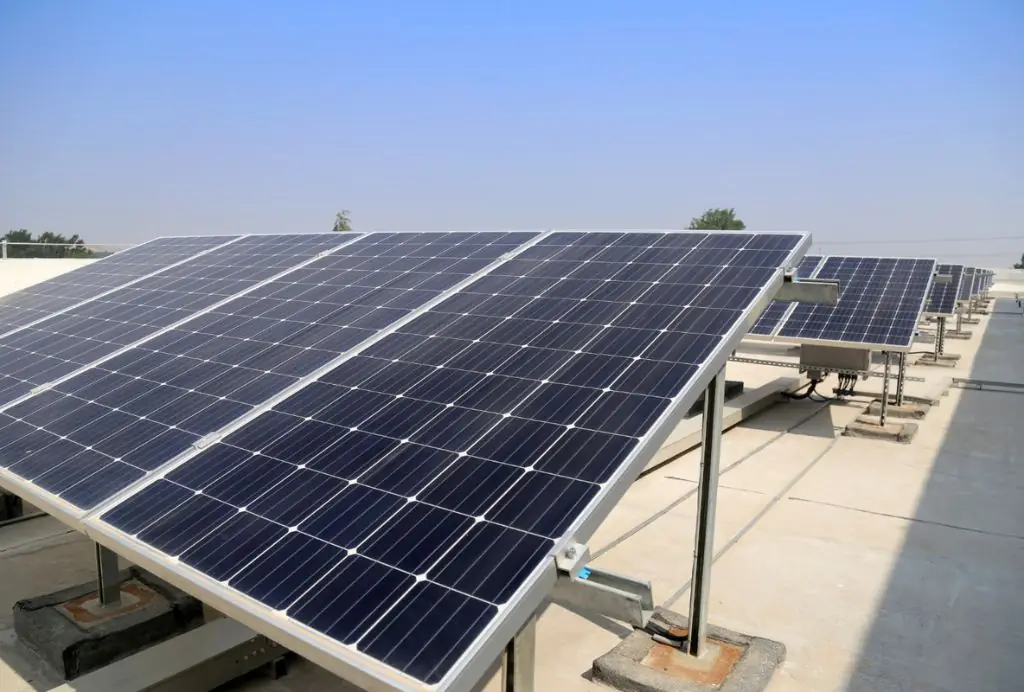
- Low pitch and long spans suit a flush or lightly tilted mount, which keeps wind loading down on a light structure.
The backup question, which is different here
In an environmentally controlled shed, ventilation failure is measured in minutes before birds are lost. Most farms already run a diesel generator for exactly this reason, and it stays whatever solar you install.
A grid-connected rooftop array does not provide backup. It stops when the grid stops, by design and by regulation. If you want the array to carry load through an outage you are into storage, and TANGEDCO hybrid inverter rules sets out what is permitted on a grid-connected system in Tamil Nadu, because the rules are specific and are routinely ignored by installers.
The honest framing: solar reduces the bill, the generator handles the outage, and a battery is a third decision to be made on its own merits rather than bundled into the solar quotation.
The tax side, which is not the residential subsidy
The PM Surya Ghar subsidy does not apply here. It is a residential scheme, and any proposal that deducts it from a commercial quotation is deducting money the business will not receive.
What a business gets instead is accelerated depreciation. Solar power generating systems sit in a 40 percent depreciation block under Appendix I of the Income Tax Rules, claimed under Section 32, against an ordinary building at 10 percent and general plant and machinery at 15 percent.
The timing decides the first year. A system commissioned and put to use for 180 days or more in the financial year takes the full 40 percent; commissioned later and the first year is halved to 20 percent, with the balance carried forward. Our guide to how to calculate it works through the arithmetic on a real invoice.
GST on a turnkey installation works out near 8.9 percent under the 70:30 composite supply rule, with the module and system portion at 5 percent. That input is creditable for a GST-registered business, which residential buyers cannot do.
Frequently asked questions
How much solar does a poultry farm need?
Work from flock size rather than roof area. Ventilation runs about 1 to 2 kW per 1,000 birds in hot weather and lighting about 0.3 to 0.5 kW per 1,000, so a 25,000 bird operation commonly lands between 35 and 60 kW.
Can solar panels be installed on a poultry shed roof?
Usually yes. Sheds are built light, so the purlin capacity check matters more than on an industrial roof, and clamp fixing avoids drilling through the sheet. Asbestos roofs should be assessed for condition before anything is fixed to them.
Will solar keep the fans running during a power cut?
No. A grid-connected array shuts down when the grid does, which is a safety requirement. Farms keep their generator for outages. Battery storage is a separate decision with its own rules in Tamil Nadu.
Does dust from the shed affect solar generation?
Yes, more than on a domestic roof. Dust and feather deposition reduces output between cleanings, so a poultry installation should have a defined cleaning frequency rather than an annual visit.
Is there a subsidy for solar on a poultry farm?
PM Surya Ghar is residential and does not apply. A farm operating as a business claims accelerated depreciation at 40 percent. Solar pumping for irrigation is covered separately under PM-KUSUM.
Tell us the flock and the shed type
Send us bird numbers, whether the sheds are open-sided or environmentally controlled, the roof sheeting type and twelve months of bills. We will size from the ventilation load rather than from the roof, and tell you what the sheds will structurally carry.
We work across Namakkal, Salem, Erode and the surrounding belt.
Call +91 98841 07170Sources
Tamil Nadu Electricity Regulatory Commission tariff orders, for LT and HT consumer categories and energy charges
Blues Renewables generation records, Tamil Nadu rooftops, for the figure of about 4.8 units per kW per day
Income Tax Act 1961 Section 32 and Appendix I of the Income Tax Rules, for the 40 percent depreciation block and the 180-day rule
GST notifications on solar photovoltaic modules and solar power generating systems, effective 22 September 2025
Published poultry shed load profiles for ventilation and lighting per 1,000 birds, broiler and layer operations
Ministry of New and Renewable Energy, PM-KUSUM, for solar pumping in agriculture