


Solar Subsidy in Tamil Nadu: Every Scheme, and Which Applies to You
There is no single solar subsidy in Tamil Nadu. Which support you receive depends on what kind of electricity consumer you are. Households claim up to ₹78,000 under PM Surya Ghar. Housing societies claim ₹18,000 per kW for common areas. Businesses and factories receive no subsidy but can claim accelerated depreciation of up to 40% in the first year plus GST input credit. Farmers with pumps may qualify under PM-KUSUM instead. Since 21 September 2026 Tamil Nadu also pays a state top-up of up to ₹22,000, taking a 3 kW home to ₹1 lakh.
Live from 21 September 2026: Tamil Nadu's Rooftop Solar Subsidy Scheme taking total support to ₹1 lakh for a domestic 3 kW system, for homes registered on the PM Surya Ghar portal since 5 August 2026. Section 8 sets out where it stands.
Start here
Which subsidy applies to you?
Most people searching for a solar subsidy assume there is one scheme. There are four different regimes depending on what kind of consumer you are, and a large share of readers are looking at the wrong one. Pick yourself out below.
I am a
You can claim
Up to ₹78,000
PM Surya Ghar
What that means
₹30,000 at 1 kW, ₹60,000 at 2 kW and ₹78,000 for 3 kW and above. It stops rising at 3 kW, so going larger is a decision about your consumption rather than about subsidy. Paid to your bank account after commissioning, not deducted at purchase.
The full PM Surya Ghar guide →| If you are | What you can claim | Where to go next |
|---|---|---|
| A homeowner with your own roof | Up to ₹78,000 under PM Surya Ghar | PM Surya Ghar in Tamil Nadu → |
| A flat owner in an apartment | Generally cannot claim individually. Your association can | Solar for apartments → |
| A housing society or RWA | ₹18,000 per kW for common facilities, up to 500 kW | Housing societies below → |
| A business, shop or office | No subsidy. Accelerated depreciation and GST input credit instead | Businesses below → |
| A factory or industrial unit | No subsidy. Accelerated depreciation and GST input credit instead | Industrial solar → |
| A school, college or trust hospital | Depends on whether the entity has taxable income | Businesses below → |
| A farmer with a pump or agricultural land | PM-KUSUM, a separate scheme | Agriculture below → |
| Installing off-grid, with no grid connection | No subsidy under PM Surya Ghar | Off-grid solar → |
Side by side
How the four routes compare
| Households | Housing societies | Business and industry | Agriculture | |
|---|---|---|---|---|
| Scheme | PM Surya Ghar | PM Surya Ghar, common facilities provision | None applicable | PM-KUSUM |
| What you get | ₹30,000 at 1 kW, ₹60,000 at 2 kW, ₹78,000 at 3 kW and above | ₹18,000 per kW | Accelerated depreciation up to 40% year one, plus GST input credit | Support for solar pumps, terms per component |
| Upper limit | Capped at ₹78,000, residential CFA available up to 10 kW | Up to 500 kW, subject to 3 kW per residential unit | Not applicable | Per scheme terms |
| Paid how | Direct bank transfer after commissioning | Direct bank transfer to the society | Through the tax computation | Per scheme terms |
| Grid connection | Required | Required | Not a subsidy condition | Varies by component |
| DCR panels | Mandatory | Mandatory | Not required unless claiming under a scheme or seeking net metering | Mandatory |
Households
PM Surya Ghar for homes
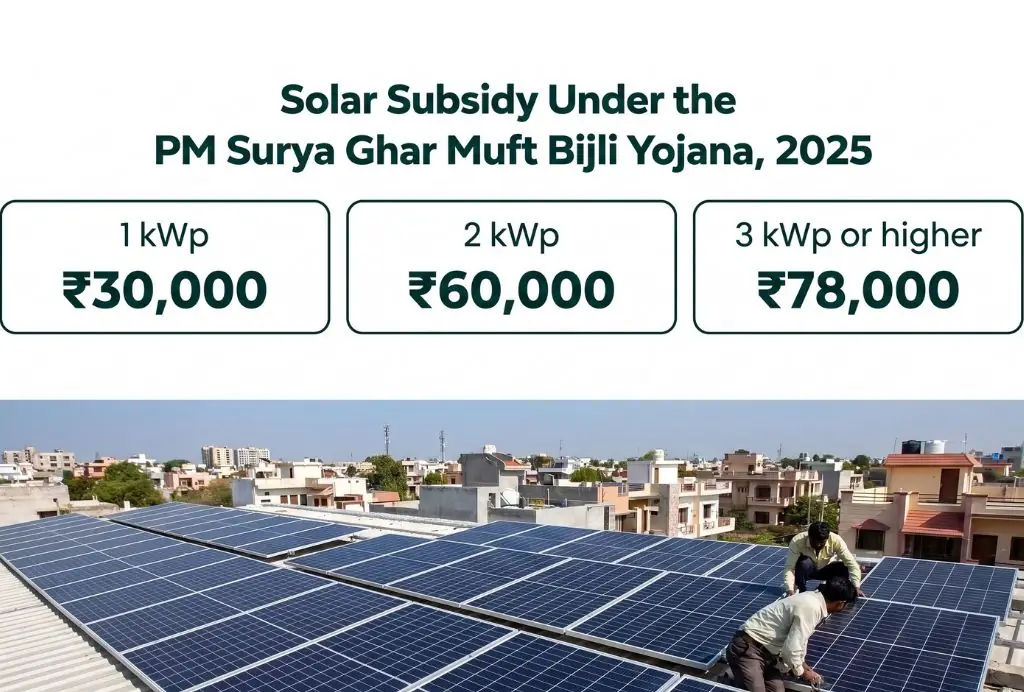
Households in Tamil Nadu claim under the PM Surya Ghar Muft Bijli Yojana, which pays ₹30,000 for a 1 kW system, ₹60,000 for 2 kW and ₹78,000 for 3 kW and above, capped at ₹78,000 regardless of system size. The subsidy is transferred directly to the applicant's bank account after TANGEDCO inspects and commissions the system, typically within about 15 days of DISCOM approval, once you redeem it on the portal. Residential Central Financial Assistance is available for systems up to 10 kW.
What the household grant pays
And where it stops.
1 kW
₹30,000
2 kW
₹60,000
3 kW and above
₹78,000
Flat at ₹78,000 from 3 kW upward. A 5 kW or 10 kW system receives the same amount, which is why sizing above 3 kW is a consumption decision, not a subsidy one.
The subsidy stops rising at 3 kW
A 5 kW or 10 kW system receives the same ₹78,000, so going larger is a decision about consumption, not about subsidy.
You pay first
The subsidy is a reimbursement after commissioning, not a discount at purchase. Plan the cash flow accordingly.
DCR panels are mandatory
This is where most rejections originate. See the DCR section.
The application process, the portal, timelines and disbursal are covered in full on the PM Surya Ghar page. This page's job is to get you to the right scheme, not to walk you through one.
The full PM Surya Ghar guide for Tamil Nadu →Housing societies
The subsidy for apartments and RWAs
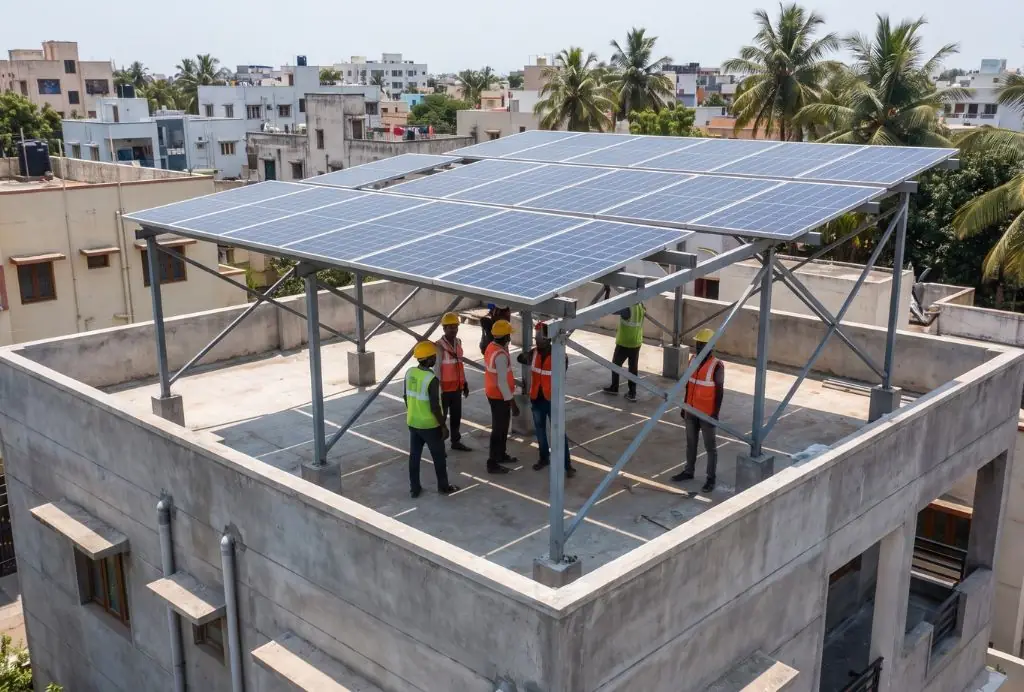
Group Housing Societies and Resident Welfare Associations claim ₹18,000 per kW under PM Surya Ghar for common-area facilities, including common lighting, lifts, pumps and EV charging, up to 500 kW and subject to a limit of 3 kW per residential unit in the building, inclusive of any individual systems residents have already installed. This is a different and often more valuable route than the individual household cap.
The society terms, in four numbers
₹18,000
per kW of common-area capacity
500 kW
scheme ceiling on the claim
3 kW
per residential unit in the building
Inclusive
of individual systems already installed
Why this matters
At 10 kW a society claims ₹1,80,000 where an individual household would be capped at ₹78,000.
A society is not limited to 10 kW. If an installer tells an association it is capped at ₹78,000 or at 10 kW, they are applying a household rule to a non-household buyer.
One practical point
An individual flat owner generally cannot claim against a society address, because the terrace is common property. Applications submitted that way are typically rejected at the feasibility stage. The route is a collective application through the association.
Solar for apartments and housing societies →Business and institutions
What businesses get instead of a subsidy
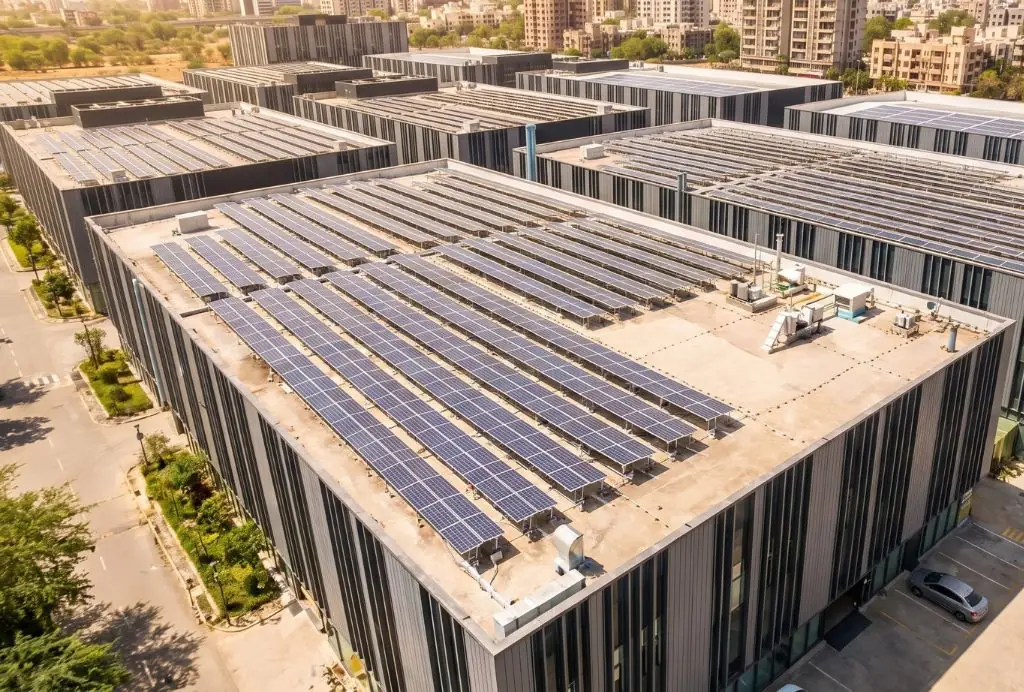
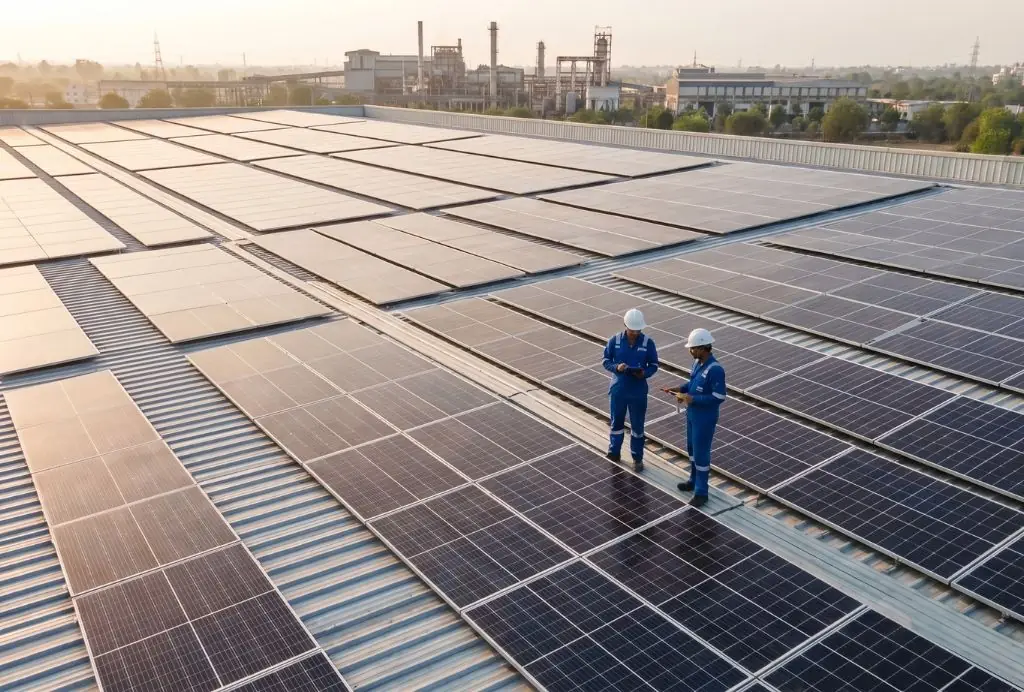
Commercial and industrial installations receive no PM Surya Ghar subsidy, which is a residential scheme. Businesses instead claim accelerated depreciation of up to 40% on the solar asset in the first year under the Income Tax Act, plus GST input tax credit where registered, which together convert a substantial share of the capital cost into a first-year tax benefit. For a profitable company this is generally worth considerably more than the household cap.
What a company claims instead
Up to 40%
Accelerated depreciation on the asset in year one
GST input credit
Claimable against output tax where registered
No PM Surya Ghar
The central grant is residential only
The condition most proposals ignore
Depreciation is only valuable to an entity with taxable income to offset. A charitable trust, a loss-making company or a newly formed entity gains nothing from it.
If your organisation falls into that group and a proposal presents 40% first-year depreciation as central to the payback, the payback figure in front of you is wrong. Check with your auditor before evaluating any quotation.
In Chennai this affects
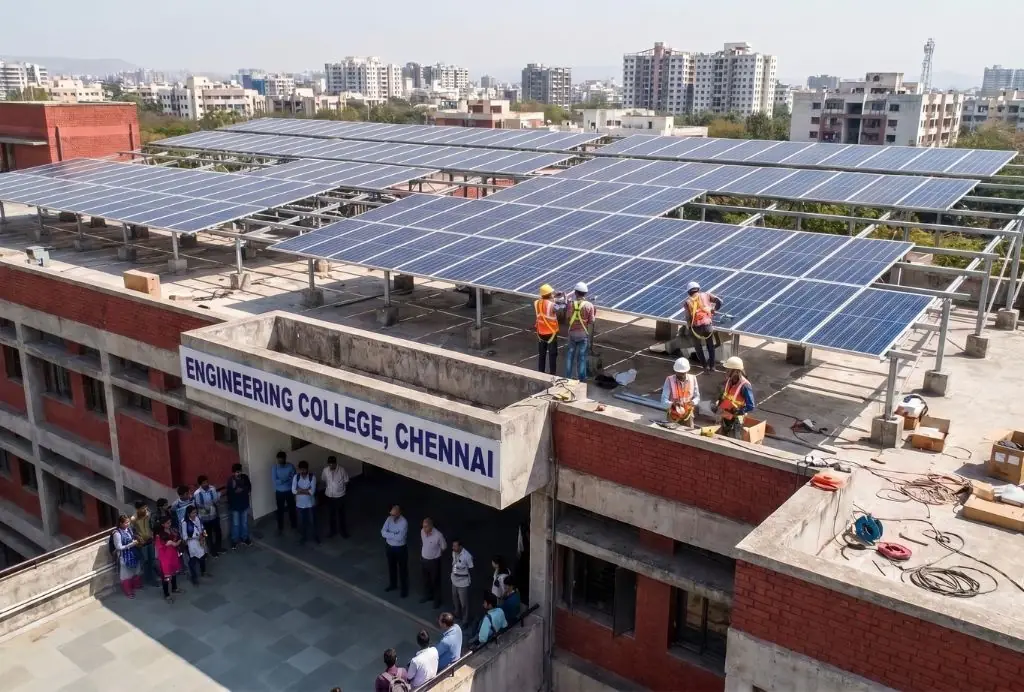
Schools and colleges, mostly trusts or societies
Trust-run hospitals
Temples and religious trusts
New businesses without an established profit position
Agriculture
PM-KUSUM for solar pumps
Farmers and agricultural landholders installing solar pumps may be eligible under the PM-KUSUM scheme, which supports standalone solar pumps and the solarisation of existing grid-connected pumps. It is a separate scheme from PM Surya Ghar, with its own eligibility criteria, application route and domestic content requirements, and terms are revised periodically. For Tamil Nadu farmers, our guide to the solar pump subsidy in Tamil Nadu covers the Chief Minister's scheme and how to apply.
What the scheme covers
Standalone solar pumps
Off-grid, where no reliable supply reaches the field.
Solarising existing pumps
Grid-connected pumps converted to run on solar.
Domestic content rules
The scheme carries its own DCR conditions.
Terms revised periodically
Check the position in the season you are buying.
If your requirement is agricultural pumping
Rather than a household or building supply, this is the route to investigate, and it should be checked before purchasing anything. Eligibility depends on the component of the scheme, landholding, pump capacity and current state-level implementation. See off-grid solar systems for how standalone agricultural systems are designed.
Check current terms through the relevant central and Tamil Nadu channels rather than relying on any vendor's summary, including ours. Scheme conditions change, and a quotation built on outdated terms helps nobody.
Announced 5 August 2026
Is there a Tamil Nadu state solar subsidy?
Yes,
and live from 21 September 2026.
In the Tamil Nadu Revised Budget 2026–27, presented to the Assembly on 5 August 2026 by Finance Minister Dr N Marie Wilson, the government announced a new Rooftop Solar Subsidy Scheme in convergence with PM Surya Ghar, under which domestic consumers receive up to ₹1 lakh for installing a 3 kW rooftop system, against the ₹78,000 the central scheme pays on its own. An allocation of ₹50 crore has been made for the year, and the scheme opened on 21 September 2026. For the wider state rules, see our guide to the Tamil Nadu solar energy policy.
Total support now
₹1,00,000
For a domestic 3 kW rooftop system
Central share
₹78,000
PM Surya Ghar, unchanged
The state adds this
~₹22,000
The difference between the two figures
Allocated for the year
₹50 crore
Which funds a limited number of homes
Who gets it, and how it is paid
It covers homes registered on the PM Surya Ghar portal on or after 5 August 2026. There is no separate application: TEDA takes the details from the PM Surya Ghar portal and pays the top-up directly to your bank account. It is limited to the first one lakh consumers, with ₹50 crore allocated this year, so registering early matters.
The arithmetic is also worth doing. If the state pays the roughly ₹22,000 difference per household, a ₹50 crore allocation covers in the order of twenty-odd thousand homes for the year, meaningful, but not universal, and very likely first-come.
So we quote on the ₹78,000 central subsidy and show the state top-up as a separate line once we have checked your PM Surya Ghar registration date and whether places in the first one lakh are still open.
The ₹20,000 per kW claim is a different thing
Websites have advertised a Tamil Nadu top-up of around ₹20,000 per kW for years. That was never payable and is not what was announced. If a quotation nets off a state subsidy, ask which scheme, and for the government order number.
Where the old state scheme went
The earlier Chief Minister's Solar Rooftop Capital Incentive was effectively superseded when PM Surya Ghar launched in February 2024, and the nodal agency TEDA has since been folded into the Tamil Nadu Green Energy Corporation.
Source: Tamil Nadu Revised Budget 2026–27, presented 5 August 2026. Confirm the operational position with the Tamil Nadu Green Energy Corporation before relying on it, including against this page, which we re-check weekly while the scheme is new.
Applies to every subsidy route
DCR panels, and why most claims fail
Since 1 June 2026, systems claiming subsidy or applying for net metering must use DCR-compliant modules, meaning panels built from solar cells on the ALMM List-II of approved domestic manufacturers. Non-DCR panels are cheaper per watt and disqualify the entire subsidy claim, which is the single most common reason claims are rejected.
Three things to ask for
Module make and model
In writing, before you sign anything.
Checked against ALMM List-II
The cells, not just the panel brand.
The DCR certificate
Ask for a copy with the quotation.
DCR modules cost more per watt
Than imported non-DCR panels. That premium is far smaller than the subsidy at residential scale, so choosing non-DCR to save money is a losing trade for a home.
An unusually cheap quote is often cheap here
And you will not discover it until the claim is rejected months later, when the panels are already on your roof.
One narrow exemption exists
Consumers who formally give up their subsidy claim and take net metering through the national portal may use non-ALMM List-II cells until 31 March 2027.
For a household, giving up ₹78,000 to save a smaller sum on hardware rarely makes sense. It should be a deliberate decision, not something a vendor arranges quietly because non-DCR panels are easier to source.
The part that catches people
The choice is permanent. Once an application is submitted under that route, the subsidy cannot be claimed retroactively.
Window closes
31 March 2027
After which non-ALMM cells are not available on either route.
Financing
Loans for rooftop solar
Residential rooftop solar is eligible for collateral-free loans from public sector and private banks under the PM Surya Ghar framework, and applications can be initiated through the national portal alongside the subsidy claim. Because the subsidy arrives as a reimbursement after commissioning rather than as a discount at purchase, many households finance the full system cost initially and use the subsidy to prepay part of the loan.
How the money actually moves
Finance the full cost
The bank funds the system, since no discount is applied at purchase.
Commission and inspect
TANGEDCO inspects, then the claim is filed on the national portal.
Subsidy lands in your account
Typically about 15 days after DISCOM approval and your redemption request, direct transfer.
Prepay part of the loan
Most households use the subsidy to knock down the principal.
Check current interest rates and tenures directly on the portal or with your bank, since terms are revised periodically. Businesses generally fund through existing facilities or equipment finance, or use an OPEX structure where the developer funds the system.
The business funding comparisonThe section nobody else writes
Six reasons subsidy claims fail
You sign, we file
We file the application and follow it through
Blues Renewables files the subsidy application and the TANGEDCO net metering application, and follows both through to the meter being installed and the money reaching your account. We also check the connection name and sanctioned load at the survey, which is where most problems surface.
Common questions
Solar subsidy, common questions
How much solar subsidy can I get in Tamil Nadu?
It depends on what kind of consumer you are. Households claim up to ₹78,000 under PM Surya Ghar, with ₹30,000 at 1 kW, ₹60,000 at 2 kW and ₹78,000 for 3 kW and above. Since 21 September 2026 Tamil Nadu adds ₹5,000, ₹10,000 or ₹22,000 on top for homes registered on the PM Surya Ghar portal from 5 August 2026, so a 3 kW home can receive ₹1,00,000. Housing societies claim ₹18,000 per kW for common areas up to 500 kW. Businesses receive no subsidy but claim accelerated depreciation and GST input credit instead.
Is there a Tamil Nadu state solar subsidy on top of the central one?
Yes, since 21 September 2026. The Tamil Nadu Revised Budget 2026–27 announced a Rooftop Solar Subsidy Scheme in convergence with PM Surya Ghar on 5 August 2026, and it opened on 21 September 2026: ₹5,000 for 1 kW, ₹10,000 for 2 kW and ₹22,000 for 3 kW and above on top of the central subsidy, so a domestic 3 kW system receives up to ₹1 lakh against the ₹78,000 the central scheme pays alone. It covers homes registered on the PM Surya Ghar portal on or after 5 August 2026, TEDA pays it directly with no separate application, and it is limited to the first one lakh consumers, with ₹50 crore allocated this year. Separately, several websites still advertise a Tamil Nadu top-up of around ₹20,000 per kW, which is not this scheme, so treat any quotation built on that figure with caution.
Do businesses get a solar subsidy?
No. PM Surya Ghar is a residential scheme, and commercial and industrial installations are not eligible. Businesses instead claim accelerated depreciation of up to 40% on the asset in the first year plus GST input tax credit, which for a profitable company is generally worth more than the household cap. The benefit requires taxable income to offset it.
Can a charitable trust or school claim solar depreciation?
Only if it has taxable income to offset. Depreciation is a deduction against taxable profit, so a trust or society without a tax liability gains nothing from it. This affects most schools and colleges and trust-run hospitals, and it means an OPEX or RESCO structure is often worth modelling alongside outright purchase.
How much subsidy can a housing society claim?
₹18,000 per kW for common facilities including lighting, lifts, pumps and EV charging, up to 500 kW and subject to a limit of 3 kW per residential unit in the building. At 10 kW that is ₹1,80,000, considerably more than an individual household's ₹78,000 cap. Societies are not limited to 10 kW.
Why do solar subsidy claims get rejected?
Most commonly because the panels are not DCR-compliant, because the electricity connection is in a different name from the applicant, because system capacity exceeds the sanctioned load, or because the application went directly to the DISCOM instead of through the national portal. Incomplete documentation is the other frequent cause.
What are DCR panels and why do they matter?
DCR-compliant modules are built from solar cells listed on ALMM List-II of approved domestic manufacturers. Since 1 June 2026, systems claiming subsidy or applying for net metering must use them. Non-DCR panels cost less per watt and disqualify the entire subsidy claim, which is the single most common reason claims fail.
When is the subsidy paid?
After the system is installed, inspected and commissioned by TANGEDCO, typically within about 15 days of DISCOM approval, once you redeem it on the portal, and transferred directly to the applicant's bank account. It is a reimbursement rather than a discount at purchase, so the full cost is paid to the installer first.
Is off-grid solar eligible for subsidy?
No. PM Surya Ghar applies to grid-connected residential rooftop systems with net metering, so off-grid installations are not eligible. Hybrid systems, being grid-connected, do remain eligible. Agricultural solar pumping is covered by the separate PM-KUSUM scheme.
Can I get a loan for rooftop solar?
Yes. Collateral-free loans for residential rooftop solar are available from public sector and private banks under the PM Surya Ghar framework, and applications can be initiated through the national portal alongside the subsidy claim. Since the subsidy is reimbursed after commissioning, many households finance the full amount and use the subsidy to prepay part of the loan.
What is the solar panel scheme in Tamil Nadu?
For homes it is the central PM Surya Ghar Muft Bijli Yojana, which pays up to ₹78,000, plus the state's Rooftop Solar Subsidy Scheme, which adds up to ₹22,000 for homes registered on the PM Surya Ghar portal from 5 August 2026. Housing societies use the PM Surya Ghar common-facility provision at ₹18,000 per kW. Farmers use PM-KUSUM and the state solar pump scheme. Businesses have no subsidy scheme and claim accelerated depreciation instead.