





Solar for Textile and Spinning Mills in Tirupur, Coimbatore and Erode
Spinning is one of the most electricity-intensive processes in Indian manufacturing. Industry bodies put it at about five units of power for every kilogram of yarn, which means a one rupee move in the tariff is a five rupee move in the cost of a kilo.
That arithmetic is why Tamil Nadu mills watch tariff orders more closely than most industries, and why rooftop solar is usually the first step rather than the last one.
Get an itemised proposalWhat decides the answer here
- About five units per kilogram of yarn. A ₹1 per unit tariff increase adds roughly ₹5 to the cost of a kilo, which is how mills size the problem.
- Three-shift running means high self-consumption. Unlike a hall or a warehouse, a mill uses almost everything its roof makes.
- The roof will not cover the load. A large shed roof is a useful fraction of a spinning mill's demand, not the answer to it.
- Sheet roofs need a purlin check, and non-penetrative clamps rather than holes through the sheet.
- Open access and group captive cover the rest, and are where the larger saving sits for a mill of any size.
What a mill roof actually covers
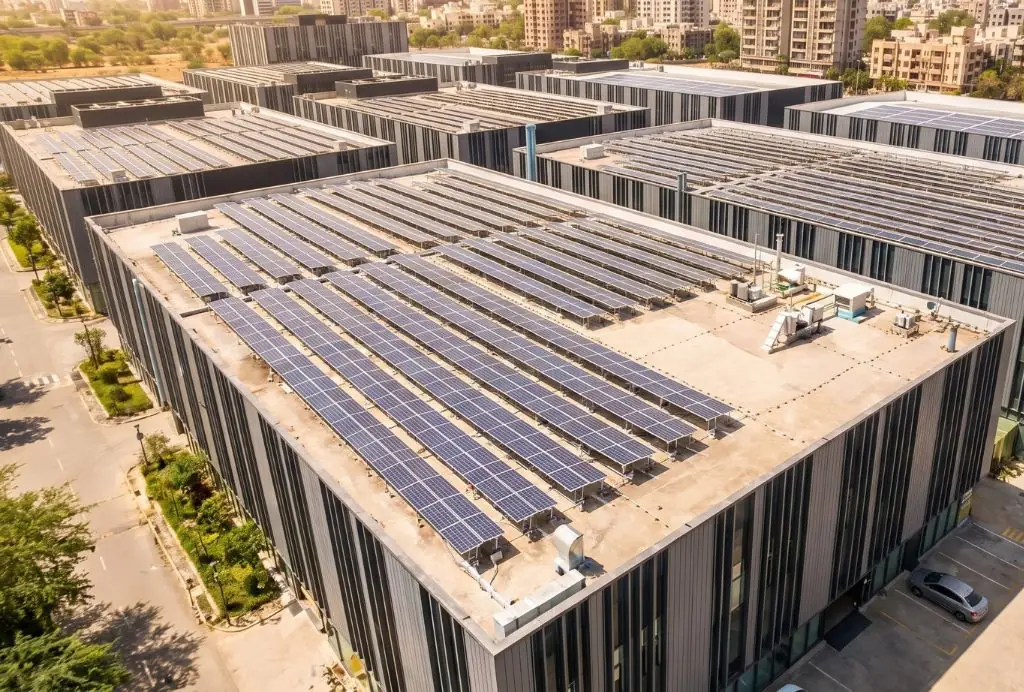
Start with the honest limit. A spinning mill draws in megawatts; its roof, however large, supports a few hundred kilowatts. Rooftop solar reduces the bill. It does not replace the supply.
What makes it worth doing anyway is the consumption pattern. A mill running three shifts consumes everything the roof generates at the moment it is generated, so almost every unit avoids the full HT tariff rather than earning an export credit. That is the best case in solar economics and very few buildings achieve it.
Capacity assumes roughly 130 sq ft per kW on a sheet roof after walkways and setbacks, and generation uses 4.8 units per kW per day.
Sheet roofs, purlins and how they are fixed
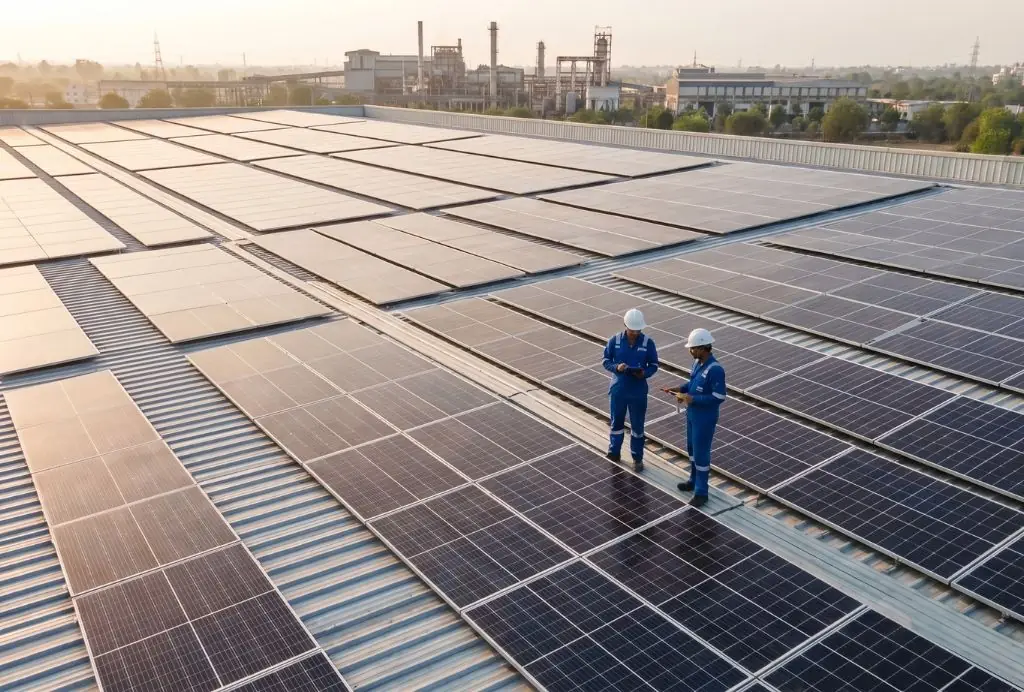
Almost every mill in the Tirupur and Coimbatore belt is under profiled metal sheet on steel purlins, and the design question is the same everywhere: what will the purlins carry, and how is the array attached without compromising the sheet.
- A structural assessment of purlin spacing, section and condition comes first. An older shed may need purlin strengthening before it takes an array.
- Non-penetrative clamp systems fix to the standing seam or the sheet rib rather than drilling through it, which matters on a roof that has to stay dry over yarn.
- Roof condition decides sequence. If the sheet is due for replacement, do it before the array, not after. Lifting an array to replace sheeting underneath is expensive twice.
industrial solar in Chennai covers the general factory case in more detail, including load capacity and the energy audit that should precede any of this.
Where the rest of the power comes from
Once the roof is full, the remaining demand is a procurement question rather than an engineering one, and Tamil Nadu mills have used both routes for years.
Open access
Buying power from a generator elsewhere in the state and wheeling it to the mill. open access solar sets out the charges, which is where the arithmetic either works or does not: wheeling, transmission, cross subsidy surcharge and banking all sit between the generation tariff and your meter.
Group captive
Taking at least 26 percent equity in the generating company and consuming at least 51 percent of its output, which removes the cross subsidy surcharge entirely. group captive covers who qualifies and what happens if a year misses either test.
OPEX on the roof
If the capital is better used in the mill, the OPEX model puts a developer's money on your roof and sells you the units. It is the same structure sold as zero capex or RESCO.
The tax side, which is not the residential subsidy
The PM Surya Ghar subsidy does not apply here. It is a residential scheme, and any proposal that deducts it from a commercial quotation is deducting money the business will not receive.
What a business gets instead is accelerated depreciation. Solar power generating systems sit in a 40 percent depreciation block under Appendix I of the Income Tax Rules, claimed under Section 32, against an ordinary building at 10 percent and general plant and machinery at 15 percent.
The timing decides the first year. A system commissioned and put to use for 180 days or more in the financial year takes the full 40 percent; commissioned later and the first year is halved to 20 percent, with the balance carried forward. Our guide to how to calculate it works through the arithmetic on a real invoice.
GST on a turnkey installation works out near 8.9 percent under the 70:30 composite supply rule, with the module and system portion at 5 percent. That input is creditable for a GST-registered business, which residential buyers cannot do.
Frequently asked questions
How much power does a spinning mill use per kilogram of yarn?
Industry bodies put it at about five units per kilogram on average. That is why a one rupee per unit tariff increase is treated as roughly five rupees on the cost of a kilo of yarn.
Can rooftop solar run a textile mill?
No, and no honest proposal will claim it. A mill draws megawatts and its roof supports a few hundred kilowatts. Rooftop solar cuts the bill at the best possible rate because a three-shift mill consumes everything it generates. Open access or group captive covers the rest.
Can solar be installed on a factory sheet roof?
Usually yes, after a structural check of the purlin spacing, section and condition. Non-penetrative clamp systems fix to the sheet rib rather than drilling through it, which keeps the roof watertight.
What is better for a mill, rooftop solar or open access?
They answer different parts of the same problem. Rooftop is the cheapest unit you will ever buy because it avoids the full HT tariff with no wheeling charges. Open access supplies the volume a roof cannot. Most mills end up with both.
Do textile mills get a solar subsidy in Tamil Nadu?
Not PM Surya Ghar, which is residential. A mill claims accelerated depreciation at 40 percent under Appendix I, and takes GST input credit on the installation.
Start with the roof and the last twelve bills
Send us the shed layout or a roof plan, your HT or LT bills for twelve months, and the connected load. We will tell you what the roof supports structurally, what share of your demand that covers, and whether open access or group captive is worth modelling for the balance.
We install across Tirupur, Coimbatore, Erode, Karur and Salem. appointing an EPC contractor covers what the contract should commit us to, including the performance ratio guarantee.
Call +91 98841 07170Sources
Tamil Nadu Electricity Regulatory Commission tariff orders, for LT and HT consumer categories and energy charges
Blues Renewables generation records, Tamil Nadu rooftops, for the figure of about 4.8 units per kW per day
Income Tax Act 1961 Section 32 and Appendix I of the Income Tax Rules, for the 40 percent depreciation block and the 180-day rule
GST notifications on solar photovoltaic modules and solar power generating systems, effective 22 September 2025
Southern India Mills Association and Tamil Nadu trade press, on power consumption of about five units per kilogram of yarn and the effect of tariff revisions
Electricity Rules 2005, for the group captive ownership and consumption tests