What Is Open Access Solar? Charges, Rules and Real Savings
Learn what open access solar is, who qualifies in Tamil Nadu, and how the three structures change your cost per unit. See every TNERC charge with current figures.


Your factory needs 2 MW. The roof holds 400 kW. So what covers the other 1.6 MW?
Open access solar answers that question for most Tamil Nadu businesses. It lets you buy electricity from a solar plant elsewhere in the state, and TANGEDCO delivers it over the wires you already use. Better still, it is a legal right rather than a favour. Section 42 of the Electricity Act 2003 obliges the utility to carry power it did not generate.
However, the charges decide whether any of it saves you money. Read on and you will learn who qualifies in Tamil Nadu, the three ways to structure a deal, what each charge costs at current TNERC rates, and why the same plant lands at ₹5.00 or ₹7.10 a unit depending on one decision you take before construction starts.
Key takeaways
- Open access lets a large consumer buy electricity from a generator other than the local utility and have it delivered over the utility's network for regulated charges.
- In Tamil Nadu the threshold is 63 kVA of contracted demand for EHT and HT consumers, lower than the 100 kW national floor set by the Green Energy Open Access Rules 2022.
- There are three structures: third party, captive and group captive. They use the same plant and the same wires, and they differ in landed cost by roughly ₹2 per unit.
- The difference is entirely surcharge exemption. Captive and group captive consumers pay no cross subsidy surcharge and no additional surcharge; third-party buyers pay both.
- Applications go to the SLDC for short term and the State Transmission Utility for medium and long term, and must be decided within 15 days or are deemed approved.
- Open access is a complement to rooftop solar, not a replacement. Nothing crosses the utility's wires on a rooftop system, so no charges apply at all.
What is open access solar
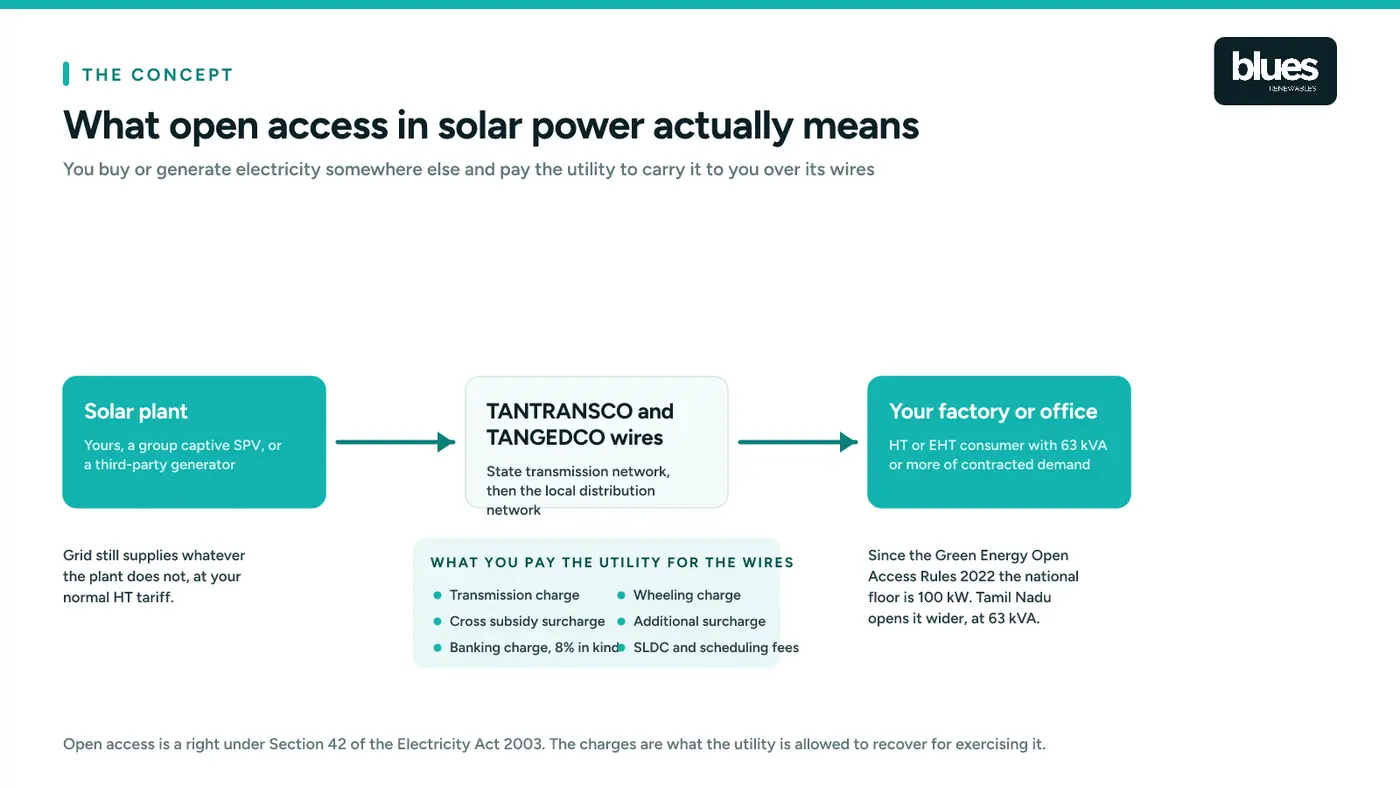
Open access solar means buying or generating solar electricity at a plant located away from your premises and having it delivered to you over the transmission and distribution network, in return for a set of charges fixed by the state regulator. In Tamil Nadu it is available to EHT and HT consumers with a minimum contracted demand of 63 kVA, under the TNERC Green Energy Open Access Regulations 2025.
The market says this both ways round. Solar open access and open access solar mean the same arrangement, and developers use the two interchangeably in proposals.
Step 1: Understand what is actually being bought
Electricity on a grid is fungible. The electrons your factory draws at 2 pm are not the ones a solar plant in Tirunelveli injected at 2 pm. What open access does is contractual and accounting. The plant injects a scheduled quantity, your meter records what you drew, and the two are netted in 15-minute blocks.
This is why open access is not a substitute for a grid connection. It reduces the units you buy from the utility, but the utility never leaves the picture. TANGEDCO still supplies the shortfall, keeps the meter, and bills you for the network you used.
Step 2: Know the three ways to structure it
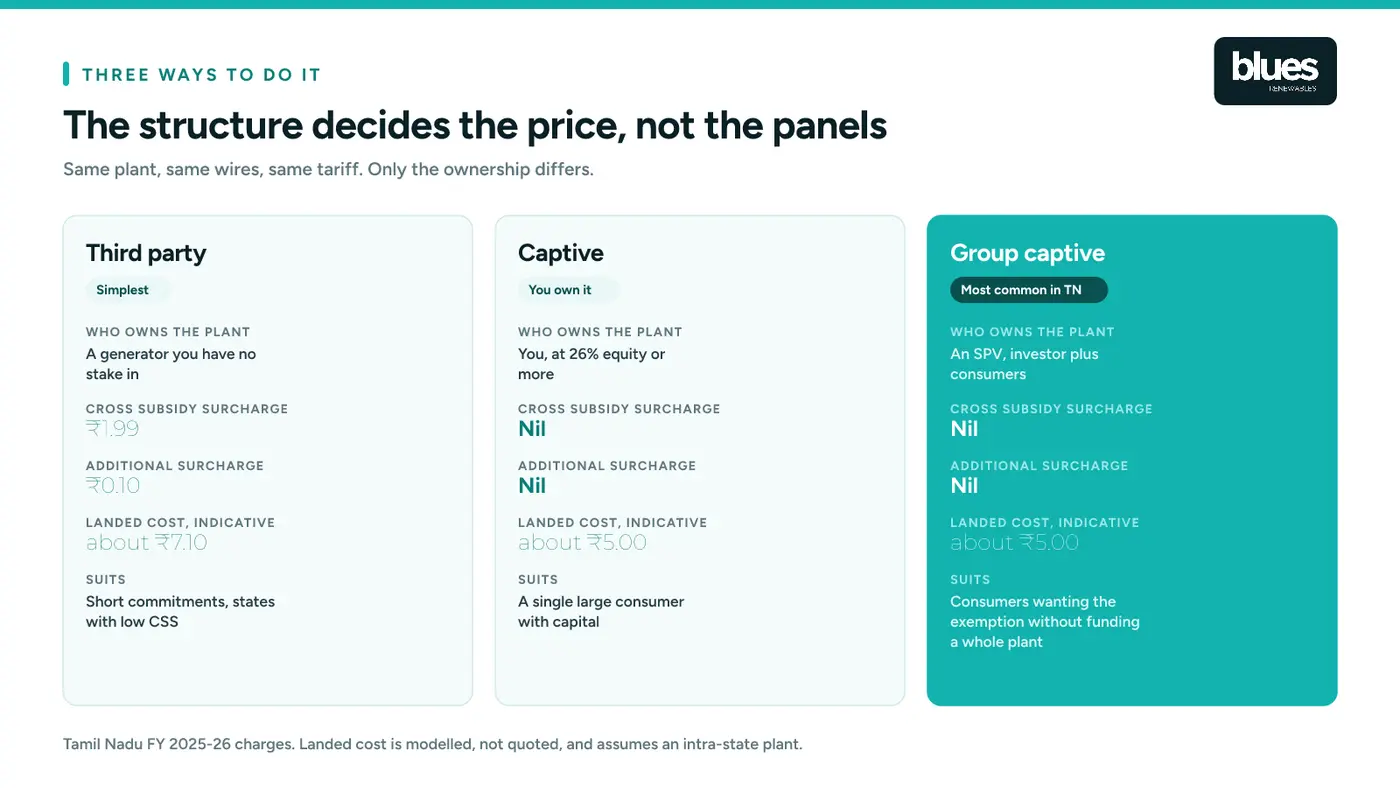
Third-party open access. You sign a power purchase agreement with a generator you have no stake in. Every charge then applies, including the cross subsidy surcharge and the additional surcharge.
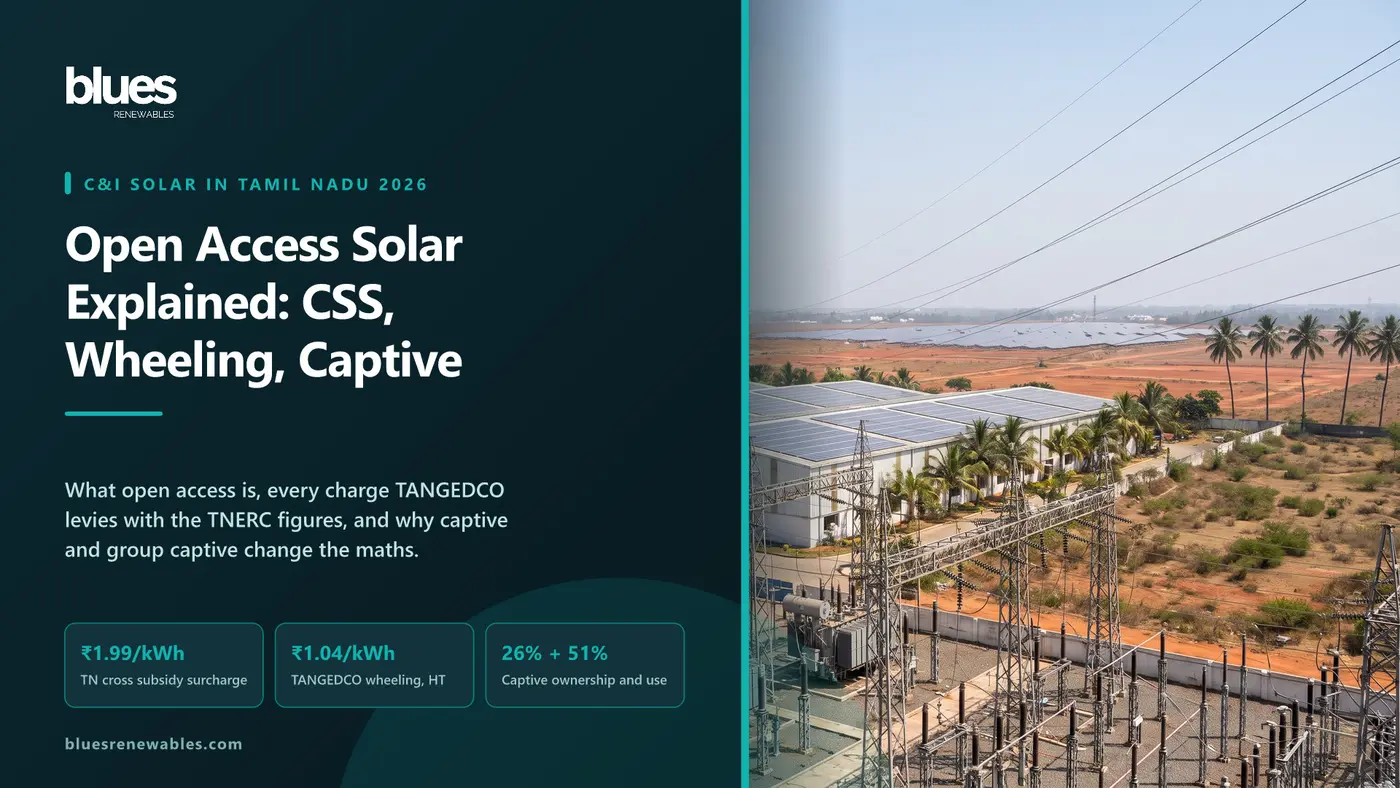
Captive. You own at least 26 percent of the plant and consume at least 51 percent of its output. Both surcharges fall away. The rules are set out in what a captive solar power plant is.
Group captive. Several consumers together hold at least 26 percent of a plant through an SPV, with an investor holding the rest. The same exemptions apply, and this is how most commercial and industrial open access solar in Tamil Nadu is actually built.
Step 3: Check you are eligible
In 2022 the Ministry of Power cut the national threshold from 1 MW to 100 kW of contracted demand, through the Green Energy Open Access Rules 2022. Captive consumers face no lower limit at all. Tamil Nadu then went further. Its Green Energy Open Access Regulations 2025, notified on 18 September 2025, open access to every EHT and HT consumer with a contracted demand of 63 kVA or more.
Eligible sources are solar, wind, wind-solar hybrid, small hydro, biomass and waste to energy. Captive generating plants have an automatic right of open access under Section 9 of the Act.
Step 4: Add up the charges before you sign anything
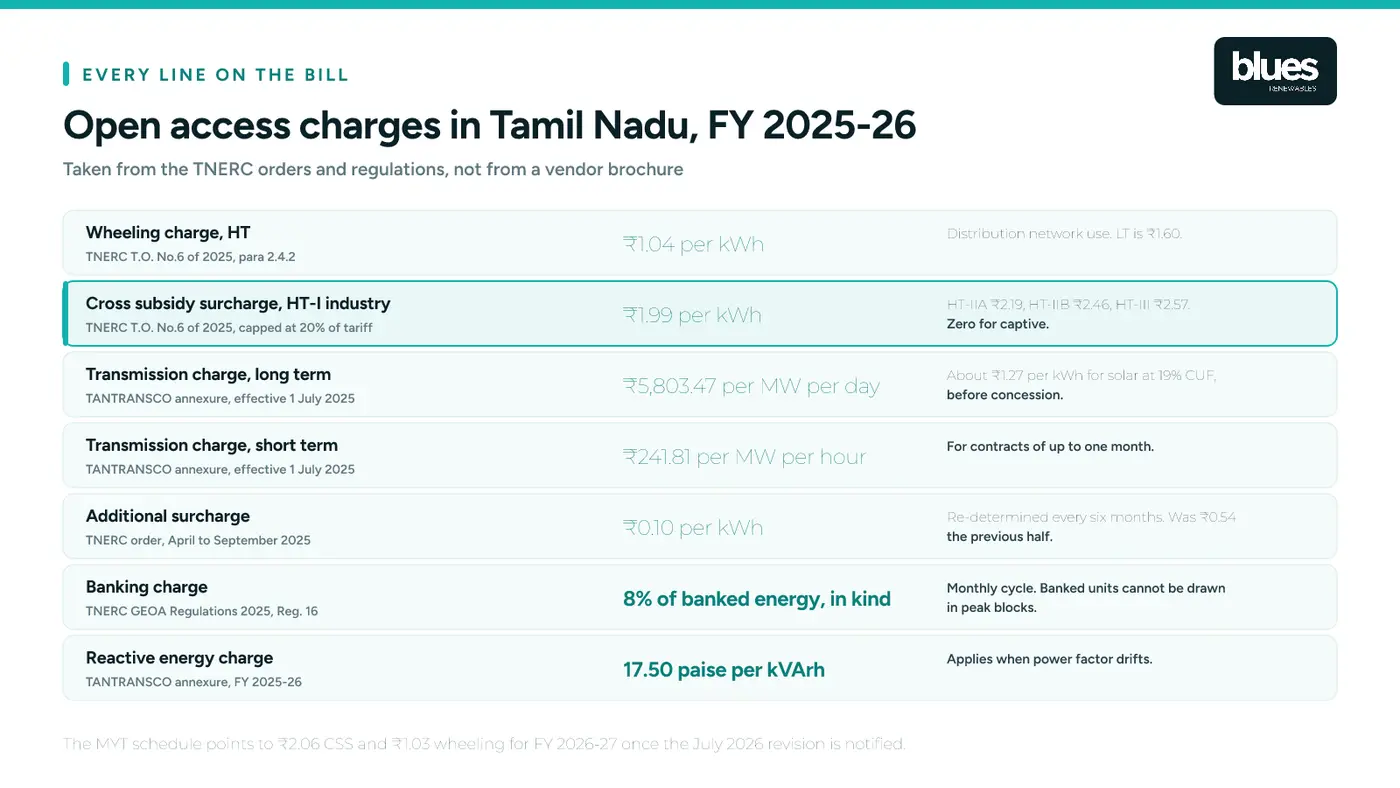
Regulation 15 of the 2025 regulations lists what a green energy open access consumer pays: transmission charges, wheeling charges, cross subsidy surcharge, additional surcharge, banking charges, standby charges, reactive energy charges, and SLDC, scheduling and deviation settlement fees.
The two that decide the economics have their own guides, because each is a substantial subject:
- The cross subsidy surcharge, ₹1.99 per unit for an HT industry, is explained in what cross subsidy in solar power means, and compared across states in CSS charge for solar, state wise.
- The wheeling and transmission charges, ₹1.04 per unit and ₹5,803.47 per MW per day, are covered in solar power wheeling charges in TANGEDCO.
Banking deserves a mention here, because it changed sharply in 2025. TNERC now charges 8 percent of banked energy, in kind, and settles on a monthly calendar cycle with no carry-forward. Critically, you cannot draw banked energy during peak-hour blocks. Whatever remains at month end goes to the utility at 75 percent of the applicable renewable tariff. For a factory whose load peaks between 6 pm and 10 pm, that peak-hour restriction costs far more than the 8 percent does.
Step 5: Apply through the right nodal agency
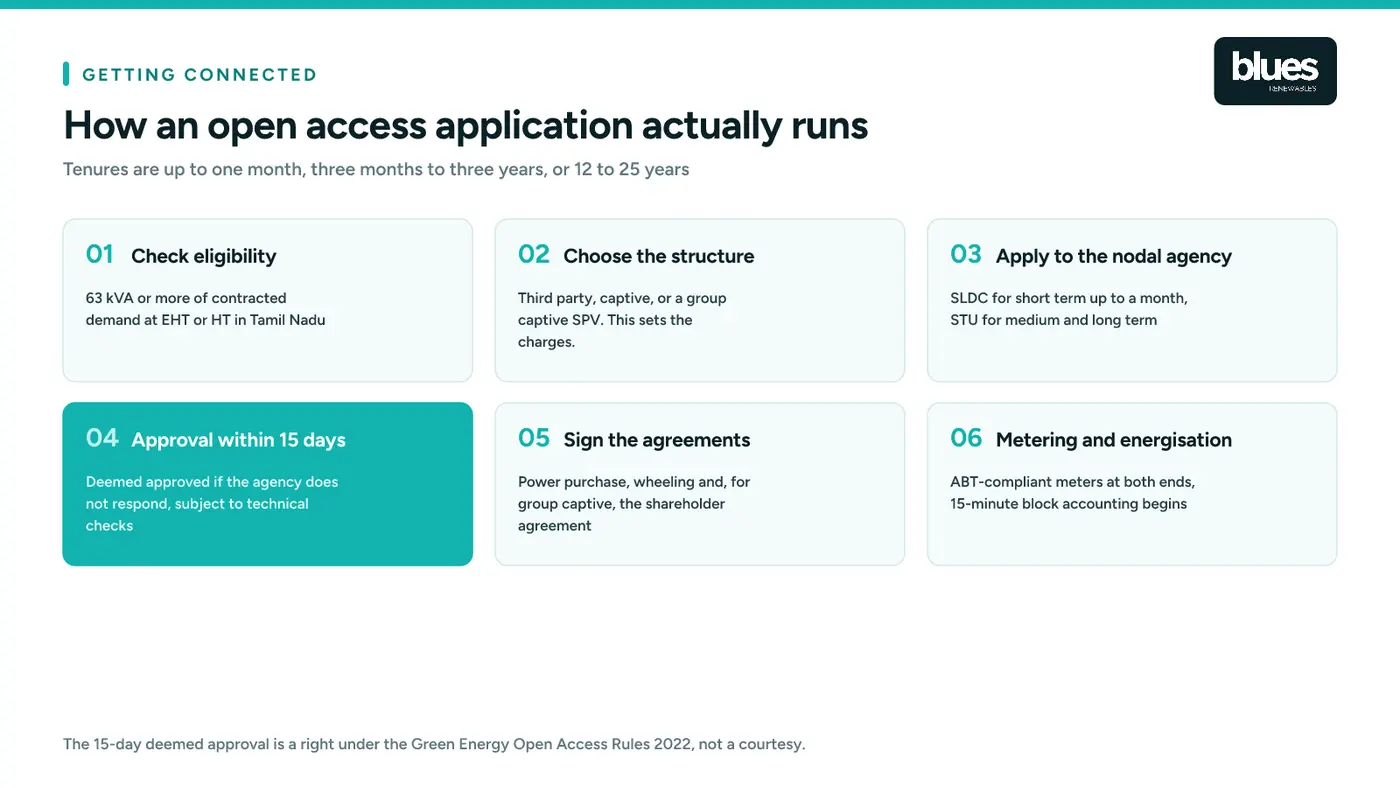
Short-term access, up to one month, goes to the State Load Despatch Centre. Medium-term, three months to three years, and long-term, 12 to 25 years, go to the State Transmission Utility. Under the 2022 Rules the nodal agency must decide within 15 days, failing which the application is deemed approved subject to technical requirements.
What open access solar costs in Tamil Nadu
The charges only make sense side by side. Figures below use FY 2025-26 TNERC charges, with the long-term transmission charge converted at 19 percent capacity utilisation. Solar tariff and loss assumptions are typical rather than quoted.
- Solar tariff or generation cost - Third party: 3.50, Captive or group captive: 3.50
- Transmission, after concession - Third party: 0.64, Captive or group captive: 0.64
- Wheeling, after concession - Third party: 0.52, Captive or group captive: 0.52
- Cross subsidy surcharge - Third party: 1.99, Captive or group captive: 0
- Additional surcharge - Third party: 0.10, Captive or group captive: 0
- Losses and banking, approximate - Third party: 0.35, Captive or group captive: 0.35
- Landed cost - Third party: about ₹7.10, Captive or group captive: about ₹5.00
Against that, an HT-I industry pays ₹7.50 per unit in energy charges, ₹608 per kVA per month in demand charges, a 25 percent surcharge on peak-hour units and 5 percent electricity tax, which commonly works out to an effective ₹8.50 to ₹9.50 per unit.
The third-party route saves something. Captive routes, by contrast, save ₹3.50 to ₹4.50 a unit. That entire difference between the two columns is surcharge exemption. That is the argument for owning a share of the plant, and it is covered in who can use power from a group captive solar plant.
When open access is the wrong answer
Open access solves one problem: a load too large for the roof. If your load is not, a rooftop system is the better instrument.
Nothing crosses the utility's network on a rooftop system, so there are no transmission, wheeling, surcharge or banking charges at all. A rooftop system under net metering settles against your own consumption without a 15-minute block match or a peak-hour restriction. And it needs no SPV, no shareholder agreement and no annual consumption test.
A 500 kW factory roof in Chennai generates roughly 2,400 units a day and displaces grid units worth ₹7.50 to ₹9.40 each with no charge stack in between. Only when the roof runs out does open access start to pay.
Mistakes that turn open access into a loss
Comparing a PPA price to the grid energy charge. ₹3.50 against ₹7.50 looks like a halving. Add ₹3.60 of charges and the saving is ₹1.40, which disappears if the additional surcharge returns to ₹0.54 as it was in early 2025.
Buying from out of state to chase a lower tariff. Concessional transmission and wheeling apply only to intra-state renewable transactions. An inter-state or exchange purchase gives up that concession before it starts.
Sizing to annual units instead of a load profile. Monthly banking with no carry-forward means a plant sized to your annual average over-generates in some months, is paid 75 percent of tariff for the surplus, and under-generates in others.
Assuming banking covers evening load. Since October 2025 banked units cannot be drawn in peak blocks, which are exactly the units carrying a 25 percent surcharge.
Treating the surcharge as fixed. The additional surcharge is re-determined every six months and the cross subsidy surcharge with each tariff order. Model the downside, not today's number.
Frequently asked questions
What is open access in solar power? The right of a large consumer to buy electricity from a generator other than the local utility and have it delivered over the utility's network for regulated charges, under Section 42 of the Electricity Act 2003. In solar it means buying or generating solar power at a plant elsewhere in the state and receiving it at your premises.
Who is eligible for open access solar in Tamil Nadu? All EHT and HT consumers with a contracted demand of 63 kVA or more, under the TNERC Green Energy Open Access Regulations 2025. Captive consumers have no minimum load requirement under the national rules.
What charges apply to open access solar? Transmission, wheeling, cross subsidy surcharge, additional surcharge, banking, standby, reactive energy and SLDC scheduling fees. Captive and group captive consumers do not pay the cross subsidy surcharge or the additional surcharge.
How long does open access approval take? The nodal agency must decide within 15 days of a complete application, failing which it is deemed approved subject to technical requirements. In practice, metering, agreements and connectivity add to that.
Is open access solar cheaper than a rooftop system? No, per unit. A rooftop system avoids the entire charge stack. Open access makes sense when the roof cannot host enough capacity for the load, and it usually complements a rooftop system rather than replacing it.
Can a small business use open access solar? In Tamil Nadu the practical floor is 63 kVA of contracted demand, which rules out most LT commercial consumers. Below that, rooftop solar under net metering is the route.
Getting it structured properly
Every number behind open access in Tamil Nadu is public, and all of it sits in TNERC's orders. What separates a project saving ₹4 a unit from one saving ₹1 is never the solar tariff. Instead it comes down to three things: whether you hold equity in the plant, whether the plant sits inside the state, and whether the contract matches a load profile the 2025 banking rules will actually honour.
Blues Renewables has installed solar across Chennai since 2020, for homes, schools, businesses and factories. For a commercial or industrial buyer we always start with your roof, because those units carry no charges at all. Then we model open access solar against your real TANGEDCO bill and contracted demand, so you can see which of the three structures fits before you commit to any of them.
Call +91 98841 07170 and we will model open access solar against your real load, across all three structures.
Sources
- Tamil Nadu Electricity Regulatory Commission, Tariff Order No.6 of 2025 dated 30 June 2025, paragraphs 2.4.1 and 2.4.2
- TANTRANSCO, Annexure on transmission charges to be collected from 1 July 2025
- TNERC, Terms and Conditions for Green Energy Open Access Regulations 2025, Notification TNERC/GEOA/25-1/2025 dated 18 September 2025, Regulations 13, 15 and 16
- Ministry of Power, Electricity (Promoting Renewable Energy Through Green Energy Open Access) Rules 2022
- Electricity Act 2003, Sections 9 and 42