


3kW Solar Panel Price in Chennai
3 kW from ₹1.32 lakh after the ₹78,000 subsidy. Installed from ₹2.1 lakh.
A 3 kW rooftop system is the most common choice for Chennai homes, and the size at which the government subsidy reaches its maximum of ₹78,000. What it costs on your roof depends on your roof, so we quote after we have seen it rather than before.
Installing in Chennai since 2020
₹78,000 subsidy filed by us
Two years free maintenance
DCR compliant panels
Size finder
Which size is right for your home?
Recommended size
3 kW
Suits a bi-monthly bill of ₹2,700 to ₹5,400.
- Installed
- from ₹2.1 lakh
- Subsidy
- ₹78,000
- After subsidy
- from ₹1.32 lakh
Output
How much power does a 3kW solar system generate in Chennai?
A 3 kW rooftop solar system in Chennai generates about 14 units a day, roughly 430 units a month, 860 units in a TANGEDCO bi-monthly cycle, or around 5,200 units a year. Chennai receives approximately 5.3 peak sun hours daily, which is better than most of northern India, so a 3 kW system here produces more than the same system installed further inland or north.
| Output | Figure |
|---|---|
| Daily generation | About 14 units |
| Monthly generation | About 430 units |
| Bi-monthly generation | About 860 units |
| Annual generation | About 5,200 units |
| Bill it offsets | About ₹5,400 per bi-monthly cycle |
| Northeast monsoon | Reduced, offset by net metering credit carried forward |
A year of generation
5,200
units from a 3 kW roof in Chennai
At 5.3 peak sun hours a day, each kW installed here returns roughly 1,730 units a year.
Sizing
Is 3 kW enough for your home?
A 3 kW system typically suits a Chennai household with a bi-monthly EB bill between ₹2,700 and ₹5,400, which usually means a two or three bedroom home running one or two air conditioners for part of the year alongside the usual fridge, fans, lighting, television, washing machine and water pump.
What is your bill per bi-monthly cycle?
Likely right size
5 kW
A 5 kW system generates about 1,440 units a cycle, which matches this band closely. It is the largest size at which the ₹78,000 subsidy still covers a meaningful share of the cost.
| Bill per bi-monthly cycle | Likely size |
|---|---|
| Up to ₹5,400 | 3 kW |
| ₹5,400 to ₹8,600 | 4 kW |
| ₹8,600 to ₹11,900 | 5 kW |
| ₹11,900 to ₹15,300 | 6 kW |
| Above ₹15,300 | 7 kW or more |
If your bill sits near a boundary, send it to us. Sizing off a bill band is a rule of thumb; sizing off twelve months of actual consumption is how it should be done, and that is what we do at the site visit.
The subsidy
The ₹78,000 subsidy, and why 3kW is the size that maximises it
Three kilowatts is the point at which the PM Surya Ghar Muft Bijli Yojana subsidy reaches its ceiling of ₹78,000. Systems below 3 kW receive less, ₹30,000 at 1 kW and ₹60,000 at 2 kW, and systems above 3 kW receive the same ₹78,000 and no more. This is why 3 kW is the most installed residential size in Chennai.
The subsidy is transferred directly to your bank account after TANGEDCO inspects and commissions the system, typically within about 15 days of DISCOM approval, once you redeem it on the portal. You pay the installer in full first and receive the subsidy as a reimbursement, so plan the cash flow accordingly. Blues Renewables files the application on the national portal, uploads the commissioning report and follows the claim through to disbursal. See the full subsidy process.
Three conditions decide whether your claim clears
- DCR compliant panels are mandatory. Since 1 June 2026, subsidised systems must use modules built from ALMM List-II certified Indian cells. Cheaper imported panels disqualify you from the entire ₹78,000. Every panel we quote is DCR compliant.
- The application must go through pmsuryaghar.gov.in. Applying directly to TANGEDCO does not work.
- The name on your bank account must match your electricity bill. The money arrives by direct transfer, so a name mismatch blocks the payment after everything else has gone right. We check this before installation day.
Specification
What a 3kW installation includes
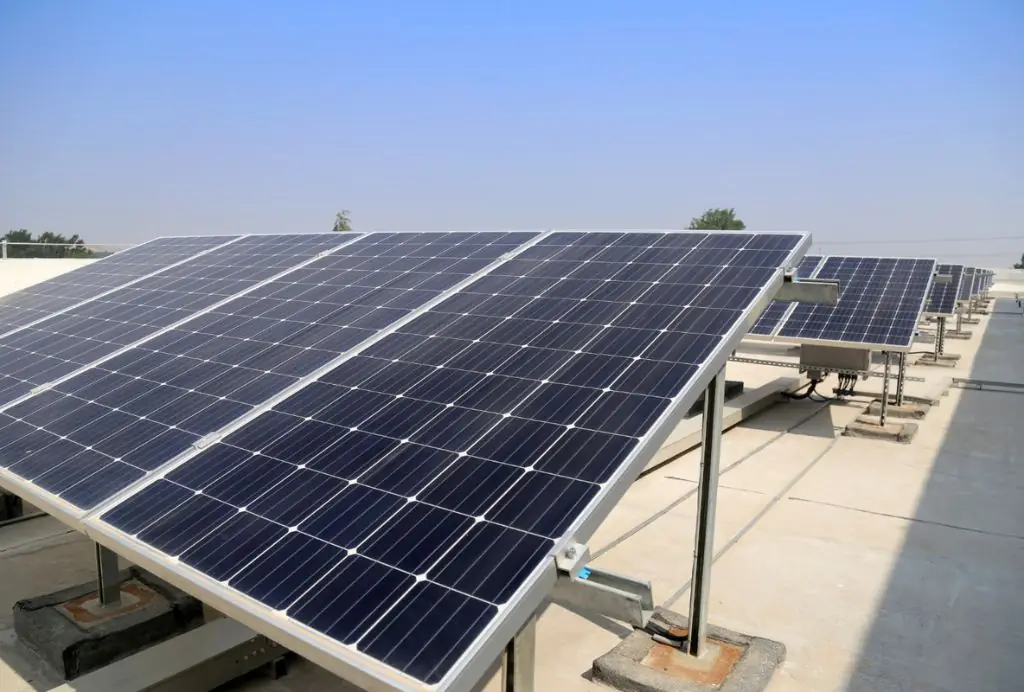
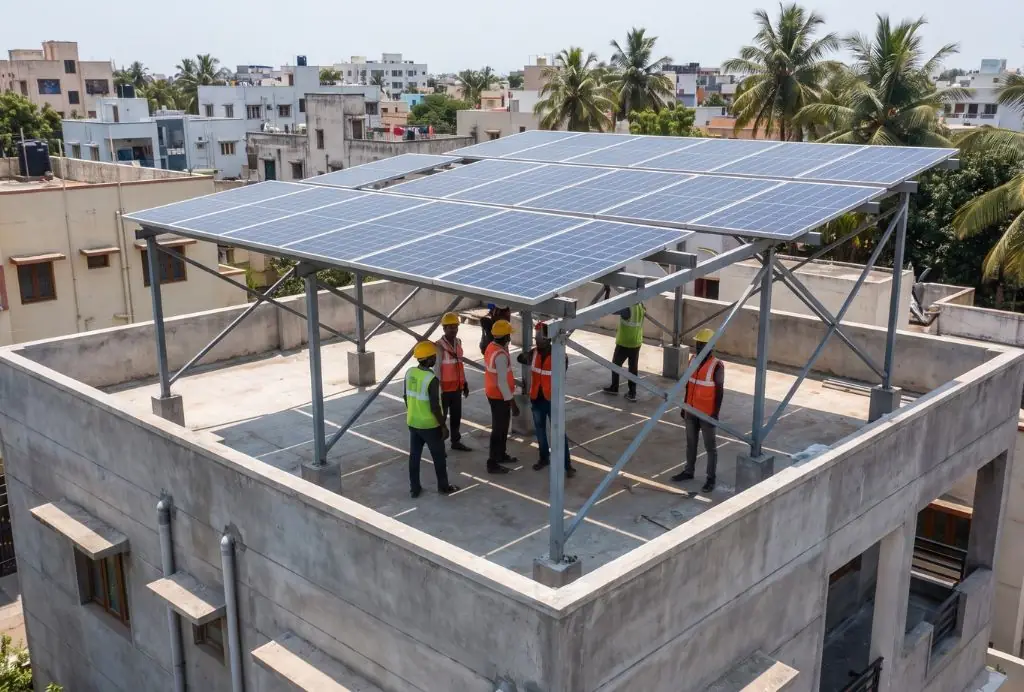
A 3 kW rooftop solar installation in Chennai needs roughly 250 to 300 square feet of shade-free roof area and typically uses five to seven panels, depending on module wattage. With the 545 to 590 watt modules common in 2026, six panels is the usual configuration.
On roof area
What matters is usable shade-free area through the middle of the day, not total terrace size. Water tanks, staircase headrooms, parapet walls and neighbouring buildings all reduce it. This is the single most common reason a roof cannot take the full 3 kW, and it is why we survey before quoting. Where the shade-free area falls short, we say so and tell you what the roof will realistically carry rather than quoting a size it cannot hold.
What drives the number
What makes one 3kW installation cost more than another
The price of a 3 kW solar system in Chennai is driven by seven things: panel technology and DCR compliance, inverter type and brand, mounting structure material, roof type and access height, distance from the coast, cable runs, and whether the quote includes net metering paperwork and maintenance. Two quotes for the same 3 kW can differ substantially, and the difference is almost always in these lines rather than in the headline.
| What varies | Effect | Why |
|---|---|---|
| DCR compliant panels | Higher | Mandatory for the ₹78,000 subsidy. Non-DCR is cheaper and disqualifies you |
| TOPCon vs Mono PERC | Slightly higher | Better output retention in Chennai heat |
| Hybrid inverter with battery | Considerably higher | Backup during outages, adds the battery cost |
| Galvanised vs painted structure | Higher | Painted mild steel pits within a couple of monsoons in coastal air |
| Coastal location | Higher | Salt mist certified modules, corrosion resistant mounting |
| Sloped tile or metal roof | Higher | More complex mounting than a flat RCC terrace |
| Height and roof access | Higher | Craneage, scaffolding, longer cable runs |
| Shading requiring split arrays | Higher | Additional structure and sometimes optimisers |
| Sanctioned load enhancement | Additional | A TANGEDCO cost before commissioning is possible |
This is why ₹2,10,000 is a starting price, not a quote. A single number is either too high for the simple jobs or too low for the difficult ones, and you find out which after the crew arrives. We survey the roof, then quote once, itemised, and that is the price. More on what drives solar prices in Chennai.
Book a free surveyComparing quotes
Comparing 3kW quotes in Chennai
When comparing 3 kW solar quotes in Chennai, compare six specific lines rather than the totals: the panel make, model and DCR status, the inverter make and warranty, the structure material, the cable and protection specification, whether TANGEDCO net metering and the subsidy filing are included, and what maintenance costs in years one and two.
We are happy to be compared on all six. Ask us for the itemised quotation and check us against anyone.
Savings
Savings and payback on a 3kW system in Chennai
A 3 kW system generating around 5,200 units a year covers most or all of the consumption of a typical Chennai household in the ₹2,700 to ₹5,400 bi-monthly bill band. Most homes recover the post-subsidy cost in four to six years, on panels warranted to perform for 25.
Tamil Nadu's domestic tariff is telescopic and bi-monthly, and it shifts sharply at 500 units. Since 10 May 2026, households consuming up to 500 units per bi-monthly cycle receive 200 free units, while those above 500 units receive only 100 and are repriced into higher slabs at the same time.
A household sitting just above that threshold is losing 100 free units and paying more per unit across the board. A 3 kW system generates 860 units per bi-monthly cycle, which is usually more than enough to move such a household decisively back under the line. For those homes the effective value of every generated unit is well above the headline tariff, and payback lands at the fast end of the range.

Which side of 500 units are you on?
Send us your last bill and we will tell you, along with what a 3 kW system would do to it.
Check my bill, get my 3kW priceTimeline
How long does a 3kW installation take?
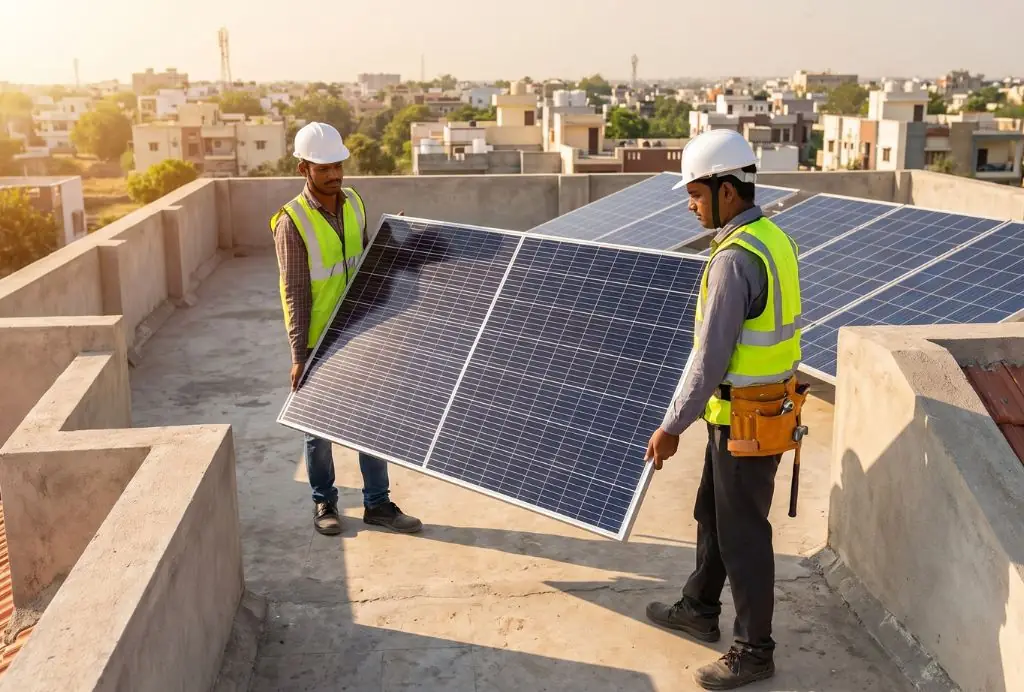
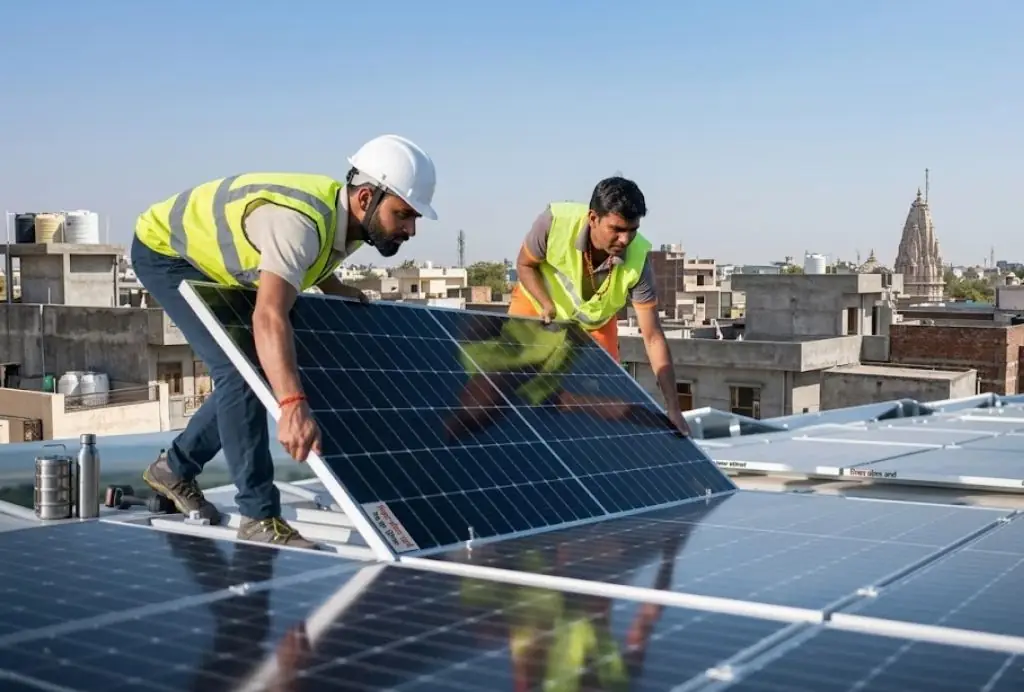
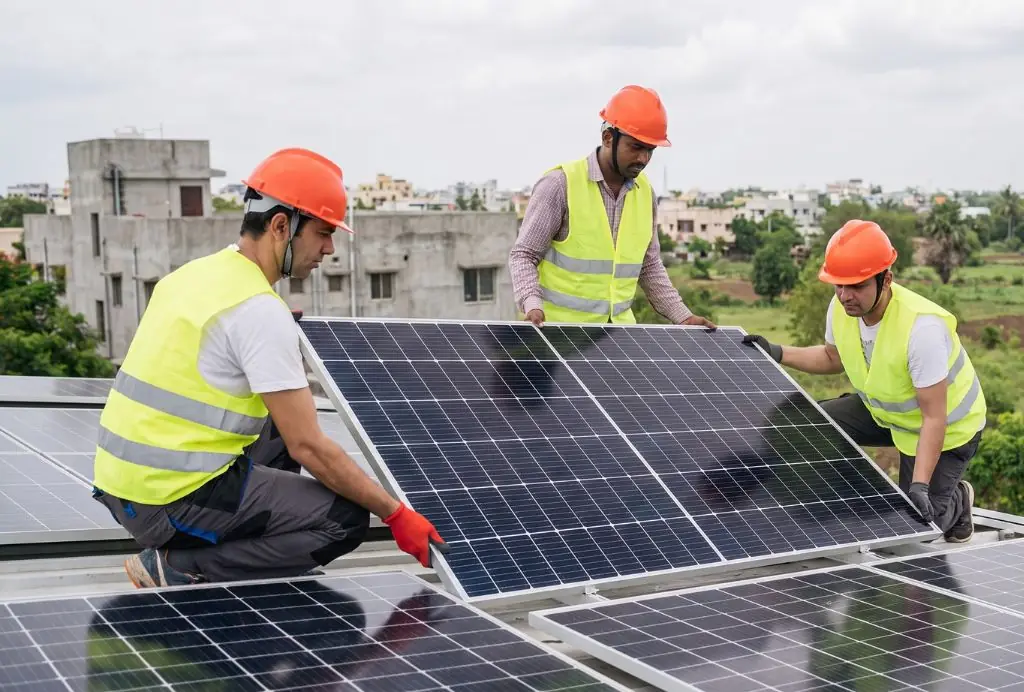
A 3 kW rooftop solar installation in Chennai typically takes six to ten weeks from site survey to a live, net-metered system. The physical installation itself is one to two days. TANGEDCO approval and bi-directional meter installation account for most of the elapsed time, commonly four to eight weeks.
STEP 01
Site assessment and energy audit
Same week as your enquiry
STEP 02
Design and itemised quotation
2 to 3 days after survey
STEP 03
PM Surya Ghar and TANGEDCO filing
Filed by us immediately on approval of the quote
STEP 04
Installation on site
1 to 2 days
STEP 05
TANGEDCO inspection and meter
4 to 8 weeks, the main variable
STEP 06
Subsidy credited to your account
about 15 days after DISCOM approval and your redemption request
The largest cause of delay is an incomplete application or a system capacity that exceeds your sanctioned load. We check the sanctioned load at the survey and file the load enhancement first where one is needed, rather than discovering the problem at inspection. More on how TANGEDCO net metering works.
Your 3kW quotation
Get your 3kW price
Every roof prices differently. Yours depends on its usable area, its type, how far you are from the coast, your access height and your sanctioned load. Send us your area and your last EB bill and we will come back with an itemised 3 kW quotation, the subsidy you will receive, and what you pay net.
What you get back
- A confirmed system size based on your actual consumption, not a bill band
- An itemised price naming every component and brand
- The ₹78,000 subsidy applied, with the net figure stated plainly
- Expected annual generation and estimated bill after installation
- No obligation, and an engineer on the visit rather than a salesperson
Common questions
3kW solar in Chennai, common questions
What is the price of a 3kW solar system in Chennai?
A 3 kW system in Chennai starts at about ₹2,10,000 installed. After the ₹78,000 PM Surya Ghar subsidy it is about ₹1,32,000, and about ₹1,10,000 if the ₹22,000 Tamil Nadu top-up applies. The final figure depends on panel technology, inverter, structure, roof type, access height and distance from the coast, so we confirm it after a site survey. What is fixed is the subsidy: every 3 kW residential system qualifies for ₹78,000 under the PM Surya Ghar Muft Bijli Yojana, credited directly to your bank account after commissioning. Send us your area and EB bill for an itemised quotation.
How many units does a 3kW solar system generate in Chennai?
About 14 units a day, 430 units a month, or roughly 5,200 units a year. Chennai receives around 5.3 peak sun hours daily, which is higher than most of northern India, so a 3 kW system generates more here than the same system installed inland or further north.
How much subsidy do I get on a 3kW solar system?
₹78,000, which is the maximum available under the PM Surya Ghar Muft Bijli Yojana. Three kilowatts is the size at which the subsidy reaches its ceiling, so a 5 kW or 10 kW system receives the same ₹78,000 and no more. The subsidy is transferred to your bank account after TANGEDCO inspects and commissions the system, usually within about 15 days of DISCOM approval, once you redeem it on the portal.
How many solar panels are in a 3kW system?
Five to seven panels, depending on module wattage. With the 545 to 590 watt modules common in 2026, six panels is the usual configuration for a 3 kW system.
How much roof area does a 3kW solar system need?
About 250 to 300 square feet of shade-free roof area. What counts is usable area through the middle of the day, not total terrace size, so water tanks, staircase headrooms, parapet walls and neighbouring buildings all reduce the figure. This is the most common reason a planned 3 kW installation will not fit, which is why the survey comes before the quote.
Is a 3kW solar system enough for a home in Chennai?
For most Chennai households with a bi-monthly EB bill between ₹2,700 and ₹5,400, yes. That typically covers a two or three bedroom home running one or two air conditioners for part of the year alongside a fridge, fans, lighting, television, washing machine and water pump. Homes consuming more should look at 5 kW.
Can I use cheaper non-DCR panels on a 3kW system?
Not if you want the subsidy. Since 1 June 2026, systems claiming PM Surya Ghar support or applying for net metering must use DCR compliant modules built from ALMM List-II certified Indian cells. Non-DCR panels cost meaningfully less per watt but disqualify you from the full ₹78,000, which is a losing trade at 3 kW by a wide margin.
How long does a 3kW installation take in Chennai?
Six to ten weeks from survey to a live system. The installation itself is one to two days, and TANGEDCO approval plus bi-directional meter installation accounts for most of the remaining time, commonly four to eight weeks. Delays usually come from incomplete applications or a system size that exceeds the sanctioned load.
What is the payback period on a 3kW solar system in Chennai?
Most Chennai homes recover the post-subsidy cost in four to six years. Payback is fastest for households consuming above 500 units per bi-monthly cycle, since those households receive only 100 free units instead of 200 under Tamil Nadu's tariff structure and pay higher slab rates at the same time.
Does a 3kW system work during power cuts?
A standard on-grid 3 kW system shuts down during a grid outage, which is a mandatory safety feature protecting line workers. If you need power during cuts, a hybrid system with battery backup is required, which costs more. We size the battery to your critical load rather than the whole house, which keeps the cost reasonable.
What is the price of a 3kW solar system without subsidy?
About ₹2,10,000 installed in Chennai. That is the amount you pay at installation. The ₹78,000 PM Surya Ghar subsidy comes back to your bank account after commissioning, taking it to about ₹1,32,000, and the ₹22,000 Tamil Nadu top-up, where you qualify, takes it to about ₹1,10,000.
Is a 3 kVA solar system the same as 3 kW?
For a home on-grid system, in practice yes. Panels are rated in kW (kWp) and inverters are sometimes rated in kVA; an on-grid inverter runs close to unity power factor, so a 3 kVA inverter delivers about 3 kW. When you compare quotes, check the total kWp of the panels and the inverter model separately.
What is the EMI on a 3 kW solar system?
On SBI's PM Surya Ghar loan you pay a 10% margin, about ₹21,000, and borrow about ₹1,89,000. That is under ₹2 lakh, so it gets SBI's lower 5.75% rate with no minimum income or CIBIL score, which works out to about ₹2,100 a month over ten years. That is close to the ₹1,800 to ₹2,600 a month a 3 kW system typically saves. Once the ₹78,000 subsidy is credited to the loan account, the balance falls to about ₹1,11,000.