TOPCon vs Mono PERC: Which Panel Belongs on an Indian Roof?
TOPCon vs Mono PERC on the four numbers that decide it on a hot Indian roof: temperature coefficient, first-year degradation, year 25 output and warranty.


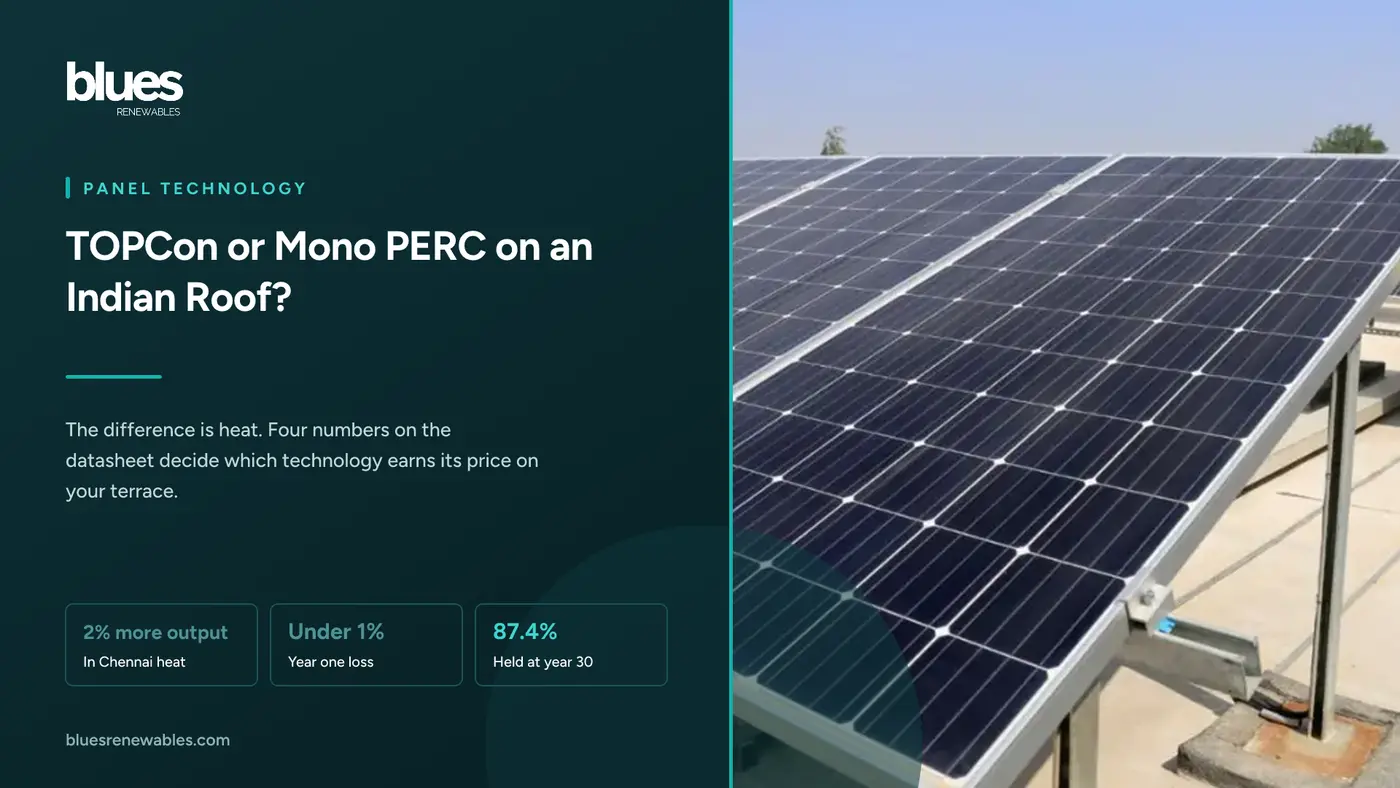
Two quotes, same 3 kW, same roof. One says Mono PERC. The other says TOPCon and costs about ₹15,000 more. Both salespeople sound certain, and neither explains what the words mean.
The honest answer is that the difference is real but small on paper and larger in practice, and almost all of it comes down to heat. A panel is rated in a laboratory at 25°C. Your terrace in Chennai in May is nowhere near 25°C, and the gap between the two technologies widens exactly when your fans and air conditioners are running hardest.
This guide compares TOPCon and Mono PERC on the four numbers that decide the outcome on an Indian roof, shows where Mono PERC is still the sensible buy, and lists what to check on the datasheet before you sign. For what each technology costs per watt, see our solar panel price in Chennai page, which carries the current bands.
Key takeaways
- Heat is the whole argument. TOPCon loses roughly 0.29 to 0.30 percent of output per degree above 25°C. Mono PERC loses about 0.34 to 0.35 percent. On a 65°C roof that gap is worth around two percent of generation.
- TOPCon starts better and fades slower. First-year degradation is commonly under 1 percent against roughly 2 percent for Mono PERC, and the annual rate afterwards is lower too.
- The warranty gap is wider than the price gap. TOPCon modules commonly carry a 30-year performance warranty holding at least 87.4 percent of rated output, against 25 years and roughly 80 to 84 percent for Mono PERC.
- Mono PERC still wins on a budget with space to spare. If your roof is larger than your requirement, buying more Mono PERC watts can beat buying fewer TOPCon watts.
- Neither matters if the model is not ALMM listed. Technology choice is irrelevant to a subsidy claim that fails verification. Ask for the model number, not the brand.
- Read the datasheet, not the brochure. Temperature coefficient, first-year degradation and the year-25 figure are all printed on it, and a supplier who will not send it has answered your question.
TOPCon vs Mono PERC: the short answer
For most Indian rooftops in 2026, TOPCon is the better buy, and the reason is climate rather than headline efficiency.
Mono PERC is the technology that made rooftop solar affordable. It is mature, it is cheap, and it works. TOPCon is its successor, and in a hot country its advantages land where they are worth most.
The case for Mono PERC is narrower than it was but has not disappeared, and it comes down to how much roof you have. More on that below.
What actually changes inside the cell
PERC stands for Passivated Emitter and Rear Cell. A reflective layer is added behind the cell so that light which passes straight through gets a second chance to be absorbed. It was a genuine step forward and it is still in most Indian installations.
TOPCon stands for Tunnel Oxide Passivated Contact. The improvement sits at the back contact. A very thin oxide layer plus a doped polysilicon layer lets electrons out while blocking the recombination losses that a direct metal contact causes.
What that buys you, in plain terms: fewer electrons lost, less sensitivity to heat, and less of the first-year fading that PERC cells are prone to. TOPCon is also an N-type cell, which is why it largely avoids the light-induced degradation that affects P-type PERC in its first weeks of sun.
You do not need any of this to choose a panel. You need the four numbers it produces.
The four numbers that decide it on an Indian roof
Temperature coefficient
This is the one that matters most here, and it is the one nobody mentions.
Every panel is rated at a cell temperature of 25°C. Modules on an Indian terrace routinely run 25 to 30°C above the surrounding air, so a 38°C May afternoon in Chennai puts the cells somewhere near 65°C.
At 65°C, a module with a temperature coefficient of −0.35 percent per °C is producing about 14 percent below its rating. A module at −0.30 percent is producing about 12 percent below. The gap is roughly two percent of output, and it appears in the middle of the day, which is when your own consumption is highest and your units are worth the most.
TOPCon modules typically list −0.29 to −0.30 percent per °C. Mono PERC typically lists −0.34 to −0.35 percent.
First-year degradation
Panels lose a little output in their first year and then settle into a slow annual decline. P-type Mono PERC commonly gives up around 2 to 2.5 percent in year one, largely to light-induced degradation. N-type TOPCon commonly stays under 1 percent.
That difference never comes back. It is a permanent offset applied to every year that follows.
The year-25 number
Read the performance warranty as a promise about year 25, not as a number of years.
Mono PERC datasheets commonly guarantee somewhere around 80 to 84 percent of rated output at year 25. TOPCon datasheets commonly guarantee at least 87.4 percent at year 30, with a 15-year product warranty behind it rather than the 10 to 12 years typical of Mono PERC.
Manufacturers vary, and some now offer 30 years on both. This is exactly why the datasheet matters more than the category.
Bifaciality
TOPCon cells collect light from the rear face more effectively than PERC cells do. On a flush rooftop installation with a dark surface beneath, that is worth very little. On an elevated structure over a light-coloured terrace, or a ground mount over pale soil, it is worth having.
If your installer is quoting bifacial modules for a flush rooftop mount, ask what rear-side gain they are actually assuming. The usual honest answer is close to nothing.
What three years of field data showed
Laboratory ratings are one thing. A published three-year field study in Qatar's desert climate tested commercial PERC, TOPCon and SHJ modules side by side and found that TOPCon modules delivered nominally higher efficiency, higher fill factor and a higher bifaciality factor, together with lower temperature coefficients and lower first-year and annual degradation.
Qatar is hotter and dustier than Chennai, so the results are not a direct transfer. But the direction is the one that matters, and it is measured over three years outdoors rather than modelled.
The same study is a reminder that PERC is not one thing. Multicrystalline and cast-mono PERC degraded faster in year one than monocrystalline PERC did. If a quote says only "Mono PERC", you still do not know quite what is arriving.
When Mono PERC is still the right buy
There is a real case, and it is about area rather than technology.
If your roof is comfortably larger than the system you need, the cheaper technology can win. Suppose TOPCon costs you 10 percent more per watt and delivers 4 percent more energy over the life of the system. On a roof with room to spare, that same 10 percent spent on additional Mono PERC watts buys more total generation than the upgrade does.
That logic reverses the moment space runs out. On a constrained terrace, where the number of panels is fixed by the area available, every watt has to work as hard as possible, and the higher-efficiency module is the only way to fit more capacity onto the same footprint.
So the decision is simpler than it looks:
- Roof larger than your requirement, budget tight: Mono PERC, and buy more of it.
- Roof roughly equal to your requirement: TOPCon, for the heat performance and the longer warranty.
- Roof smaller than your requirement: the highest efficiency you can afford, which today means TOPCon or better.
What to check on the datasheet before you sign
Ask for the datasheet of the exact model, then check six lines:
- Model number, and confirm it appears on the ALMM list. A brand can have both listed and unlisted models, and the subsidy is checked against the model.
- Temperature coefficient of Pmax, expressed as a percentage per °C. Lower is better.
- First-year degradation, stated separately from the annual rate.
- Guaranteed output at end of warranty, with the year it applies to.
- Product warranty years, which cover defects, as distinct from the performance warranty.
- Bifaciality factor, if bifacial modules are being quoted, along with the rear-side gain assumed in the generation estimate.
If the supplier sends a brochure instead of a datasheet, ask again. A brochure prints the efficiency and hides the temperature coefficient, which is the number that decides how the panel behaves in the month you need it most.
Frequently asked questions
Is TOPCon better than Mono PERC?
On most Indian rooftops, yes. TOPCon holds its output better in heat, loses less in the first year and usually carries a longer performance warranty. Mono PERC remains a sound choice where the roof is larger than the system you need and budget leads the decision.
What is the difference between TOPCon and Mono PERC?
Both are silicon cells with a passivated rear surface. TOPCon adds a thin tunnel oxide and a doped polysilicon layer at the rear contact, which reduces recombination losses. In practice it produces a lower temperature coefficient, lower first-year degradation and a higher bifaciality factor.
Does TOPCon perform better in Indian heat?
That is its main advantage here. A typical TOPCon module loses about 0.30 percent of output per degree above 25°C against roughly 0.35 percent for Mono PERC. At the 65°C cell temperatures common on an Indian terrace in summer, that is worth around two percent of generation.
Is TOPCon worth the extra cost in India?
It depends on your roof. If space is the binding constraint, yes, because efficiency decides how much capacity fits. If you have more roof than you need, the same money spent on additional Mono PERC capacity may generate more.
What warranty do TOPCon panels come with?
Commonly a 15-year product warranty and a 30-year performance warranty holding at least 87.4 percent of rated output at year 30. Mono PERC commonly carries 10 to 12 years product and 25 years performance ending nearer 80 to 84 percent. Terms vary by manufacturer, so read the datasheet.
Are TOPCon panels ALMM approved in India?
Many are, but approval attaches to specific models rather than to a technology or a brand. Ask for the model number being supplied and check it against the list yourself before you pay.
Is Mono PERC being discontinued?
It is being displaced rather than discontinued. Manufacturing capacity has shifted heavily towards N-type, and the practical consequence for a buyer is that Mono PERC stock is increasingly older stock. Ask when the modules were manufactured.
Where this fits
Once you have settled the technology, our solar panel price in Chennai page gives the current price per watt for each type and what a fair installed cost looks like. Before you pay anyone, how to verify a solar company covers the registrations you can check yourself, including how to confirm an ALMM listing. If you are still sizing the system, how many solar panels are required for 3 kW works through the panel count at each wattage.
Blues Renewables specifies and installs this equipment. We do not manufacture or sell panels, which means we have no reason to push you towards one cell technology over another. We will give you the make, model and datasheet of every component before you pay anything.
Call +91 98841 07170 and ask which technology your roof actually justifies.
Sources
- Kumar et al., Comprehensive assessment of performance and reliability of PERC, TOPCon and SHJ modules in desert climates, Solar Energy, 2025, three-year outdoor field study
- Manufacturer datasheets for commercial Mono PERC and TOPCon modules sold in India, for temperature coefficient, first-year degradation and warranty terms
- Ministry of New and Renewable Energy, Approved List of Models and Manufacturers for solar PV modules
- Blues Renewables installation records, Chennai and Tamil Nadu, 2020 to 2026, for observed roof-level module temperatures