Will Solar Panels Make My Roof Leak?
Panels do not leak. Holes do. What causes a leak after installation, how to avoid one on an RCC terrace or a sheet roof, and who pays when it happens.

It is the question people ask last, usually after they have already decided to go ahead, and it is the one with the most at stake. A leak does not announce itself on commissioning day. It arrives in the second or third northeast monsoon, as a damp patch on a bedroom ceiling, and by then the array has been on the roof for two years and nobody wants to own the problem.
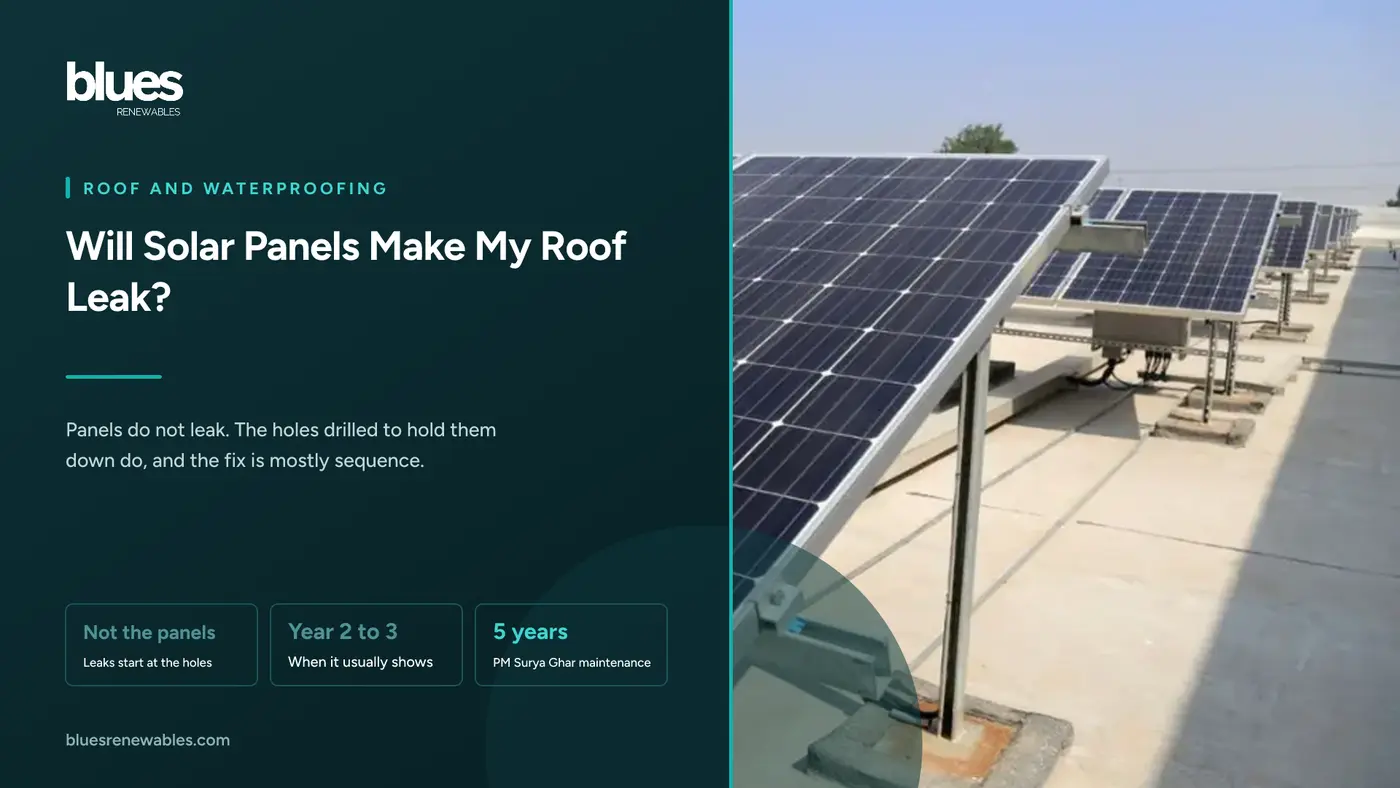
The reassuring part is that a solar array does not leak. Nothing about a panel or a rail lets water into a building. What lets water in is the hole somebody drilled to hold it down, and whether that hole was treated properly on the day.
This guide covers where leaks actually start, how the roof type changes the answer, and who is responsible when one appears.
Key takeaways
- Panels do not cause leaks. Penetrations do, and a roof that was already marginal fails faster once anything is fixed to it.
- The fix is mostly sequence. Waterproof the terrace before the array goes on, not after, because doing it afterwards means lifting the array.
- Non-penetrative mounting exists and suits many roofs, particularly sheet roofs and terraces in good condition.
- Chennai tests this every October. The northeast monsoon is the audit, and it arrives after the installer has been paid.
- This is workmanship, not product, so it sits with your installer, and it is the one warranty that dies if they close down.
- Photograph every penetration before it is covered. It is the only evidence that will matter in year three.
Where a leak actually starts
Four causes, in roughly the order they turn up.
An untreated penetration. A bolt through an RCC slab without a sealed sleeve, or a self-drilling screw through a metal sheet without the right washer. Water follows the fastener down. This is the commonest cause by a distance.
A penetration treated with the wrong thing. Ordinary silicone on a hot Chennai terrace has a short life. It hardens, shrinks and lifts within a couple of summers, and the joint opens. The material matters as much as the care taken applying it.
Existing waterproofing that was already failing. If the terrace had hairline cracks or a tired coat before the array arrived, the array did not cause the leak, but it did make the repair five times harder and it will get the blame.
Ponding. A badly planned layout can interrupt the fall of a terrace or block a drain outlet, leaving standing water where none used to sit. Water that cannot leave will eventually find a way in.
Notice what is not on that list. The modules, the rails and the clamps do not leak. It is always the interface with the building.
Your roof type decides the method
Flat RCC terrace
The common Chennai case and the most forgiving, because you have options.
Ballasted or non-penetrative mounting holds the structure down with weight rather than bolts. No holes at all, which removes the whole risk category. It needs the roof to carry the extra dead load and it needs careful wind design, which on this coast is not a formality.
Bolted with proper treatment is still perfectly sound and is often necessary for an elevated structure. What matters is what happens at each hole: a chemical anchor, a sleeve, a sealant rated for roof temperatures rather than a bathroom silicone, and a collar built up around the base so water sheds away rather than pooling at the foot.
Either way, the sequence is the thing. If the terrace needs waterproofing, do it before the array. A fresh coat under an installed array means dismantling and reinstalling to get at it.
Metal sheet roof
Common on factories, warehouses, poultry sheds and workshops.
Non-penetrative clamp systems grip the standing seam or the sheet rib and fix nothing through the sheet. On a profile that accepts them this is the right answer, and it is why we specify them on industrial roofs wherever the profile allows.
Where a fastener is unavoidable, it goes through the crown of the profile, never the valley, with an EPDM-bonded washer, and it is torqued rather than driven until it crushes. A screw driven too hard deforms the washer and the joint fails on the first hot day.
Sloped or Mangalore tiled roof
The most demanding, because the waterproofing is the tiles themselves and every fixing means lifting them. Done properly, brackets fix to the rafters and a flashing or a replacement tile carries the bracket through the plane. Done carelessly, a cracked tile is a leak with no obvious source.
What to require in the quotation
None of this is exotic, and all of it is checkable before you pay.
- The mounting method, named. Ballasted, bolted or clamped, not "standard structure".
- The treatment at each penetration, including the sealant and its temperature rating.
- Who is doing the waterproofing, if any is needed, and whether it happens before the array.
- A written workmanship warranty covering water ingress, with a number of years on it.
- Photographs of every penetration before the structure covers them.
That last one costs nothing and settles arguments. An installer who will not photograph their own waterproofing is telling you how confident they are in it. How to verify a solar company covers the rest of what a quotation should contain.
Who pays when it leaks
This is where the answer gets uncomfortable, and it is why the paperwork matters.
A roof leak is a workmanship failure, not a product failure. The panel manufacturer's warranty does not touch it and neither does the inverter's. It sits entirely with the company that drilled the hole.
Which means it is the one warranty that disappears when your installer does. Product and performance warranties belong to manufacturers and survive a contractor closing down; the workmanship cover does not. Solar panel warranty claim in India sets out which cover survives what.
Two practical consequences.
Ask how long the workmanship warranty runs and get it in writing. One year is thin for something whose failure mode appears in year two or three. Systems installed under PM Surya Ghar carry a five-year maintenance obligation from the registered vendor, which is worth knowing you already hold.
If the installer has gone, you are paying a waterproofing contractor and, separately, someone to lift and refit the array. Budget for both, and use the opportunity to have the terrace done properly rather than patched.
Frequently asked questions
Do solar panels cause roof leaks?
The panels do not. Leaks come from the penetrations made to fix the mounting structure, from sealant that was not rated for roof temperatures, or from waterproofing that was already failing before the array arrived.
Can solar be installed without drilling the roof?
Often yes. Ballasted mounting on a flat terrace holds the structure with weight, and clamp systems on a metal sheet roof grip the profile rather than fixing through it. Both need proper wind design, which matters on the Tamil Nadu coast.
Should I waterproof the terrace before installing solar?
Yes, if it needs it. Doing it afterwards means dismantling the array to reach the surface underneath, which costs far more than doing it in the right order.
Who is responsible if my roof leaks after solar installation?
Your installer. Water ingress from the mounting is a workmanship matter, not a product defect, so the panel and inverter manufacturers' warranties do not cover it. This is the one warranty that is lost if the installer closes down.
How long should the workmanship warranty be?
Ask for as long as you can get and treat one year as thin, because this failure mode typically surfaces in the second or third monsoon. Systems installed under PM Surya Ghar carry a five-year maintenance obligation from the registered vendor.
Does a leak mean the whole array has to come off?
Usually not. A single failed penetration can often be reached by lifting a few modules. A general waterproofing failure across the terrace is the case where the array does have to come off, which is the argument for treating the roof first.
Can solar go on a Mangalore tiled roof without leaks?
Yes, with the right method. Brackets should fix to the rafters with a flashing or a purpose-made tile carrying the bracket through the roof plane. Fixing through tiles without that detail is how cracked tiles and untraceable leaks happen.
Where this fits
Before choosing anyone, how to verify a solar company covers the checks you can run yourself, and is your solar quote too high explains why the cheapest quotation is usually cheap on the structure. For what happens when something fails later, see solar panel warranty claim in India.
Blues Renewables photographs every penetration before it is covered and hands the set over with the commissioning documents. We would rather you had the evidence than had to take our word for it in year three.
Call +91 98841 07170.
Sources
- IS 875 Part 3, wind loading, for the design wind speed that governs ballasted and non-penetrative mounting on the Tamil Nadu coast
- Ministry of New and Renewable Energy, PM Surya Ghar: Muft Bijli Yojana vendor agreement, for the five-year comprehensive maintenance obligation
- Manufacturer installation guidance for standing seam and trapezoidal sheet clamp systems
- Blues Renewables installation and service records, Chennai and Tamil Nadu, 2020 to 2026