Is Your Solar Quote Too High? Audit It Per Watt
Convert any solar quotation to a rate per watt, compare it to the Tamil Nadu benchmark, and see which reasons for a higher price are legitimate.



You have three quotations open on your phone. They are for different system sizes, one includes a battery, one nets off a subsidy and one does not, and the totals range across forty thousand rupees. Every salesperson has told you theirs is the fair one.
There is a simple way through this, and it is the same method installers use internally. Convert every quote to a rate per watt. Once all three are expressed in the same unit, the comparison stops being a matter of who sounded most convincing.
This guide shows you how to do that in two minutes, what the Tamil Nadu benchmark actually is, and, more usefully, which reasons for a higher rate are legitimate engineering and which are simply margin.
Key takeaways
- Divide the total by the watts. A ₹2,10,000 quote for a 3 kW system is ₹70 per watt. Every quote becomes comparable the moment you do this.
- The benchmark in Chennai runs from about ₹70 per watt at 3 kW down to about ₹58 per watt at 10 kW, installed and before subsidy. Smaller systems legitimately cost more per watt.
- Compare before subsidy, always. A quote that nets off the subsidy is not cheaper, it is presented differently, and the subsidy reaches you afterwards as a reimbursement.
- DCR compliance adds roughly ₹8 to ₹11 per watt and is mandatory for the subsidy, so a non-DCR quote is not competing with a DCR quote.
- The legitimate reasons for a higher rate are visible. Structure height, wind design, cable specification, protection equipment and roof access all cost real money.
- Divide the total by the watts. A ₹2,10,000 quote for a 3 kW system is ₹70 per watt. Every quote becomes comparable the moment you do this. - The benchmark in Chennai runs from about ₹70 per watt at 3 kW down to about ₹58 per watt at 10 kW, installed and before subsidy. Smaller systems legitimately cost more per watt. - Compare before subsidy, always. A quote that nets off the subsidy is not cheaper, it is presented differently, and the subsidy reaches you afterwards as a reimbursement. - DCR compliance adds roughly ₹8 to ₹11 per watt and is mandatory for the subsidy, so a non-DCR quote is not competing with a DCR quote. - The legitimate reasons for a higher rate are visible. Structure height, wind design, cable specification, protection equipment and roof access all cost real money. - Tamil Nadu's state top-up is live since 21 September 2026. It adds up to ₹22,000 at 3 kW for homes registered on the PM Surya Ghar portal on or after 5 August 2026, so check your registration date before a quote nets it off.
Work out your quote's rate per watt
Take the total installed cost and divide it by the system size in watts. A 3 kW system is 3,000 watts, and a 5.5 kW system is 5,500 watts.
₹2,10,000 for 3 kW comes to ₹70 per watt. ₹3,20,000 for 5 kW comes to ₹64 per watt.
Three rules make the comparison honest.
Use the number before subsidy. The central subsidy is a reimbursement paid to your bank account after TANGEDCO inspects and commissions the system. It does not reduce what you pay the installer on the day, so netting it off compares two different things.
Use the actual capacity, not the nominal one. Six 550 W panels is 3.3 kW, not 3 kW. Installers routinely quote a "3 kW system" that is really 3.3 kW, which makes the rate per watt look ten percent worse than it is. Multiply the panel wattage by the panel count and use that.
Make sure you are pricing the same scope. If one quote includes a battery and another does not, they are not comparable at any price. Strip the battery out before dividing.
What the benchmark actually is
A complete rooftop installation in Chennai, covering panels, inverter, mounting structure, cabling, earthing, installation and commissioning, runs from about ₹70,000 per kW at 3 kW, easing to about ₹58,000 per kW at 10 kW, before subsidy. That is ₹70 down to ₹58 per watt.
Our solar panel price in Chennai page carries the full breakdown by system size, along with the current price per watt for each panel technology.
The downward slope is real and it is not a discount for bulk. Net metering paperwork, the DISCOM application, the site visit and the mobilisation of a team cost roughly the same whether they are done for 3 kW or 10 kW, so those fixed costs are spread across more watts as the system grows. This is why a 2 kW quote at ₹75 per watt can be entirely fair while a 10 kW quote at the same rate is not.
If your quote sits inside the band for its size, it is not an outlier and the question becomes what it contains rather than what it costs. If it sits well above, work through the next two sections before concluding you are being overcharged.
Five reasons a higher rate is legitimate
These cost real money, they are visible on a site visit, and a good installer will point at them unprompted.
An elevated structure. Raising the array on a frame so the terrace stays usable underneath costs considerably more steel than a low flush mount. It is often the right choice and it is not padding.
Cyclone-rated wind design. Chennai sits on a coast with a high basic wind speed, and a structure engineered for it uses heavier sections, deeper foundations and more fixings. This is the single most common place a cheap quote saves money, and it is invisible until the year it is not.
Difficult roof access. A narrow lane, no crane access, a fourth-floor terrace with a spiral staircase, or a sloped tiled roof all add labour and time.
Better components. A TOPCon module with a 30-year performance warranty costs more per watt than older Mono PERC stock, and a hybrid or premium inverter costs more than an entry-level string inverter. Our comparison of TOPCon and Mono PERC covers whether that upgrade earns its keep on your roof.
DCR compliance. Domestic Content Requirement panels cost roughly ₹8 to ₹11 per watt more than non-DCR panels, and they are mandatory if you intend to claim the subsidy. A non-DCR quote will always look cheaper and will fail at verification.
That last one matters enormously and is frequently the whole explanation for a gap between two quotes. Ask each installer, in writing, whether the panels they are quoting are DCR compliant.
Four reasons a higher rate is not legitimate
Charging for the subsidy as a service. Filing the application is part of a normal scope. A separate fee to "process your subsidy" is a fee for work that should already be included.
A premium for a brand you cannot verify. If a quote is higher because of the module brand, ask for the model number and check it on the ALMM list yourself. A brand name with no model number behind it is not a specification.
Oversizing you did not ask for. A 6 kW system on a household that consumes 300 units a month will not save proportionally more, because Tamil Nadu's free units and fixed charges stay on the bill regardless. Confirm the size was derived from your consumption rather than from your roof area.
Vague scope with a high number. A quotation without makes, models, structure specification and an exclusions list cannot be audited at all. The price is not the problem. The absence of detail is.
The subsidy presentation that makes a bad quote look good
This one catches careful people.
The PM Surya Ghar subsidy pays ₹30,000 for a 1 kW system, ₹60,000 for 2 kW, and ₹78,000 for 3 kW and above. It is transferred to your bank account after commissioning, typically within 30 to 45 days.
An installer quoting ₹2,30,000 for 3 kW and presenting it as "₹1,52,000 after subsidy" is quoting ₹76.67 per watt, which is above the band. An installer quoting ₹2,05,000 and presenting the full figure is quoting ₹68.33 per watt. The second is the better deal, and the first looks cheaper only because the subsidy has been moved to a different line.
Two further traps sit alongside it.
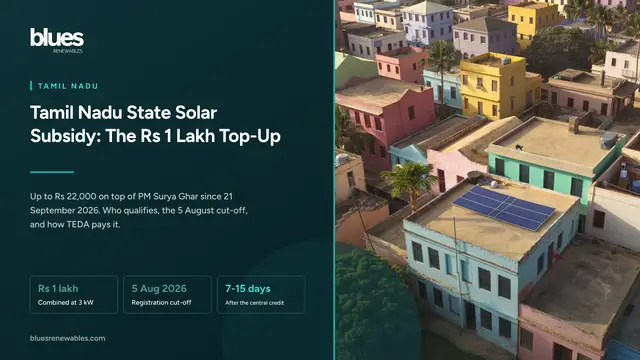
Tamil Nadu added a state top-up for residential rooftop solar on 21 September 2026, up to ₹22,000 on 3 kW, but only for homes registered on the PM Surya Ghar portal on or after 5 August 2026, and it is limited to the first one lakh consumers, with ₹50 crore allocated this year. A quote that nets it off for an earlier registration is netting off money you will not receive. Several sites still advertise an older figure of around ₹20,000 per kW. Our PM Surya Ghar last date page tracks its status.
And the subsidy requires an Aadhaar-seeded bank account, because it is paid by direct transfer. An unseeded account blocks the payment after everything else has gone right. Fix that before installation day rather than after.
What a suspiciously cheap quote is cheap on
The instinct to distrust the highest quote is sound. The instinct to trust the lowest is not.
A quote that sits well below the band is usually saving money in three specific places, all of which are invisible once the system is commissioned and all of which decide whether it survives fifteen monsoons: the mounting structure, the cable specification, and the protection equipment.
There is a fourth possibility worth naming. The cheapest quote sometimes comes from a business that will not exist in year three, which matters because the workmanship warranty is the one that dies with the installer. Solar panel warranty claim in India explains which cover survives and which does not, and how to verify a solar company covers the registrations you can check before paying.
Three questions that settle it
If you ask nothing else, ask these, and ask all three quotes:
What is the make and model of the panel and the inverter, and is the panel DCR compliant? This settles most price gaps on its own.
What wind speed is the mounting structure designed for, and what is the section size? A supplier who cannot answer has not engineered it.
What is excluded? Civil work, cable beyond a stated length, a meter box change and load enhancement are the usual omissions, and they reappear as extras after you have paid.
The answers will separate the quotes faster than the totals did.
Frequently asked questions
How do I know if my solar quote is too high?
Divide the total installed cost, before subsidy, by the system size in watts. In Chennai the benchmark runs from about ₹70 per watt at 3 kW down to about ₹58 per watt at 10 kW. A quote well above the band for its size needs explaining.
What is a fair price per watt for solar in Tamil Nadu?
Roughly ₹58 to ₹70 per watt installed before subsidy, depending on system size, covering panels, inverter, structure, cabling, earthing, installation and commissioning. Smaller systems sit at the higher end because fixed costs do not scale down.
Why is one solar quote so much cheaper than another?
Most often because the panels are not DCR compliant, which saves roughly ₹8 to ₹11 per watt but disqualifies the subsidy, or because the mounting structure, cable specification or protection equipment has been reduced. All three are invisible after commissioning.
Should I compare solar quotes before or after subsidy?
Always before. The subsidy is reimbursed to your bank account after commissioning, so it does not change what you pay the installer. Comparing after-subsidy figures lets a higher quote present itself as the cheaper one.
Does a bigger solar system cost less per watt?
Yes. Net metering paperwork, the DISCOM application and team mobilisation cost about the same at any size, so those fixed costs spread across more watts. That is why a 2 kW system is legitimately dearer per watt than a 10 kW one.
Is there a Tamil Nadu state subsidy on top of PM Surya Ghar?
### Is there a Tamil Nadu state subsidy on top of PM Surya Ghar? Yes. Since 21 September 2026, Tamil Nadu adds up to ₹22,000 at 3 kW on top of PM Surya Ghar, for homes registered on the portal on or after 5 August 2026, so the combined subsidy can reach ₹1,00,000. TEDA pays it directly, with no separate application.
How much GST should be on a solar quotation?
GST on solar panels and solar power generating systems is 5 percent, reduced from 12 percent on 22 September 2025. For a turnkey installation the 70:30 composite supply rule gives an effective rate of about 8.9 percent. Buying components separately can attract 18 percent on inverters, batteries and structures.
Where this fits
For the full price breakdown by system size and panel technology, see solar panel price in Chennai. Before paying anyone, work through how to verify a solar company, which covers the registrations you can check yourself in an afternoon. If you are still choosing components, TOPCon vs Mono PERC explains what the upgrade actually buys.
Blues Renewables issues itemised quotations with the make, model and rating of every component, the structure specification and design wind speed, and an explicit list of exclusions. You are welcome to take ours and audit it exactly as described above. We would rather you did.
Send us the quote you are holding on +91 98841 07170 and we will tell you what it is missing, including if the answer is nothing.
Sources
- Blues Renewables installed pricing, Chennai and Tamil Nadu, 2026, for the rate per watt by system size
- Ministry of New and Renewable Energy, PM Surya Ghar: Muft Bijli Yojana, for Central Financial Assistance slabs and the reimbursement process
- Ministry of New and Renewable Energy, Approved List of Models and Manufacturers, and Domestic Content Requirement provisions
- GST notifications on solar photovoltaic modules and solar power generating systems, effective 22 September 2025, and the 70:30 composite supply rule
- IS 875 Part 3, wind loading, for the Chennai basic wind speed and cyclone importance factor