Solar vs Diesel Generator: They Do Not Solve the Same Problem
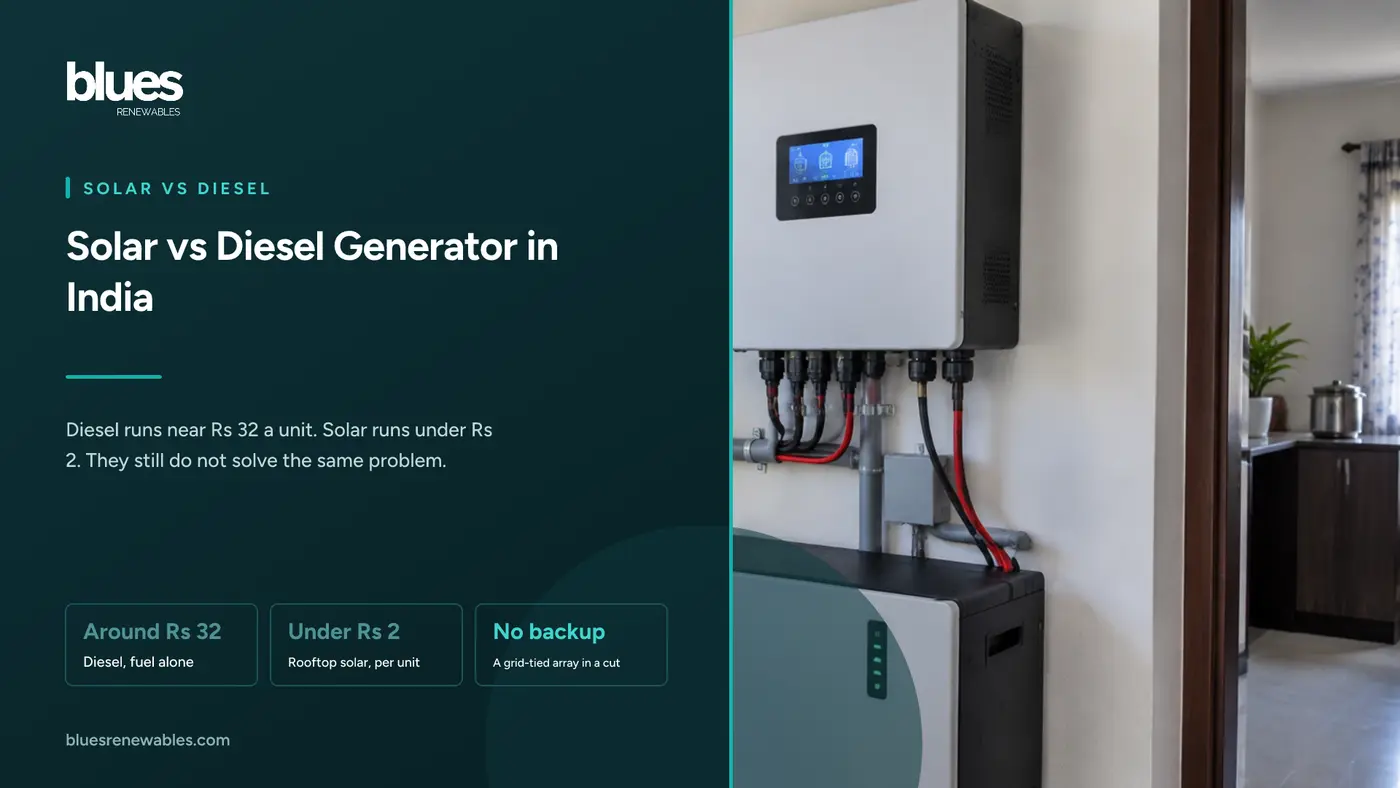
Diesel backup runs near ₹30 a unit before maintenance. Solar runs under ₹2. But a grid-tied array gives you no backup at all, which is the part comparisons skip.

Ask whether solar can replace the diesel generator and you will get a confident yes from people selling solar and a confident no from people selling generators. Both are answering a question you did not quite ask.
A generator exists so that the lights stay on when the grid fails. A solar array exists so that the bill is smaller when the grid is working. They are priced against different problems, and the moment you compare them on cost per unit alone you are comparing an insurance policy with a savings account.
This guide puts real numbers on both, then sets out the cases where one genuinely displaces the other.
Key takeaways
- Diesel backup costs around ₹30 a unit on fuel alone at current prices, before maintenance, before servicing and before the capital.
- Rooftop solar costs under ₹2 a unit across its life, which is less than the grid and far less than diesel.
- A grid-connected array provides no backup. It disconnects the instant the grid fails, by regulation and for the safety of line workers.
- So solar does not replace a generator. It replaces grid purchases, which is a different and larger bill.
- Storage is the thing that displaces diesel, and it is a separate decision with its own economics and its own rules in Tamil Nadu.
- Most sites that get this right keep all three: solar for the bill, the grid for the bulk, and the generator for the outage.
What a diesel unit actually costs
The arithmetic is unforgiving and most owners have never done it, because the fuel bill and the electricity bill arrive separately.
A diesel generator running under reasonable load consumes roughly 0.3 to 0.35 litres of diesel per unit of electricity produced. Diesel in 2026 sits near ₹95 to ₹100 a litre.
0.33 litres per unit at ₹97 a litre works out at about ₹32 a unit, on fuel alone.
That figure carries nothing else. Not the oil changes, not the filters, not the annual service, not the operator, not the overhaul at the end of a few thousand hours, and not the capital cost of the machine, which runs ₹35,000 to ₹45,000 for a 5 kVA set and ₹60,000 to ₹80,000 for a 10 kVA one, far more for anything industrial.
It also assumes the set is reasonably loaded. A generator running lightly loaded burns close to the same fuel for fewer units, which pushes the real cost per unit higher still. A 75 kVA set under load burns in the region of 12 to 15 litres an hour.
What a solar unit costs
Solar has almost the opposite shape: nearly all cost at the start, almost none afterwards.
Take the figures this site uses throughout. Installed cost runs about ₹58 to ₹70 per watt for a small rooftop system, and generation averages about 4.8 units per kW per day in Tamil Nadu.
One kilowatt costs around ₹65,000 and produces about 1,750 units a year. Across a 25-year life that is roughly 43,000 units, which is about ₹1.50 a unit before maintenance. Allow generously for cleaning, an inverter replacement and a little degradation, and it still lands under ₹2.
That is the cheapest electricity available to an Indian building, and it is why the comparison looks so lopsided.
The three sources, side by side
- Rooftop solar - Cost per unit: under ₹2, Available when the grid fails: No, What you are buying: A smaller bill
- Grid, domestic - Cost per unit: around ₹7 at the margin, Available when the grid fails: No, What you are buying: Everything else
- Grid, commercial - Cost per unit: ₹7 to ₹8.50, Available when the grid fails: No, What you are buying: Everything else
- Diesel generator - Cost per unit: around ₹32 on fuel alone, Available when the grid fails: Yes, What you are buying: Availability
Read the third column before the second. It is the whole argument.
Why a grid-tied array gives you nothing in an outage
This surprises people who have just spent two lakh rupees, so it is worth being plain about.
A standard on-grid solar inverter is required to disconnect within moments of losing the grid. The reason is not commercial, it is safety: a system that kept exporting into a dead line would energise a network that engineers are working on believing it to be dead. The function is called anti-islanding and every grid-connected inverter sold in India has it.
The practical consequence: on a cloudless afternoon, in a power cut, a 5 kW rooftop array powers nothing. The panels are generating and the inverter has shut down.
No installer can configure around this on a standard on-grid system, and any who offers to is proposing something you should not accept.
What actually displaces diesel
Storage, and only storage. A battery lets the array carry load through an outage, which is the function the generator was bought for.
Two honest caveats before anyone sells you one.
It costs more than the problem does, for most sites. A battery sized to carry a household through the evening is a large fraction of the cost of the solar itself. Where outages are rare, the generator sits idle for a few hours a year and that is cheaper than storing power you did not need to store.
Tamil Nadu has specific rules about it. Battery backup on a grid-connected system is permitted, but restricted, and the arrangement requires prior intimation. TANGEDCO hybrid inverter rules sets out exactly what is allowed and what is routinely done anyway. This is worth reading before a quotation arrives, because it is a common place for an installer to offer something that will not survive inspection.
Where storage does earn its place is at sites where an outage is expensive rather than inconvenient: a poultry shed where ventilation failure kills birds within minutes, a milk chilling centre, a cold store, a data room.
When solar genuinely reduces generator running
Even without a battery, solar can cut diesel consumption, and here the mechanism is indirect.
A business running a generator through a daily load-shedding window in daylight will find that solar reduces the load the generator has to carry when the grid is up, and in some configurations allows a smaller set to cover the same site. Where the generator runs to cover peak demand charges rather than outages, solar shaving the peak reduces both.
That is a genuine saving, it is site specific, and it needs measuring rather than assuming. Anyone quoting a diesel saving without an energy audit of when the generator actually runs is guessing.
Frequently asked questions
Is solar cheaper than a diesel generator?
Per unit, by a very wide margin. Rooftop solar costs under ₹2 a unit across its life against roughly ₹32 a unit for diesel on fuel alone at current prices. They are not substitutes, though: only the generator works during an outage.
Can solar replace my diesel generator?
Not on its own. A grid-connected array shuts down when the grid fails, so it provides no backup. Solar plus battery storage can replace a generator, at a cost that is only justified where outages are frequent or expensive.
Why does my solar system not work during a power cut?
Because the inverter is required to disconnect when the grid goes down, so that it cannot energise lines that engineers may be working on. It is called anti-islanding and it is a safety requirement on every grid-connected inverter, not a fault or a limitation of your particular system.
How much does it cost to run a diesel generator per unit in India?
A reasonably loaded set consumes about 0.3 to 0.35 litres per unit. At ₹95 to ₹100 a litre that is roughly ₹30 to ₹35 a unit for fuel alone, before servicing, oil, filters, the operator and the capital cost of the machine.
Should I buy solar or a generator first?
They answer different questions. If your problem is the size of the bill, solar. If your problem is that the power goes out and something expensive happens, a generator. Most sites with both bought the generator first because they had to, then added solar because the bill justified it.
Does solar reduce how much diesel I burn?
Sometimes, and it needs measuring. If the generator runs during daylight to cover load shedding or to shave a demand peak, solar reduces what it has to carry. If it only runs at night during outages, solar changes nothing about it.
Where this fits
If backup is the actual problem you are solving, TANGEDCO hybrid inverter rules covers what Tamil Nadu permits on a grid-connected system, and our off-grid solar systems in Chennai page covers the fully independent case. If the bill is the problem, what rooftop solar costs and is your solar quote too high are the places to start.
Blues Renewables will tell you which of the three problems you actually have before quoting for any of them. If your generator runs twice a year, we will say that storage is not worth costing.
Call +91 98841 07170.
Sources
- Published diesel generator fuel consumption figures of 0.3 to 0.35 litres per kWh, and Indian retail diesel prices, 2026
- Indian generator capital cost ranges for 5 kVA and 10 kVA sets, 2026
- Blues Renewables installed pricing and generation records, Tamil Nadu, for the levelised cost of rooftop solar
- Central Electricity Authority connectivity standards on anti-islanding for grid-connected inverters
- Tamil Nadu Electricity Regulatory Commission and TANGEDCO, on battery arrangements behind a grid-connected system