Solar Panel Warranty Claim in India: What to Do When the Installer Has Gone
Three warranties cover a rooftop system and three different parties honour them. Which is which, what to keep, and how to claim when the installer has gone.


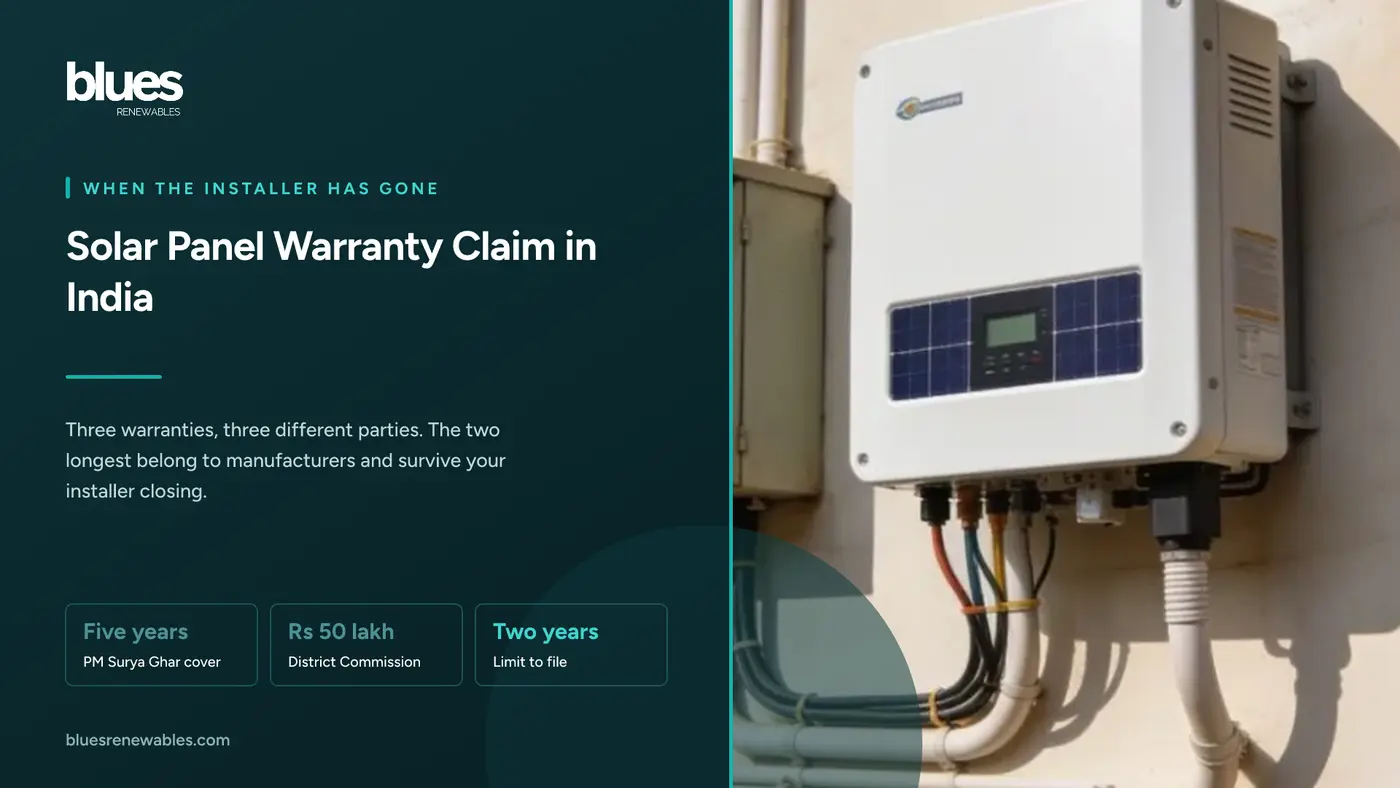
The inverter stops in year four. You call the number on the invoice and it rings unanswered. The WhatsApp display picture is still there, the website has expired, and the engineer who commissioned the system now works somewhere else.
This is the most common warranty problem in Indian rooftop solar, and it is worth understanding before it happens, because the answer is better than most people assume. A rooftop system is covered by three separate warranties honoured by three different parties, and the two longest ones are not the installer's at all. Losing your installer is a serious inconvenience. It is rarely the end of your cover.
This guide sets out which warranty covers what, the five-year obligation most subsidy customers do not know they hold, the paperwork that decides whether a claim survives, and how to escalate when a manufacturer refuses.
Key takeaways
- Three warranties, three parties. The panel manufacturer covers defects and long-term output. The inverter manufacturer covers the inverter. Your installer covers workmanship. Only the third one dies with the installer.
- Product and performance warranties are the manufacturer's obligation, not the installer's, and they survive the installer closing down entirely.
- PM Surya Ghar customers hold a five-year maintenance obligation from the vendor, written into the standard agreement under the scheme.
- Serial numbers are the claim. Without module serial numbers and the commissioning documents, a manufacturer has no way to confirm what you own and every reason to decline.
- A performance warranty needs measured evidence, not an impression that output has fallen. Keep your generation data from the start.
- Consumer commissions handle this. Complaints can be filed online through e-Daakhil, and the District Commission covers claims up to ₹50 lakh, which is every rooftop dispute.
Solar panel warranty claim in India: three warranties, three different people
Almost every argument about warranties starts with someone conflating these three. Separate them and most confusion disappears.
Product warranty, from the panel manufacturer
This covers manufacturing defects and workmanship in the module itself: delamination, junction box failure, cell cracking that is not your fault, frame corrosion. Indian manufacturers commonly offer 10 to 12 years, with 15 years increasingly standard on newer N-type modules.
The obligation sits with the manufacturer. It does not pass through the installer, and the installer closing down does not extinguish it.
Performance warranty, from the panel manufacturer
This is a promise about output, not about defects. It guarantees that the module still produces at least a stated percentage of its rated power after a stated number of years, typically along a straight line from year one.
Mono PERC modules commonly guarantee somewhere near 80 to 84 percent at year 25. Newer TOPCon modules commonly guarantee at least 87.4 percent at year 30. Our guide to TOPCon vs Mono PERC covers why those numbers differ.
Again, the manufacturer carries this, for 25 or 30 years, regardless of who installed it.
Workmanship warranty, from your installer
This covers the things the installer did rather than the things the factory made: the mounting structure, the cabling, the earthing, the waterproofing of roof penetrations, the quality of the terminations. One to five years is typical, and five is what the subsidy scheme requires.
This is the warranty that disappears when the installer does. It is also, in our experience, the one that gets claimed most often, because the majority of rooftop faults are connection and structure faults rather than panel faults.
And the inverter, separately
The inverter carries its own manufacturer warranty, commonly 5 to 10 years, sometimes extendable at purchase. It is the component most likely to need a claim, because it is the only part of the system with active electronics running every day.
Check whether your inverter brand has an Indian service presence. A warranty honoured from another country by email is not the same product as one with a service centre in Chennai.
The five-year obligation most subsidy customers do not know they have
If your system went in under PM Surya Ghar: Muft Bijli Yojana, the standard vendor agreement under the scheme is not a bare supply contract. It is executed for the design, supply, installation, commissioning and five-year comprehensive maintenance of the rooftop system, along with warranty.
That means a registered vendor who installed your system under the scheme owes you five years of maintenance, not simply a working system on handover day. The obligation is written into the scheme's own documentation, which the Tamil Nadu DISCOM publishes alongside the guidelines.
Two practical consequences follow.
First, if your vendor is ignoring you within those five years, you are not asking a favour. You are asking for performance of a written obligation, and saying so in writing tends to change the tone of the conversation.
Second, the DISCOM and the national portal both have a record of which registered vendor installed your system. A vendor who wants to keep receiving subsidy work has a reason to care about a complaint routed that way.
What happens when the installer shuts down
Work through it in this order.
1. Establish what actually failed. A panel fault, an inverter fault and a wiring fault go to three different places. If the inverter display shows an error code, photograph it. If one string is dead and another is fine, say so. The more precisely you can describe the fault, the less easily anyone can deflect it.
2. Go to the manufacturer directly. For a panel or inverter fault, the manufacturer is the warranty provider and you do not need the installer's permission or involvement. Most Indian manufacturers accept claims directly from end customers and have a service email or a portal.
3. Send the documents unprompted. A manufacturer receiving a claim with the invoice, the model, the serial numbers and the commissioning date attached will process it. One receiving "my panel is not working" will ask for those things and lose a fortnight.
4. Find a replacement service provider for the labour. Here is the part people miss. A manufacturer honouring a product warranty typically supplies a replacement module or inverter. It does not usually pay for someone to climb onto your roof and fit it. That labour was your installer's workmanship cover, and it has gone. Budget for a service visit.
5. Escalate if the manufacturer refuses. See below.
The paperwork that decides whether a claim survives
Collect these now, while everything works, and keep a copy somewhere that is not a phone.
- Tax invoice, itemising the modules and inverter with makes, models and quantities
- Module serial numbers, which appear on the module label and should appear on your handover documents. Photograph the labels before the panels go up, because afterwards they are on the underside, three metres in the air
- Inverter serial number and the warranty certificate or registration confirmation
- Datasheets for the exact models supplied, which is where the guaranteed output figures live
- Commissioning report and handover document, with the date
- Net metering approval and the meter installation record from TANGEDCO
- Baseline generation data for the first full month, which is what a performance claim will eventually be measured against
That last one is the one nobody keeps and everybody needs. A performance warranty claim is a claim that output has fallen below a guaranteed line. You cannot show that without knowing where you started.
How to file when the manufacturer refuses
Rooftop solar sold to a household is a consumer transaction, and the consumer commissions exist for exactly this.
Send a written demand first. Email the manufacturer and, if they still exist, the installer, setting out the fault, the date it started, the warranty clause you rely on, and what you want done. Give a deadline. This becomes your evidence that you tried.
File online through e-Daakhil. The consumer grievance portal at edaakhil.nic.in lets you file a complaint and pay the fee online, without travelling to the commission. The National Consumer Helpline at consumerhelpline.gov.in is the softer first step if you would rather attempt mediation.
File with the right commission. Under the Consumer Protection Act 2019 and the jurisdiction rules notified under it, the District Commission hears complaints where the value of the goods or services paid does not exceed ₹50 lakh. The State Commission covers above ₹50 lakh up to ₹2 crore, and the National Commission above ₹2 crore. Every residential rooftop dispute and most commercial ones sit with the District Commission.
Mind the limitation period. A complaint must ordinarily be filed within two years of the cause of action arising. For a failed component, that is the date of failure and refusal, not the date of installation, but do not test the point by waiting.
What a warranty will not cover
Knowing this prevents a wasted claim.
- Cyclone, storm and lightning damage. This is an insurance question, not a warranty question, and it matters on this coast. Ask whether your system is covered under your household policy or needs a separate endorsement.
- Soiling and output lost to dirt. Cleaning is maintenance. Our guide to solar panel cleaning and AMC cost covers what that should cost.
- Shading that appeared after commissioning. A neighbour's new floor is not a manufacturing defect.
- Damage from unauthorised work. Someone untrained opening the inverter or reterminating a string will usually void the cover.
- A bill that is not zero. This is not a fault at all. Why your electricity bill is not zero after solar explains what legitimately remains.
Frequently asked questions
What happens to my solar warranty if the installer shuts down?
The product and performance warranties belong to the panel and inverter manufacturers and survive intact. Only the installer's workmanship warranty is lost. You can claim from the manufacturer directly, though you will usually have to arrange and pay for the labour to fit a replacement.
How do I claim a solar panel warranty in India?
Identify the failed component, then contact that component's manufacturer with the tax invoice, the model number, the serial number, the commissioning date and photographs of the fault. Manufacturers accept claims from end customers and do not require the installer to be involved.
What is the difference between product warranty and performance warranty?
A product warranty covers manufacturing defects for around 10 to 15 years. A performance warranty guarantees a minimum percentage of rated output for 25 to 30 years. A panel can be outside its product warranty and still inside its performance warranty.
How long is the warranty on solar panels in India?
Commonly 10 to 12 years product and 25 years performance for Mono PERC, and 15 years product and 30 years performance for many newer TOPCon modules. Inverters are usually 5 to 10 years. Terms vary by manufacturer, so read the datasheet rather than the brochure.
Does PM Surya Ghar include a maintenance guarantee?
Yes. The standard vendor agreement under the scheme covers design, supply, installation, commissioning and five years of comprehensive maintenance along with warranty, so a registered vendor owes you service for five years, not just a working handover.
Can I file a consumer complaint against a solar company?
Yes. Complaints can be filed online through the e-Daakhil portal. The District Commission handles claims up to ₹50 lakh, which covers residential rooftop disputes, and complaints must ordinarily be filed within two years of the cause of action.
Do I need the panel serial numbers to claim?
In practice, yes. Serial numbers are how a manufacturer confirms which modules you hold and when they were made. Photograph the labels before installation, because afterwards they face the roof.
Is cyclone damage covered by the solar warranty?
No. Storm, cyclone and lightning damage is an insurance matter. On the Tamil Nadu coast it is worth confirming whether your household policy covers the installation or whether it needs to be added.
Where this fits
The cheapest protection is choosing an installer who will still be reachable in year five. How to verify a solar company covers the registrations you can check yourself before paying, and appointing a solar EPC contractor covers what the contract should say about service obligations.
Blues Renewables has installed solar across Chennai and Tamil Nadu since 2020. Our Udyam registration is UDYAM-TN-02-0495778, our address in Guindy is published on every page of this site, and we hand over serial numbers, datasheets and commissioning records as a matter of course. We also service systems we did not install.
If your installer has gone quiet and you are stuck, call +91 98841 07170.
Sources
- Ministry of New and Renewable Energy, Guidelines for PM-Surya Ghar: Muft Bijli Yojana, and the standard vendor agreement at Annexure 2, covering five-year comprehensive maintenance, as published by TANGEDCO
- Consumer Protection Act 2019, and the Consumer Protection (Jurisdiction of the District, State and National Commission) Rules notified thereunder, for pecuniary jurisdiction
- e-Daakhil consumer grievance portal, and the National Consumer Helpline
- Manufacturer warranty documentation for solar modules and inverters sold in India, for product and performance warranty terms
- Blues Renewables service records, Chennai and Tamil Nadu, 2020 to 2026