Solar Pump Subsidy in Tamil Nadu: The Two Schemes, Who Qualifies, and How to Apply
Tamil Nadu farmers can get 70 to 80 percent off a standalone solar pump under the Chief Minister's scheme and PM-KUSUM. Who qualifies, pump sizes, and where to apply.

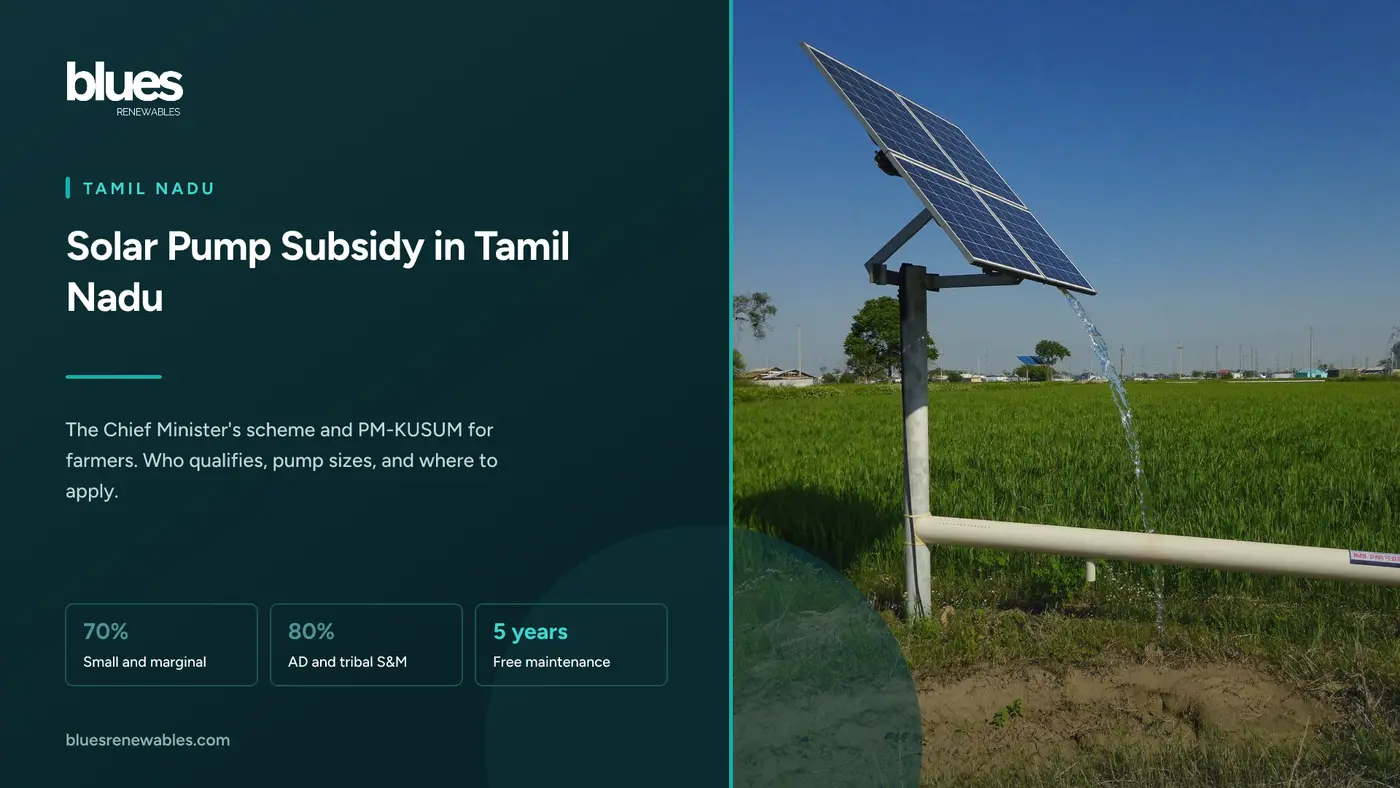
For a farmer without a reliable electricity connection, a solar pump is the difference between irrigating on the grid's schedule and irrigating on the sun's. In Tamil Nadu it is also one of the most heavily subsidised things you can buy: up to 80 percent of the cost for some farmers.
There are two routes to that subsidy, the central PM-KUSUM scheme and the state's own Chief Minister's solar pump scheme, both delivered through the Agricultural Engineering Department. They overlap, and the details change by year and district, which is why so many farmers find the process confusing.
This guide sets out both schemes, who qualifies, what you get and how to apply.
Key takeaways
- Tamil Nadu's Chief Minister's Solar Powered Pumpsets scheme offers standalone solar pumps of 5, 7.5 and 10 HP through the Agricultural Engineering Department.
- Subsidy is 70 percent for small and marginal farmers, and 80 percent for Adi Dravidar and tribal small and marginal farmers, according to the department's district notices. Other farmers have been offered 60 percent.
- PM-KUSUM Component B is the central scheme for standalone solar pumps up to 7.5 HP, delivered in Tamil Nadu through the same department.
- Five years of free maintenance and insurance come with pumps installed under the state scheme.
- The schemes are for standalone, off-grid pumps, generally for farmers who do not already have an electricity connection for the pump.
- Budgets are limited and allocated by district, so apply early in the year.
The Chief Minister's Solar Powered Pumpsets scheme
This is Tamil Nadu's own scheme, run by the Department of Agricultural Engineering.
What you get. A standalone solar-powered pump set, AC or DC, in 5, 7.5 or 10 HP, with the solar panels, controller and pump supplied and installed.
Subsidy. The department's district notices give:
- Small and marginal farmers - Subsidy: 70 percent
- Adi Dravidar and tribal small and marginal farmers - Subsidy: 80 percent
- Other farmers - Subsidy: 60 percent
Maintenance. Free maintenance and insurance for five years on pumps installed under the scheme.
Budget. For 2025-26 the state allocated ₹24 crore to install standalone solar pumps for about 1,000 farmers without an electricity connection. Each district receives a target number of units; the Nilgiris, for example, was allotted 50 for 2025-26.
PM-KUSUM Component B
PM-KUSUM is the central government's scheme for solar in agriculture. Its Component B funds standalone solar pumps up to 7.5 HP for farmers, particularly where grid supply is unavailable. The subsidy is shared between the Centre and the state, with the farmer paying the balance.
In Tamil Nadu, Component B is implemented through the Agricultural Engineering Department, the same department as the state scheme, which is why the two are often presented together. The department decides how the central and state support combine in a given year.
PM-KUSUM also has components for solarising grid-connected pumps and for small solar plants on farmland, which work differently. Our solar subsidy in Tamil Nadu page gives the overview.
Who qualifies
Exact conditions are set in each year's notification, but the schemes generally require:
- You are a farmer with land records in your name for the land where the pump will be used.
- You do not already have an electricity connection for the pump. These are standalone schemes for farmers off the grid.
- You have a water source, such as a well or borewell, suitable for the pump size.
- Your farmer category, small, marginal, Adi Dravidar or tribal, is documented, since it decides the subsidy rate.
Some districts also link the scheme with micro-irrigation, so a drip or sprinkler system may be encouraged or required.
How to apply
Contact your district Agricultural Engineering office, or check the department's online application for the current year.
Choose the pump size that suits your water source and land, 5, 7.5 or 10 HP.
Submit the documents: land records, Aadhaar, bank passbook, a photograph, and proof of your farmer category.
Pay your share once the application is approved.
The supplier installs the pump and the department inspects it.
Pumps under these schemes are supplied through the department's selected suppliers. Buying a pump yourself and asking for the subsidy afterwards does not work.
Choosing the right pump size
Bigger is not always better. The right size depends on how deep the water is, how much you need to lift each day, and the area you irrigate.
- 5 HP suits shallower wells and smaller plots.
- 7.5 HP is the most common size for borewells of moderate depth.
- 10 HP suits deep borewells or larger areas, and is outside PM-KUSUM Component B's 7.5 HP limit.
A solar pump runs when the sun is up, strongest from late morning to mid-afternoon. Plan irrigation around those hours, and consider a storage tank if you need water at other times.
If you do not qualify
Farmers who already have an electricity connection, want a larger system, or need it outside the scheme's timeline can still install a solar pump by paying the full cost. For farmhouses and plots, an off-grid solar system can run the pump and the house together. Our off-grid solar systems page explains the options, and on-grid, off-grid or hybrid helps you decide which suits your site.
Frequently asked questions
How much subsidy is there on solar pumps in Tamil Nadu?
Under the Chief Minister's Solar Powered Pumpsets scheme, 70 percent for small and marginal farmers and 80 percent for Adi Dravidar and tribal small and marginal farmers, according to the department's district notices. Other farmers have been offered 60 percent.
Which department handles solar pump subsidy in Tamil Nadu?
The Department of Agricultural Engineering, for both the state scheme and PM-KUSUM Component B.
What sizes of solar pumps are available under the scheme?
5, 7.5 and 10 HP under the state scheme. PM-KUSUM Component B covers pumps up to 7.5 HP.
Can I get a solar pump subsidy if I already have an electricity connection?
The standalone schemes are generally for farmers without an electricity connection for the pump. Other PM-KUSUM components cover solarising grid-connected pumps.
Is maintenance included?
Yes. Pumps installed under the state scheme come with five years of free maintenance and insurance.
What documents do I need?
Land records, Aadhaar, a bank passbook, a photograph and proof of your farmer category. Your district office may ask for water source details.
When should I apply?
Early in the financial year. Budgets are allocated by district as a fixed number of units, and they run out.
Where this fits
For all the solar subsidies available in the state, see solar subsidy in Tamil Nadu. For the wider framework, see the Tamil Nadu solar energy policy. For pumps outside the subsidy route, see off-grid solar systems.
Blues Renewables designs off-grid solar for farmhouses, plots and pumps across Tamil Nadu. If you have applied under the scheme, we can advise on pump sizing for your water source; if you do not qualify, we can design a system you own outright.
Call +91 98841 07170.
Sources
- The Nilgiris District Administration, Tamil Nadu, press release on the Chief Minister's Solar Pump Set Subsidy Scheme for farmers, 2025-26, for pump sizes, subsidy rates by category, five-year maintenance and insurance, and the district allocation
- International Institute for Sustainable Development, Solar Agri Bulletin, 2025 budget special edition, on the ₹24 crore allocation for about 1,000 farmers and the 60 to 70 percent subsidy structure
- Ministry of New and Renewable Energy, PM-KUSUM, on Component B standalone solar pumps up to 7.5 HP