Tamil Nadu Solar Energy Policy: What Actually Applies to Your Rooftop in 2026
The 2019 state solar policy, the TNERC regulations that really govern rooftops, network charges, the 2024 draft rules and the new state top-up, in one place.

Search for Tamil Nadu's solar policy and you will find documents from 2012, 2019, 2022, 2024 and 2025, some of which exist and some of which are summaries of each other. For a homeowner or a factory deciding on rooftop solar, most of it is beside the point.
What decides your installation is not the policy document at all. It is a set of regulations from the state electricity regulator, TNERC, plus the central PM Surya Ghar scheme and a new state top-up. The policy sets targets; the regulations set your meter, your charges and your settlement.
This guide separates the two, and sets out what actually applies in 2026.
Key takeaways
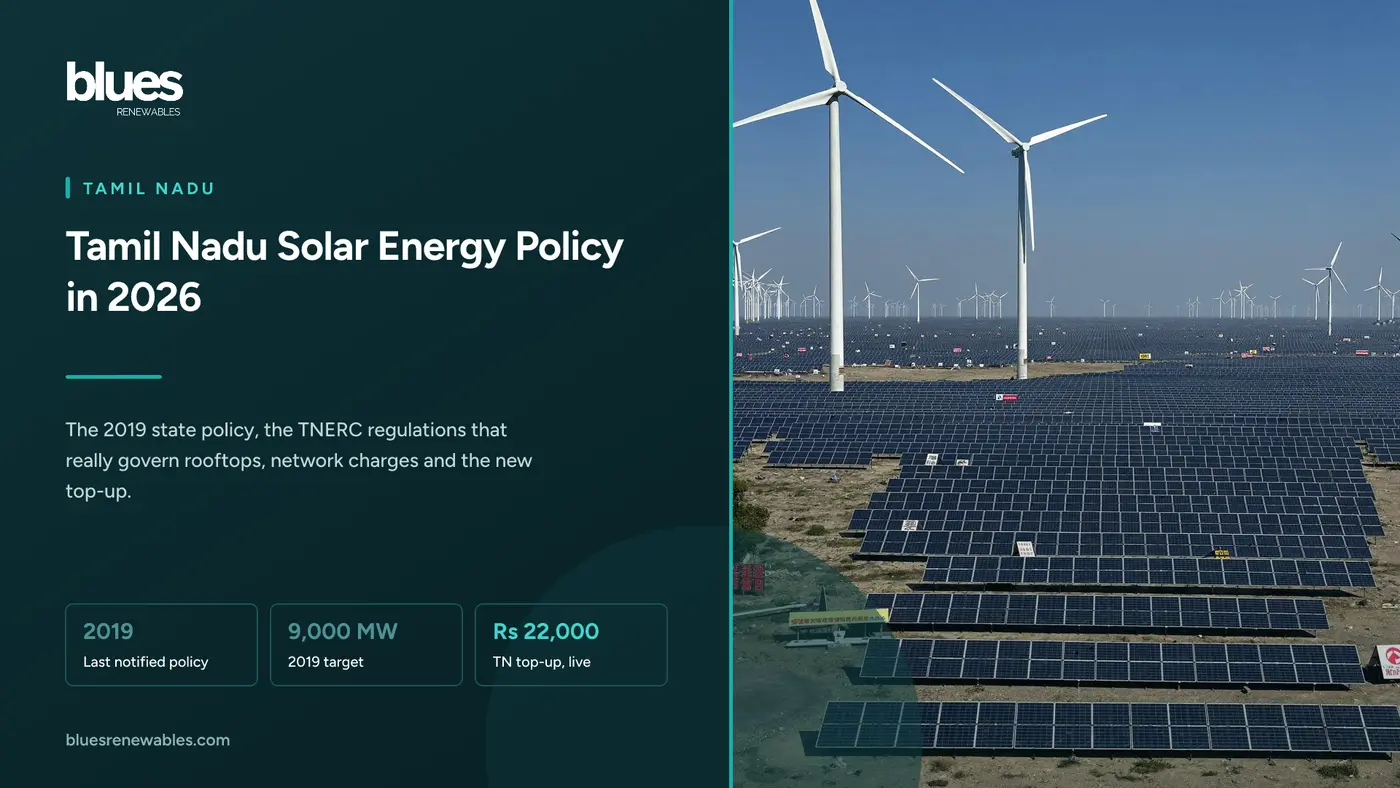
- The last notified state solar policy we can verify is the Tamil Nadu Solar Energy Policy 2019, effective 4 February 2019, with a target of 9,000 MW by 2022-23, about 40 percent from consumer-category systems such as rooftops.
- Rooftop rules come from TNERC, under its Grid Interactive Solar PV Energy Generating Systems Regulations 2021, with a 2024 draft published to replace them.
- Network charges apply to rooftop solar in Tamil Nadu, including a reduced rate for small domestic systems, and a 50 percent cut for MSMEs from December 2023.
- Homes up to your sanctioned load use net metering, settled annually.
- Tamil Nadu announced a state top-up to PM Surya Ghar on 5 August 2026 and launched it on 21 September 2026: up to ₹22,000 on 3 kW, for homes registered since 5 August.
- Claims of a "2023 policy" with a 20 GW target circulate widely; we have not been able to locate a notified policy document behind them.
The Tamil Nadu Solar Energy Policy 2019
The 2019 policy replaced the earlier 2012 policy and came into effect on 4 February 2019. Its main provisions:
- Target: 9,000 MW of solar by 2022-23.
- Split: about 40 percent, roughly 3,600 MW, from consumer-category systems, meaning rooftop and other installations at consumers' premises, with the rest utility scale.
- Rooftop incentive: consumer-category solar exempted from electricity tax for two years.
- Metering: net feed-in facility for low-tension consumers.
- Facilitation: the Tamil Nadu Energy Development Agency, TEDA, designated to help consumers access central incentives.
- Manufacturing: support for making solar components in the state.
The 9,000 MW target date has passed. The policy remains the last state solar policy we can confirm as notified.
What about a 2023, 2024 or 2025 policy?
Many sites describe a "Tamil Nadu Solar Energy Policy 2023" targeting 20 GW by 2030. We have not been able to find a notified government order for it. In 2024 the state did release policies on wind repowering, small hydro and pumped storage, and in 2026 announced plans for a battery storage policy. Until a new solar policy is notified, treat the 2019 policy and the TNERC regulations as the framework.
The rules that actually govern your rooftop: TNERC
The Tamil Nadu Electricity Regulatory Commission sets the terms that determine what a rooftop system costs and earns.
The 2021 regulations. TNERC's Grid Interactive Solar PV Energy Generating Systems Regulations, issued on 7 October 2021, set the metering arrangements, network charges and procedures for rooftop solar.
The 2024 draft. In June 2024 TNERC published draft regulations to replace the 2021 rules. The draft lets domestic consumers choose net metering, net billing or a feed-in arrangement, allows them to switch between net metering and net feed-in twice a year, introduces gross metering for larger systems, and requires a web-based application with fixed timelines. Check whether it has been finalised before relying on any single provision.
Capacity. A home can generally install up to its sanctioned load. Our guide to the solar capacity limit in Tamil Nadu explains how that is measured.
Net metering and settlement
For homes, net metering is the default: units you export offset units you import, and the account is settled annually. Our guide to the TANGEDCO net metering application covers the process, and why your electricity bill is not zero after solar explains the settlement.
For systems exporting under a feed-in arrangement, TNERC sets a generic tariff; for systems up to 10 kW it has been ₹3.61 per unit.
Network charges
Tamil Nadu levies network charges on grid-connected rooftop solar, meant to cover the cost of the grid that rooftop systems rely on. Under the 2021 regulations:
- LT commercial: ₹1.27 per unit.
- Domestic up to 10 kW: 20 percent of the commercial rate.
- Domestic above 10 kW: 75 percent of the commercial rate.
In December 2023 TNERC cut network charges for MSMEs by half, from ₹1.53 to ₹0.765 per unit. The charges are contested; consumer groups argue they duplicate fixed charges. Our full guide to network charges on rooftop solar in Tamil Nadu sets out how they are calculated and who pays.
Subsidies that apply in Tamil Nadu
PM Surya Ghar, the central scheme: ₹30,000 for 1 kW, ₹60,000 for 2 kW, ₹78,000 for 3 kW and above. See the PM Surya Ghar subsidy guide.
The state top-up, announced in the revised budget on 5 August 2026 and launched on 21 September 2026: ₹5,000 for 1 kW, ₹10,000 for 2 kW and ₹22,000 for 3 kW and above, for the first one lakh consumers registered on the PM Surya Ghar portal on or after 5 August 2026, with ₹50 crore allocated this year.
Solar pumps for farmers, under PM-KUSUM and the Chief Minister's solar pump scheme. See solar pump subsidy in Tamil Nadu.
Businesses receive no capital subsidy, but can claim accelerated depreciation. See solar power plant subsidy in India.
For businesses: open access and captive
Larger consumers can buy solar power from off-site plants through open access or captive arrangements, subject to wheeling, banking and cross-subsidy charges. Our guides cover open access solar, captive solar power plants, wheeling charges and cross-subsidy surcharge.
Who you deal with: TANGEDCO's successors
In 2024 the state reorganised TANGEDCO. Distribution, including rooftop net metering and billing, sits with the Tamil Nadu Power Distribution Corporation. Renewable energy generation and development sits with the Tamil Nadu Green Energy Corporation. Many forms and people still say TANGEDCO; they mean the distribution corporation for rooftop purposes.
Frequently asked questions
What is the current Tamil Nadu solar energy policy?
The last state solar policy we can verify as notified is the Tamil Nadu Solar Energy Policy 2019, effective 4 February 2019. The rules for rooftop systems come from TNERC's regulations.
What was the target of the Tamil Nadu Solar Energy Policy 2019?
9,000 MW of solar by 2022-23, about 40 percent of it from consumer-category systems such as rooftops.
Is there a Tamil Nadu solar policy 2023 with a 20 GW target?
The claim appears on many sites, but we have not been able to find a notified government order for it. Treat it with caution until one is published.
Does Tamil Nadu charge network charges on rooftop solar?
Yes. Under the 2021 TNERC regulations, network charges apply, with domestic systems up to 10 kW paying 20 percent of the commercial rate. MSMEs received a 50 percent reduction in December 2023.
Is there a state solar subsidy in Tamil Nadu?
A top-up to PM Surya Ghar, announced on 5 August 2026, launched on 21 September 2026: up to ₹22,000 for 3 kW and above, for homes registered on the portal on or after 5 August 2026.
Who approves rooftop solar in Tamil Nadu now?
The Tamil Nadu Power Distribution Corporation, the distribution successor to TANGEDCO, handles net metering and grid connection for rooftop systems.
Can I sell all my solar power to the grid in Tamil Nadu?
The 2024 draft regulations introduce gross metering for larger systems, and feed-in arrangements for others at tariffs TNERC sets. For most homes, net metering is the arrangement that applies.
Where this fits
For the subsidy route, start with solar subsidy in Tamil Nadu. For the charges, see network charges on rooftop solar. For the process, see the TANGEDCO net metering application.
Blues Renewables has installed rooftop solar across Chennai and Tamil Nadu since 2020 and tracks the TNERC rules as they change. If a policy question is holding up your decision, ask us; we will tell you what applies to your connection, and what does not.
Call +91 98841 07170.
Sources
- IamRenew, February 2019, on the Tamil Nadu Solar Energy Policy 2019: effective date, the 9,000 MW target, the 40 percent consumer-category share, the two-year electricity tax exemption, net feed-in for LT consumers and TEDA's role
- Citizen consumer and civic action group (CAG), on TNERC's Grid Interactive Solar PV Energy Generating Systems Regulations 2021 and the network charge rates
- Mercom India, on TNERC's 50 percent network charge reduction for MSMEs (December 2023) and the ₹3.61 per unit generic tariff for systems up to 10 kW
- Mercom India and SolarQuarter, June 2024, on TNERC's draft Grid Interactive Solar PV Energy Generating Systems Regulations 2024
- Power Line Magazine, December 2024, on Tamil Nadu's 2024 renewable energy policies
- DT Next and Saur Energy, August 2026, on the state rooftop solar top-up and the planned battery storage policy