Tamil Nadu State Solar Subsidy 2026: The ₹1 Lakh Rooftop Top-Up Explained
Tamil Nadu adds up to ₹22,000 to PM Surya Ghar, ₹1 lakh in all at 3 kW. Who qualifies, the 5 August cut-off, how TEDA pays and what to do if it is late.

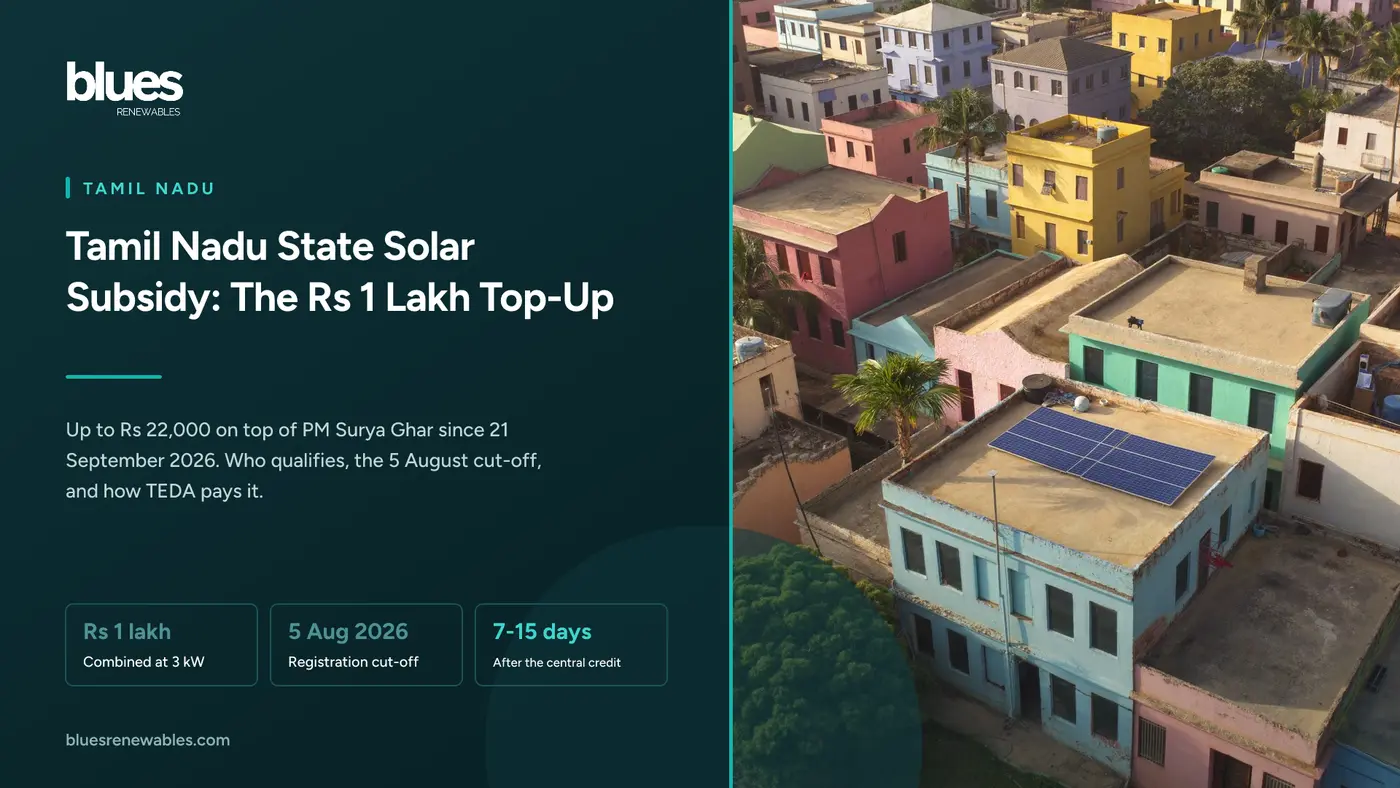
Since 21 September 2026, a Tamil Nadu home that puts 3 kW of solar on its roof can get ₹1,00,000 back: ₹78,000 from the Centre under PM Surya Ghar and ₹22,000 from the state. On a typical Chennai price of about ₹2,10,000, that brings a 3 kW system down to about ₹1,10,000.
The state part comes with conditions that most summaries skip. It applies only to homes that registered on the PM Surya Ghar portal on or after 5 August 2026. It arrives after the central subsidy, not with it. And this year's ₹50 crore allocation covers far fewer than one lakh homes at the full ₹22,000 rate.
This guide covers the Tamil Nadu state solar subsidy itself: amounts, eligibility, payment, net price and what to do if it is late.
Key takeaways
- The state pays ₹5,000 for 1 kW, ₹10,000 for 2 kW and ₹22,000 for 3 kW and above, on top of PM Surya Ghar. Combined: ₹35,000, ₹70,000 and ₹1,00,000.
- Only registrations on the PM Surya Ghar portal from 5 August 2026 qualify. Your registration date decides it, not your installation date.
- There is no separate application. TEDA pays by direct benefit transfer using your PM Surya Ghar data.
- The state part follows the central subsidy. The state portal says it is released only after the central amount is disbursed, then credited within 7 to 15 days.
- ₹50 crore funds about 22,700 homes at ₹22,000 each, not one lakh. Nothing published says what happens once it runs out.
- Homes only, and you must own the system. Businesses, farms and leased (RESCO) systems do not qualify.
What the Tamil Nadu state solar subsidy is
The Tamil Nadu state solar subsidy is a capital top-up for grid-connected rooftop solar on homes, paid over and above PM Surya Ghar. It was announced in the revised 2026-27 budget on 5 August 2026, with ₹50 crore set aside. Energy Minister C.T.R. Nirmal Kumar launched it in Chennai on 21 September 2026 through the Tamil Nadu Power Distribution Corporation (TNPDCL, formerly TANGEDCO).
The scheme rests on G.O. (Ms) No. 102 of the Energy (E1) Department, dated 19 September 2026. It fixes the amounts and the 5 August cut-off, limits the scheme to the first one lakh consumers, names TEDA as the paying agency and TNGECL as the nodal agency. News reports call it the Tamil Nadu Rooftop Solar Subsidy Scheme; the portal calls it the Tamil Nadu Solar Acceleration Scheme. Same top-up, two names.
You do not apply for it separately. You apply for PM Surya Ghar as normal, as our guide to PM Surya Ghar in Tamil Nadu explains, and the Tamil Nadu state solar subsidy follows.
How much the state pays
The state pays ₹5,000 for 1 kW, ₹10,000 for 2 kW and ₹22,000 for 3 kW and above. PM Surya Ghar pays ₹30,000 per kW for the first 2 kW and ₹18,000 for the third, capped at ₹78,000. Together: ₹35,000, ₹70,000 and ₹1,00,000.
Two points are easy to miss. First, the ₹22,000 is a flat amount, not ₹22,000 per kW. A 5 kW or 10 kW home gets the same ₹22,000 as a 3 kW home. Figures of around ₹20,000 per kW that still circulate appear to come from an earlier, discontinued state incentive, not this scheme.
Second, the top-up favours the third kilowatt. Moving from 2 kW to 3 kW adds ₹18,000 of central subsidy and ₹12,000 of state subsidy, so the third kilowatt now attracts ₹30,000, the same as each of the first two, up from ₹18,000. For a home choosing between 2 kW and 3 kW, that tips the arithmetic towards 3 kW.
One gap remains. PM Surya Ghar pro-rates part sizes such as 2.5 kW; no source we found says whether the state does the same or rounds down to the 2 kW slab. Get it in writing before you rely on a figure.
Who is eligible, and the 5 August cut-off
To qualify for the Tamil Nadu state solar subsidy, you need all of the following:
- A domestic connection with TNPDCL. Commercial, industrial and agricultural connections are excluded.
- A PM Surya Ghar registration dated 5 August 2026 or later. Every source we found says there is no retrospective benefit. Registered in July and commissioned in October means no state part.
- A grid-connected system with a net meter. Off-grid systems do not qualify.
- An empanelled vendor and approved panels. The state portal specifies DCR-compliant ALMM modules installed by a TEDA-empanelled vendor. Our PM Surya Ghar vendor list explains how to check one.
- Ownership of the system. PM Surya Ghar requires consumer ownership, so leased or RESCO systems lose the central subsidy, and with it the state part, which is paid only after the central amount.
The portal describes coverage as residential systems up to 10 kW, and the order limits the scheme to the first one lakh consumers.
Two claims need caution. Some sites say SC/ST households get extra support under this scheme; we have not found that in any government or news source. No source says how apartment common-area systems are treated; for those, start with solar subsidy in Tamil Nadu.
How TEDA pays it
TEDA, the Tamil Nadu Energy Development Agency, pays the Tamil Nadu state solar subsidy by direct benefit transfer to the bank account on your application, using the data already on the PM Surya Ghar portal. The Tamil Nadu Green Energy Corporation (TNGECL) coordinates the scheme with the Centre.
The order of events matters. The state portal says the state amount is released only after installation, net metering, commissioning and disbursal of the central subsidy, and once eligibility is confirmed. It then gives 7 to 15 days for the credit.
Published timings differ: Trade Brains reports 7 to 15 days after the process, and an installer's summary of the order says 30 to 60 days after verification. Both fit once you count from different points. The central subsidy usually arrives 30 to 45 days after commissioning and the state part a week or two later, so roughly five to nine weeks in a smooth case. The scheme is a week old; treat that as a target, not a track record.
What it does to the net price
Neither subsidy comes off the invoice. You pay the full price, and both amounts reach your bank account after commissioning. Prices below are typical for Chennai; smaller systems cost more per watt, and the 1 kW figure is an estimate, because few homes install a system that small.
- 1 kW - Typical price: ₹80,000, Central subsidy: ₹30,000, After central: ₹50,000, State top-up: ₹5,000, After both: ₹45,000, Combined share of price: 44%
- 2 kW - Typical price: ₹1,50,000, Central subsidy: ₹60,000, After central: ₹90,000, State top-up: ₹10,000, After both: ₹80,000, Combined share of price: 47%
- 3 kW - Typical price: ₹2,10,000, Central subsidy: ₹78,000, After central: ₹1,32,000, State top-up: ₹22,000, After both: ₹1,10,000, Combined share of price: 48%
- 5 kW - Typical price: ₹3,20,000, Central subsidy: ₹78,000, After central: ₹2,42,000, State top-up: ₹22,000, After both: ₹2,20,000, Combined share of price: 31%
Note: Blues Renewables installs from 3 kW. The 1 kW and 2 kW figures above are market estimates for comparison; with both subsidies returning up to ₹1,00,000 at 3 kW, that is the better starting size for most homes.
The share peaks at 3 kW, because both subsidies stop growing there; above 3 kW you pay for each extra kilowatt in full. A 5 kW system can still be right for a large bill, but size to your consumption and sanctioned load, not to the subsidy.
If a quote shows only the after-subsidy figure, compare the full price per watt using our guide on whether your solar quote is too high. Solar loan EMIs can bridge the gap until the subsidies land.
The ₹50 crore cap: how far it goes
₹50 crore divided by ₹22,000 is about 22,700 homes. To cover one lakh homes, the average payout would have to be ₹5,000, the 1 kW rate. Most homes install more: Dinamalar reported 97,732 systems and 337.49 MW in the state at the launch, about 3.5 kW each. At that mix, this year's money runs out well short of one lakh homes.
The government may add money in a later budget or supplementary grant. Nothing published says what happens to eligible homes once the ₹50 crore is spent, and the quota language points to first come, first served. If you plan to install this year, earlier registration and commissioning is the safer side of the cap.
If the state subsidy is not credited
Work through these checks in order:
Check your registration date. If it is before 5 August 2026, the Tamil Nadu state solar subsidy does not apply to your application.
Check whether the central subsidy has arrived. If it has not, the state part will not come either. Our guide to PM Surya Ghar subsidy not received covers that problem.
If the central amount arrived more than 15 days ago, check your status on the TNPDCL rooftop portal at tnebltd.gov.in/usrp, which looks up applications by application number or mobile number.
Check the bank account. It must be the account on your PM Surya Ghar application, seeded with Aadhaar, in the same name as the electricity connection.
Confirm your category and ownership. A commercial tariff or a leased system disqualifies the application.
Escalate with dates in hand. Call TNPDCL's Minnagam line on 1912 or the portal's toll-free 1800 425 2500, then write to TEDA with your application number, commissioning date and central credit date. The national helpline, 15555, handles the central part only.
Frequently asked questions
Is the Tamil Nadu state solar subsidy available now?
Yes. It was launched on 21 September 2026 and applies to homes that registered on the PM Surya Ghar portal on or after 5 August 2026.
How much is the Tamil Nadu solar subsidy for 3 kW?
₹22,000 from the state plus ₹78,000 from PM Surya Ghar, ₹1,00,000 in total.
Is the ₹22,000 paid per kW?
No. It is a flat amount for any system of 3 kW and above. A 5 kW home receives the same ₹22,000.
Do I need to apply separately for the state subsidy?
No. TEDA uses your PM Surya Ghar application data and pays the state amount by direct benefit transfer.
I registered before 5 August 2026. Can I still get it?
Not on the published criteria. Every source we found says registrations before 5 August do not qualify.
When will the state part reach my account?
After the central subsidy: within 7 to 15 days of it, according to the state portal.
Does the state top-up apply to businesses or leased systems?
No. It covers domestic connections only, and the system must be owned by the consumer.
Will my installer deduct the subsidy from the price?
Normally not. You pay the full price, and both subsidies come back to your bank account after commissioning.
Where this fits
To see which subsidy applies to your home, society or business, start with solar subsidy in Tamil Nadu. To apply, follow PM Surya Ghar in Tamil Nadu and the TANGEDCO net metering application. For the central criteria, see PM Surya Ghar eligibility, and for the wider rules, the Tamil Nadu solar energy policy.
Blues Renewables, based in Guindy, has installed rooftop solar for homes, schools, businesses and factories across Tamil Nadu since 2020, with two years of free maintenance on every installation. Tell us your registration date and your bill, and we will tell you which subsidies you qualify for before you sign.
Call +91 98841 07170.
Sources
- TNPDCL, Tamil Nadu solar rooftop portal (tnebltd.gov.in/usrp), accessed 29 September 2026: combined amounts, TEDA disbursement, TNGECL's coordinating role, release only after central disbursal, the 7 to 15 day credit, coverage up to 10 kW, DCR and ALMM requirements, helplines, status lookup, and the G.O. download marked pending
- DT Next, 5 August 2026: the revised budget announcement, the ₹50 crore allocation and convergence with PM Surya Ghar
- SolarBytes, 24 September 2026: the 21 September launch by the Energy Minister through TNPDCL, the combined amounts, eligibility from 5 August 2026 and the target of one lakh homes by March 2027
- Dinamalar, 22 September 2026: the state amounts, about 1.13 lakh applications, 97,732 systems, 337.49 MW, 1,859.27 MW of total rooftop capacity and the Chief Minister's ₹50 crore allocation
- ETV Bharat Tamil and Puthiyathalaimurai, 21 September 2026: the launch, the state amounts and direct benefit transfer by TEDA
- ANI, September 2026: the Energy Minister's statement at the launch
- Trade Brains, 24 September 2026: automatic processing by TEDA with no separate application, and the 7 to 15 day credit
- Tamil Nadu Energy (E1) Department, G.O. (Ms) No. 102, 19 September 2026: the state amounts, the 5 August 2026 cut-off, the first one lakh consumers, the ₹50 crore allocation, and the roles of TEDA and TNGECL
- An installer's summary of the order, September 2026: the 30 to 60 day credit
- MNRE, PM Surya Ghar: Muft Bijli Yojana guidelines: the central subsidy amounts and the consumer ownership requirement