Network Charges on Rooftop Solar in Tamil Nadu: Who Pays, How Much, and How They Are Worked Out
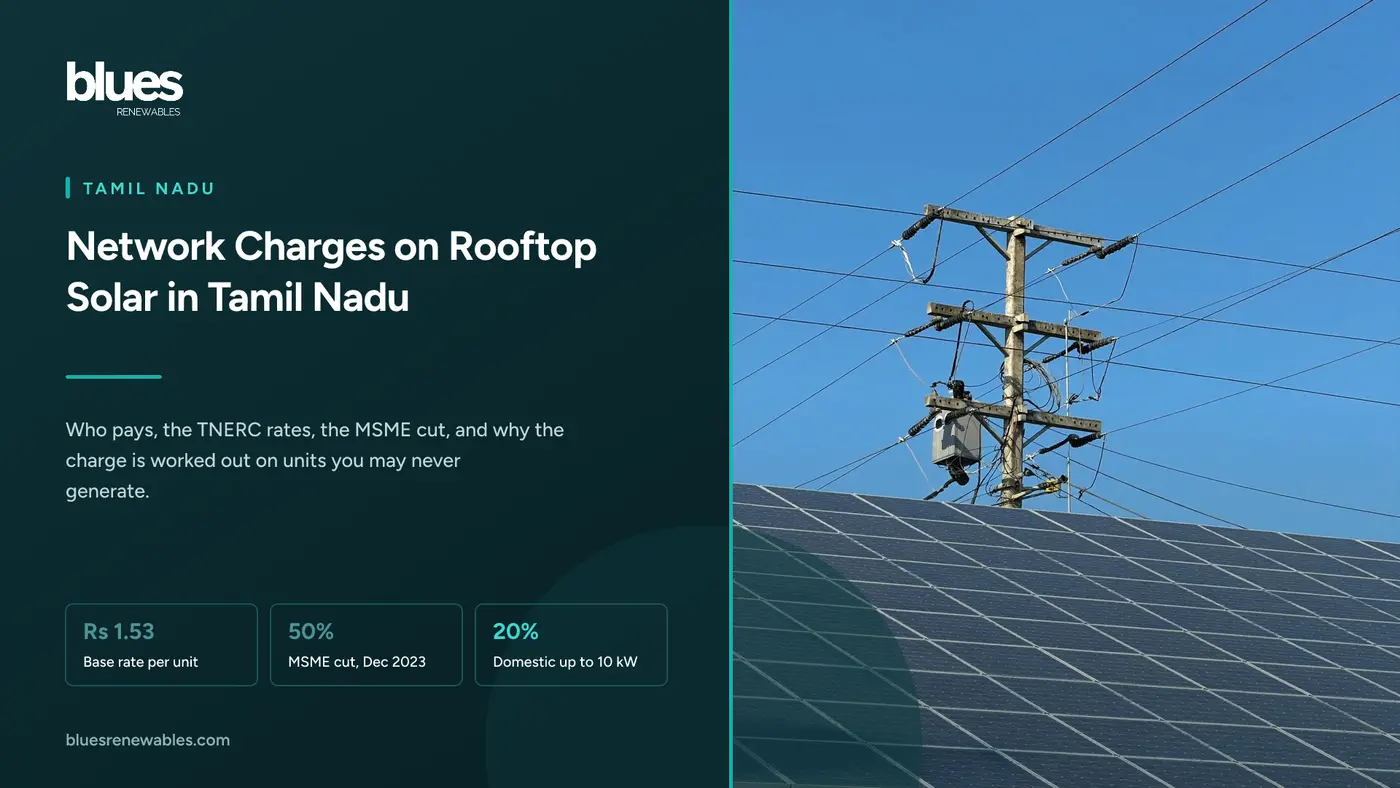
Tamil Nadu charges rooftop solar owners for using the grid. The TNERC rates, the 20 percent domestic rate, the 50 percent MSME cut, and a worked example of the monthly cost.

Network charges are the line on a rooftop solar business case that most quotations leave out, and in Tamil Nadu they can move the payback by a year or more for a commercial building.
The idea behind them is simple. A grid-connected rooftop system leans on the grid: it exports in the day, imports at night, and relies on the network to absorb and balance both. The regulator decided that rooftop owners should pay towards that network, separately from their normal fixed charges.
This guide explains who pays, the rates, how the charge is calculated, and what it does to the numbers.
Key takeaways
- Tamil Nadu levies network charges on grid-connected rooftop solar, under TNERC's Grid Interactive Solar PV Energy Generating Systems Regulations of 2021.
- The charge is calculated on units generated, and because most rooftops have no generation meter, the utility assumes a standard generation of 5.04 units per kW per day.
- Domestic systems up to 10 kW pay 20 percent of the base rate; domestic systems above 10 kW pay 75 percent.
- MSMEs got a 50 percent cut in December 2023, from ₹1.53 to ₹0.765 per unit.
- Commercial and industrial rooftops pay the full rate, which matters for the payback calculation.
- The charges are contested by consumer groups, who argue they duplicate fixed charges. They apply regardless.
What network charges are
TNERC defines network charges as covering the costs the distribution utility incurs to create, develop and maintain the network and provide the grid support that lets a grid-connected rooftop system function. They are separate from the fixed charges on your bill, which are based on sanctioned load.
For a rooftop owner, the practical point is that they are a cost per unit of solar generation, paid for as long as the system is connected.
The rates
The 2021 regulations set the original rates, and later tariff orders revised the base.
- LT commercial, 2021 regulations - Rate: ₹1.27 per unit
- HT, 2021 generic tariff order - Rate: ₹0.83 per unit
- Base rate cited in TNERC's December 2023 order - Rate: ₹1.53 per unit
- MSMEs, from December 2023 - Rate: ₹0.765 per unit, half the base
- Domestic up to 10 kW - Rate: 20 percent of the base rate
- Domestic above 10 kW - Rate: 75 percent of the base rate
Rates are revised through TNERC tariff orders, so check the current order before finalising a commercial business case.
How the charge is calculated
Network charges are levied on units generated by the rooftop system. Most rooftop installations in Tamil Nadu have a net meter, which records exports and imports, but no separate generation meter. So the utility does not measure what your system generates. It assumes it.
The assumption is a capacity utilisation factor of 21 percent, which works out to 5.04 units per kW per day. Every system is charged as if it generates that, whatever it actually produces.
That has a side effect worth knowing. A system that is shaded, dirty or under-performing still pays network charges on 5.04 units per kW per day. A well-maintained system in a good location that genuinely produces close to that pays a charge that matches its output.
Worked examples
These use the 5.04 units per kW per day basis and the ₹1.53 base rate. They are illustrations; check the current order and your category.
A 50 kW rooftop on an LT commercial building
- Assumed generation: 50 kW x 5.04 = 252 units a day, about 7,560 units a month.
- Network charge at ₹1.53: about ₹11,570 a month.
The same 50 kW system on an MSME
- At ₹0.765 per unit: about ₹5,780 a month.
A 5 kW domestic system
- Assumed generation: 5 kW x 5.04 = 25.2 units a day, about 756 units a month.
- At 20 percent of ₹1.53, which is about ₹0.31 per unit: about ₹230 a month.
For a home the charge is small next to the savings. For a commercial building paying the full rate, it is a real cost that belongs in the payback.
What network charges do to payback
Network charges reduce the net value of every unit your system produces. For a commercial or industrial rooftop, a quotation that shows savings at your full grid tariff without deducting network charges overstates the return.
When comparing quotes, ask for the savings calculation to show network charges as a separate line. Our guide to calculating solar payback shows where they fit, and is your solar quote too high covers the rest of the quote.
For factories that qualify as MSMEs, the December 2023 reduction halves the charge. Confirm your MSME status is registered with the utility so the lower rate is actually applied.
Why the charges are contested
Consumer and civic groups have objected to network charges, arguing that fixed charges already pay for network maintenance and that charging rooftop owners again amounts to double billing. They also point out that the assumed-generation method charges under-performing systems for units they never produce.
These arguments have not removed the charges. They are a live regulatory issue, and a future TNERC order could change the rates or the method. Plan on the current rules.
Network charges versus other charges
Rooftop network charges are different from the charges that apply when you buy solar from an off-site plant:
- Wheeling charges apply to power carried over the network from a remote plant. See solar power wheeling charges in TANGEDCO.
- Cross-subsidy surcharge applies to open access purchases. See CSS charge for solar.
- Fixed charges apply to every connection, solar or not. See why your bill is not zero after solar.
Frequently asked questions
What are network charges on rooftop solar in Tamil Nadu?
A per-unit charge TNERC levies on grid-connected rooftop systems to cover the cost of the grid they rely on, separate from fixed charges.
How much are network charges for commercial rooftop solar?
The base rate cited in TNERC's December 2023 order is ₹1.53 per unit, on assumed generation. The 2021 regulations set ₹1.27 for LT commercial. Check the current tariff order.
Do homes pay network charges on rooftop solar in Tamil Nadu?
Yes, at a reduced rate. Domestic systems up to 10 kW pay 20 percent of the base rate, and above 10 kW pay 75 percent.
Did MSMEs get a reduction?
Yes. In December 2023 TNERC halved network charges for MSMEs, from ₹1.53 to ₹0.765 per unit.
Why am I charged on units my system did not generate?
Most rooftops have no generation meter, so the utility assumes 5.04 units per kW per day for every system. An under-performing system still pays on that assumed figure.
Are network charges the same as wheeling charges?
No. Wheeling charges apply to power carried from a remote plant under open access or captive arrangements. Network charges apply to rooftop systems at your own premises.
Will network charges change?
They are set by TNERC and revised through its orders, and they are contested by consumer groups. Plan on the current rates and check for new orders.
Where this fits
For the wider framework, see the Tamil Nadu solar energy policy. For commercial systems, see solar EPC companies in Chennai. For the tax benefit that offsets the charge for businesses, see rooftop solar accelerated depreciation.
Blues Renewables shows network charges as a separate line on every commercial proposal, at the rate for your category, so the payback we quote is the payback you get. Send us your last twelve months of bills and we will run the numbers with the charges included.
Call +91 98841 07170.
Sources
- Citizen consumer and civic action group (CAG), on TNERC's Grid Interactive Solar PV Energy Generating Systems Regulations 2021, the network charge rates by category, the units-generated basis and the 5.04 units per day assumption at 21 percent capacity utilisation, and the objections raised
- Mercom India, on the TNERC generic tariff order of October 2021 (₹0.83 HT and ₹1.27 LT) and the December 2023 order halving MSME network charges from ₹1.53 to ₹0.765 per unit