Apartment Association Solar Approval: Getting the Vote
Learn how to get apartment association solar approval, discover the resolution wording and consent rules, and read how to answer the objections that sink proposals.


The numbers were never the hard part. A common-area solar system pays for itself, cuts every resident's maintenance charge, and nobody at the AGM disputes that in principle.
Then it gets deferred. Somebody asks who is liable if the roof leaks, somebody else says the terrace belongs to all of us, and the item rolls to the next meeting.
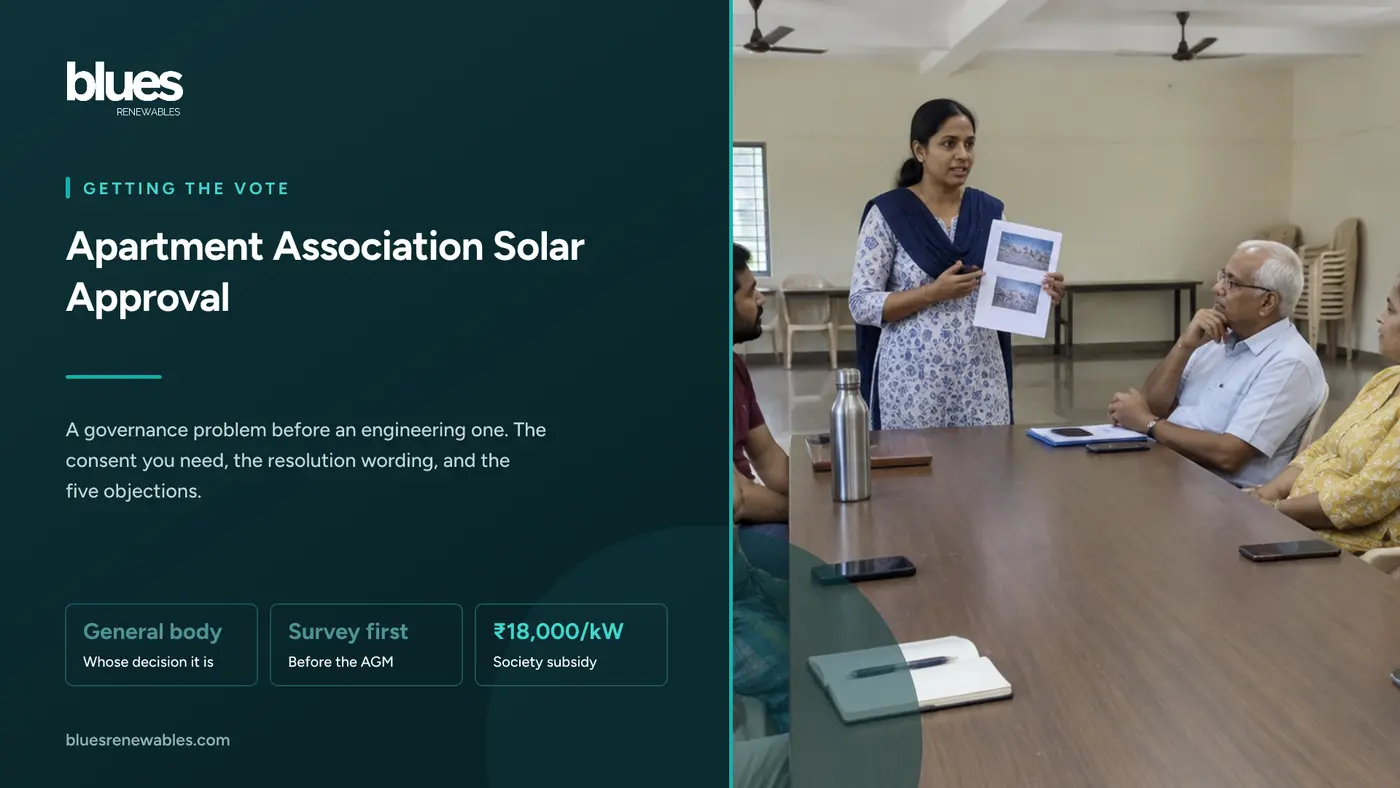
Apartment association solar approval is a governance problem before it is an engineering one. This guide is written for the secretary or treasurer who has already decided and now has to carry a room: what consent the DISCOM actually needs, how to word the resolution, and how to answer the five objections that come up every time.
Key takeaways
- The terrace is common property, so a common-area system needs a proper association decision rather than a committee instruction.
- The DISCOM application runs against the association's common-area service connection, which is why the resolution has to exist before the paperwork does.
- Resident welfare associations and group housing societies can claim a common infrastructure subsidy of ₹18,000 per kW, which is a different rate from the individual residential subsidy.
- Approval fails on liability and process questions, not on the financial case. Answer those in the proposal and the vote gets easier.
- Bring a survey before the AGM, so the figures on the slide are your building's roof, not a national average.
- Put roof access, maintenance responsibility and insurance in the resolution itself. These are what people worry about later.
What apartment association solar approval actually requires
Three things have to line up, and they are not the same thing.
A decision by the association. The terrace is common property held for all owners. Installing a plant on it, and committing association funds, is a decision for the general body under your association's own by-laws, not something a managing committee can do on its own initiative. Check your by-laws for the majority and notice period they require, because these vary.
Consent, documented. A rooftop project affects common property, so the consent position needs to be recorded clearly in the minutes. Where a proposal changes how a shared area is used, being able to show that owners were notified and that the decision was taken properly is what protects the committee later.
A service connection to apply against. The common-area connection, in the association's name, is what the application is filed on. If your common-area connection is still in a builder's name, or if the association is not yet formally registered, fix that first. It will otherwise stop the application dead.
The financial case to put in front of the room
Keep it short and specific to your building.
A common-area system powers lifts, water pumps, basement ventilation, corridor and stairwell lighting, the sewage treatment plant and the clubhouse. These loads run every day, largely in daylight, and they are paid for out of maintenance charges that every owner contributes to.
That last point is the one to lead with. A common-area system reduces what every flat pays, uniformly, whether or not that owner has any interest in solar. It is not a benefit to the enthusiasts on the committee.
Bring three numbers:
Your current common-area bill, averaged over twelve months
The system size your roof can actually take, from a survey rather than an estimate
The expected monthly reduction, and the payback in years
Associations are also eligible for a common infrastructure subsidy of ₹18,000 per kW for common-area systems, which is worth stating explicitly because most owners have only heard the individual residential figure.
For the full cost and sizing picture, our solar for apartments in Chennai page covers what systems of each size cost and what they save.
The five objections, and how to answer them
Every AGM raises the same five. Prepare the answers and the meeting is short.
"The terrace belongs to all of us"
It does, which is exactly why the general body is being asked rather than the committee deciding alone. Note in the proposal how much of the terrace the array occupies, that it sits on a raised structure, and that the space underneath stays usable for water tanks, access and drying.
A raised mounting structure is worth specifying for this reason alone.
"What if the roof leaks?"
Fair, and common. Answer it with the mounting method rather than a reassurance. Ask your installer whether the structure is ballasted or anchored, and if anchored, what waterproofing treatment is applied at each penetration and what warranty covers it.
Put the answer in the resolution. A committee that can point to a recorded waterproofing warranty is in a much better position three monsoons later.
"Who maintains it?"
Name the arrangement. Panels need cleaning, and on the Chennai coast an unmaintained array loses meaningful generation. Specify whether maintenance sits with the installer under an annual contract, and for how long, and what it costs per year.
Budget it as a line item rather than assuming the facility manager will absorb it.
"What happens if the committee changes?"
This is why the decision belongs in a resolution and not in a committee minute. A resolution passed by the general body, with the asset recorded in the association's books and the contracts in the association's name, survives a change of office bearers.
"Can individual flats install their own instead?"
Sometimes, and it is a different project. An individual flat owner installing on shared terrace space needs the association's permission, and it raises questions about which owners get the space and how it is allocated.
Common-area solar avoids all of that because it benefits everyone equally through the maintenance account. If you want to keep the meeting focused, propose the common-area system and handle individual requests separately.
What to put in the resolution
Do not pass a one-line approval. A resolution that names the specifics is what prevents the argument from reopening.
Include:
- The decision to install a common-area solar system, with the capacity in kW
- The approved budget, and the source of funds, whether corpus, sinking fund or a special contribution
- The mounting method and the waterproofing warranty term
- Authorisation for named office bearers to sign the DISCOM application and the contract on the association's behalf
- The maintenance arrangement, including the annual cost and who holds the contract
- Insurance, stating whether the asset is added to the building policy
- That the asset belongs to the association, recorded in its books
Circulate the proposal with the AGM notice rather than tabling it on the day. Most deferrals happen because owners feel they were asked to decide something they had not read.
The order to do things in
Sequence matters more than speed.
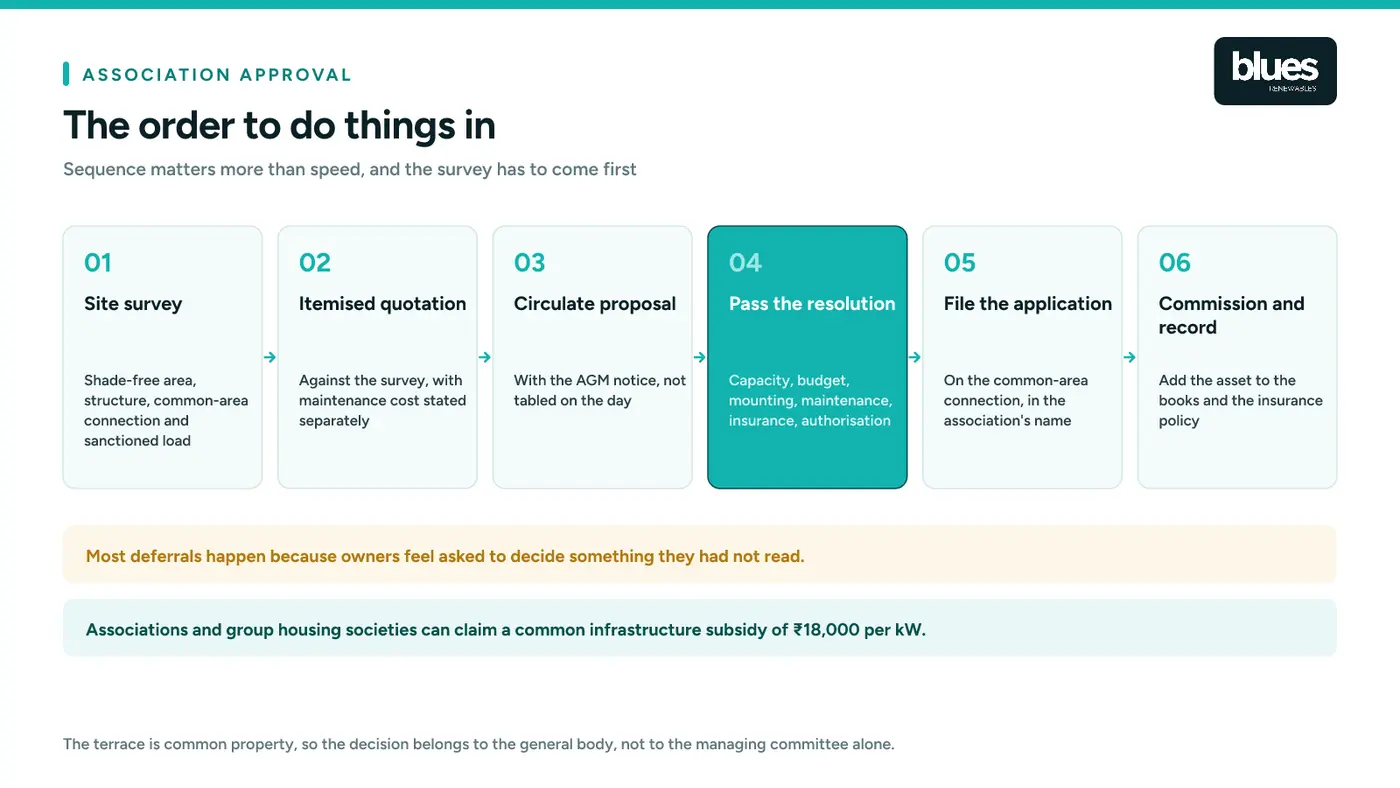
Get a site survey. Shade-free area measured across the day, structure assessed, common-area connection and sanctioned load checked.
Get an itemised quotation against that survey, with the maintenance cost stated separately.
Circulate the proposal with the AGM notice, including the survey findings and the three numbers above.
Pass the resolution with the specifics named.
File the DISCOM application on the common-area connection.
Install and commission, then add the asset to the books and the insurance policy.
The survey comes first for a practical reason. A proposal built on a national rule of thumb falls apart when somebody asks how much of the terrace the water tanks take, and that question is always asked.
Frequently asked questions
Does an apartment association need approval to install solar?
Yes. The terrace is common property and association funds are being committed, so the decision belongs to the general body under your by-laws rather than to the managing committee alone.
What subsidy can a housing society get for solar?
Resident welfare associations and group housing societies are eligible for a common infrastructure subsidy of ₹18,000 per kW for common-area systems, which is a different rate from the individual residential subsidy.
Do all flat owners have to agree?
Follow your by-laws for the required majority and notice period, and record the decision properly in the minutes. What matters is that owners were notified and the decision was taken through the correct process.
Whose name does the solar connection go in?
The association's common-area service connection. If that connection is still in the builder's name, transfer it before applying.
What should the AGM resolution say?
Capacity, budget and funding source, mounting method and waterproofing warranty, authorisation for named office bearers to sign, the maintenance arrangement and its cost, insurance, and that the asset belongs to the association.
Who pays for maintenance of a common-area solar system?
The association, from the maintenance account, usually under an annual contract with the installer. Budget it explicitly rather than assuming it will be absorbed.
What if the roof leaks after installation?
Ask before installing whether the structure is ballasted or anchored, and what waterproofing warranty covers each penetration. Record that warranty in the resolution.
Can one flat owner install solar on the shared terrace?
Only with the association's permission, and it raises allocation questions about shared space. A common-area system avoids this because the benefit reaches every flat through lower maintenance charges.
Where this fits
Once the room has said yes, the costs, sizing and savings for each system size are on our solar for apartments in Chennai page, and the metering route is covered in the TANGEDCO net metering application guide. Budget for upkeep using our solar panel cleaning and AMC cost guide.
Blues Renewables has installed solar across Chennai since 2020, for homes, schools, businesses and factories, including common-area systems for apartment associations. We survey the terrace and provide the figures in a form you can circulate with the AGM notice.
Call +91 98841 07170 and book a survey before your next general body meeting, so the numbers on the slide are your building's.
Sources
- MNRE, Guidelines for implementation of PM Surya Ghar: Muft Bijli Yojana, on common infrastructure assistance for group housing societies and resident welfare associations
- TANGEDCO, Salient Features and Guidelines, Generic Tariff Order for Grid Interactive PV Solar Energy Generating System (GISS), Order No. 8 of 2021 dated 22 October 2021
- Blues Renewables common-area installation records, Chennai, 2020 to 2026