Solar Capacity Limit in Tamil Nadu: Sanctioned Load Rules
Learn what caps your solar capacity in Tamil Nadu, discover why sanctioned load matters more than your past bills, and read how to size for an EV you have not bought yet.


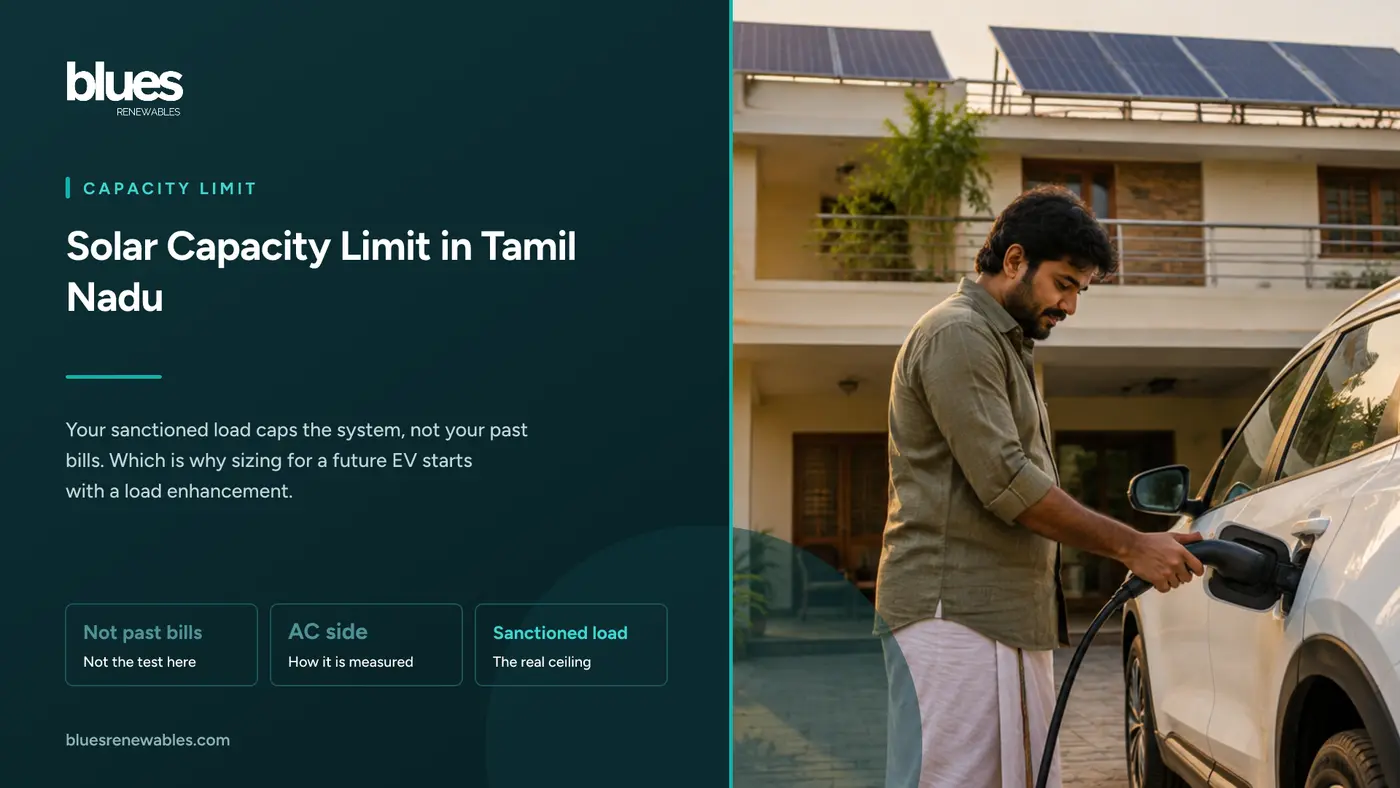
You are buying an electric car next year. You want the solar system to cover it. The installer says you cannot go that big because the DISCOM will only approve capacity matching what you have used in the past.
In Maharashtra that complaint was real enough in 2026 that it took a High Court nudge to resolve. Owners there were being held to their last twelve months of consumption, which is no help at all if the reason you are oversizing is a purchase you have not made yet.
Tamil Nadu works differently, and the difference is in your favour. The cap here is your sanctioned load, not your consumption history. This guide explains what the solar capacity limit in Tamil Nadu actually is, where it is written, and the correct route to a larger system when you are sizing for a future load.
Key takeaways
- Tamil Nadu caps rooftop solar at your sanctioned load or contracted demand, not at your past consumption.
- That is the useful distinction: a load enhancement raises the ceiling, while a year of low bills does not lower it.
- Net metering for domestic consumers runs up to the level of sanctioned load or contracted demand.
- Net billing and feed-in cover all categories except hut and agriculture, up to sanctioned load, to a maximum of 999 kW.
- Capacity is reckoned on the AC side, so the inverter rating is what counts against the cap, not the panel wattage.
- Existing net-metered consumers may add capacity later provided the total still does not exceed the sanctioned load.
What the solar capacity limit in Tamil Nadu is
The governing document is the TANGEDCO Salient Features and Guidelines issued with the Generic Tariff Order for Grid Interactive PV Solar Energy Generating Systems, Order No. 8 of 2021, dated 22 October 2021.
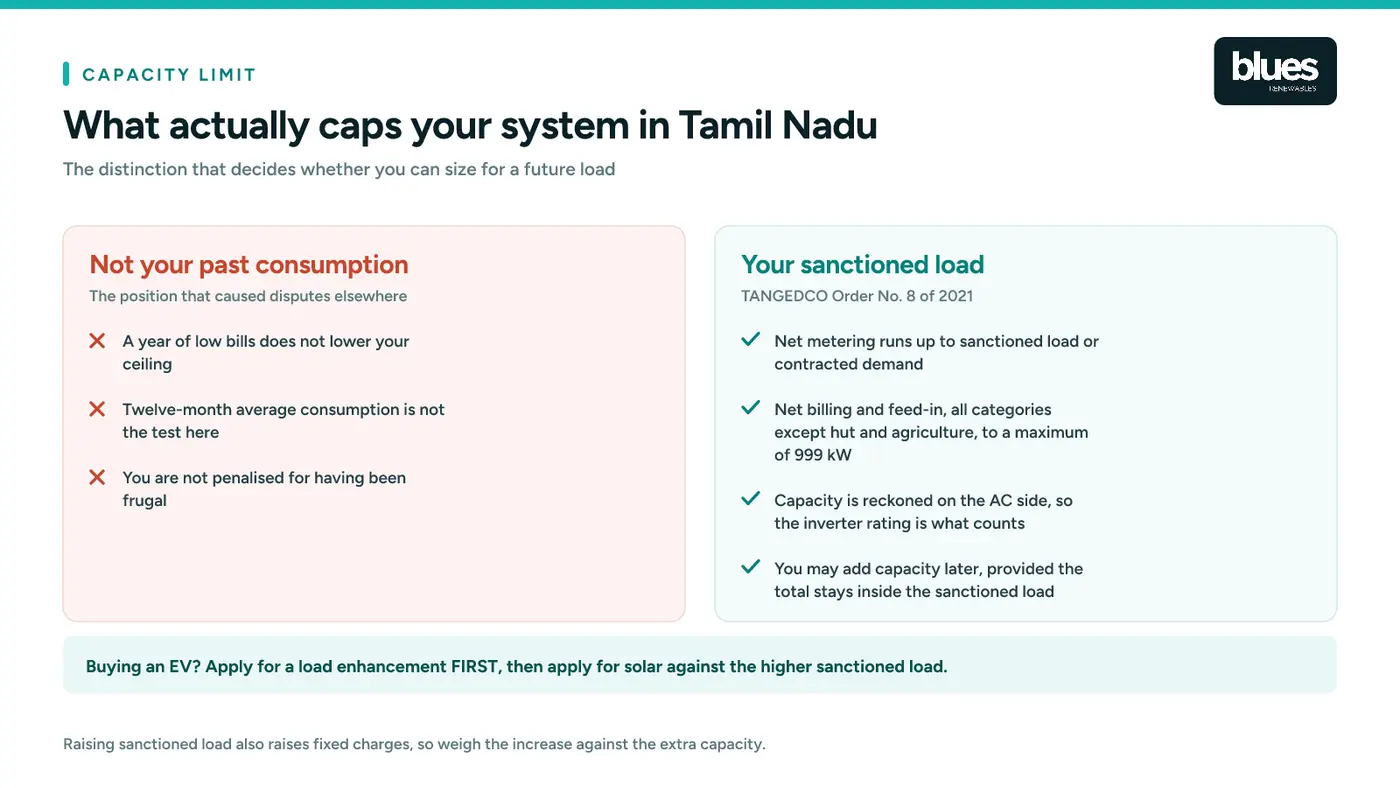
It sets the position plainly. Domestic consumers registered after 22 October 2021 are eligible for the net metering mechanism up to the level of sanctioned load or contracted demand.
For net billing or feed-in, all electricity consumer categories except hut and agriculture, at any tariff and voltage level, are eligible up to the level of sanctioned load or contracted demand, up to a maximum capacity of 999 kW.
Note what is absent. There is no clause tying your permitted solar capacity to your consumption over the previous twelve months. The constraint is the load your connection is sanctioned for.
Capacity is measured on the AC side
One detail that changes the arithmetic. The order states that solar plant capacity in all categories is reckoned as the capacity on the AC side.
That means your inverter's AC output rating is what counts against the sanctioned load, not the sum of your panel wattages. A 5 kW inverter with 6 kWp of panels on it counts as 5 kW. Mild DC oversizing, which is normal good practice because panels rarely produce their rated output, does not eat into your cap.
Say this back to any installer who tells you otherwise.
Adding capacity later
You are not locked into your first decision. The order provides that consumers already provided with net metering may add additional solar capacity and retain the net metering facility, provided the total solar capacity does not exceed the sanctioned load of the service connection.
Consumers may also apply for additional loads, with total loads not exceeding the sanctioned load or contracted demand, or 999 kW, whichever is lower, subject to technical feasibility.
So phased installation is legitimate. Start at 3 kW, add later, as long as the running total stays inside the ceiling.
Sizing for an EV you have not bought yet
This is where the Tamil Nadu position pays off, and it points to a specific sequence.
An electric car is a substantial new load. Charged at home, it can add a meaningful number of units a month depending on how far you drive. Sizing solar for the household you have today and then buying the car leaves you undersized, and retrofitting is more expensive than building it in.
Because the cap is sanctioned load rather than history, the route is straightforward:
Check your current sanctioned load. It is printed on your electricity bill.
Work out the load you will actually have, including the charger, which is typically rated in the low single-digit kW for a home unit.
Apply for a load enhancement first if the charger would take you past your current sanctioned load.
Then apply for solar up to the new, higher sanctioned load.
Doing it in that order matters. The solar application is assessed against the sanctioned load at the time, so raising the load afterwards means a second round of paperwork to raise the solar capacity as well.
A load enhancement also has consequences of its own, because fixed charges are levied on sanctioned load. Raising it raises that component of your bill. Weigh the increase against the value of the extra solar capacity rather than enhancing reflexively.
Sizing the solar, not just the cap
The cap is a ceiling, not a recommendation. Two numbers decide the sensible size.
In Chennai, a system generates roughly 4.8 units per kW per day across the year. A home charger adds consumption that is unusually easy to schedule, because a car parked during the day is the best possible daytime load.
That second point is worth more than extra panels. A unit you consume as you generate it saves your full retail tariff, while an exported unit earns less. Charging at midday rather than overnight converts export into self-consumption, which is the highest-value thing you can do with a rooftop system.
Our solar panel size calculator works this through against your own consumption.
What else the cap interacts with
The subsidy is capped separately. Central assistance peaks at ₹78,000 for systems of 3 kW and above, and residential assistance runs up to 10 kW. Capacity above that is perfectly legal, it simply attracts no additional subsidy.
Gross metering is a different route. Under the order, the minimum system size for gross metering is 151 kWp, up to a maximum of 999 kW, and LT consumers are not eligible. It is not a residential option.
Network charges step up above 10 kW. Domestic systems up to 10 kW pay network charges at 20 percent of the base rate, and above 10 kW at 75 percent. See network charges on rooftop solar in Tamil Nadu.
Technical feasibility still applies. The sanctioned load sets the ceiling, and the DISCOM still assesses whether the local network can take the connection. A feasibility rejection is a network issue, not a capacity rule.
Frequently asked questions
What is the maximum solar capacity I can install in Tamil Nadu?
Up to the level of your sanctioned load or contracted demand. For net billing and feed-in, the ceiling is your sanctioned load up to a maximum of 999 kW.
Does TANGEDCO limit solar capacity to my past consumption?
No. The governing order ties eligibility to sanctioned load or contracted demand, not to your consumption over previous months. This differs from the position some other states have taken.
Can I install solar for a future EV purchase?
Yes. Because the cap is sanctioned load, apply for a load enhancement first if the charger takes you past your current sanctioned load, then apply for solar against the higher figure.
Is solar capacity measured on panel wattage or inverter rating?
On the AC side, so the inverter rating counts against your sanctioned load. Modest DC oversizing of the panel array does not count against the cap.
Can I add more panels to my existing rooftop system?
Yes. Existing net-metered consumers may add capacity and retain net metering, provided the total solar capacity still does not exceed the sanctioned load of the connection.
Will raising my sanctioned load increase my bill?
Yes, because fixed charges are levied on sanctioned load. Compare that increase against the value of the additional solar capacity before applying.
How much solar does a home EV charger need?
It depends on your driving distance, but a home charger is usually rated in the low single-digit kW. The bigger advantage is that daytime charging turns exported units into self-consumed ones, which are worth considerably more.
What is the minimum size for gross metering in Tamil Nadu?
151 kWp, up to a maximum of 999 kW, and LT consumers are not eligible. It is not a residential route.
Where this fits
Once you know your ceiling, size the system against your actual use with the solar panel size calculator, then follow the TANGEDCO net metering application process. If you are considering storage alongside it, the rules are covered in our guide to TANGEDCO hybrid inverter rules.
Blues Renewables has installed solar across Chennai since 2020, for homes, schools, businesses and factories. We check your sanctioned load at survey and tell you whether a load enhancement is worth filing before the solar application, rather than after.
Call +91 98841 07170 with your bill and we will tell you the largest system your connection can actually take.
Sources
- TANGEDCO, Salient Features and Guidelines, Generic Tariff Order for Grid Interactive PV Solar Energy Generating System (GISS), Order No. 8 of 2021 dated 22 October 2021
- Tamil Nadu Electricity Regulatory Commission, Order No. 8 of 2021, and the Commission's Order dated 22 December 2020 in M.P. No. 32 of 2020 on retaining net metering when capacity is added
- MNRE, Guidelines for implementation of PM Surya Ghar: Muft Bijli Yojana, on residential Central Financial Assistance limits
- Blues Renewables installation and generation data, Chennai, 2020 to 2026