Solar Panel Cleaning and AMC Cost in Chennai (2026)
Discover what solar panel cleaning and AMC cost in Chennai, learn how often coastal dust needs washing, and read why bird droppings void more warranties than storms.


Nobody sells you the second year. The quote covers panels, structure, inverter and paperwork, and then the installer disappears once the five-year support period is quietly running down.
Then generation slips. Not dramatically, just a few units a day, until a bill arrives that looks like the bills you were getting before you went solar.
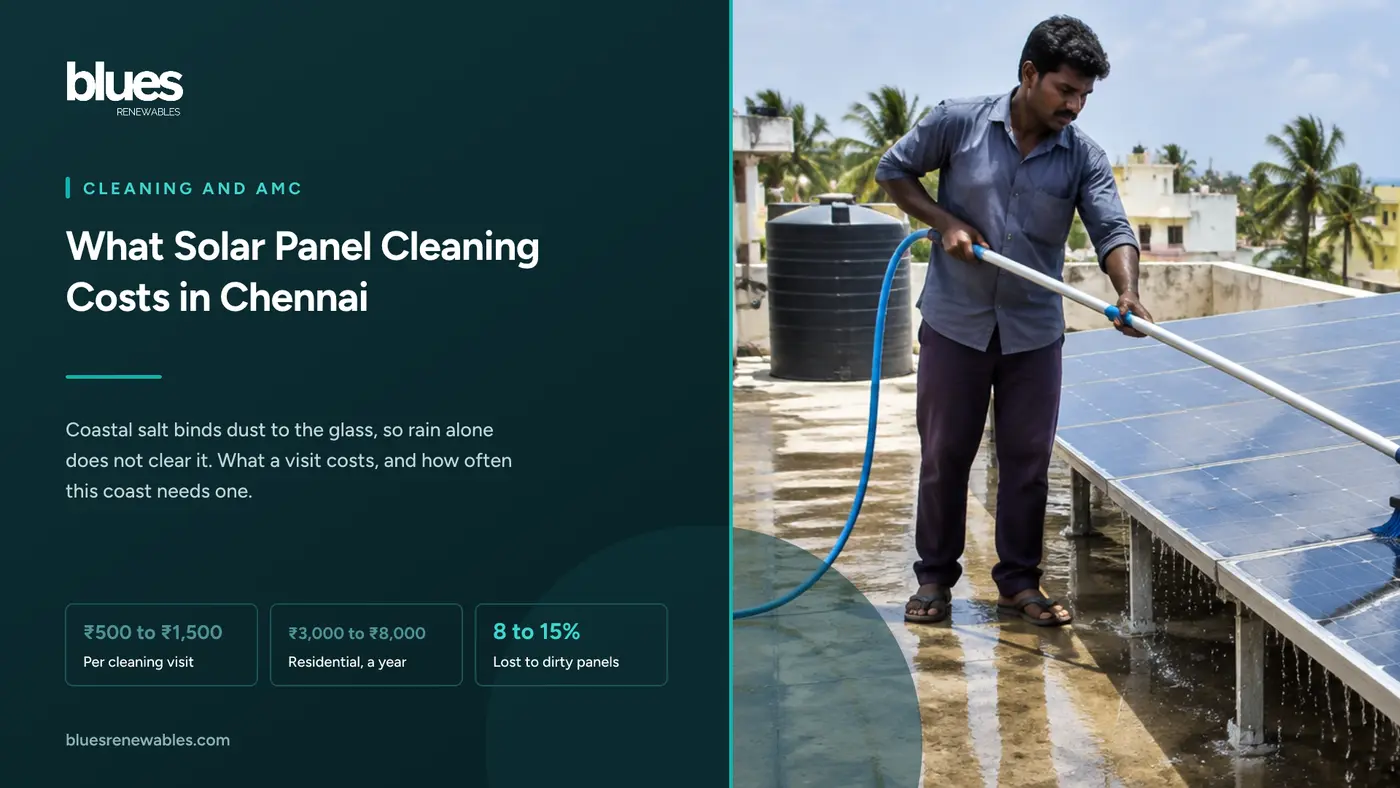
Almost always, the panels are dirty. This guide covers solar panel cleaning and AMC cost in Chennai honestly: what a visit should cost, how often the coast really needs it, what an annual maintenance contract should include, and the one kind of dirt that damages panels rather than just shading them.
Key takeaways
- Dirty panels cost 8 to 15 percent of generation in Chennai, because coastal salt binds dust to the glass instead of letting it blow off.
- A professional cleaning visit runs roughly ₹500 to ₹1,500 depending on system size and access.
- A residential AMC typically runs ₹3,000 to ₹8,000 a year for a 3 to 5 kW system, covering scheduled visits, cleaning and inverter checks.
- Bird droppings are the real hazard. They create hot spots, and hot spot damage is generally excluded from panel warranties.
- Automatic sprinkler systems handle routine dust and do not replace manual cleaning, because they cannot shift droppings or the crust that forms along the lower edge.
- Clean monthly through the dry months and after any dust-heavy or dry-windy spell. Monsoon rain does much of the work, but not all of it.
What solar panel cleaning costs in Chennai
Pricing depends mostly on how hard your array is to reach.
A standard rooftop residential system on an accessible terrace sits at the lower end. A raised structure, a fourth-floor terrace with no water point, or an array set back from the parapet pushes the price up because it needs equipment and more time.
Typical market rates in 2026:
- Single cleaning visit, residential: ₹500 to ₹1,500
- Annual maintenance contract, 3 to 5 kW: ₹3,000 to ₹8,000 a year
- Commercial and industrial AMC: quoted per kW per year, commonly ₹2,500 to ₹4,000 per kW for smaller commercial systems, falling sharply with scale
Ask what the price actually buys. A visit that is one person with a hose is not the same product as a visit that includes inverter error log checks, a structure and earthing inspection, and a generation report against expectation.
Why Chennai is harder on panels than most of India
Two local conditions make the coast unusually demanding.
Salt in the air. Within a few kilometres of the coast, salt mist settles with the dust and holds it. Inland dust largely blows off between showers. Salt-bound dust does not, so it builds into a film that a light rain smears rather than removes.
A long dry season with dusty wind. From roughly February to June, there is enough airborne dust and little enough rain for a measurable film to form within weeks. This is the period where cleaning pays for itself most obviously.
The result, measured across our own installations, is generation loss in the 8 to 15 percent range when panels are left unwashed through a dry season. On a 3 kW Chennai system generating about 4.8 units per kW per day, losing a tenth of that is roughly 1.4 units a day, or about 430 units a year.
At domestic slab rates, that is worth substantially more than the cleaning.
How often to clean
Set the frequency by season rather than by the calendar.
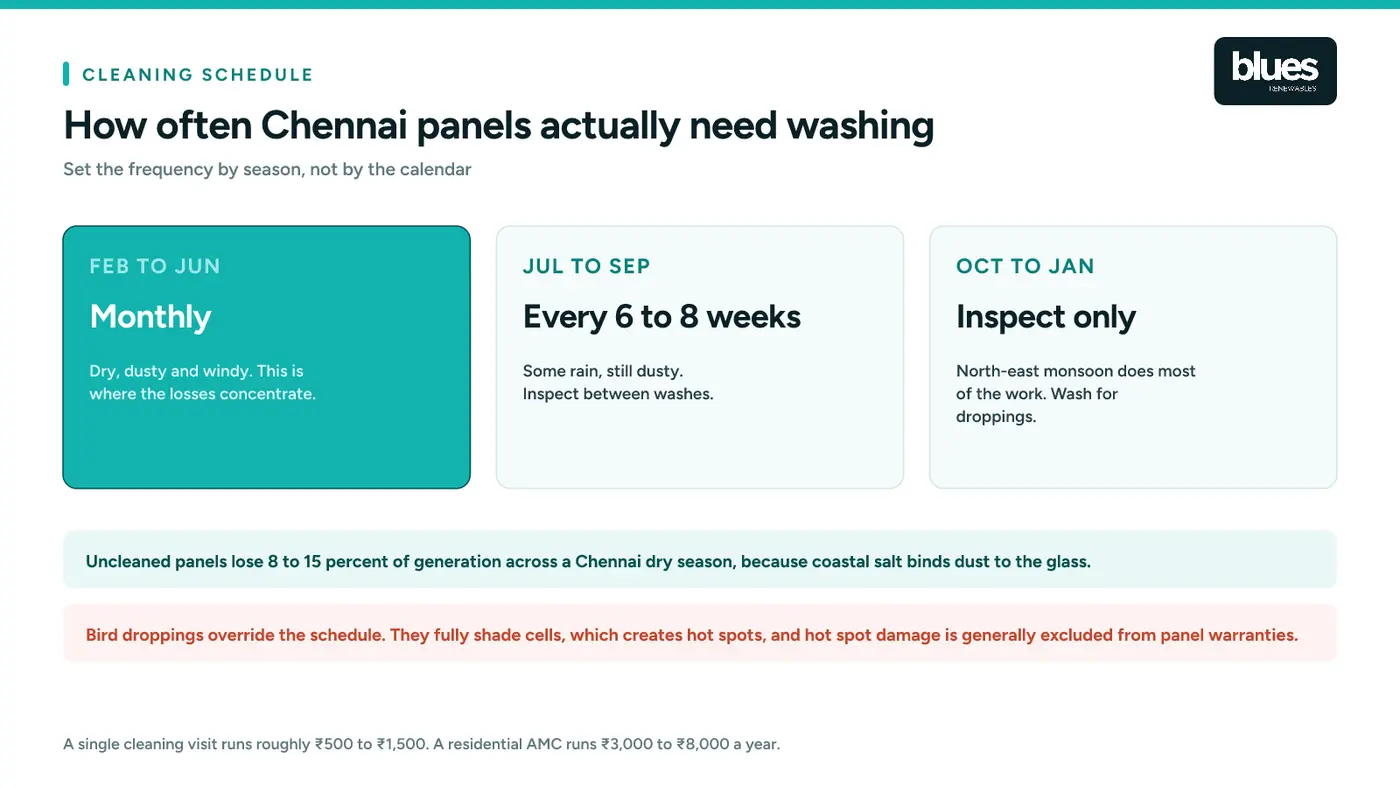
- February to June, the dry months: clean monthly. This is where the losses concentrate.
- July to September: every six to eight weeks. Some rain, still dusty.
- October to January, the north-east monsoon: rain does most of the work. Inspect rather than clean, and wash only if you see droppings or a crust.
Two triggers override the schedule. Clean after any construction dust nearby, and clean whenever you can see bird droppings, regardless of when you last washed.
Bird droppings are a different problem
Dust shades a panel. Droppings block a cell completely.
When one cell in a string is fully shaded while its neighbours are producing, current is forced through it and it heats. That is a hot spot. Sustained hot spots damage the cell and can delaminate the backsheet, and hot spot damage caused by a lack of maintenance is generally excluded from panel warranties.
This is why a dropping matters more than a general film of dust, and why "it will wash off in the rain" is poor advice. A dropping bakes on.
The same applies to the crust that builds along the lower edge of a panel, where runoff carries dust down and leaves it against the frame. That strip shades the bottom row of cells and behaves the same way.
What a proper AMC should include
An annual maintenance contract is worth having only if it covers more than washing. Ask for these in writing:
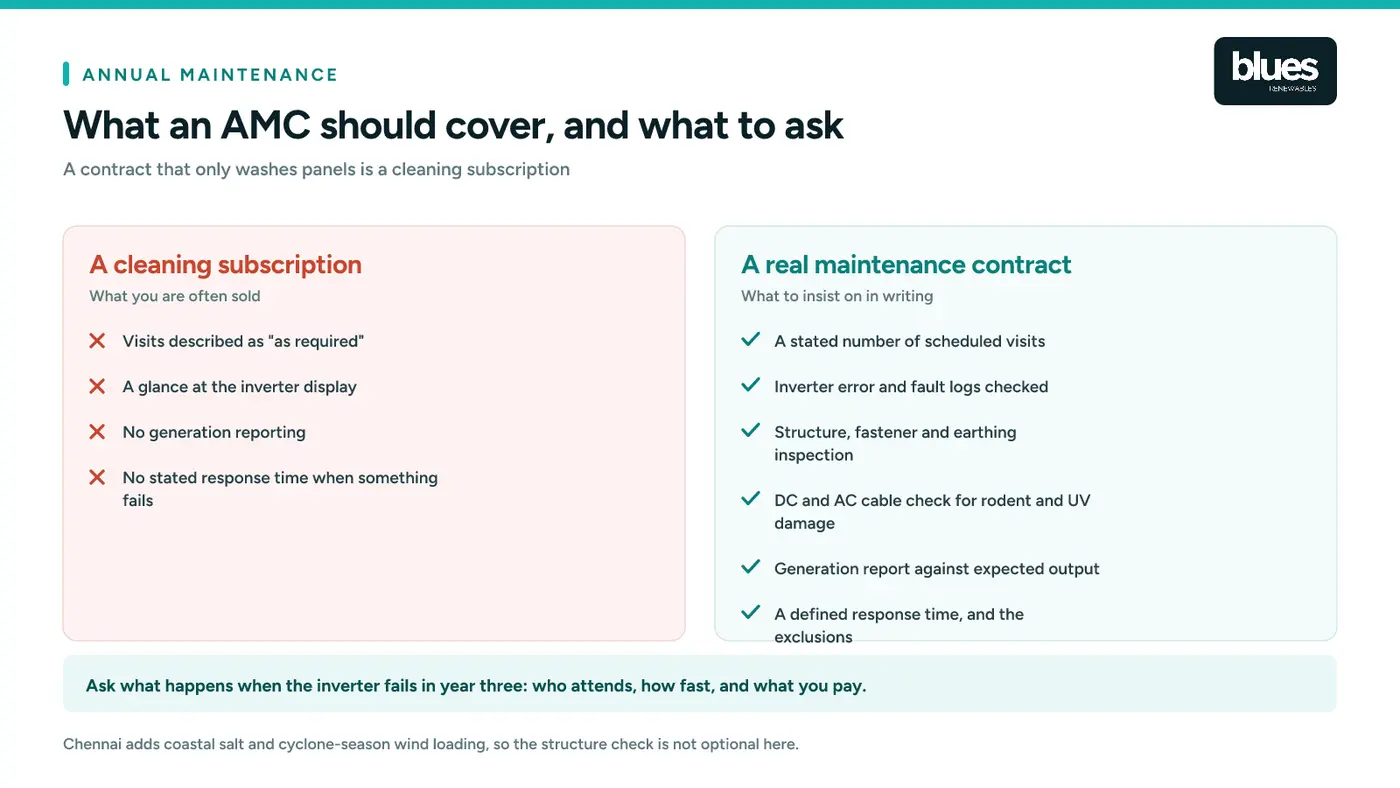
- Scheduled cleaning visits, with the number stated, not "as required"
- Inverter inspection, including error and fault logs rather than a glance at the display
- Structure and fastener check, which matters in Chennai because of cyclone-season wind loading
- Earthing and lightning protection check
- DC and AC cable inspection for rodent damage and UV degradation
- A generation report comparing actual output against what the system should produce
- A defined response time for faults, and what is excluded
That last one separates a real contract from a cleaning subscription. Ask what happens when the inverter fails in year three: who attends, how quickly, and what you pay.
Do sprinkler systems work?
Partly, and the honest answer matters because they are actively sold as a replacement for manual cleaning.
An automatic sprinkler on a timer handles routine dust well. It does not remove bird droppings, and it does not clear the crust along the lower edge, because the water runs down and over rather than lifting deposits off. Both of those are the deposits that cause hot spots.
So a sprinkler reduces how often you need a manual wash. It does not end it. Budget for both or budget for manual cleaning alone, but do not buy a sprinkler expecting to stop climbing to the roof.
Doing it yourself, safely
Plenty of owners clean their own panels. If you do:
- Wash early morning or evening. Cold water on hot glass risks thermal stress, and a hot panel dries with streaks.
- Use a soft brush, not an abrasive pad. The anti-reflective coating scratches.
- Use plain water where possible. Hard water leaves deposits, so squeegee the surface dry if your supply is hard.
- Never stand on the panels. Micro-cracks in cells do not show until generation drops.
- Keep the pressure moderate. High-pressure jets can force water past the frame seal.
If your array is on a raised structure or near an edge, pay someone. A fall costs more than a decade of AMC.
Frequently asked questions
How much does solar panel cleaning cost in Chennai?
A professional visit for a residential rooftop system usually costs ₹500 to ₹1,500, depending on system size and how accessible the array is. Raised structures and upper-floor terraces sit at the higher end.
How often should solar panels be cleaned?
Monthly through the dry months from February to June, every six to eight weeks from July to September, and mainly inspection during the north-east monsoon. Clean immediately whenever you see bird droppings.
What does a solar AMC cost per year?
For a 3 to 5 kW residential system, ₹3,000 to ₹8,000 a year is typical. Commercial systems are usually quoted per kW per year, commonly ₹2,500 to ₹4,000 per kW for smaller installations, falling with scale.
How much generation do dirty panels lose?
In Chennai, 8 to 15 percent across a dry season, because coastal salt binds dust to the glass rather than letting it blow off. Inland losses are typically smaller.
Do bird droppings damage solar panels?
Yes. A dropping fully shades cells, which creates a hot spot as current is forced through them. Sustained hot spots damage cells, and that damage is generally excluded from panel warranties.
Are automatic solar panel cleaning systems worth it?
They handle routine dust and reduce how often you need a manual wash, but they do not remove bird droppings or the crust along the lower edge of the panel. Treat them as a supplement, not a replacement.
Can I clean solar panels myself?
Yes, with a soft brush, plain water, moderate pressure, early in the morning or in the evening. Never stand on the panels, and pay a professional if the array is on a raised structure or near an edge.
Does rain clean solar panels?
It helps, but not completely on the coast. Salt-bound dust smears rather than lifting, and rain does nothing for droppings that have dried on.
Where this fits
Cleaning protects the generation you paid for, so it belongs alongside the numbers in our solar payback period guide, where uncleaned panels are one of the most common reasons real payback runs longer than the calculator promised. If you are still sizing a system, the solar panel size calculator is the place to start.
Blues Renewables has installed solar across Chennai since 2020, for homes, schools, businesses and factories. We include the first two years of maintenance on every system we install, and we will service a system we did not install.
Call +91 98841 07170 for an AMC quote against your actual array and access, not a per-kW guess.
Sources
- Blues Renewables generation and maintenance records, Chennai and Tamil Nadu, 2020 to 2026
- Panel manufacturer warranty terms on hot spot and maintenance-related exclusions
- Tamil Nadu Electricity Regulatory Commission, Tariff Order No. 6 of 2025 dated 30 June 2025, for domestic slab rates used in the loss calculation