Electricity Bill After Solar Not Zero? Here Is Why
Learn why your electricity bill after solar is not zero, discover which TANGEDCO charges never disappear, and read what a realistic Tamil Nadu bill looks like.


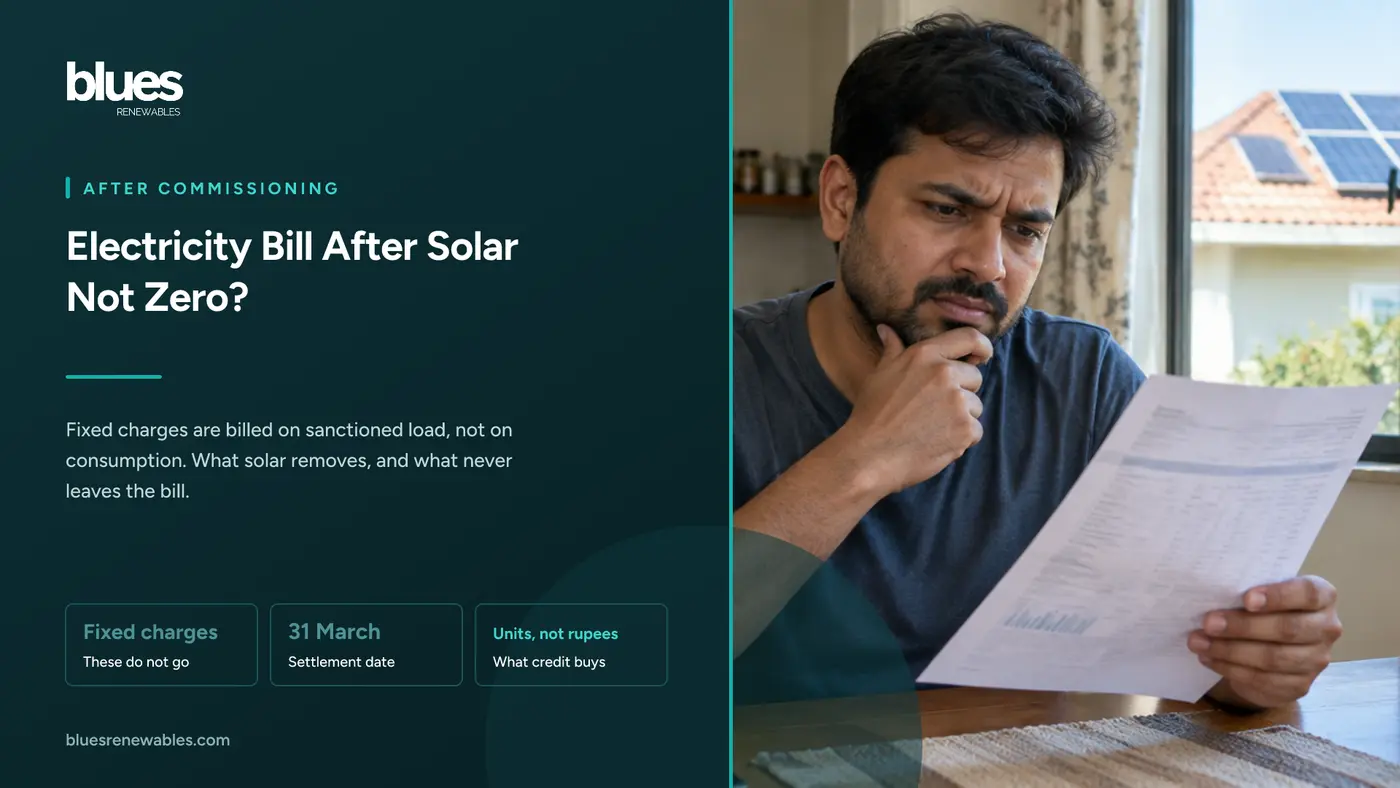
The system is commissioned, the export register is climbing, and the bill still arrives. Not a large bill, but a bill, and somebody at the office told you it would be zero.
Owners across India hit this in the first billing cycle, and the reaction is usually the same: something must be broken, or the DISCOM is not crediting the export.
Usually neither is true. An electricity bill after solar that is not zero is normal, and the reasons are written into how the tariff is built rather than into your installation. This guide explains what stays on the bill in Tamil Nadu, what genuinely should disappear, and how to tell an ordinary bill from a real fault.
Key takeaways
- Fixed charges are billed on your sanctioned load, not your consumption. Generating your own power does not remove them.
- Net metering credits units, not rupees. Your credit is only worth what it offsets, and it does not pay the fixed component.
- The settlement period ends on 31 March. Unused export credit is settled then, not carried indefinitely.
- Solar displaces your most expensive units first, so the bill falls faster than consumption does, and the last portion is the hardest to remove.
- A genuinely zero bill needs the system to cover consumption and the export value to cover the fixed charges. That is uncommon and usually uneconomic to chase.
- Investigate only if the export register is not moving, the meter was never replaced, or the bill did not fall at all.
Why your electricity bill after solar is not zero
Three things keep a number on the bill, and only the third is ever a problem.
Fixed charges do not depend on consumption
Your tariff has a fixed component tied to the sanctioned load of the connection, plus energy charges tied to units consumed. Solar reduces the second. It does not touch the first.
That charge pays for the grid staying available to you: the line, the transformer, the ability to draw power at 8 pm and through a week of monsoon cloud. You are still connected and still using that service, so you still pay for it.
This is the single most common surprise, and it is the one thing no installation can change short of disconnecting from the grid entirely.
Net metering settles in units, then converts
Under net metering, your export is credited against your import in units. If you import 400 units and export 250, you are billed on the net 150 plus the fixed component.
What surplus export does not do is pay off the fixed charge. Units offset units. The fixed component is a separate line and it is charged in rupees regardless.
So a household exporting well can reach a bill that is nothing but fixed charges and taxes. That is the floor for a grid connected system, and hitting it means the system is working exactly as designed.
The settlement period resets on 31 March
Credit does not accumulate forever. The settlement period runs to 31 March, and at the end of it the position is settled rather than rolled onward indefinitely.
Practically, this means banking a large surplus through the low-consumption months has limits. A system sized far beyond your annual consumption does not keep converting that surplus into value at the same rate, which is one reason oversizing has diminishing returns.
What a realistic Tamil Nadu bill looks like
Take a Chennai household with a 3 kW system.

The system generates roughly 4.8 units per kW per day, so about 14.4 units a day or around 430 units a month. If the household consumes around 400 units a month, a well-matched system covers the energy charge almost entirely across the year, with summer running short and winter running surplus.
What remains on the bill:
- Fixed charges on the sanctioned load
- Any net import in months where consumption exceeds generation, typically the hot months
- Applicable taxes and duties
What should have gone:
- The bulk of the energy charge, and specifically the units that were being billed at the highest slab rates
That last point explains why the bill falls faster than consumption. Solar displaces your marginal units, which are your most expensive. Removing the top 200 units of a 400 unit bill saves far more than half the money.
It also explains why the last stretch is stubborn. Once solar has removed the expensive slabs, the remaining units are the cheap ones, and adding panels to chase them returns much less per rupee spent.
Can you actually get a zero bill?
Rarely, and it is usually not worth engineering. It helps to know what the scheme actually promises: our guide to PM Surya Ghar's 300 free units explains why no units are credited to you.
To reach a true zero you would need generation to cover all your consumption and enough surplus export value at settlement to offset the fixed charges for the year. That requires deliberately oversizing well beyond your own use.
Run the arithmetic before chasing it. Extra panels cost money now, the surplus is settled at export rates rather than at the retail rate you save by self-consuming, and you are still capped by your sanctioned load. In most Chennai homes the money spent on those extra panels returns less than the same money left in the bank.
A better target is a bill that is fixed charges and little else, reached with a system sized to your actual consumption. That is the economically sensible endpoint, and most well-sized systems get there.
Self-consumption is where the value is
One habit changes the number more than extra hardware will.
A unit you consume as it is generated saves you the full retail tariff, including the slab rate you would otherwise have paid. A unit you export earns you a lower export value. The gap between those two is large.
So running the washing machine, the pump, the dishwasher and any daytime-flexible load between 10 am and 3 pm moves units from the low-value column to the high-value column at no cost. For most households this is worth more than another panel.
When the bill is telling you something is wrong
Most non-zero bills are normal. These are not.
The export register is not moving. Check the export reading on your bidirectional meter across two cycles. If it is not incrementing, either the meter is not configured for export or the system is not exporting. Raise it with your section office.
The meter was never replaced. A net metered connection needs a bidirectional meter. If your old meter is still in place, your export is not being recorded and may even be adding to your import reading. This needs immediate attention.
The bill did not fall at all. If your consumption pattern has not changed and the energy charge is roughly what it was, the system may not be generating. Check the inverter for faults and compare its daily figures against roughly 4.8 units per kW per day.
Generation has dropped noticeably. Before assuming a fault, check whether the panels are dirty. In Chennai, uncleaned panels lose 8 to 15 percent across a dry season, which shows up on the bill long before it shows up as an error on the inverter.
There are charges you do not recognise. Ask the section office for a line-by-line explanation in writing. Tariff components change through regulatory orders, and it is reasonable to ask which order a charge comes from.
Frequently asked questions
Why is my electricity bill not zero after installing solar?
Because fixed charges are billed on your sanctioned load rather than on consumption, and solar only reduces the energy charge. A bill consisting of fixed charges and taxes is the normal floor for a grid connected system.
Do fixed charges go away with solar in Tamil Nadu?
No. They are tied to the sanctioned load of the connection and pay for grid availability. You remain connected, so they remain payable.
What happens to my extra solar units at the end of the year?
The settlement period runs to 31 March, and the position is settled at that point rather than carried forward indefinitely. This is why very large surpluses return less than owners expect.
Is it possible to get a truly zero electricity bill with solar?
It is possible but uncommon, because you would need generation to cover all consumption plus enough surplus value to offset fixed charges. In most Chennai homes the extra panels required cost more than they return.
Why did my bill fall by more than my consumption did?
Solar displaces your most expensive units first. Removing the highest slab units saves disproportionately more money than removing the cheapest ones.
How can I reduce the remaining bill without buying more panels?
Shift flexible loads such as washing, pumping and dishwashing into daylight hours. A self-consumed unit saves your full retail tariff, while an exported unit earns less.
How do I know if my net meter is working?
Check that the export reading on the bidirectional meter increases between cycles. If it is static, or if your old single-direction meter is still installed, raise it with your section office.
Should I complain to TANGEDCO about a small bill?
Not if it is fixed charges and taxes on a system that is generating normally. Raise it if the export register is static, the meter was never changed, or the bill did not fall at all.
Where this fits
If the metering itself is the issue rather than the amount, start with the TANGEDCO net metering application guide. If the bill has crept back up over time, the likely cause is covered in our guide to solar panel cleaning and AMC cost. To check whether your system is the right size in the first place, use the solar calculator.
Blues Renewables has installed solar across Chennai since 2020, for homes, schools, businesses and factories. We size systems against your actual consumption and we tell you before you buy what will still be on your bill afterwards.
Send your latest bill to +91 98841 07170 and we will tell you whether what you are seeing is normal.
Sources
- TANGEDCO, Salient Features and Guidelines, Generic Tariff Order for Grid Interactive PV Solar Energy Generating System (GISS), Order No. 8 of 2021 dated 22 October 2021, on net metering, settlement on 31 March and capacity limits
- Tamil Nadu Electricity Regulatory Commission, Tariff Order No. 6 of 2025 dated 30 June 2025, for fixed charges and domestic slab rates
- Blues Renewables generation and billing records, Chennai, 2020 to 2026