How Many Solar Panels Required to Run 5HP Motor? Nine or Ten
How many solar panels required to run 5HP motor: nine to ten 550 W panels for direct pumping. Learn why the array is oversized, and discover the cheaper grid-tied route.


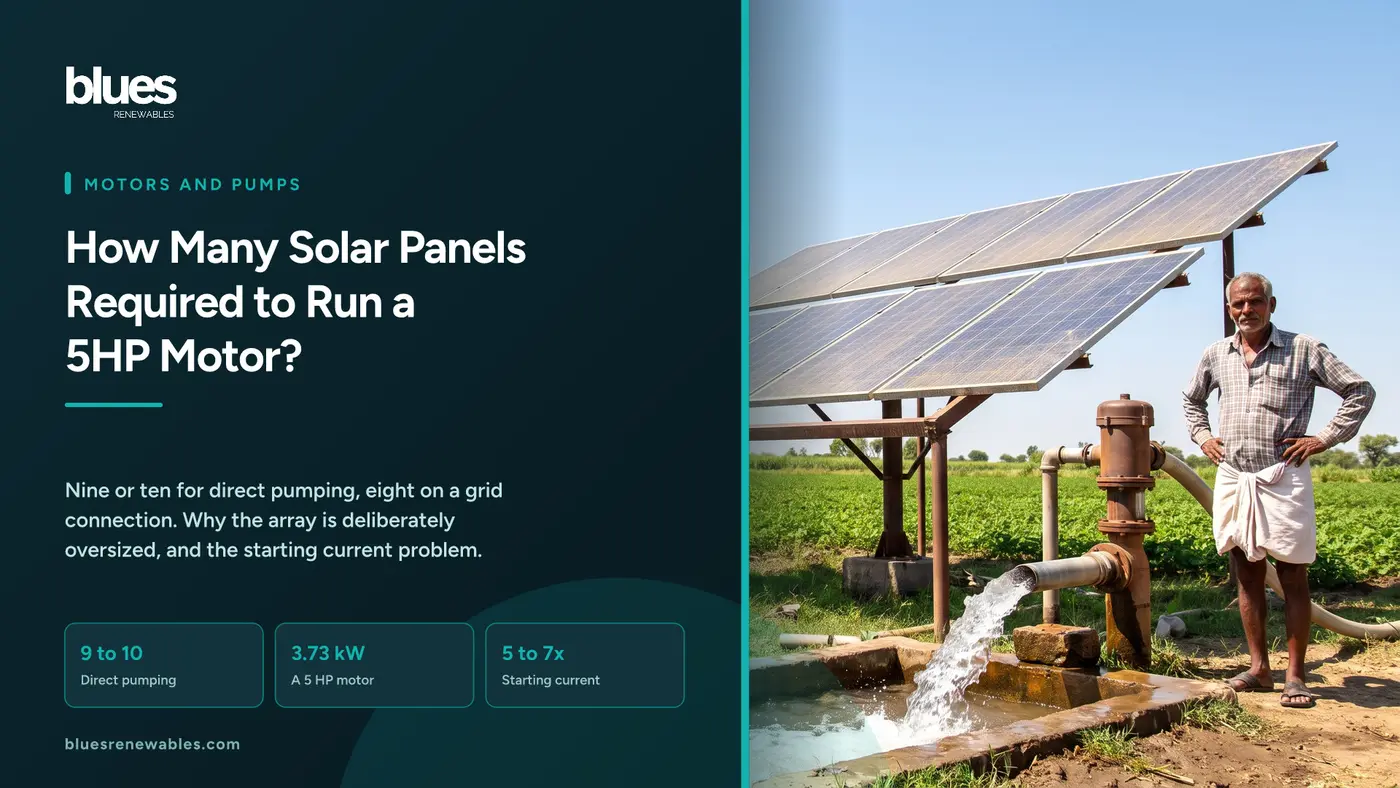
Nine or ten panels, if you want the motor to run straight off the array with no grid and no battery. Eight, if the motor is on a grid connection and you only need to cover its energy.
Those are two genuinely different questions hiding inside how many solar panels required to run 5HP motor, and they produce different answers because one is about power at every instant and the other is only about energy over a day.
This guide covers both routes, the oversizing rule that direct pumping needs, the starting current problem that wrecks undersized systems, the counts for 1 HP and 50 HP, and where subsidy fits for agricultural pumps.
Key takeaways
- A 5 HP motor is 3.73 kW. For direct solar pumping, size the array at 1.3 to 1.5 times that, so 5 to 5.6 kW, or nine to ten panels of 550 W.
- On a grid connection you need less. Running 5 HP for five hours a day uses about 18.7 units, which about 3.9 kW of solar covers. That is eight panels.
- Starting current is the real design constraint. An induction motor draws five to seven times its running current at start, which is why solar pumps use a VFD controller rather than a direct connection.
- A 1 HP motor needs about two panels; a 50 HP installation needs roughly 90 to 100.
- Oversizing is deliberate, not waste. It keeps the pump running at useful speed through the weaker hours of the morning and evening.
- PM-KUSUM supports agricultural solar pumps, which changes the economics considerably for farm use.
How many solar panels are required to run a 5 HP motor
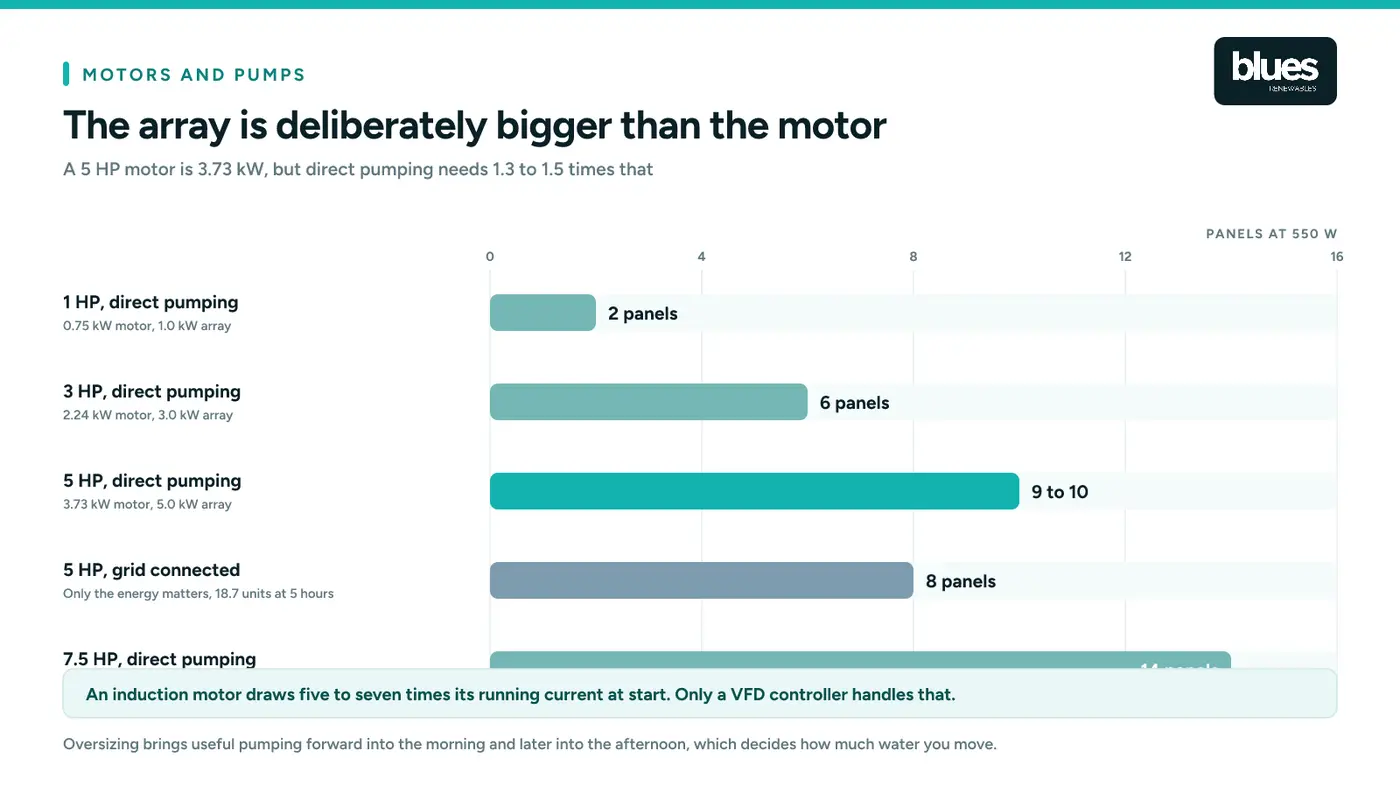
A 5 HP motor rated at 3.73 kW requires nine to ten solar panels of 550 W, giving 5.0 to 5.5 kW, when it runs directly from the array without a grid connection or battery. The array is deliberately larger than the motor because solar output varies through the day. Where the motor instead sits on a grid-connected supply, about 3.9 kW, or eight panels, covers its daily energy at five hours of running.
Start with the motor rating in kilowatts
1 HP = 0.746 kW, so a 5 HP motor is 3.73 kW of shaft power. Allowing for motor efficiency, the electrical input is nearer 4.1 to 4.4 kW at full load.
That figure is the running load. Two things push the array above it.
Route one: direct solar pumping, no grid
This is the standard build for agricultural borewells and open wells, and the one PM-KUSUM funds.
There is no battery. The panels feed a controller, the controller drives the motor, and the pump runs whenever there is enough sun. Output rises through the morning, peaks at midday and falls away in the evening.
Size the array at 1.3 to 1.5 times the motor rating.
- 1 HP - Motor kW: 0.75 kW, Array at 1.35×: 1.0 kW, Panels at 550 W: 2
- 2 HP - Motor kW: 1.49 kW, Array at 1.35×: 2.0 kW, Panels at 550 W: 4
- 3 HP - Motor kW: 2.24 kW, Array at 1.35×: 3.0 kW, Panels at 550 W: 6
- 5 HP - Motor kW: 3.73 kW, Array at 1.35×: 5.0 kW, Panels at 550 W: 9 to 10
- 7.5 HP - Motor kW: 5.59 kW, Array at 1.35×: 7.5 kW, Panels at 550 W: 14
- 50 HP - Motor kW: 37.3 kW, Array at 1.35×: 50 kW, Panels at 550 W: 91
Why oversize? Because an array sized exactly to the motor only delivers full power for perhaps two hours around noon. At nine in the morning it might produce 40 percent of rating, and the pump either runs at a crawl or not at all. Adding a third more capacity brings useful pumping forward into the morning and later into the afternoon, which is what actually determines how much water you move in a day.
The extra panels are cheap relative to the borewell, the pump and the civil work. Skimping there is the commonest false economy in solar pumping.
Route two: grid-connected, offset the energy
If the motor already runs on a grid supply, you do not need the array to carry it instant by instant. You need enough generation to cover the units it consumes, with the grid smoothing the difference.
Array kW = daily running hours × motor kW ÷ 4.8
- 3 hours - Units used: 11.2, Array needed: 2.3 kW, Panels at 550 W: 5
- 5 hours - Units used: 18.7, Array needed: 3.9 kW, Panels at 550 W: 8
- 8 hours - Units used: 29.8, Array needed: 6.2 kW, Panels at 550 W: 12
At five hours a day, the grid-connected route needs eight panels against nine or ten for direct pumping, and it carries no risk of the pump stopping under cloud. Where a grid connection already exists and is reliable, it is usually the better buy.
The starting current problem
This is where undersized systems fail, and it is worth understanding before anyone quotes you.
An induction motor started direct-on-line draws five to seven times its full load current for a second or two while it comes up to speed. A 5 HP motor drawing perhaps 7 amps running can demand 40 amps at the instant of starting.
No solar array can supply that surge. It is a current-limited source: push it beyond its capability and the voltage collapses instead.
The answer is a variable frequency drive, which every proper solar pump controller includes. A VFD ramps frequency up from zero, so the motor accelerates gently and never draws the surge at all. It also lets the pump run at reduced speed in weak light rather than stalling.
Two things follow.
- Never connect a motor directly to an array through a simple switch. It will fail to start, and repeated stalling will burn the winding.
- Where a battery-backed inverter drives the motor, the inverter must be rated for the starting surge, not the running load. That is why off-grid motor systems need much larger inverters than their kilowatt figures suggest.
Panel counts for other motor sizes
A 1 HP motor needs about 1 kW of array for direct pumping, which is two panels of 550 W. On a grid connection running three hours a day it uses 2.2 units, needing under half a kilowatt.
A 50 HP installation is a different category. At 37.3 kW the array runs to roughly 50 kW, about 91 panels and some 7,700 sq ft of ground. By that point you are building a small solar plant, and the sensible route is usually a grid-connected system with net metering, or open access supply, rather than direct drive. Our guide to can factories run on solar power in India covers the options at industrial scale.
Subsidy for agricultural pumps
Farm pumping has its own scheme. PM-KUSUM supports standalone solar pumps and the solarisation of existing grid-connected agricultural pumps, with central financial assistance topped up by a state share, leaving the farmer with a minority of the cost.
Two points worth checking before you budget.
- Rates and the farmer's share vary by state and by component, and allocations run in tranches. Confirm the current position with your state nodal agency rather than relying on any article, including this one.
- The scheme covers agricultural pumping specifically. A 5 HP motor in a workshop or a housing society pump house falls outside it, and is treated as an ordinary commercial installation.
Note also that the GST rate on solar equipment fell from 12 percent to 5 percent on 22 September 2025, which reduced pump system costs alongside everything else.
Frequently asked questions
How many solar panels are required to run a 5HP motor? Nine to ten panels of 550 W, giving 5.0 to 5.5 kW, for direct solar pumping with no grid or battery. On a grid connection running five hours a day, about eight panels cover the energy instead.
How many solar panels are required to run a 1HP motor? Two panels of 550 W, about 1 kW, for direct pumping. That is 1.35 times the motor's 0.75 kW rating, which keeps the pump running through the weaker morning and evening hours.
How many solar panels are required for 50HP motors? About 91 panels of 550 W, roughly 50 kW, needing some 7,700 sq ft of ground. At that scale a grid-connected or open access arrangement usually makes more sense than direct drive.
Why is the solar array larger than the motor rating? Because solar output varies through the day. An array sized exactly to the motor only delivers full power around noon. Oversizing by 30 to 50 percent brings useful pumping forward into the morning and later into the afternoon.
Can a solar panel start a motor directly? No. An induction motor draws five to seven times its running current at start, which an array cannot supply. A variable frequency drive in the pump controller ramps the motor up gently and avoids the surge entirely.
Do I need batteries to run a motor on solar? Not for daytime pumping. Direct drive systems run the pump while the sun shines and store water in a tank rather than storing electricity, which is far cheaper. Batteries only make sense where the motor must run after dark.
How many units does a 5HP motor use per day? About 18.7 units at five hours of running, based on 3.73 kW of shaft power. Actual consumption depends on motor efficiency and load, and runs somewhat higher at full load.
Is a solar pump cheaper than a grid connection? Where no connection exists, almost always, because a new agricultural connection carries its own cost and waiting time. Given a reliable existing connection, though, a grid-tied array offsetting the energy usually costs less than a standalone pumping system.
Getting the sizing right
For the method behind these numbers, read how to calculate how many solar panels are required. If the motor is one load among many on an industrial site, start with can factories run on solar power in India and industrial solar in Chennai. For battery-backed builds, see how many solar panels are required to charge a 200Ah battery, and for larger arrays how much land is required for a 1MW solar power plant.
Blues Renewables has installed solar across Chennai since 2020, for homes, schools, businesses and factories. We size motor loads from the starting characteristics as well as the running load, because a system that cannot start the pump is not a cheaper system, only a useless one.
Call +91 98841 07170 and we will confirm how many solar panels are required to run your 5HP motor, and whether direct drive or a grid-tied array costs you less.
Sources
- Ministry of New and Renewable Energy, PM-KUSUM scheme for solar agricultural pumps
- Press Information Bureau, Ministry of New and Renewable Energy, "GST on Renewable Energy Devices Rationalised to 5%", 17 September 2025
- Solar pump controller and VFD datasheets for starting current handling in Indian supply
- Module dimensions and ratings from current mono PERC and TOPCon datasheets
- Blues Renewables installation data, Chennai, 2020 to 2026