How Many Solar Panel Required to Charge 200Ah Battery? The Real Answer
How many solar panel required to charge 200Ah battery: about 600 W with MPPT. Learn the watt-hour maths, discover why the controller changes the answer, and read the 150Ah case.


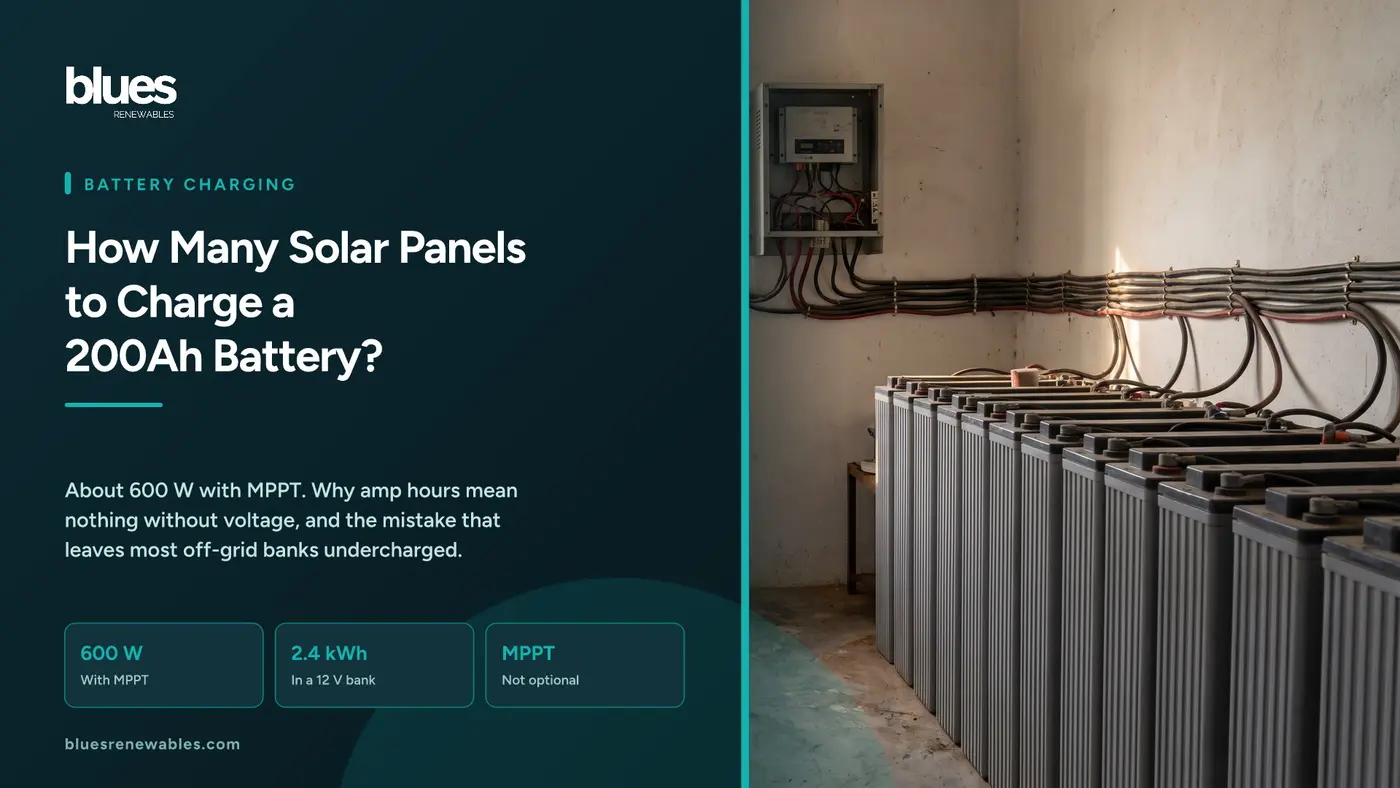
About 600 watts, which in 2026 is a single large panel. But that number is worthless without two pieces of information nobody asks for: the battery's voltage, and what kind of charge controller sits between them.
Get either wrong and the same "200Ah battery" needs anywhere from 450 W to 1,200 W. That is why how many solar panel required to charge 200Ah battery produces such wildly different answers across the internet.
This guide gives you the actual calculation, the panel count for 12 V and 24 V banks, why an MPPT controller changes the answer by a third, the 150 Ah case, and the mistake that leaves most off-grid systems chronically undercharged.
Key takeaways
- A 12 V 200 Ah battery holds 2.4 kWh. Charging it in one day needs about 600 W with MPPT, or nearer 750 W with a PWM controller.
- Amp hours mean nothing without voltage. The same 200 Ah at 24 V holds 4.8 kWh and needs roughly double the panels.
- One 550 W panel plus MPPT just about does it. Two panels is the build that actually works on a cloudy week.
- A 150 Ah 12 V battery needs about 450 W, comfortably one panel.
- Never size panels for the battery alone. They must charge the battery and carry your daytime loads at the same time.
- Modern 550 W panels need MPPT on a 12 V system. Their voltage is far too high for a PWM controller to use efficiently.
How many solar panels are required to charge a 200Ah battery
Charging a 12 V 200 Ah battery from empty in a single day requires about 600 W of solar with an MPPT charge controller, which is one 550 W to 600 W panel, or two smaller ones. With a PWM controller the requirement rises to roughly 750 W. A 24 V 200 Ah bank holds twice the energy and needs about 1,200 W.
Step 1: Convert amp hours to watt hours
This is the step that gets skipped, and it is the reason answers diverge.
Watt hours = Amp hours × Battery voltage
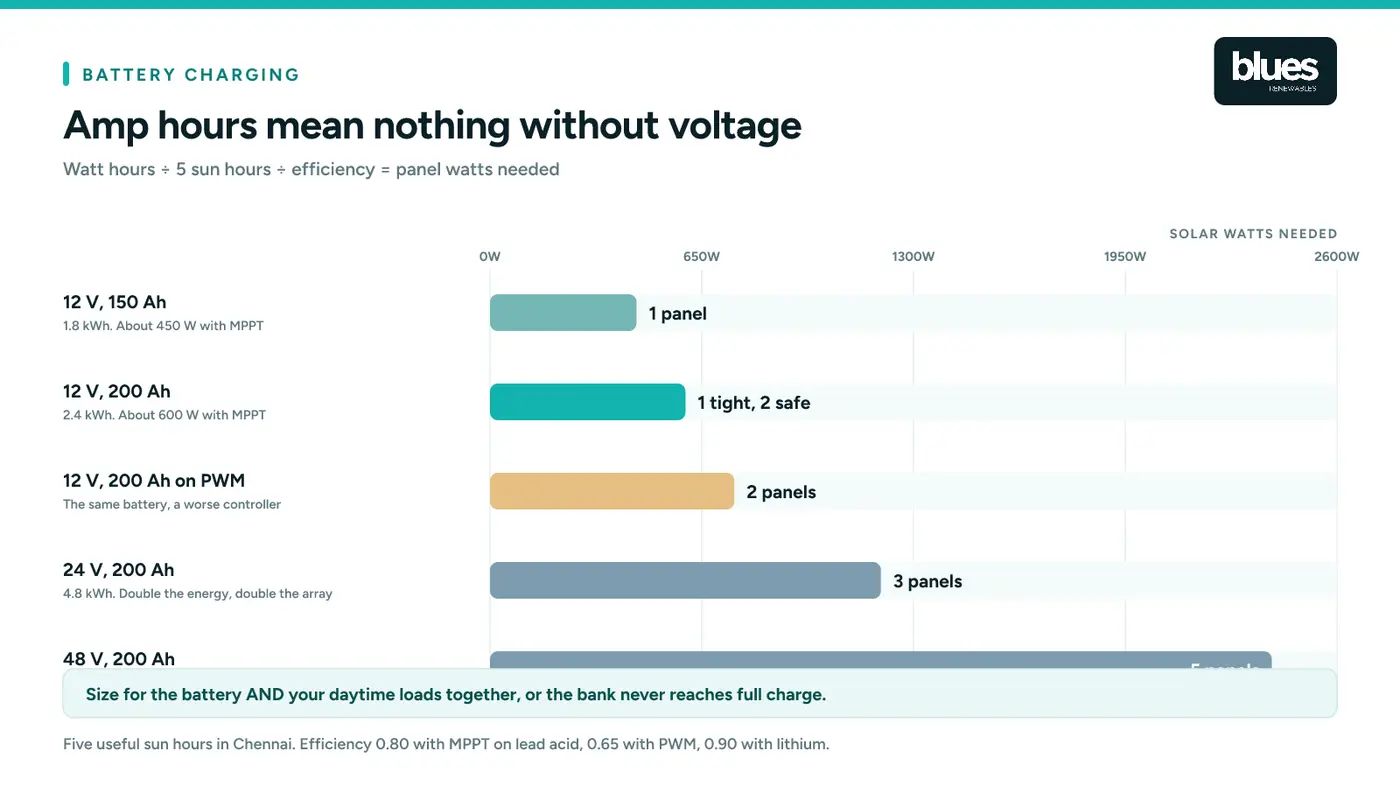
- 12 V, 150 Ah - Watt hours: 1,800 Wh, In units: 1.8 kWh
- 12 V, 200 Ah - Watt hours: 2,400 Wh, In units: 2.4 kWh
- 24 V, 200 Ah - Watt hours: 4,800 Wh, In units: 4.8 kWh
- 48 V, 200 Ah - Watt hours: 9,600 Wh, In units: 9.6 kWh
A "200 Ah battery" is therefore not one thing. At 48 V it stores four times what it stores at 12 V, and needs four times the array.
Step 2: Divide by usable sun hours
Chennai gets about 5.3 peak sun hours a day. Use 5 for charging calculations, since the first and last hours of daylight contribute little at useful power.
Step 3: Divide by system efficiency
Energy is lost in the controller, the cables and the battery's own charge acceptance. This is where the controller type bites.
- MPPT with lithium (LiFePO4) - Combined efficiency: about 0.90
- MPPT with tubular lead acid - Combined efficiency: about 0.80
- PWM with tubular lead acid - Combined efficiency: about 0.65
Panel watts = Watt hours ÷ 5 ÷ efficiency
For a 12 V 200 Ah lead acid battery with MPPT: 2,400 ÷ 5 ÷ 0.80 = 600 W.
With a PWM controller instead: 2,400 ÷ 5 ÷ 0.65 = 738 W, so call it 750 W.
Panel count, by battery and controller
- 12 V 150 Ah - Controller: MPPT, Watts needed: 450 W, Panels at 550 W: 1
- 12 V 150 Ah - Controller: PWM, Watts needed: 555 W, Panels at 550 W: 2
- 12 V 200 Ah - Controller: MPPT, Watts needed: 600 W, Panels at 550 W: 1, tight; 2 comfortable
- 12 V 200 Ah - Controller: PWM, Watts needed: 750 W, Panels at 550 W: 2
- 24 V 200 Ah - Controller: MPPT, Watts needed: 1,200 W, Panels at 550 W: 3
- 48 V 200 Ah - Controller: MPPT, Watts needed: 2,400 W, Panels at 550 W: 5
The 12 V 200 Ah row with MPPT deserves a note. A single 550 W panel delivers about 2,340 Wh into the battery on a good day, against the 2,400 Wh needed. It works in clear weather and falls short the moment a cloud passes. Two panels is the build we would install, because a battery that never quite reaches full charge sulphates and dies early.
Why a 550 W panel needs MPPT on a 12 V system
Worth understanding before you buy a cheap controller.
A modern 550 W module has a maximum power voltage around 41 V, while a 12 V battery charges at roughly 14 V.
A PWM controller simply connects the two, dragging the panel down to battery voltage. Your 550 W panel, forced to operate at 14 V instead of 41 V, delivers barely a third of its rated power. You have paid for 550 W and are using perhaps 190 W.
An MPPT controller converts the excess voltage into extra current, so nearly all of the panel's output reaches the battery.
With large modern panels on a low-voltage battery, MPPT is not an upgrade. It is the only thing that works. PWM is only sensible with older 12 V nominal panels of around 150 W to 250 W, which are no longer common supply.
The mistake that starves most off-grid systems
Here is the error we see most often on site.
People size the array to charge the battery, then connect their daytime loads to the same system. Now the panels must do both jobs at once, and the battery only receives whatever is left over. On a normal day it never reaches full charge.
Size for both.
Panel watts = (Daily load Wh + Battery Wh to replace) ÷ 5 ÷ efficiency
Take a small off-grid setup running 1.5 kWh of daytime load, with a 12 V 200 Ah battery to recharge:
(1,500 + 2,400) ÷ 5 ÷ 0.80 = 975 W, so two 550 W panels.
That is a very different answer from the 600 W the battery alone suggested, and it is why so many systems disappoint their owners in the second month.
Lead acid or lithium changes the sums
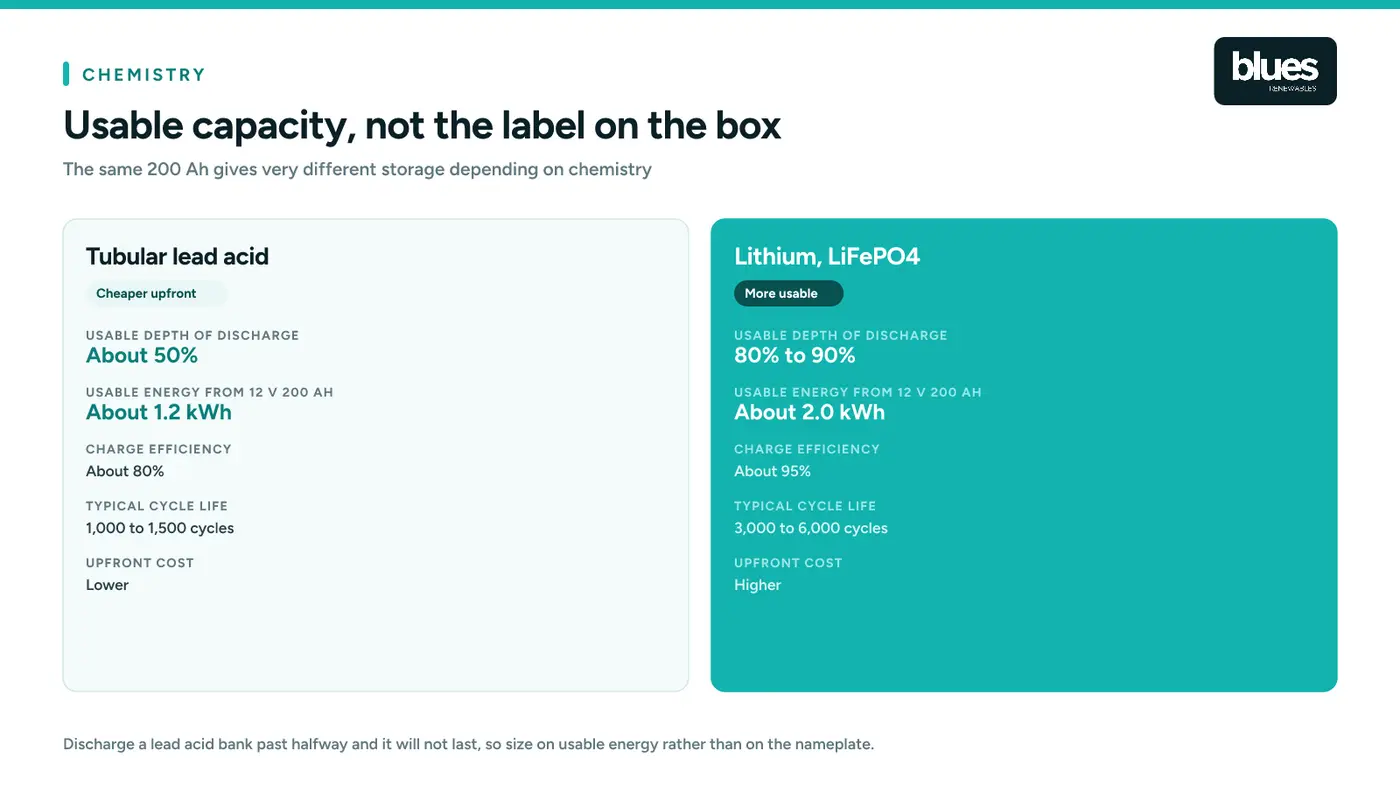
- Usable depth of discharge - Tubular lead acid: about 50%, Lithium, LiFePO4: 80% to 90%
- Usable energy from 12 V 200 Ah - Tubular lead acid: about 1.2 kWh, Lithium, LiFePO4: about 2.0 kWh
- Charge efficiency - Tubular lead acid: about 80%, Lithium, LiFePO4: about 95%
- Typical cycle life - Tubular lead acid: 1,000 to 1,500, Lithium, LiFePO4: 3,000 to 6,000
- Upfront cost - Tubular lead acid: Lower, Lithium, LiFePO4: Higher
The middle row matters most. A lead acid battery you discharge past halfway will not last, so a 200 Ah lead acid bank gives you roughly 1.2 kWh of genuinely usable storage, while the same nominal lithium bank gives around 2 kWh.
If you are sizing storage by what you can actually take out of it rather than by the label, lithium needs a smaller nominal capacity and charges more efficiently from the same array.
Inverter questions this raises
A 1 kVA inverter. At a typical 0.8 power factor that is about 800 W of load. How many batteries depends entirely on backup hours: one 12 V 150 Ah or 200 Ah battery gives roughly an hour and a half of usable backup at that load on lead acid, so two batteries in a 24 V configuration is the common build for meaningful backup.
A 3 kVA 24 V inverter. That is about 2,400 W of load and a 24 V battery bank, meaning at least two 12 V batteries in series. For the array, size on your daily energy rather than the inverter rating: most 3 kVA installations we see pair with 2 kW to 3 kW of panels, which is four to six modules of 550 W.
The inverter rating tells you the maximum instantaneous load it can carry. It does not tell you how much energy you use in a day, and only the second number sizes an array.
Frequently asked questions
How many solar panel required to charge 200Ah battery? About 600 W with an MPPT controller for a 12 V 200 Ah battery, which is one 550 W panel at a stretch or two comfortably. With PWM, allow 750 W. A 24 V 200 Ah bank needs about 1,200 W.
How many solar panel required to charge 150Ah battery? About 450 W with MPPT, which one 550 W panel covers comfortably. With a PWM controller allow around 555 W, so two panels.
How many solar panels required for a 150Ah battery at 24V? A 24 V 150 Ah bank holds 3.6 kWh, so about 900 W with MPPT, which is two 550 W panels.
For a 1kVA solar system how many batteries are required? One 12 V 150 Ah or 200 Ah battery gives roughly an hour and a half of usable backup at full load on lead acid. Two batteries in a 24 V bank is the usual build where longer backup matters.
A 3kVA 24V inverter needs how many solar panels? Size on daily energy use, not the inverter rating. Most 3 kVA installations pair with 2 kW to 3 kW of panels, which is four to six 550 W modules.
Can I charge a 12V battery with a 550W panel? Only through an MPPT controller. A 550 W module operates near 41 V, and a PWM controller would drag it to battery voltage and waste roughly two thirds of its output.
How long does it take to charge a 200Ah battery on solar? About one full sunny day with a correctly sized array, meaning around five useful sun hours. An undersized array or a PWM controller stretches it across two or more days, which shortens battery life.
Do I need batteries if I have grid power? Usually not. Net metering lets you export by day and draw at night far more cheaply than storage does. Batteries earn their place where supply is genuinely unreliable, which our off grid solar system in Chennai page covers.
Getting the sizing right
For grid-connected sizing, which suits most Chennai homes better, read how many solar panels required for a house and how to calculate how many solar panels are required. Specific system sizes are covered in 1 kW and 3 kW. If your interest in batteries is air conditioning, how many solar panels required for 1.5 ton AC explains why net metering usually beats storage. Our hybrid solar system in Chennai page covers systems that do both.
Blues Renewables has installed solar across Chennai since 2020, for homes, schools, businesses and factories. We size battery systems from your daily energy use and your backup requirement separately, because conflating the two is what leaves a bank permanently undercharged.
Call +91 98841 07170 and we will work out how many solar panels are required to charge your 200Ah battery, alongside the loads it has to carry.
Sources
- Manufacturer datasheets for tubular lead acid and LiFePO4 solar batteries in Indian supply
- MPPT and PWM charge controller efficiency ranges from current controller datasheets
- Module electrical characteristics from current mono PERC and TOPCon datasheets in Indian supply
- Tamil Nadu Electricity Regulatory Commission, Grid Interactive Solar Energy Generating Systems Regulations
- Blues Renewables installation data, Chennai, 2020 to 2026