Can Factories Run on Solar Power in India? The Honest Answer
Learn whether factories can run on solar power in India, discover what share your roof can realistically cover, and read the four routes beyond it.


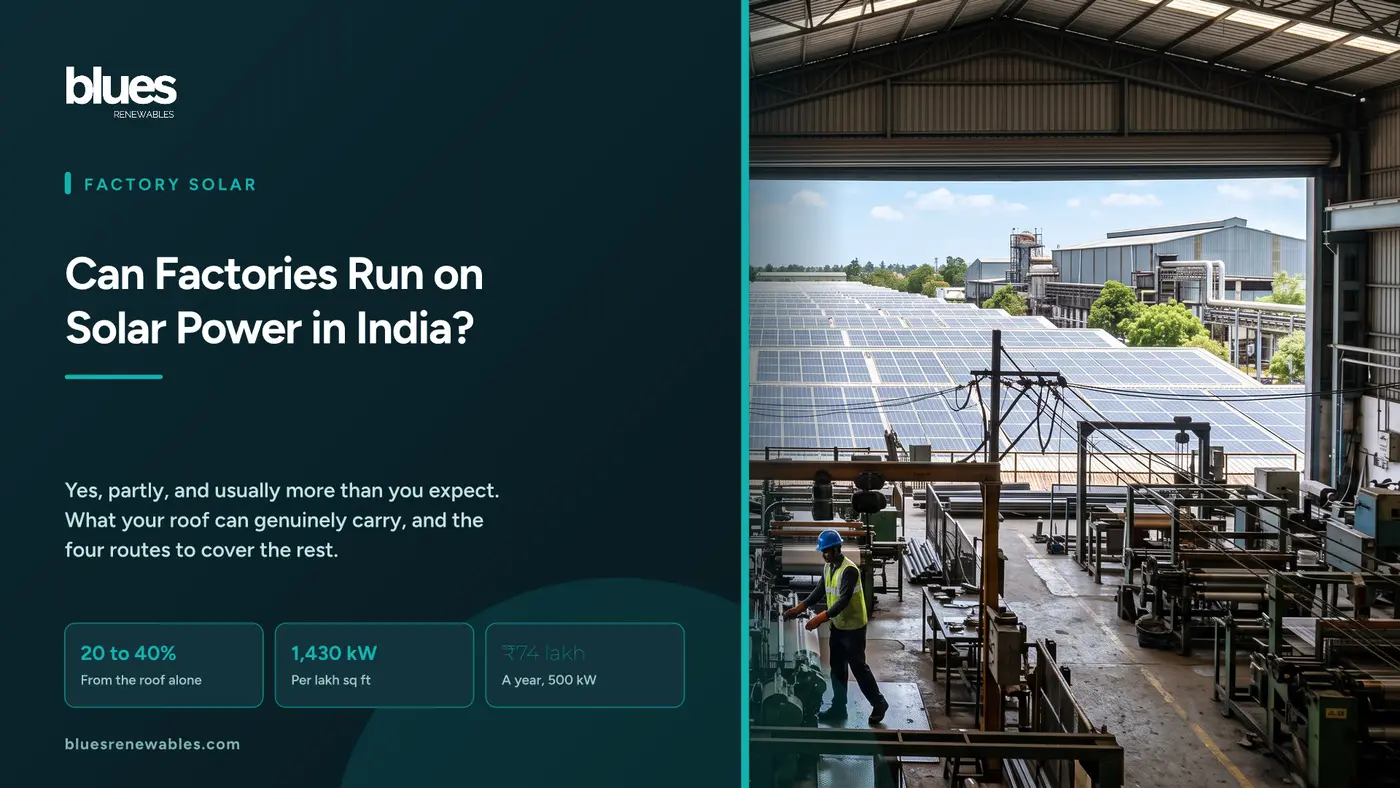
Yes, partly. Often a much larger part than a factory owner expects, and almost never the whole thing from the roof alone.
That is the honest answer to can factories run on solar power in India, and the interesting question sits underneath it. Not whether solar works, but what share of your consumption it can realistically carry, and what the remaining share costs to reach.
This guide gives you the roof-versus-load arithmetic, the coverage a real factory achieves, the four routes beyond the roof, and the one factor that decides more than roof size ever will.
Key takeaways
- A factory roof typically covers 20 to 40 percent of annual consumption for a two or three shift operation, and 50 to 70 percent for a single daytime shift.
- Roof area is the binding constraint. A one lakh square foot roof supports roughly 1.4 MW, which is well short of what a comparable load draws.
- Your shift pattern matters more than your roof size. Solar generates for about eight useful hours; a three-shift plant buys the other sixteen from the grid.
- Rooftop units are the cheapest you will ever get, because they attract no wheeling charge, no transmission charge and no cross subsidy surcharge.
- Open access and group captive take you beyond the roof, at ₹5 to ₹7 landed per unit against ₹8 to ₹9.50 from the grid.
- Running literally on solar around the clock needs storage, which still rarely pays for an Indian factory on grid-connected supply.
Can factories run on solar power in India
Factories in India can run a substantial share of their operations on solar power, but not all of it from rooftop generation alone. Solar produces during daylight only, while most factories draw power across two or three shifts, so rooftop solar typically supplies between 20 and 70 percent of annual consumption depending on the shift pattern. Reaching higher requires off-site generation through open access or a captive plant, or battery storage.
The framing that helps is this. Solar is an energy resource, not a capacity resource. It reduces the units you buy, but on its own it will not let you disconnect from the grid.
The roof-versus-load arithmetic
Two numbers decide what your roof can do.
Roof area to capacity. Allow roughly 50 square feet per kW of module area, rising to 70 or even 100 square feet per kW on a real industrial roof once you leave walkways, setbacks, skylights and shading gaps around ducting and tanks.
Capacity to generation. In Chennai, expect about 4.8 units per kW per day averaged across the year, so roughly 1,750 units per kW annually.
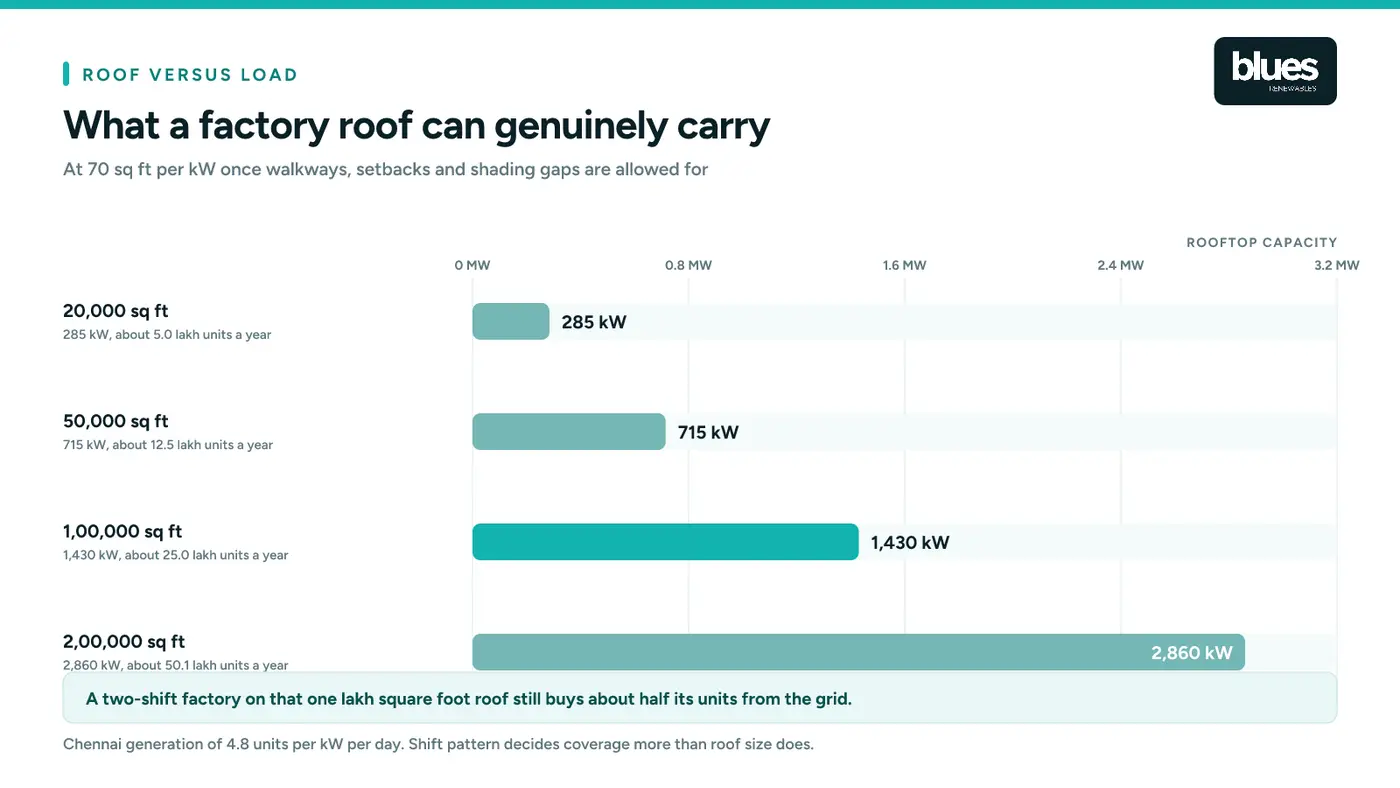
- 20,000 sq ft - Capacity at 70 sq ft per kW: 285 kW, Annual generation: 5.0 lakh units, Covers a factory drawing: about 1,370 units a day
- 50,000 sq ft - Capacity at 70 sq ft per kW: 715 kW, Annual generation: 12.5 lakh units, Covers a factory drawing: about 3,430 units a day
- 1,00,000 sq ft - Capacity at 70 sq ft per kW: 1,430 kW, Annual generation: 25.0 lakh units, Covers a factory drawing: about 6,860 units a day
- 2,00,000 sq ft - Capacity at 70 sq ft per kW: 2,860 kW, Annual generation: 50.1 lakh units, Covers a factory drawing: about 13,720 units a day
Now set that against demand. A factory with 1 MW of connected load running two shifts at reasonable utilisation draws somewhere around 12,000 to 15,000 units a day. A one lakh square foot roof gives you 6,860. So the roof covers roughly half the daily energy, and only during the hours it is generating.
That is not a disappointing result. Quite the opposite. It simply is not "running the factory on solar".
What share can you realistically cover
Your shift pattern does most of the work here.
- Single day shift, 9 to 6, five or six days - Rooftop coverage of annual units: 50% to 70%
- Two shifts - Rooftop coverage of annual units: 30% to 45%
- Three shifts, continuous - Rooftop coverage of annual units: 20% to 30%
- Continuous process with high night load - Rooftop coverage of annual units: 15% to 25%
A single-shift garment unit or a machine shop working days can get most of the way there on its roof. Continuous-process plants cannot, whatever the roof size, because two thirds of their consumption happens in darkness.
There is a second constraint people miss. Even during daylight, solar output rises and falls with the sun, while your load is comparatively flat. On a clear afternoon your array may briefly exceed your load, exporting the surplus at a lower value. That is why sizing to your daytime minimum load rather than your peak usually produces better economics, a point developed in how to calculate solar payback period.
Four routes beyond the roof
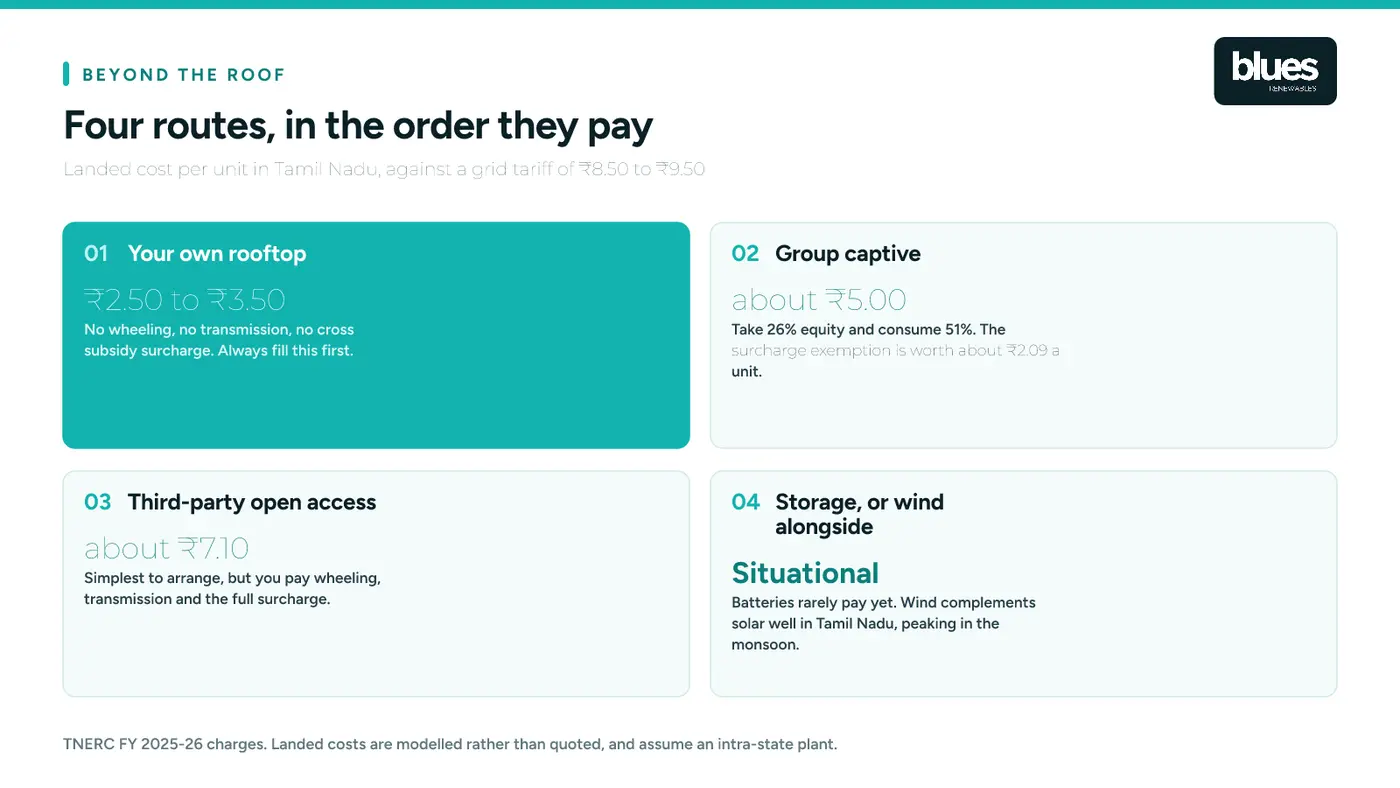
1. Fill the roof first. Always. Rooftop units are the cheapest electricity available to an Indian factory because they never touch the distribution network, so they attract no wheeling charge, no transmission charge and no cross subsidy surcharge. Nothing off-site beats them per unit.
2. Third-party open access. Buy from a remote solar farm and have it wheeled to you over the state network. You pay wheeling, transmission and cross subsidy surcharge on top of the generator's tariff, landing around ₹7.10 a unit in Tamil Nadu. In Tamil Nadu the entry threshold is 63 kVA of contracted demand at HT or EHT. Start with what open access solar is.
3. Captive or group captive. Take equity in the generating company and the cross subsidy surcharge and additional surcharge fall away, worth about ₹2.09 a unit in Tamil Nadu. Landed cost drops to roughly ₹5.00. The tests are 26 percent equity and 51 percent consumption, explained in what a captive solar power plant is and who can use power from a group captive solar plant.
4. Storage, and wind alongside solar. Batteries shift daytime generation into the night shift, but at current prices they rarely pay for a grid-connected Indian factory. Pairing solar with wind is often the better move in Tamil Nadu, because the wind season peaks during the monsoon months when solar output dips, and the two profiles complement each other across the year.
- Your own rooftop - Indicative landed cost: ₹2.50 to ₹3.50 equivalent, Charges you pay: None
- Group captive - Indicative landed cost: about ₹5.00, Charges you pay: Wheeling and transmission
- Third-party open access - Indicative landed cost: about ₹7.10, Charges you pay: Wheeling, transmission, CSS, additional surcharge
- Grid supply, HT - Indicative landed cost: ₹8.50 to ₹9.50, Charges you pay: The full tariff
Read that table top to bottom and the strategy writes itself. Fill the roof, then use open access or group captive for the balance, in that order.
What it costs and what it returns
A 500 kW rooftop plant on a factory in Chennai runs roughly ₹2.60 to ₹2.90 crore installed. It generates about 8.76 lakh units a year, displacing grid units at ₹8.50, which is about ₹74 lakh a year where the factory consumes nearly all of it.
Add the tax treatment and the first year improves further. A manufacturer outside the concessional 22 percent regime claims 60 percent depreciation in year one, and input tax credit is generally available where the power is consumed captively in taxable manufacturing. Both are covered in rooftop solar accelerated depreciation and GST on a solar power plant.
Payback typically lands between three and four years on an asset warranted for 25.
Five things that decide whether it works
Roof condition and age. A 25 year asset on sheeting with eight years left is a problem you will pay for twice. Re-sheet first, or plan for removal and reinstatement.
Structural capacity. Older industrial sheds were not designed for the extra load. Chennai also sits in a 50 metre per second basic wind zone under IS 875 Part 3, with a cyclone importance factor applied, so the mounting design matters more here than inland.
Shading from your own building. Tanks, ducting, cooling towers, monitor roofs and adjacent taller sheds all cost output. Insist on a shadow analysis across the year, not a walk on the roof.
Your daytime minimum load. Size to it. Generation above your load gets exported at a lower value and weakens both your payback and your input tax credit position.
Cleaning access. Dust and coastal salt cost 8 to 15 percent of output if panels go unwashed through the dry months. Design walkways in from the start.
Frequently asked questions
Can factories run on solar power in India? Partly, and often substantially. Rooftop solar typically supplies 20 to 40 percent of a multi-shift factory's annual units, and 50 to 70 percent for a single day shift. Running entirely on solar requires off-site generation through open access or captive arrangements, and storage for night load.
Can a factory run 100 percent on solar? Not from its roof alone, and not literally around the clock without storage. A factory can offset 100 percent of its annual consumption on paper by combining rooftop with open access and banking arrangements, but it still draws grid power at night.
How much roof area does a factory need for 1 MW of solar? Roughly 50,000 square feet of clear module area, or nearer 70,000 to 100,000 square feet of gross roof once walkways, setbacks and shading gaps are allowed for.
How much can a factory save with solar? A 500 kW rooftop plant in Chennai displaces about 8.76 lakh units a year, worth around ₹74 lakh annually against an HT tariff of ₹8.50, before the depreciation and input tax credit benefits.
What is the payback for factory solar? Three to four years is typical for rooftop, helped by high HT tariffs and strong daytime self-consumption. Working it out for your own plant is covered in how to calculate solar payback period.
Do factories need batteries to use solar? Rarely. Grid-connected factories use the grid itself as the balancing mechanism, which is far cheaper than storage. Batteries make sense mainly where supply is unreliable or where night tariffs are exceptionally high.
Can a factory sell surplus solar power? Surplus can be exported under the applicable state metering arrangement, though export is usually worth less than self-consumption. Selling power also makes it an exempt supply for GST, which affects your input tax credit.
What if my factory roof is too small? Fill it anyway, since those are your cheapest units, then cover the balance through open access solar or a group captive arrangement.
Where this fits
Start with the roof, then read what open access solar is and what a captive solar power plant is for the routes beyond it. Funding is covered in the CAPEX model in solar and the OPEX model, and the tax position in rooftop solar accelerated depreciation. Our industrial solar in Chennai page covers what we do on factory sites.
Blues Renewables has installed solar across Chennai since 2020, for homes, schools, businesses and factories. We begin every factory enquiry with your load curve and your roof survey, because the honest answer to what solar can cover comes from those two documents and nothing else.
Call +91 98841 07170 and we will tell you how far your own plant can run on solar power, what comparable factories across India actually achieve, and what the balance would cost through open access or group captive.
Sources
- Tamil Nadu Electricity Regulatory Commission, Tariff Order No.6 of 2025 dated 30 June 2025
- TNERC, Terms and Conditions for Green Energy Open Access Regulations 2025
- Electricity Act 2003, Sections 9 and 42, on captive generation and open access
- Income Tax Act 1961, Section 32 and Section 32(1)(iia)
- IS 875 Part 3, wind loads for building design
- Blues Renewables installation data, Chennai, 2020 to 2026, for generation and roof-area ratios