How to Calculate How Many Solar Panels Are Required: One Formula
Learn how to calculate how many solar panels are required in three steps, discover the panel count for every system size from 1 kW to 30 kW, and read what changes it.


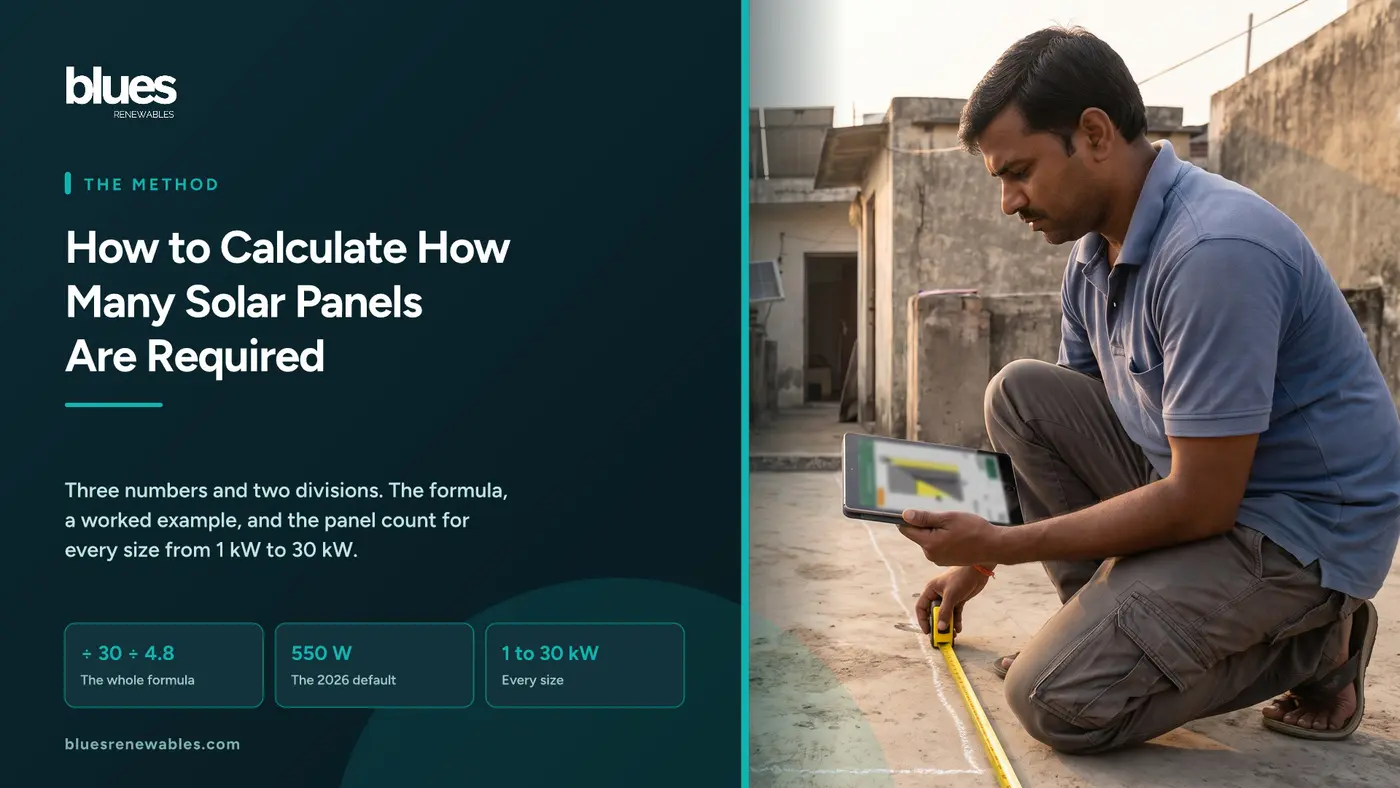
Three numbers and two divisions. That is the whole calculation, and you can do it on your phone before an installer arrives.
The reason how to calculate how many solar panels are required feels complicated is that most explanations skip the middle step, the one that converts kilowatts of capacity into units of electricity. Get that right and everything else follows.
This guide gives you the formula, a worked example, the panel count for every system size from 1 kW to 30 kW, the two other ways to size a system, and the five things that change the answer once a surveyor sees your roof.
Key takeaways
- The formula is: monthly units ÷ 30 ÷ 4.8 = system size in kW. Then divide watts by panel wattage and round up.
- 4.8 units per kW per day is the Chennai figure, after real losses. It is not the same as peak sun hours.
- At 550 W panels, multiply kW by about 1.85 to get the panel count. A 3 kW system is six panels, 5 kW is ten.
- Allow about 85 sq ft of roof per kW, including the mounting frame and walking space.
- Round up, not down. Below 3 kW the extra panel also unlocks subsidy; above it, the panel simply pays for itself in generation.
- Three sizing routes exist: from your bill, from your appliances, or from your roof. Use the bill unless you have no bill.
How to calculate how many solar panels are required
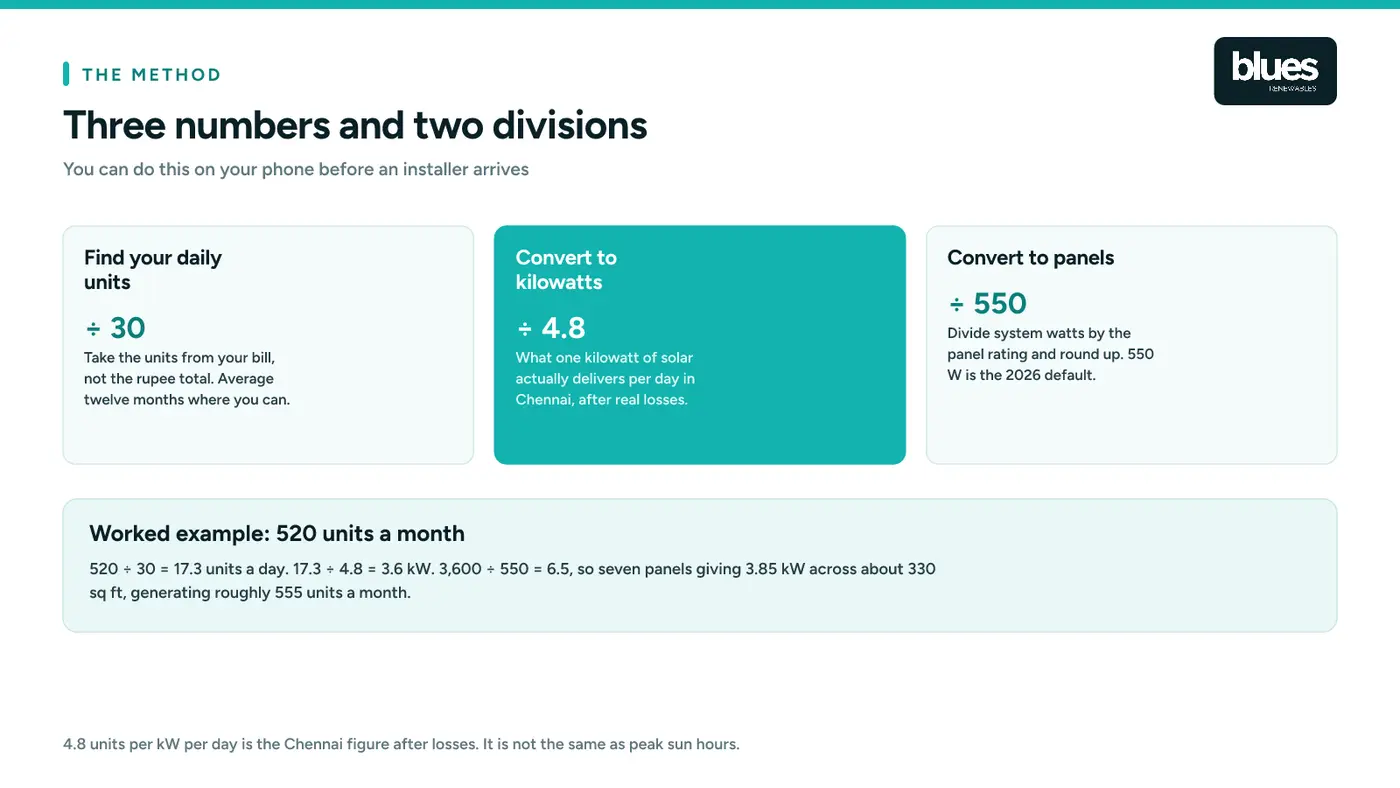
To calculate how many solar panels you need, divide your monthly electricity units by 30 to get daily units, divide that by 4.8 to get the system size in kilowatts, then divide the system size in watts by your panel wattage and round up. At the 550 W modules standard in India in 2026, a home using 400 units a month needs about 2.8 kW, which is six panels.
Step 1: Find your daily units
Take the units from your electricity bill, not the rupee total. Tariffs are slabbed, so two homes using the same units can pay very different amounts.
Daily units = monthly units ÷ 30
Average twelve months if you can. Chennai summers and monsoons differ enough that a single bill will mislead you in one direction or the other.
Step 2: Convert units into kilowatts
System size in kW = daily units ÷ 4.8
This is the step that gets skipped. The 4.8 is how many units one kilowatt of solar actually delivers per day in Chennai, averaged across the year.
It is not the same as peak sun hours. Chennai gets about 5.3 peak sun hours, but you never receive all of it as useful energy. Losses come from cell temperature, which is significant in a Chennai summer, plus dust, cable resistance, inverter conversion and module mismatch. The 4.8 figure has all of that taken off already.
Use 4.8 for Chennai and most of Tamil Nadu. Elsewhere in India the figure runs roughly 4.0 to 5.0, lower where winters are longer and hazier, so adjust if you are sizing outside the south.
Step 3: Convert kilowatts into panels
Panels = system size in watts ÷ panel wattage, rounded up
Indian rooftop supply in 2026 runs on 540 W to 600 W mono PERC and TOPCon modules. Take 550 W as the default unless a quotation states otherwise. The 250 W and 330 W panels that older articles assume have largely left residential supply, which is why their panel counts look so high.
A worked example
A Chennai household using 520 units a month.
- Daily units - Calculation: 520 ÷ 30, Result: 17.3 units
- System size - Calculation: 17.3 ÷ 4.8, Result: 3.6 kW
- Panels at 550 W - Calculation: 3,600 ÷ 550 = 6.5, Result: 7 panels
- Actual capacity - Calculation: 7 × 550, Result: 3.85 kW
- Roof footprint - Calculation: 3.85 × 85 sq ft, Result: about 330 sq ft
- Generation - Calculation: 3.85 × 4.8 × 30, Result: about 555 units a month
Seven panels, 3.85 kW, generating a little more than the household uses. That headroom is deliberate: panels lose roughly 0.5 percent of output a year, and a system sized exactly to today's consumption falls short of it within a decade.
Panel count for every system size
At the module ratings actually sold in India, from 600 W down to 550 W.
- 1 kW - Panels at 600 W: 2, Panels at 550 W: 2, Roof footprint: about 85 sq ft, Monthly generation: 144 units
- 2 kW - Panels at 600 W: 4, Panels at 550 W: 4, Roof footprint: about 170 sq ft, Monthly generation: 288 units
- 3 kW - Panels at 600 W: 5, Panels at 550 W: 6, Roof footprint: about 250 sq ft, Monthly generation: 432 units
- 4 kW - Panels at 600 W: 7, Panels at 550 W: 8, Roof footprint: about 340 sq ft, Monthly generation: 576 units
- 5 kW - Panels at 600 W: 9, Panels at 550 W: 10, Roof footprint: about 420 sq ft, Monthly generation: 720 units
- 6 kW - Panels at 600 W: 10, Panels at 550 W: 11, Roof footprint: about 510 sq ft, Monthly generation: 864 units
- 7 kW - Panels at 600 W: 12, Panels at 550 W: 13, Roof footprint: about 595 sq ft, Monthly generation: 1,008 units
- 8 kW - Panels at 600 W: 14, Panels at 550 W: 15, Roof footprint: about 680 sq ft, Monthly generation: 1,152 units
- 10 kW - Panels at 600 W: 17, Panels at 550 W: 19, Roof footprint: about 850 sq ft, Monthly generation: 1,440 units
- 30 kW - Panels at 600 W: 50, Panels at 550 W: 55, Roof footprint: about 2,550 sq ft, Monthly generation: 4,320 units
Two of these have their own guides, because the rounding decision differs: 3 kW, where the sixth panel unlocks the last subsidy slab, and 5 kW, where subsidy has already capped and the decision turns on your roof instead. Pricing for each size sits on our solar panel price in Chennai page.
The two other ways to size a system
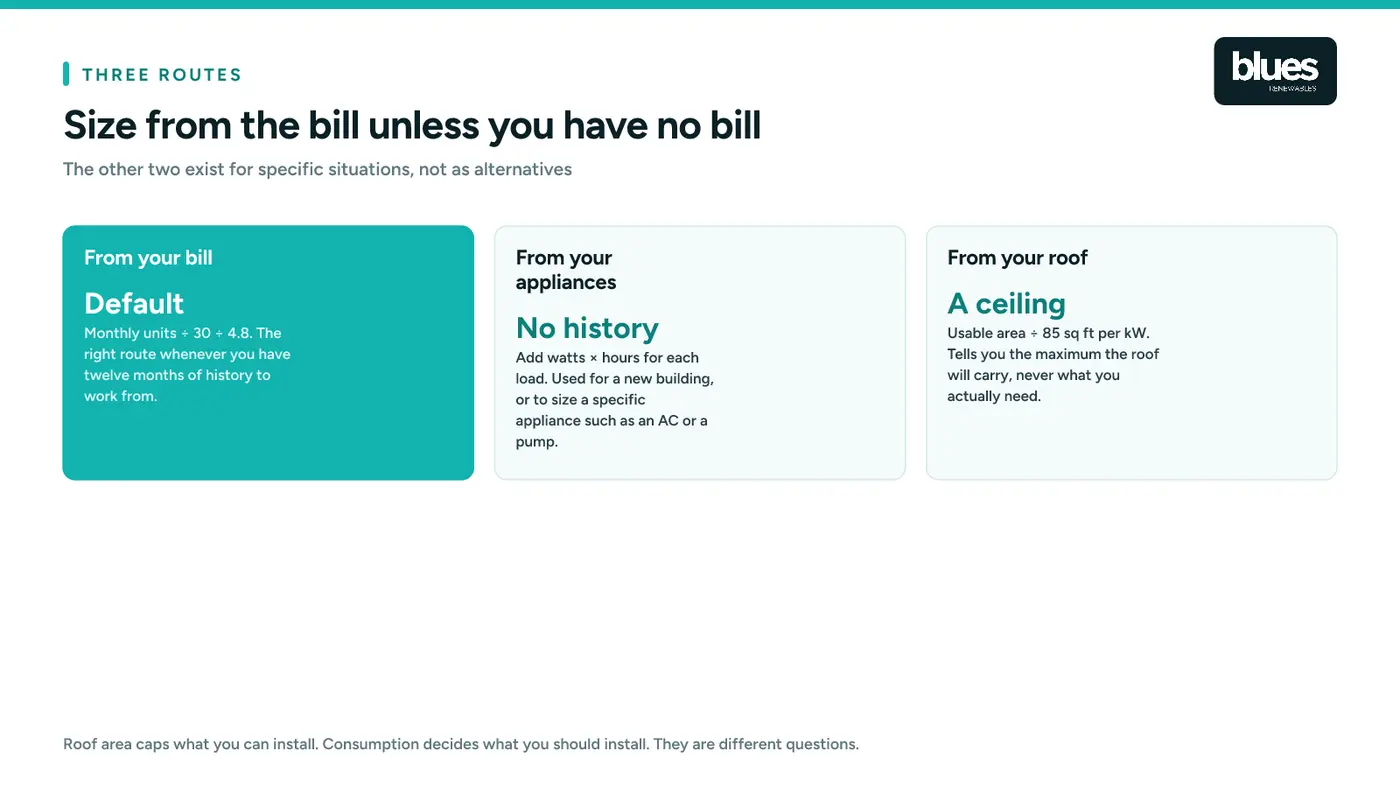
From your appliances, when you have no bill history. New building, new connection, or a specific load you want to cover. Add up the watts of each appliance, multiply by the hours you run it, and you have daily watt hours. Divide by 1,000 for units, then continue from Step 2. This is the route used for air conditioning and motors and pumps.
From your roof, when the roof is the binding constraint rather than the budget. Divide the usable area by 85 sq ft to get the maximum kilowatts it will carry. This tells you a ceiling, never a requirement, and it is the right route for a large warehouse roof with a small load.
The bill method is the right default. Use the others only when it does not apply.
Five things that change the answer
Shading. A water tank, parapet, staircase head room or neighbouring building can cost 10 to 20 percent of output, and it hits hardest on small arrays where there is nowhere to move. Surveying the shadows across a full year is worth more than a glance on the day.
Roof orientation and tilt. South-facing at roughly your latitude is ideal. East or west costs perhaps 10 to 15 percent, which means more panels for the same units.
Cleaning. Chennai dust and coastal salt cost 8 to 15 percent of generation if panels go unwashed through the dry months. That is a maintenance decision, not a sizing one, but it changes what you actually receive.
How much you use during daylight. Units you consume as they are generated are worth your full tariff. Exported units earn a lower credit, so the last kilowatt of a large system on a small daytime load pays worst. This is developed in how to calculate solar payback period.
Future load. An electric vehicle adds 10 to 15 units on a charging day, which is 2 to 3 kW of solar on its own. If one is likely within a few years, size the structure and inverter for it now.
Frequently asked questions
How do I calculate how many solar panels are required? Divide your monthly units by 30, then by 4.8, to get the system size in kilowatts. Multiply by 1,000 and divide by your panel wattage, then round up. At 550 W panels, a 3 kW system is six panels.
How many solar panels required for 2kW? Four panels of 550 W, giving 2.20 kW, needing about 170 sq ft of roof and generating roughly 288 units a month in Chennai.
How many panels required for a 4 kW solar system? Seven panels at 600 W or eight at 550 W. Eight 550 W panels give 4.40 kW and need about 340 sq ft.
How many solar panels required for 6kW? Ten panels at 600 W or eleven at 550 W, giving 6.05 kW and needing about 510 sq ft of roof.
How many solar panels required for 7kW? Twelve at 600 W or thirteen at 550 W, giving 7.15 kW and about 595 sq ft of footprint.
How many panels required for an 8 kW solar system? Fourteen at 600 W or fifteen at 550 W, giving 8.25 kW across roughly 680 sq ft.
How many solar panels required for 10kW? Seventeen at 600 W or nineteen at 550 W, giving 10.45 kW and needing about 850 sq ft.
How many solar panels required for 30kW? About 55 panels of 550 W, roughly 30.25 kW, needing around 2,550 sq ft. At this size you are usually on a commercial connection, covered in industrial solar in Chennai.
Why do older articles say I need far more panels? They assume 250 W to 330 W modules. Indian residential supply moved to 540 W to 600 W panels, so the same kilowatts now take roughly half as many.
Should I round the panel count up or down? Up. Below 3 kW the extra panel also earns more PM Surya Ghar subsidy. Above 3 kW subsidy has capped, so the extra panel is judged purely on the generation it adds, which almost always beats its marginal cost.
Getting the sizing right
For specific sizes, see 1 kW, 3 kW and 5 kW. To size a home from its bill, read how many solar panels required for a house. For appliance-led sizing, see 1.5 ton AC, a 5HP motor and charging a 200Ah battery. What happens after sizing is covered in how to install solar panels on your home.
Blues Renewables has installed solar across Chennai since 2020, for homes, schools, businesses and factories. We run this calculation from twelve months of your bills and a shadow survey, then tell you where our answer differs from the one you worked out yourself, and why.
Call +91 98841 07170 and we will calculate how many solar panels are required for your roof and your consumption, with the assumptions written down so you can check them.
Sources
- MNRE, Guidelines for implementation of PM Surya Ghar: Muft Bijli Yojana, subsidy slabs
- Tamil Nadu Electricity Regulatory Commission, Grid Interactive Solar Energy Generating Systems Regulations
- Press Information Bureau, Ministry of New and Renewable Energy, "GST on Renewable Energy Devices Rationalised to 5%", 17 September 2025
- Module dimensions and ratings from current mono PERC and TOPCon datasheets in Indian residential supply
- Blues Renewables installation data, Chennai, 2020 to 2026, for generation and loss assumptions