Solar Loan EMI for a Home in Tamil Nadu (2026 Rates)
Learn what a solar loan EMI actually costs in Tamil Nadu, compare bank rates from 7 percent, and discover why the monthly saving usually beats the monthly instalment.



A 3 kW rooftop system in Chennai costs about ₹2.1 lakh before subsidy. Most households that want solar do not have ₹2.1 lakh sitting idle, and that single fact stops more installations than any doubt about the technology.
It should not. Under PM Surya Ghar, public sector banks lend for residential rooftop solar at rates starting around 7 percent, and loans up to ₹2 lakh are collateral free.
This guide shows what a solar loan EMI works out to in Tamil Nadu, which banks lend and on what terms, what documents you need, and the comparison that actually matters: the instalment against the electricity bill it replaces.
Key takeaways
- Public sector banks lend for residential rooftop solar from roughly 7 percent, with the best rates going to applicants with strong credit scores.
- Loans up to ₹2 lakh are collateral free for systems up to 3 kW under the scheme. The system and the subsidy assignment serve as security.
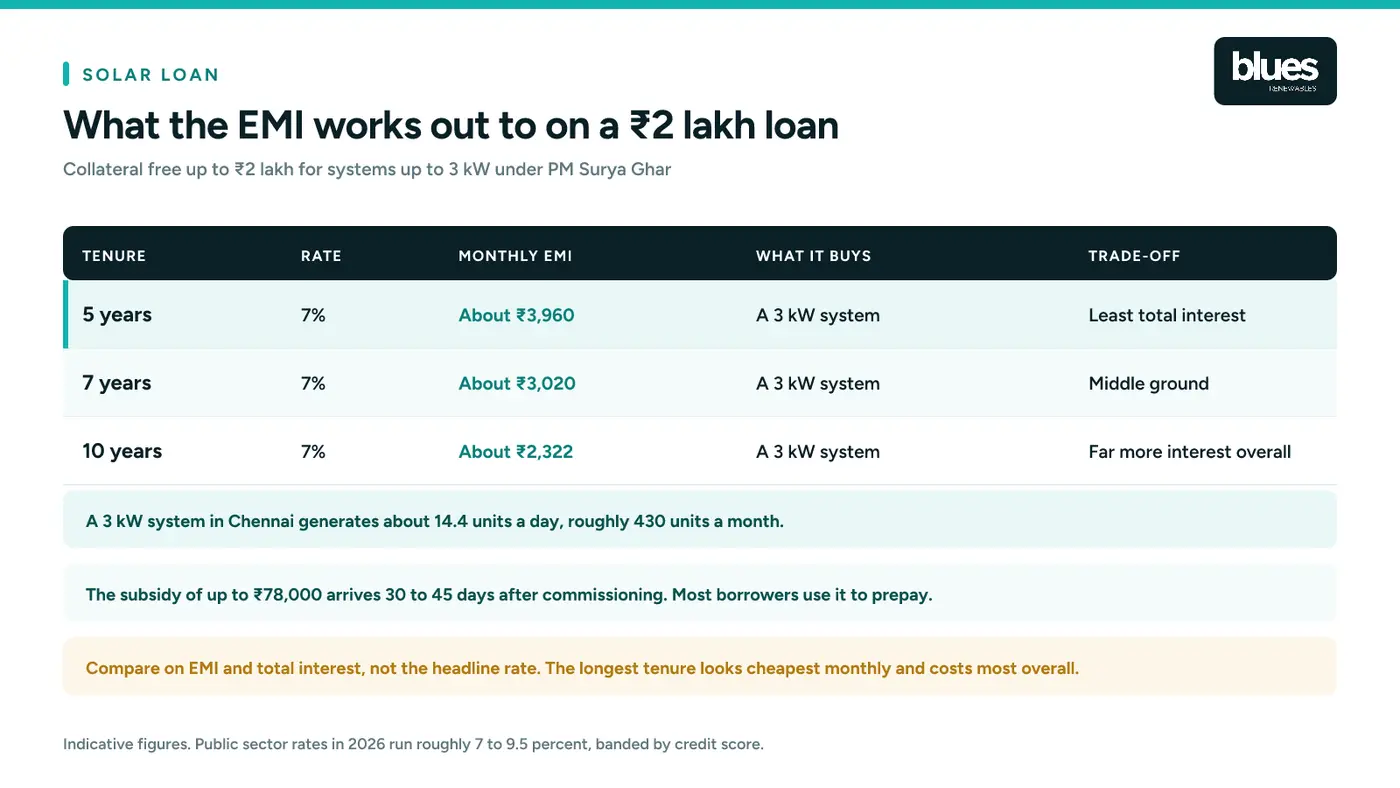
- On ₹2 lakh at 7 percent over five years, the EMI is roughly ₹3,960 a month. Over ten years it falls to about ₹2,322, but total interest more than doubles.
- The subsidy of up to ₹78,000 arrives after commissioning and can be used to prepay, which is how most borrowers shorten the loan.
- For many Chennai households the monthly saving is close to the EMI, so the system is roughly cash-flow neutral while it is being paid off and free afterwards.
- Compare on EMI and total interest, not the headline rate. A longer tenure looks cheaper monthly and costs much more overall.
What a solar loan EMI costs in Tamil Nadu
Work with the two system sizes most Chennai homes buy.
A 3 kW system costs about ₹2.1 lakh installed before subsidy, and attracts the maximum central subsidy of ₹78,000. That is the size at which the subsidy peaks, which is why it is the most common residential choice. For a smaller home, the 2 kW price page works through the same numbers with a ₹60,000 subsidy.
A 5 kW system costs about ₹3.2 lakh installed. The subsidy is still capped at ₹78,000, so the extra 2 kW is funded entirely by you.
Indicative EMIs on a ₹2 lakh loan, which covers most of a 3 kW installation:
- 5 years at 7 percent: about ₹3,960 a month
- 7 years at 7 percent: about ₹3,020 a month
- 10 years at 7 percent: about ₹2,322 a month
The ten-year option looks attractive at a glance. It is not, unless cash flow is genuinely tight, because you pay far more interest in total for the same system. Treat the longest tenure as a fallback rather than a default.
The comparison that matters
Set the EMI against the bill it displaces rather than against zero.
A 3 kW system in Chennai generates roughly 4.8 units per kW per day, which is about 14.4 units a day or around 430 units a month. For a household whose consumption sits in the upper domestic slabs, displacing 430 units a month is a meaningful monthly reduction.
For many Chennai homes, the monthly bill saving lands in the same range as a five-year EMI. That makes the arrangement close to cash-flow neutral while you repay, and then the saving is yours outright for the remaining twenty years of the system's life.
Run your own numbers rather than trusting a general claim, because the answer depends entirely on your tariff slab and how much you consume during daylight. Our solar calculator does this against your bill.
Which banks lend, and on what terms
Public sector banks run dedicated products under PM Surya Ghar, coordinated through the national lending portal. Rates in 2026 generally sit between 7 and 9.5 percent, banded by credit score.
What is broadly consistent across lenders:
- Collateral free up to ₹2 lakh for systems up to 3 kW
- Tenures commonly up to 10 years, sometimes with a short moratorium until commissioning
- Margin money of around 10 percent on larger loans, though many lenders fund the full cost at the smallest sizes
- Best rates go to applicants with a credit score around 750 and above
Above 3 kW, or above ₹2 lakh, expect the lender to ask for security and to apply a margin. The loan stops being a small standardised product and starts being an ordinary secured personal loan.
Several banks now run solar loan desks at larger branches in Tamil Nadu. It is worth asking for that desk by name, because a branch that processes these regularly moves faster than one seeing its first application.
What you will be asked for
Keep a single folder with:
- Identity and address proof, with Aadhaar and PAN
- A recent electricity bill for the service connection where the system will be installed
- Proof of ownership of the property, or documented consent if the connection is not in your name
- Income proof: salary slips and bank statements, or ITR and business proof if self employed
- The installer's quotation, itemised, with system capacity and component makes
- Your PM Surya Ghar application reference
The single most common delay is a mismatch between the name on the electricity connection and the name on the loan application. Resolve that before you apply, not during.
How the subsidy interacts with the loan
The central subsidy is a reimbursement paid to your bank account after commissioning, typically 30 to 45 days later in Tamil Nadu. It is not deducted from the installer's invoice. Check that you qualify before you borrow: see PM Surya Ghar eligibility.
So the sequence is:
Borrow enough to pay the installer in full
The system is installed, inspected and commissioned
The subsidy of up to ₹78,000 is credited to your account
Use it to prepay the loan
Most lenders permit prepayment on these loans without penalty, but confirm it in writing before you sign. Prepaying ₹78,000 against a ₹2 lakh loan early in the term removes a large share of the interest you would otherwise pay.
One caution worth repeating. The subsidy requires that you own the system. If a company offers a home installation at zero upfront cost while keeping ownership, you forfeit up to ₹78,000. A loan keeps ownership with you and keeps the subsidy.
Loan or OPEX for a home?
For a residential rooftop in Tamil Nadu, borrowing usually beats a developer-owned arrangement, for one reason above all: the subsidy.
Under a loan you own the plant, claim the subsidy, keep every unit it generates, and own an asset outright once the loan closes. Under an OPEX or RESCO arrangement you avoid the capital outlay but forfeit the residential subsidy and buy your own rooftop's power at a per-unit tariff for the length of the contract.
For businesses the calculation is genuinely different, because accelerated depreciation and input tax credit change the arithmetic. We cover that in CAPEX vs OPEX vs RESCO solar.
Frequently asked questions
What is the EMI for a solar loan in Tamil Nadu?
On a ₹2 lakh loan at 7 percent, roughly ₹3,960 a month over five years, about ₹3,020 over seven years, and about ₹2,322 over ten years. The longer tenures cost considerably more in total interest.
Can I get a solar loan without collateral?
Yes. Under PM Surya Ghar, loans up to ₹2 lakh for systems up to 3 kW are collateral free at participating public sector banks. The system and the subsidy assignment serve as security.
What is the interest rate for a solar panel loan in 2026?
Public sector banks generally quote between 7 and 9.5 percent, with the lowest rates going to applicants with a credit score around 750 or above.
Which banks give solar loans in Tamil Nadu?
The major public sector banks run products under the PM Surya Ghar scheme, and several operate dedicated solar loan desks at larger branches. Ask for that desk rather than the general personal loan counter.
Can I use the subsidy to repay the loan?
Yes, and most borrowers do. The subsidy is credited to your account roughly 30 to 45 days after commissioning, and prepaying it against the loan removes a large share of the interest. Confirm your lender allows prepayment without penalty.
Do I still get the subsidy if I take a loan?
Yes. The subsidy depends on you owning the system, not on how you paid for it. A loan keeps ownership with you.
Is the EMI less than my electricity bill saving?
For many Chennai households on a five-year tenure they are close. It depends on your tariff slab and how much you use during daylight hours, so calculate it against your own bill rather than relying on a general figure.
What documents do I need for a solar loan?
Aadhaar and PAN, a recent electricity bill, proof of property ownership, income proof, the itemised installer quotation, and your PM Surya Ghar application reference.
Where this fits
Before borrowing, size the system against your actual consumption using the solar panel size calculator, and check which subsidy applies to you. If you are comparing a loan against a developer-funded arrangement, read CAPEX vs OPEX vs RESCO solar first, because the subsidy is the deciding factor for a home.
Blues Renewables has installed solar across Chennai since 2020, for homes, schools, businesses and factories. We prepare the itemised quotation banks ask for and we file the subsidy claim that pays down your loan.
Call +91 98841 07170 with your last electricity bill and we will tell you what the EMI and the saving both look like at your address.
Sources
- MNRE, Guidelines for implementation of PM Surya Ghar: Muft Bijli Yojana, on Central Financial Assistance and consumer ownership
- PM Surya Ghar national portal, lending information and participating bank list
- Tamil Nadu Electricity Regulatory Commission, Tariff Order No. 6 of 2025 dated 30 June 2025, for domestic slab rates
- Blues Renewables installation pricing and generation data, Chennai, 2020 to 2026