Does TANGEDCO Allow a Hybrid Inverter? The 2026 Rule
Learn what TANGEDCO actually permits for hybrid inverters and battery backup on rooftop solar, and discover the one step that keeps your net metering safe.


Ask two installers in Chennai whether TANGEDCO allows a hybrid inverter and you will get two confident, opposite answers. One says it is routine. The other says your application will be rejected, or that you will be fined later.
Both are repeating what they were told at a section office, and neither is quoting the order.
The rule is written down. It is in the TANGEDCO guidelines that govern every grid connected rooftop system in Tamil Nadu, and it is narrower and more practical than either camp suggests. This guide sets out what the TANGEDCO hybrid inverter position actually says, what it means for battery backup at home, and the one procedural step that decides whether your installation is compliant.
Key takeaways
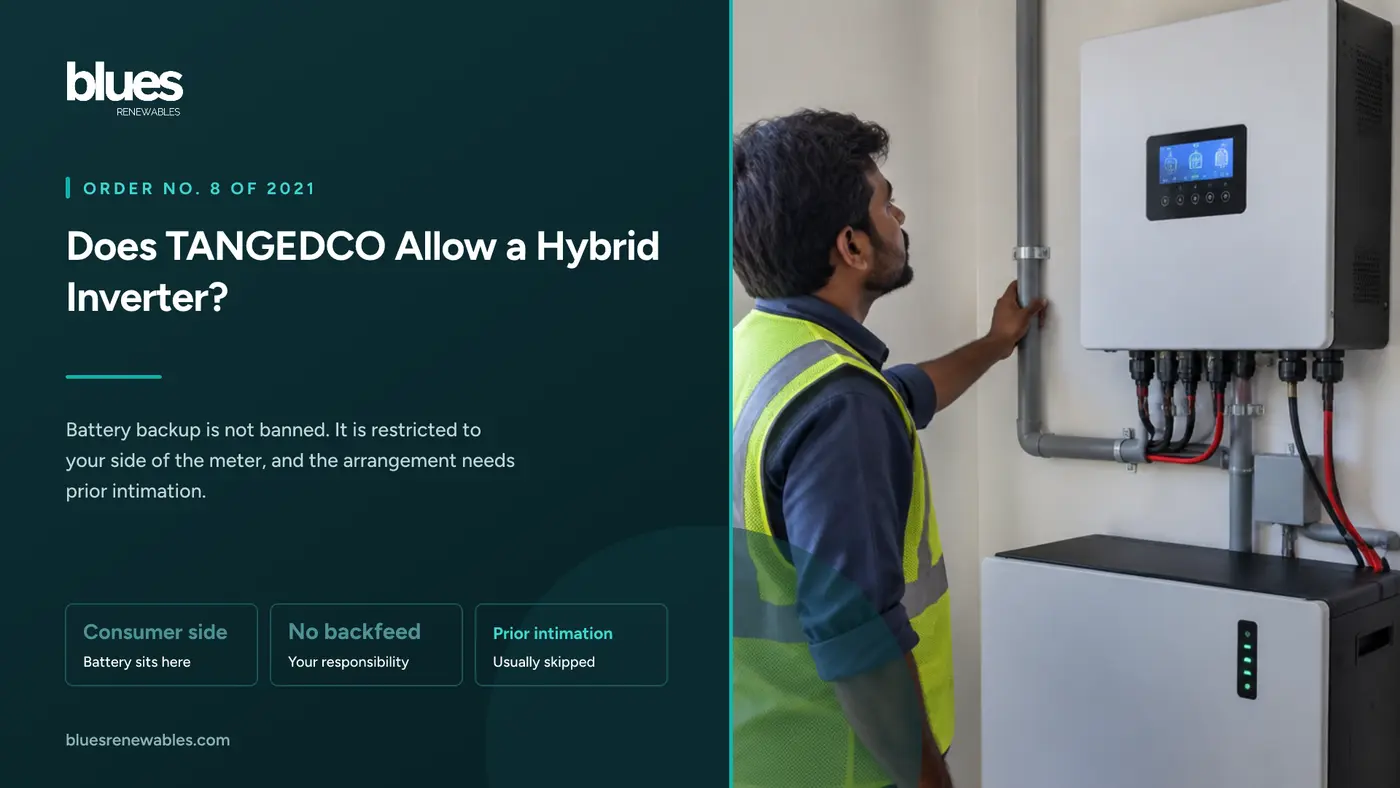
- Battery backup is not banned. The governing order restricts it to the consumer side rather than prohibiting it.
- The consumer is made responsible for preventing battery, generator or backup power from reaching the grid. That obligation is the real substance of the rule.
- A system connected behind the meter is allowed only after prior intimation to TANGEDCO. Intimation is the step most disputes turn on, and it is the step installers skip.
- Anything you export must meet quality limits on waveshape, frequency and DC components, with harmonics and flicker inside Central Electricity Authority limits.
- Your sanctioned load still caps the system, whether the inverter is hybrid or not.
- Retrofitting a hybrid inverter quietly after approval puts your net metering at risk and is not what the order contemplates.
What TANGEDCO says about hybrid inverters
The relevant document is the TANGEDCO Salient Features and Guidelines issued with the Generic Tariff Order for Grid Interactive PV Solar Energy Generating Systems, Order No. 8 of 2021, dated 22 October 2021. It still governs rooftop connections in Tamil Nadu.
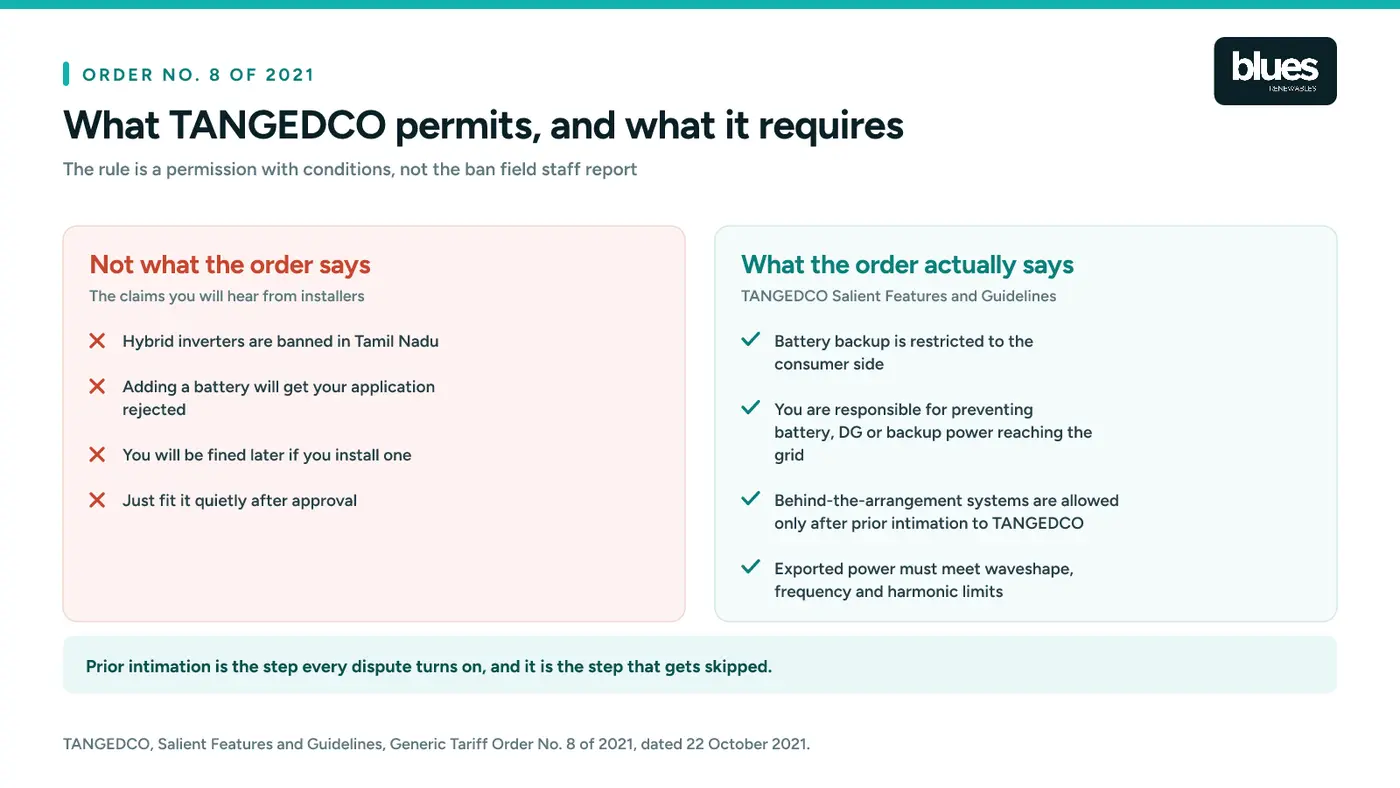
Two clauses decide the question.
The first deals with storage directly. Any battery backup is restricted to the consumer side, and the consumer is made responsible for taking adequate safety measures to prevent battery power, diesel generator power or other backup power from being injected into the network.
Read that carefully, because it is a permission with a condition attached, not a prohibition. Storage is contemplated. What is not allowed is your battery or generator energising the grid.
The second clause is the procedural one. Grid connected renewable energy generating systems connected behind the arrangement are allowed only after prior intimation to TANGEDCO.
That is the sentence that settles most arguments. A behind-the-meter configuration is permitted, and it is permitted on condition that you tell TANGEDCO about it in advance.
Why linemen come up in every conversation
Field staff who say hybrid inverters are not allowed are usually thinking about one real hazard rather than a written ban.
When a feeder goes dead for maintenance or after a storm, linemen work on the assumption that the line is dead. A system that keeps energising the network during an outage puts them in danger. That is why grid tied inverters are required to disconnect from the network when the grid goes down, and why the order puts the duty to prevent backfeed on the consumer.
A properly configured hybrid inverter does exactly this. It isolates from the grid during an outage and runs only your own loads from the battery. The concern is legitimate. The blanket answer that follows from it is not.
What this means for your installation
Translate the order into practice and the position is workable.
Storage for your own use is fine. A battery that carries your lights, fans, router and refrigerator through a Chennai outage sits squarely within a rule that restricts battery backup to the consumer side. Under PM Surya Ghar, a grid-connected system with a battery can qualify for the subsidy subject to the regulator's approval, while a fully off-grid system cannot; see PM Surya Ghar eligibility.
Backfeed is your responsibility, in writing. The order does not merely ask your installer to configure it correctly. It puts the obligation on you, the consumer. That is worth knowing when you compare quotes, because a cheap installation that gets this wrong leaves you carrying the consequence.
Intimation is not optional. If your configuration places generation behind the meter, TANGEDCO has to be told beforehand. An installer who tells you to leave it off the paperwork is exposing your net metering approval, not protecting it.
Export quality still applies. Whatever you send to the grid must meet the quality requirements the order sets on waveshape, frequency and the absence of DC components, and must keep harmonics and flicker within Central Electricity Authority limits. Reputable hybrid inverters meet these. Unbranded ones may not, and the certificate is worth asking for.
The retrofit problem
A pattern shows up on Indian owner forums: get an on-grid system approved, then swap the inverter for a hybrid afterwards and keep quiet about it.
We do not recommend it and we will not do it. The order asks for prior intimation, so a silent change after approval is the one thing it clearly does not contemplate. Your net metering arrangement rests on the approved configuration. If an inspection finds something different, the arrangement is what you put at risk, and the saving was never worth it.
If you want storage later, the honest route is to tell TANGEDCO and have the change recorded.
Choosing between on-grid and hybrid in Chennai
The regulatory answer does not settle the engineering one. Hybrid hardware costs more, so the question is whether you need it.
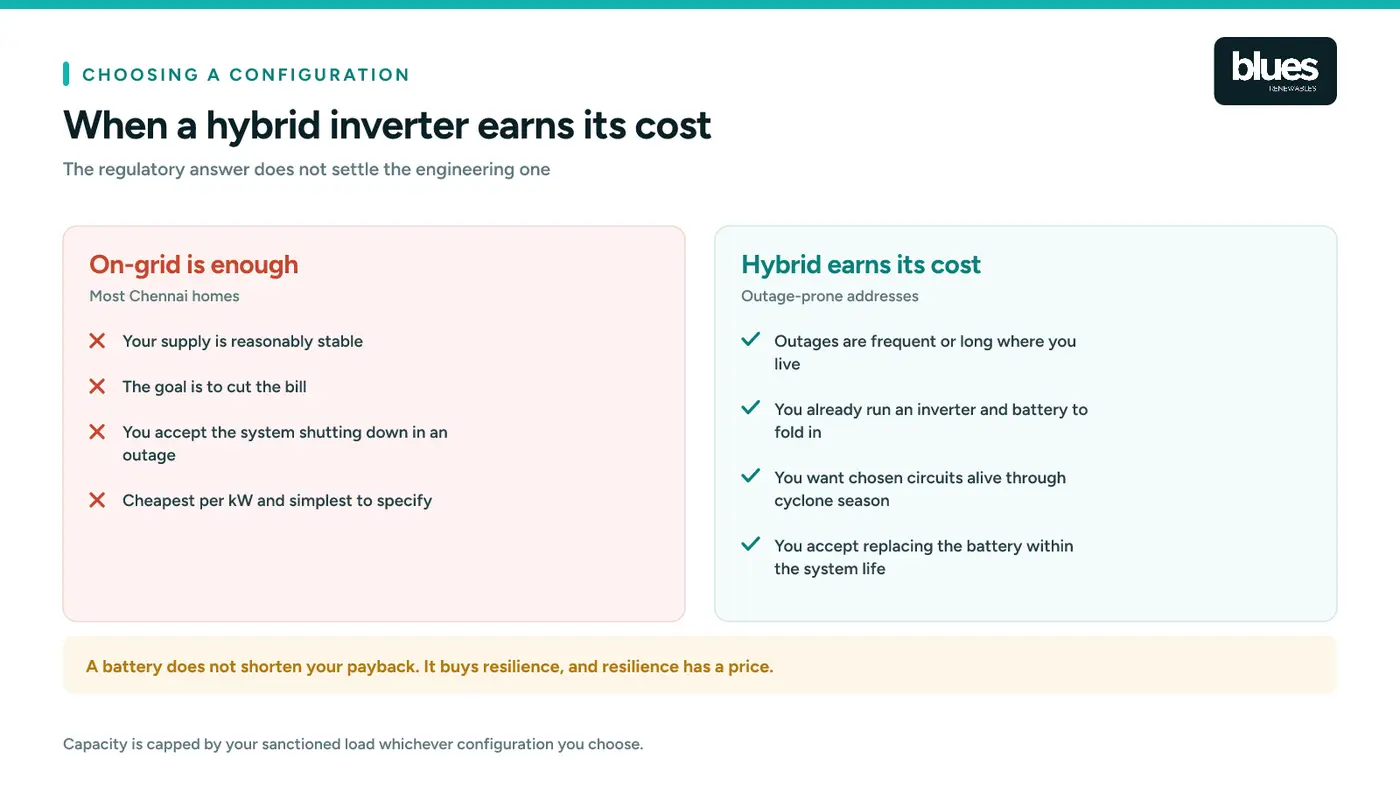
On-grid suits you if your supply is reasonably stable, your goal is to cut the bill, and you are content for the system to shut down during an outage. It is the cheaper, simpler, more common choice, and for most Chennai homes it is the right one.
Hybrid earns its cost if outages are frequent or long where you live, you already run an inverter and battery you would like to fold into one system, or you want specific circuits to stay alive through a cyclone-season outage.
Two points of arithmetic are worth stating plainly. A battery does not improve your payback. It buys resilience, and resilience has a price. Second, the battery is the part that wears out first, so budget for a replacement inside the system's life rather than being surprised by one.
If you are weighing the configurations more broadly, our comparison of on-grid, off-grid and hybrid systems covers the engineering side in detail.
Getting it approved without drama
Four habits keep a hybrid installation clean in Tamil Nadu.
Declare the configuration in the application. Put the inverter make, model and topology in the paperwork from the start.
Keep the anti-backfeed measures documented. Ask your installer for the settings and the protection arrangement in writing, because the obligation sits with you.
Give prior intimation for anything behind the meter. In writing, before commissioning, not after an inspector asks.
Stay inside your sanctioned load. The cap applies whatever the inverter type. If you need more capacity, raise the sanctioned load first.
None of this is onerous. It is one extra letter and an honest application form.
Frequently asked questions
Does TANGEDCO allow hybrid inverters?
The governing order does not ban them. It restricts battery backup to the consumer side, makes the consumer responsible for preventing backup power reaching the grid, and allows systems connected behind the arrangement only after prior intimation to TANGEDCO.
Will my net metering application be rejected if I use a hybrid inverter?
Not because it is hybrid. Applications run into trouble when the configuration is undeclared, when anti-backfeed protection is not demonstrated, or when the capacity exceeds the sanctioned load.
Can I add a battery to my existing rooftop solar in Tamil Nadu?
Battery backup restricted to your own side of the meter is contemplated by the order. Because the arrangement changes, give TANGEDCO prior intimation rather than making the change silently.
Why do some installers say hybrid inverters are not allowed?
Usually because a section office told them so, and that advice comes from a real safety concern about backfeed endangering linemen during outages. The written rule addresses that concern with conditions rather than a ban.
Do I need permission before installing a hybrid system?
For a grid connected system behind the arrangement, yes. The order requires prior intimation to TANGEDCO.
Does a hybrid inverter affect my subsidy?
The central subsidy depends on you owning the system and on approved components, not on the inverter being hybrid. Confirm the specific model is on the approved list before you buy it.
Is a hybrid inverter worth the extra cost in Chennai?
Only if you want power during outages. It does not shorten payback, and the battery is the component most likely to need replacing within the life of the system.
Where this fits
If you are still choosing a configuration, start with on-grid vs off-grid vs hybrid and our hybrid solar systems in Chennai page. The approval route itself is covered in the TANGEDCO net metering application guide.
Blues Renewables has installed solar across Chennai since 2020, for homes, schools, businesses and factories. We file the net metering paperwork ourselves and we declare the configuration we actually install, because the alternative puts your approval at risk rather than ours.
Call +91 98841 07170 and we will tell you whether a hybrid inverter earns its cost at your address, before you pay for one.
Sources
- TANGEDCO, Salient Features and Guidelines, Generic Tariff Order for Grid Interactive PV Solar Energy Generating System (GISS), Order No. 8 of 2021 dated 22 October 2021
- Tamil Nadu Electricity Regulatory Commission, Grid Interactive Solar PV Energy Generating Systems Regulations
- Central Electricity Authority regulations on harmonics, flicker and power quality for grid connected systems
- Blues Renewables net metering filings, Chennai and Tamil Nadu, 2020 to 2026