Home Solar for EV Charging: How Much Do You Actually Need?
How much rooftop solar an electric car needs, why the timing problem matters more than the sizing, and what a kilometre costs on solar, grid and petrol.


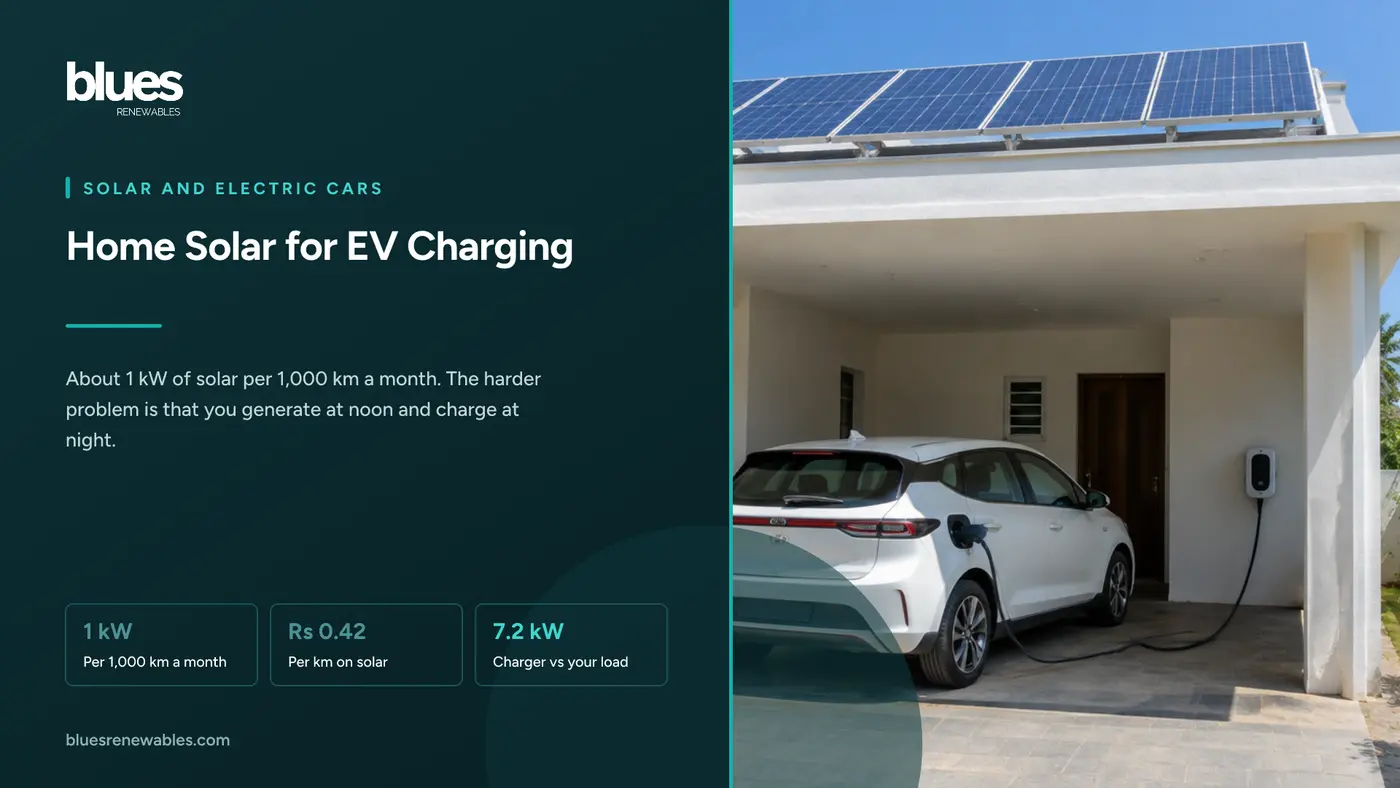
An electric car and a solar roof look like an obvious pair. Both cut a bill, both run on the same units, and the maths seems to write itself.
Then you notice the problem. Your panels generate between about nine in the morning and four in the afternoon. Your car is usually out during those hours, and it plugs in at night. The two curves barely overlap, which is why the honest version of this calculation is less about how many panels you need and more about when the electricity moves.
This guide works out the sizing, then deals with the timing, then puts a number on what a kilometre actually costs three different ways.
Key takeaways
- Roughly 1 kW of solar per 1,000 km a month. At Chennai generation of about 4.8 units per kW per day and a real-world 13 to 15 kWh per 100 km, one kilowatt covers around a thousand kilometres of driving in a month.
- An EV is a large new load. A thousand kilometres a month is about 130 to 150 units, comparable to adding a second air conditioner running daily.
- Timing decides the economics, not sizing. A unit you consume yourself is worth your marginal tariff. A unit you export and buy back later is worth far less.
- Charge in daylight where you can. Even two daytime charges a week changes the return materially.
- Sanctioned load blocks more EV owners than roof space does. A 7.2 kW charger may force a load enhancement, and in Tamil Nadu your permitted solar capacity is tied to sanctioned load too.
- On solar, a kilometre costs well under a rupee. Against petrol it is not close, and against grid charging it still roughly halves.
How much solar an EV actually needs
Three numbers, and you can do this on a phone.
Step 1: find your monthly kilometres. Use the odometer rather than an estimate. Most Indian private cars run 800 to 1,200 km a month, and people consistently guess high.
Step 2: convert kilometres to units. Real-world consumption on current Indian EVs sits around 13 to 15 kWh per 100 km. Owner testing of the Tata Nexon EV 45 has recorded about 127 Wh per km over a long run with air conditioning, which is 12.7 kWh per 100 km, and the smaller Tata Tiago EV works out similarly when its tested real-world range is set against its usable pack.
Use 14 kWh per 100 km as a planning figure. It is close enough, and it leaves a margin for charging losses, which are real and usually ignored.
Step 3: convert units to kilowatts. In Chennai a rooftop system generates about 4.8 units per kW per day, so 1 kW delivers roughly 144 units a month.
Put those together and a useful rule falls out.
A thousand kilometres a month needs about 140 units, and 1 kW of rooftop solar produces about 144 units a month. One kilowatt of solar per thousand kilometres of driving.
Solar for how much you drive
Monthly distance, the units it needs, and the solar capacity that covers it. These sit on top of whatever your household already uses.
- 500 km - Units needed: 70 units, Solar to cover it: 0.5 kW, Roughly: one extra panel
- 1,000 km - Units needed: 140 units, Solar to cover it: 1 kW, Roughly: two panels
- 1,500 km - Units needed: 210 units, Solar to cover it: 1.5 kW, Roughly: three panels
- 2,000 km - Units needed: 280 units, Solar to cover it: 2 kW, Roughly: four panels
- 3,000 km - Units needed: 420 units, Solar to cover it: 3 kW, Roughly: six panels
Two adjustments worth making. City driving in Chennai traffic with the air conditioning running costs more per kilometre than the figures above, so round up if most of your driving is short urban trips. And if you are sizing a system from scratch rather than adding to one, work from your electricity bill first and treat the EV as an addition. Our guide to how many solar panels a house needs covers the household half of that sum.
The problem nobody mentions: you drive by day and charge at night
This is where most EV and solar articles stop being useful.
Your system generates in a bell curve centred on the middle of the day. Your car, for most households, leaves in the morning and returns in the evening, and charging happens overnight on a timer. The generation and the consumption almost never coincide.
That does not make the system useless. It changes what each unit is worth.
A unit you generate and consume in the same moment saves you your marginal tariff, which for a Chennai household on solar is around ₹7.00. A unit you export during the day and buy back at night earns you an export credit of about ₹3.00 and then costs you ₹7.00 to buy, so the round trip loses roughly ₹4.00 per unit compared with using it directly.
Over a year of charging an EV entirely at night, that difference is the single largest number in the calculation. It does not stop the system paying for itself. It does mean an EV charged in daylight is worth substantially more to you than the same EV charged at midnight.
Three ways to line generation and charging up
Charge in daylight when the car is home. The cheapest fix costs nothing. Weekends, work-from-home days, and any afternoon the car is parked are all opportunities, and a timer that starts at eleven in the morning rather than eleven at night moves a charge from the expensive column to the cheap one. For many households, two or three daytime charges a week covers most of their driving.
Use net metering as an imperfect battery. Exported units are credited and set against what you import, with the account settled annually. It works, and it is the default arrangement, but the credit is worth less than the tariff you avoid, so treat it as a fallback rather than the plan.
Add storage, if the numbers justify it. A battery stores the afternoon and releases it at night, which solves the timing problem properly. It also costs more than the problem does for most households, and it brings its own rules. If you are considering it, TANGEDCO hybrid inverter rules covers what is permitted on a grid-connected system in Tamil Nadu, because the restrictions are real and catch people out.
For most EV owners the honest recommendation is the first option, supported by the second. Storage earns its place when you have frequent outages, not merely because you own a car.
What a kilometre costs, three ways
Using 14 kWh per 100 km, a marginal tariff of ₹7.00 per unit, an export credit of ₹3.00 per unit, and a petrol car returning 15 km per litre at ₹100 per litre.
- Petrol, 15 km/l at ₹100/l - Cost per km: ₹6.67, Cost per 1,000 km: ₹6,670
- EV charged from the grid at ₹7.00 - Cost per km: ₹0.98, Cost per 1,000 km: ₹980
- EV charged from your own solar in daylight - Cost per km: ₹0.42, Cost per 1,000 km: ₹420
The third row needs explaining, because it is not free. Those units could have been exported for ₹3.00 each, so the real cost of using them is the credit you gave up. That is what the figure represents.
Two conclusions follow. Against petrol, the case was already overwhelming before solar entered the room. Against grid charging, your own solar roughly halves the running cost again, and the gap widens every time the tariff rises.
Treat the petrol figure as an assumption rather than a fact. Pump prices move, and you should substitute your own.
Does an EV change the system size you should buy?
Yes, and by more than people expect.
A household using 400 units a month that adds a car doing 1,200 km is now using about 570 units. That is a 40 percent increase, and it usually moves the sensible system size up by 1 to 2 kW.
It is considerably cheaper to install that capacity at the outset than to return in two years and extend. A second visit means a second scaffolding and labour mobilisation, possibly a larger inverter than the one already fitted, and a fresh net metering application. If an EV is likely within three years, size for it now.
There is one exception worth naming. If your roof cannot take the larger system, do not oversize the inverter in hope. Size what the roof supports and revisit it later.
Sanctioned load, the thing that actually blocks people
This is the part that stops EV owners, and it has nothing to do with panels.
A home AC charger is typically 3.3 kW or 7.2 kW. Add a 7.2 kW charger to a house sanctioned at 5 kW and the charger alone exceeds the connection before anything else switches on. You will need a load enhancement from TANGEDCO.
That enhancement matters twice over, because in Tamil Nadu the rooftop solar capacity you are permitted is tied to your sanctioned load rather than to your past consumption. Raising the sanctioned load for the charger also raises the ceiling on the solar system you are allowed to install. Our guide to the solar capacity limit and sanctioned load in Tamil Nadu sets out how that cap works.
So the sequence is: check your sanctioned load first, apply for enhancement if the charger needs it, and only then finalise the solar capacity. Doing it in that order saves an application.
Frequently asked questions
How much solar do I need to charge an electric car in India?
About 1 kW of rooftop solar for every 1,000 km you drive in a month. That assumes real-world consumption near 14 kWh per 100 km and Chennai generation of about 4.8 units per kW per day, which gives roughly 144 units a month per kilowatt.
How many units does an electric car use per month?
Around 140 units for 1,000 km, at 14 kWh per 100 km. City driving with the air conditioning running pushes that higher, so use your own odometer and round up.
Can I charge my EV at night using solar?
Not directly, because the panels are not generating. Under net metering your daytime exports are credited against your night-time imports, but the credit is worth less than the tariff you pay, so charging in daylight is materially cheaper where your routine allows it.
Is solar worth it for EV charging in India?
Yes, on the numbers. Charging from the grid costs roughly ₹0.98 a kilometre at a ₹7.00 tariff. Charging from your own daytime generation costs about ₹0.42 a kilometre once you account for the export credit you forgo. Both are far below petrol.
Do I need a bigger solar system if I buy an EV?
Usually 1 to 2 kW more. A car doing 1,200 km a month adds about 170 units, which is a large increase on a typical household bill, and installing the extra capacity at the outset costs far less than extending later.
Will an EV charger exceed my sanctioned load?
It can. A 7.2 kW home charger on a 5 kW connection needs a load enhancement. In Tamil Nadu that matters twice, because your permitted solar capacity is linked to sanctioned load, so enhancing for the charger also raises the solar ceiling.
Does an EV charger need separate approval from TANGEDCO?
A load enhancement is a DISCOM application in its own right. Handle it before finalising the solar capacity, since the two are linked and doing them in the wrong order can mean applying twice.
Where this fits
If you are sizing a system from scratch, start with how many solar panels a house needs and add the EV load on top. The solar panel price in Chennai page shows what the extra capacity costs, and solar capacity limit and sanctioned load in Tamil Nadu explains the ceiling you are working within.
Blues Renewables has installed rooftop solar across Chennai and Tamil Nadu since 2020. If you drive an EV or expect to, tell us the monthly kilometres and we will size the system for the car as well as the house, and tell you plainly whether your sanctioned load needs raising first.
Call +91 98841 07170 with your odometer reading and your last electricity bill.
Sources
- Owner and publication road testing of the Tata Nexon EV 45 and Tata Tiago EV in Indian conditions, for real-world consumption in watt-hours per kilometre
- Tamil Nadu Electricity Regulatory Commission tariff orders, for domestic tariff structure and export credit
- Blues Renewables generation records, Chennai rooftops, for the figure of about 4.8 units per kW per day across roughly 5.3 peak sun hours
- TANGEDCO, sanctioned load and load enhancement procedure for LT domestic services