PM Surya Ghar Eligibility: Who Can Claim the Subsidy, and Who Cannot
The scheme's actual eligibility rules from the MNRE guidelines: residential connection, DCR panels, grid connection. Tenants, SC/ST, age limit, second homes and businesses answered.

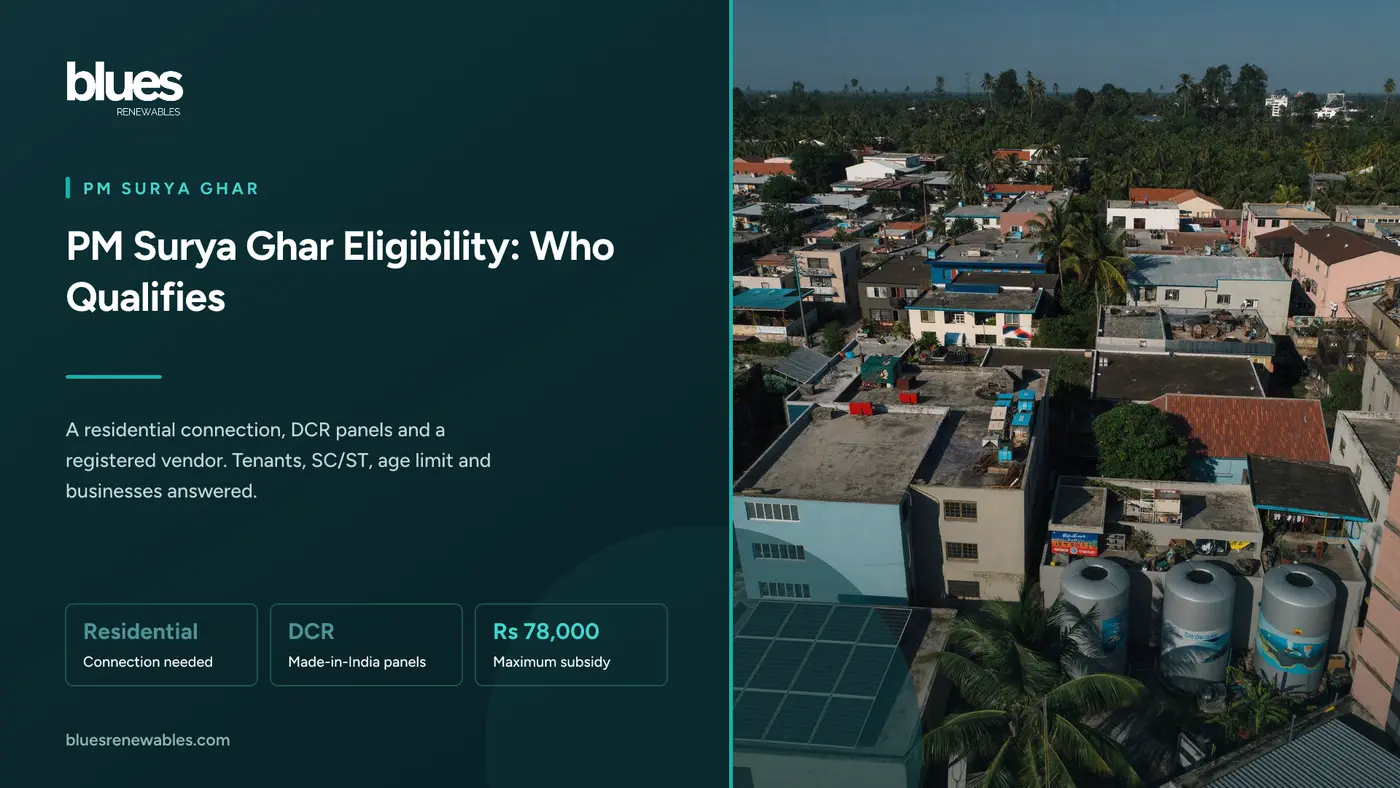
Most eligibility questions about PM Surya Ghar come down to one test: is the solar system tied to a residential electricity connection? If it is, you are very likely eligible. If it is not, no amount of paperwork will change that.
The rest of the rules are about what gets installed and how, and they trip up far more people than the question of who they are. Caste, age and income play no part in the central scheme.
This guide sets out the eligibility rules as the MNRE guidelines state them, then answers the specific cases people ask about.
Key takeaways
- You need a residential electricity connection with a valid consumer account number from your DISCOM. The system is tagged to that connection.
- The system must be grid connected and installed on a roof, terrace, balcony or elevated structure. Fully off-grid systems are not eligible.
- Panels must be DCR: modules made in India from Indian-made cells. Non-DCR panels in any form make the whole system ineligible.
- You must use a vendor registered on the National Portal.
- Businesses, shops and government buildings are not eligible. The subsidy is for residential consumers and housing society common areas only.
- There is no caste category, income limit or age limit in the central scheme. SC/ST households get the same subsidy as everyone else, though some states add their own support.
The core eligibility rules
These come from MNRE's guidelines for the Central Financial Assistance to Residential Consumers component.
A residential connection. Any consumer with a valid consumer account number from a distribution utility can apply on the National Portal. The rooftop system is tagged to that particular residential connection.
The right kind of installation. The system must be grid connected and installed on a roof, terrace or balcony, or on top of an elevated structure. Building-integrated solar also qualifies. Group and virtual net metering arrangements qualify where the DISCOM approves the metering.
Residential only. No subsidy is given to non-residential consumers, including government, commercial and industrial connections.
Capex mode. You fund the system yourself, with your own money or a loan. Models where a third party owns the system, such as RESCO or utility-led aggregation, are handled under separate guidelines.
DCR panels. The modules must be manufactured from domestically manufactured cells. The guidelines call this an essential condition.
A registered vendor. The system must be installed by a vendor registered on the National Portal. See our PM Surya Ghar vendor list guide.
Once per installation. A rooftop system can receive the subsidy only once. A system moved to a new location does not qualify again.
How much you are eligible for
- 1 kW - Central subsidy: ₹30,000
- 2 kW - Central subsidy: ₹60,000
- 3 kW and above - Central subsidy: ₹78,000 (the maximum)
- Housing society common areas - Central subsidy: ₹18,000 per kW, up to 500 kW at 3 kW per house
Part sizes are pro-rated: 1.5 kW gets ₹45,000, and 2.5 kW gets ₹69,000. Special category states such as the Northeast, Uttarakhand, Himachal Pradesh and Jammu and Kashmir receive 10 percent more. Since 21 September 2026 Tamil Nadu adds a state top-up on top of these amounts, up to ₹22,000 at 3 kW; our PM Surya Ghar last date page covers its status.
Specific cases
Tenants and rented houses
The subsidy follows the electricity connection, not the person living in the house. A tenant can apply only if the connection is in the tenant's name, and even then the landlord's consent to use the roof is needed in practice. More often the owner, as the connection holder, applies. Our documents guide covers the paperwork for tenants, joint owners and inherited property.
SC/ST households
The central scheme has no separate SC/ST category. The subsidy amounts above apply equally to every eligible household. Some states add their own support for particular groups, so check your state's announcements.
Age limit
The scheme itself has no age limit. If you take a loan, the bank applies its own age criteria, which vary by lender. Our guide to solar loan EMI in Tamil Nadu covers the loan terms.
Second homes and multiple connections
Eligibility is tied to each residential connection. A second home with its own residential connection is assessed on that connection. What you cannot do is claim twice for the same installation.
Houses that already have solar
If you received a central subsidy under an earlier rooftop scheme and now add capacity, you are eligible only for the balance up to 3 kW overall. The guidelines give an example: a household with 1 kW under the earlier scheme that expands to 4 kW can claim for the additional 2 kW, ₹48,000.
Apartments and flats
An individual flat owner generally cannot put a system on a shared terrace in their own name. The housing society or residents' association can claim ₹18,000 per kW for common-area systems. See solar for apartments in Chennai.
Shops, offices and businesses
Not eligible. The subsidy excludes commercial, industrial and government connections. Businesses benefit from accelerated depreciation instead; see solar power plant subsidy in India.
Battery and hybrid systems
Grid-connected systems with a battery can qualify, subject to approval by your state electricity regulator. Fully off-grid systems cannot. In Tamil Nadu, see TANGEDCO hybrid inverter rules.
What makes an eligible household lose the subsidy
Being eligible is not the same as receiving it. These are the ways eligible households still lose it:
- Non-DCR panels, even partly.
- An unregistered vendor.
- A name mismatch between the electricity connection, the bank account and the application.
- A failed DISCOM inspection, usually because the installed system does not match the documents.
Our guide to why the PM Surya Ghar subsidy is not received covers each of these in detail.
Frequently asked questions
Who is eligible for PM Surya Ghar?
Any household with a residential electricity connection and a valid consumer account number, installing a grid-connected system with DCR panels through a registered vendor.
Is there an income limit for PM Surya Ghar?
No. The central scheme has no income criterion.
Can SC/ST families get extra subsidy under PM Surya Ghar?
Not under the central scheme, which pays the same amount to every eligible household. Some states offer their own additional support.
Is there an age limit for PM Surya Ghar?
No age limit applies to the subsidy. Banks apply their own age criteria for loans.
Can a tenant apply for PM Surya Ghar?
Only if the electricity connection is in the tenant's name and the landlord agrees to the use of the roof. Usually the owner applies.
Is PM Surya Ghar available for commercial buildings?
No. Commercial, industrial and government connections are excluded.
Can I get the subsidy on an off-grid system?
No. Off-grid systems are not eligible. Grid-connected systems with a battery can qualify subject to your state regulator's approval.
Can I claim again if I move house?
No. A system is eligible only once, and a system relocated to a new site does not qualify again.
Where this fits
Once you know you qualify, the PM Surya Ghar subsidy guide takes you through applying. For the paperwork, see documents required for solar subsidy. For timing, see the PM Surya Ghar last date.
Blues Renewables checks eligibility before we quote, including the connection name, the roof and the panel model, so there are no surprises at inspection. If you are not sure you qualify, send us your electricity bill and we will tell you.
Call +91 98841 07170.
Sources
- Ministry of New and Renewable Energy, Guidelines for PM-Surya Ghar: Muft Bijli Yojana, Central Financial Assistance to Residential Consumers, sections on eligibility, capex mode, non-residential segments, CFA structure and benchmark cost, DCR modules, pre-existing rooftop systems, single eligibility per installation, and non-metered grid-connected systems