PM Surya Ghar Subsidy Not Received? Fix It in 2026
Learn why the PM Surya Ghar subsidy has not arrived, discover the rejection reasons that cause most delays, and read the exact escalation route that gets it paid.


Your system was commissioned weeks ago. The installer has been paid, the meter is spinning backwards, and the bank account is still empty. Meanwhile a neighbour who signed up later has already had the money credited.
That gap is almost never bad luck. If your PM Surya Ghar subsidy has not been received, there is usually one specific, fixable reason sitting in your application, and it is rarely the reason people assume.
This guide shows you how to find it. You get the real timeline, the rejection reasons that account for most stuck files, how to read your status on the portal, and the escalation route that works when the file is simply sitting there.
Key takeaways
- The central subsidy is a reimbursement after commissioning, not a discount off your quote. If you expected it to reduce the invoice, nothing has gone wrong yet.
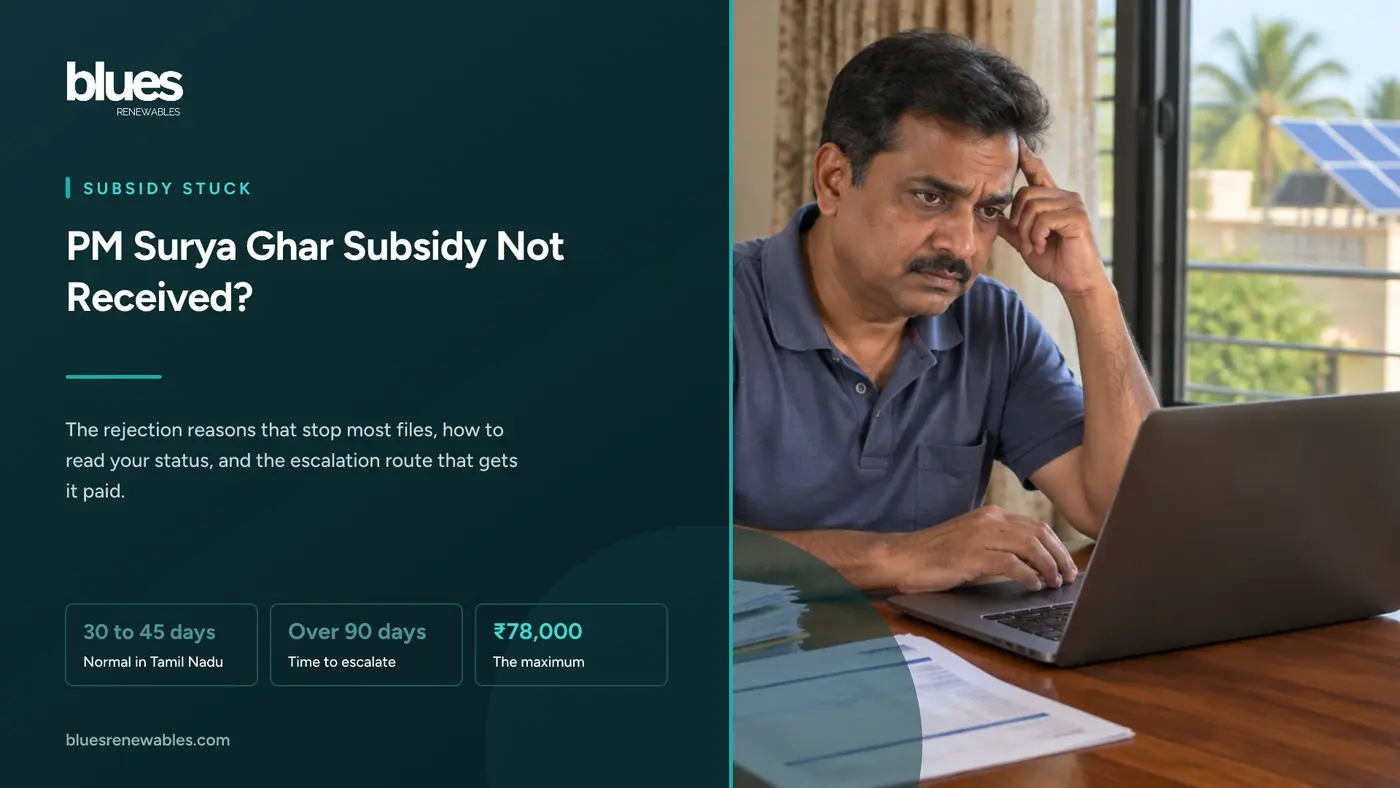
- The official benchmark is 30 working days from the commissioning certificate to the credit. In practice 30 to 45 days is normal in Tamil Nadu, and past 90 days something is stuck.
- A name or account mismatch is the single largest cause of stuck files. The consumer name, the bank account and the Aadhaar record must agree exactly.
- Rejection is almost always correctable. Fix the flagged item and resubmit, because a clean resubmission usually keeps your place in the queue.
- The subsidy requires that you own the plant. A RESCO, OPEX or lease arrangement on a home forfeits up to ₹78,000.
- Escalate in order: DISCOM first, then the national helpline, then the state nodal agency. Skipping steps slows you down rather than speeding you up.
Why the PM Surya Ghar subsidy has not been received
Start by ruling out the most common misunderstanding, because it costs people weeks of worry.
The Central Financial Assistance under PM Surya Ghar is paid after your system is installed, inspected and commissioned. It goes directly to your bank account. It is not deducted from the price your installer quotes, and no installer can hand it to you on the day of installation.
So the clock does not start when you sign the contract. It starts when the DISCOM issues your commissioning certificate and the installation is marked complete on the national portal.
Current subsidy rates are fixed and easy to check against what you were promised:
- ₹30,000 per kW for the first 2 kW
- ₹18,000 for the third kW
- Capped at ₹78,000 for any system of 3 kW and above
If your quote showed a larger figure, the difference was never central subsidy.
The realistic timeline in Tamil Nadu
Government material quotes 30 working days from commissioning to credit. Our own installations across Chennai and Tamil Nadu since 2020 land closer to 30 to 45 calendar days, because the file passes through the DISCOM before it reaches the disbursing system.
Use these markers:
- Under 45 days: normal. Nothing to do.
- 45 to 90 days: worth checking your portal status and your bank details.
- Over 90 days: something is blocked. Start the escalation below.
If the Tamil Nadu state top-up has not arrived
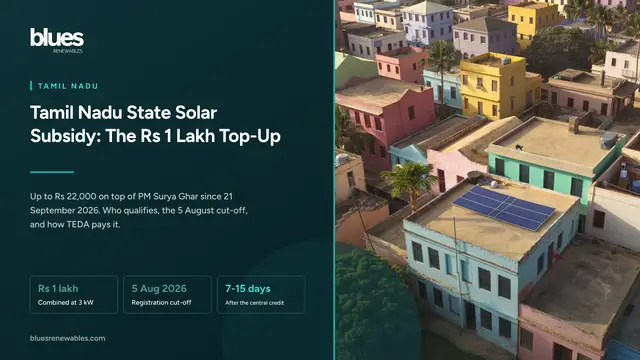
Since 21 September 2026, Tamil Nadu adds its own top-up to PM Surya Ghar: ₹5,000 for 1 kW, ₹10,000 for 2 kW and ₹22,000 for 3 kW and above. TEDA pays it by direct benefit transfer using your PM Surya Ghar data, and TNPDCL's rooftop portal says it is released only after the central subsidy has been credited, then within 7 to 15 days. A missing state amount while the central one is still pending is expected, not a fault.
If the central subsidy has arrived and the state part has not, check three things: that you registered on the PM Surya Ghar portal on or after 5 August 2026, because earlier registrations do not qualify; that the bank account on your application is in the name on the electricity connection; and your status on the TNPDCL rooftop portal, by application number or mobile number. Then call TNPDCL's Minnagam line on 1912 or the portal's toll-free 1800 425 2500 with your application number and the date the central amount arrived. Our guide to the Tamil Nadu state solar subsidy covers the scheme in full.
The reasons applications get rejected or stuck
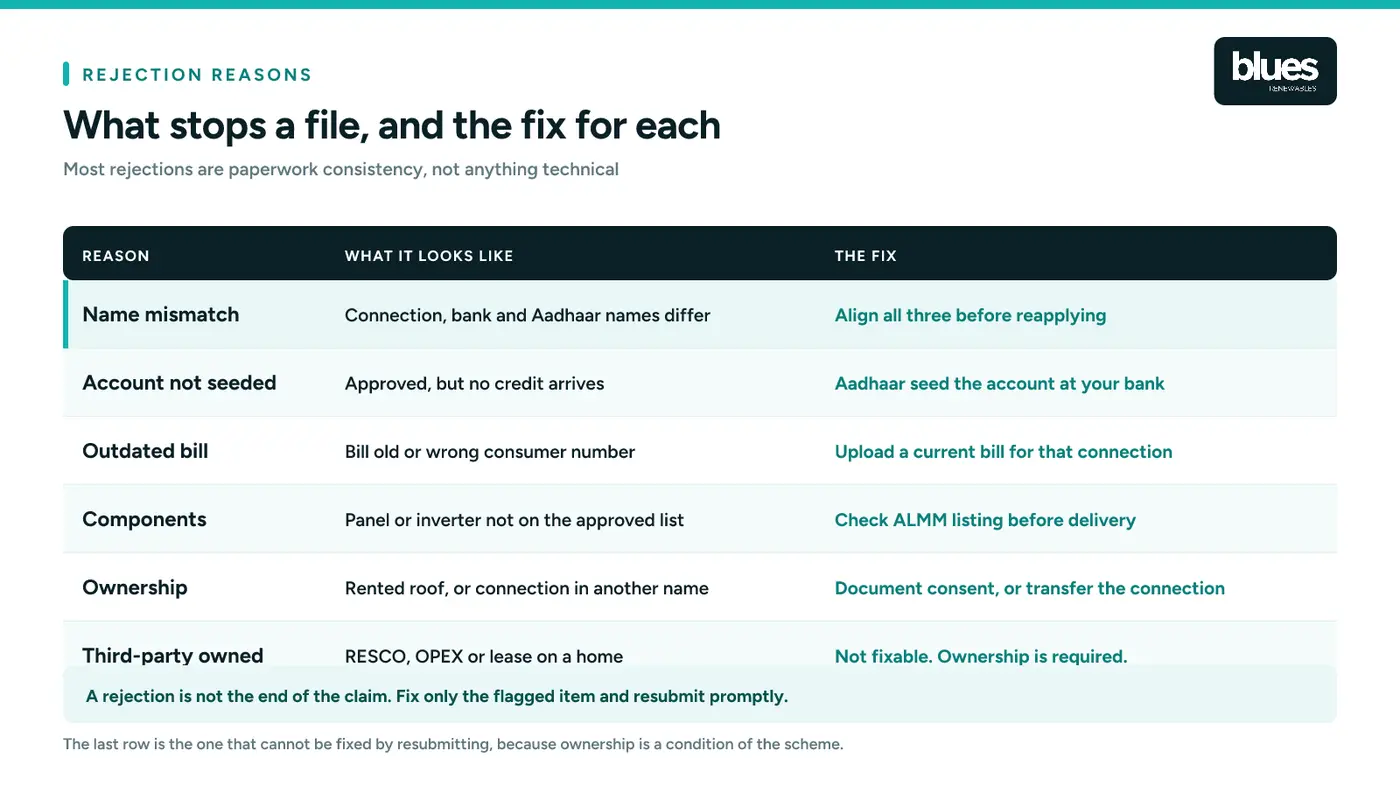
Most stuck files fail on paperwork consistency rather than anything technical. Work down this list in order, because the first three catch the majority.
Name and bank account mismatches
The name on the electricity service connection, the name on the bank account and the Aadhaar record all have to match. An initial expanded on one and abbreviated on another is enough to stop a payment.
Two versions of this problem are common in Tamil Nadu. First, the service connection is still in a parent's or a previous owner's name while the bank account is in yours. Second, the bank account is not Aadhaar seeded, so the direct benefit transfer cannot complete even though the application is approved.
Check the seeding with your bank before you do anything else. It is the fastest thing on this list to fix and one of the most frequent blockers.
An outdated or mismatched electricity bill
The bill you upload must be recent and must show the same consumer number as the application. An old bill, or a bill from a different service connection at the same address, gets the file returned.
Components that are not on the approved lists
Panels must be ALMM listed and the inverter must be on the approved model list. If your installer supplied something outside those lists, the subsidy fails at technical verification no matter how good the hardware is.
This is worth checking before installation, not after. Ask for the make, model and ALMM listing of the exact modules being delivered, and verify them yourself. Our guides to the PM Surya Ghar vendor list and the vendor agreement cover what to check and what to put in writing.
Ownership and property issues
The subsidy is for the consumer who owns the system. Three situations break this:
- The roof or premises is rented and consent is not documented
- The service connection belongs to someone else
- The system is owned by a developer under a RESCO, OPEX or lease arrangement
The last one is the expensive one. MNRE guidelines exclude third-party-owned systems from the residential subsidy. If a company offered you a home system at zero upfront cost and kept ownership, you have traded up to ₹78,000 for that convenience. That may still suit you, but it should have been a choice you made knowingly.
An ineligible connection type
The residential CFA applies to domestic connections. Commercial, industrial and agricultural connections are not eligible for this particular scheme, though other routes such as accelerated depreciation may apply to a business instead. Our guide to PM Surya Ghar eligibility covers every case, including tenants and second homes.
How to check your application status
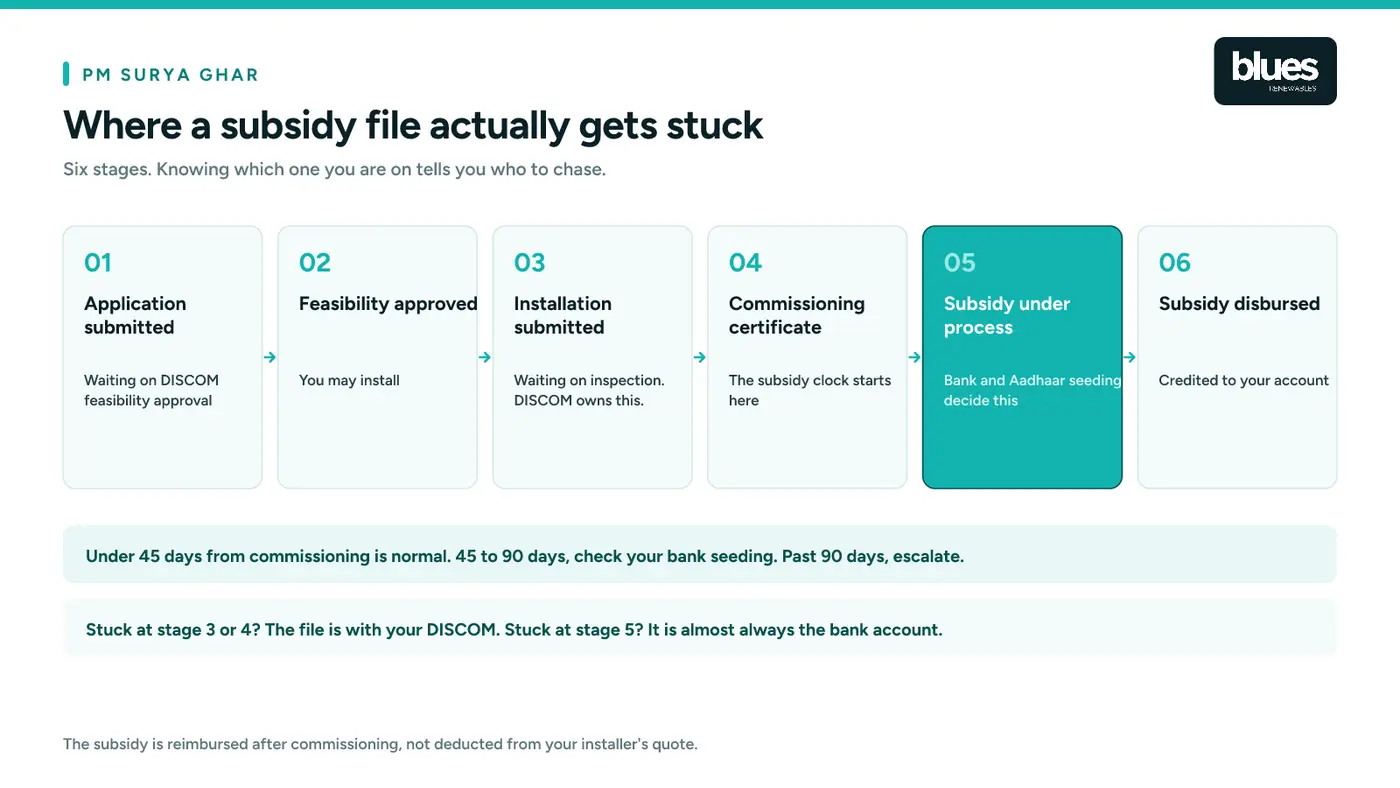
Log in to the national PM Surya Ghar portal with the mobile number you applied with, and open your application. The status line tells you which stage you are at.
Read it against these stages:
Application submitted, waiting for DISCOM feasibility approval
Feasibility approved, you may install
Installation details submitted, waiting for inspection
Commissioning certificate issued, the subsidy clock starts here
Subsidy under process, the file is with the disbursing system
Subsidy disbursed
If you are stuck at stage 3 or 4, the issue sits with your DISCOM. If you are stuck at stage 5 for more than a few weeks, the issue is usually your bank details.
A rejection shows a reason code or a remark. Read it literally. It is almost always naming the exact document that failed.
How to escalate when nothing moves
Escalate in sequence. Jumping straight to a national helpline for something your local office can fix simply adds a routing step. Our guide to raising a PM Surya Ghar complaint sets out which body owns which problem.
First, your DISCOM. Visit the section office that handles your service connection and ask for the solar or renewable desk. Take your application number, the commissioning certificate and a recent bill. Most stuck files are resolved here because the block is a document the office is waiting on.
Second, the national helpline. The PM Surya Ghar national helpline is 15555; the toll-free 1800-180-3333 is also widely listed. Have your application number ready. Use this when the DISCOM says the file has left them but the portal has not moved.
Third, the state nodal agency. In Tamil Nadu this is the agency coordinating the scheme with TANGEDCO. Use it when the DISCOM and the helpline point at each other.
Finally, a written grievance. If the file has been stuck past 90 days and the first three routes have failed, file a written complaint through the public grievance system. Keep it factual: application number, commissioning date, days elapsed, and what each office told you.
Keep a dated note of every call and visit. When a file has bounced between offices, that log is what ends the argument.
What to do if your application was rejected
A rejection is not the end of the claim. In most cases you correct the flagged item and resubmit.
Work in this order:
Read the exact reason on the portal. Do not guess from what a neighbour experienced.
Fix only what is flagged. Changing other fields invites a fresh round of checks.
Resubmit promptly. A quick, clean resubmission generally keeps your position in the DISCOM queue.
Keep the same consumer number unless the rejection was specifically about the connection.
If the rejection was about ownership because your system is third-party owned, resubmission will not help. That is a structural issue with the arrangement, not a paperwork error.
How to avoid this on your next system
If you are reading this before installing, three habits prevent almost all of it.
Get the names aligned first. Service connection, bank account and Aadhaar in the same name, with the bank account Aadhaar seeded. Do this before you apply, not after.
Insist on documented components. Ask for the ALMM listing of the exact panel model and the approved listing of the exact inverter model, in writing, before delivery.
Ask who owns the plant. If the answer is anyone other than you, the residential subsidy is gone. Get that stated plainly in the contract.
Frequently asked questions
Why has my PM Surya Ghar subsidy not been received yet?
Most often because the file is waiting on a document, or because your bank account is not Aadhaar seeded so the transfer cannot complete. Check your status on the portal first, then confirm seeding with your bank. Under 45 days from commissioning, nothing is wrong yet.
How long does the PM Surya Ghar subsidy take?
The official benchmark is 30 working days from the commissioning certificate. In Tamil Nadu, 30 to 45 calendar days is typical. Past 90 days, treat it as stuck and escalate.
What are the most common PM Surya Ghar rejection reasons?
Name mismatches across documents, a non-Aadhaar-seeded bank account, an outdated electricity bill, components that are not ALMM listed, and ownership problems such as a rented roof or a third-party-owned system.
Can I reapply if my PM Surya Ghar application was rejected?
Yes. Most rejections are correctable. Fix the specific item that was flagged and resubmit. Only a structural problem, such as the plant being owned by a developer rather than by you, cannot be fixed by resubmitting.
Does the subsidy come off my installer's quote?
No. It is reimbursed to your bank account after commissioning. You pay the full amount to the installer and receive the subsidy separately.
Do I lose the subsidy if the developer owns the system?
Yes, for a home. MNRE guidelines require consumer ownership, so RESCO, OPEX and lease arrangements on a residential rooftop forfeit the central subsidy of up to ₹78,000.
Who do I contact if my DISCOM is not responding?
Call the PM Surya Ghar helpline on 1800-180-3333 with your application number, then approach the state nodal agency. File a written grievance if the file is past 90 days.
How much subsidy should I actually receive?
₹30,000 per kW for the first 2 kW, ₹18,000 for the third, capped at ₹78,000 for anything at 3 kW or above. Any larger figure you were quoted did not come from this scheme.
Why has my Tamil Nadu state subsidy not been credited?
The state top-up is paid only after the central subsidy, and then within 7 to 15 days, according to TNPDCL's rooftop portal. If the central amount has arrived and the state part has not, check that you registered on the PM Surya Ghar portal on or after 5 August 2026 and that the bank account matches the connection holder's name.
Where this fits
If you are still choosing a system, read our guide to the documents required for solar subsidy before you apply, and check which subsidy applies in Tamil Nadu. If the delay is on the metering side rather than the money side, the TANGEDCO net metering application process is covered separately.
Blues Renewables has installed solar across Chennai since 2020, for homes, schools, businesses and factories. We file the subsidy and net metering paperwork ourselves on every system we install, and we tell you upfront which of your documents will cause a problem.
Send us your application number on +91 98841 07170 and we will tell you what is blocking it, whether or not we installed your system.
Sources
- MNRE, Guidelines for implementation of PM Surya Ghar: Muft Bijli Yojana
- PM Surya Ghar: Muft Bijli Yojana national portal, application status and helpline
- TANGEDCO, Salient Features and Guidelines, Generic Tariff Order for Grid Interactive PV Solar Energy Generating System, Order No. 8 of 2021 dated 22 October 2021
- Blues Renewables subsidy filing records, Chennai and Tamil Nadu, 2020 to 2026