Waaree Solar: Everything You Need to Know in 2026
India's largest module maker by a distance. What Waaree makes in 2026, what it costs per watt, how its warranty reads, and where it is the wrong pick.

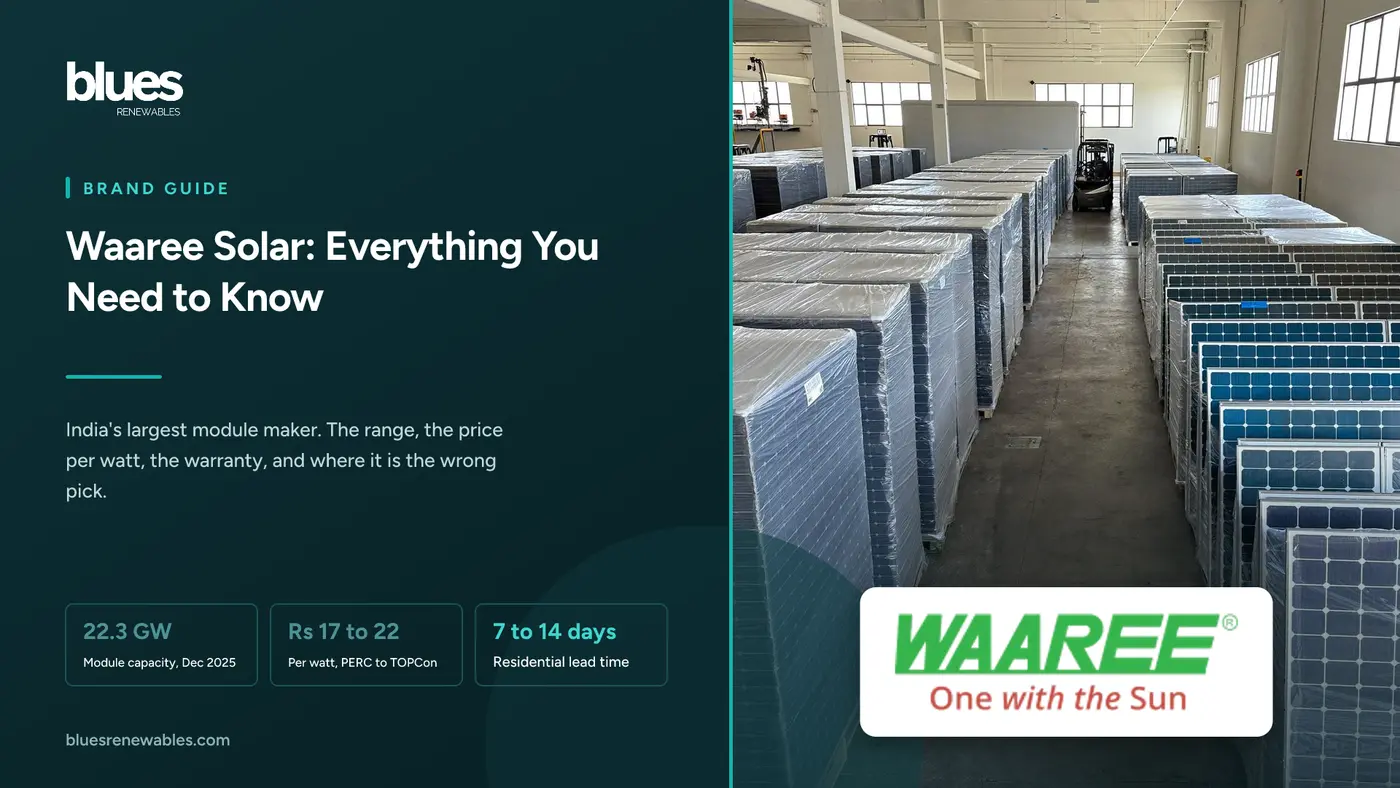
If an installer in India quotes you a panel without naming the brand, there is a fair chance it is a Waaree. The company makes more modules than anyone else in the country, ships them faster than anyone else, and sits on the ALMM list with enough models that almost every quotation can be built around one.
That scale is the reason to consider Waaree, and it is also the reason to read the model number rather than the logo. A brand with this many SKUs spans a wide band of efficiency and warranty terms, and the cheapest Waaree on a quote is not the same product as the best one.
This guide sets out what Waaree actually makes in 2026, what it costs, how the warranty reads, and the situations where another brand is the better call.
Key takeaways
- Waaree is India's largest module manufacturer, with about 22.3 GW of aggregate module capacity as of December 2025, 19.7 GW of it in India.
- The range runs from Mono PERC to HJT, roughly 330 W to 730 W, with module efficiency from about 20.4 percent to 23.5 percent depending on series.
- Pricing tracked in Q2 2026 put Waaree Mono PERC at ₹17 to ₹19 a watt and TOPCon at ₹19 to ₹22, consistently about ₹2 a watt under Tata Power Solar.
- Lead time is the practical advantage. Standard residential SKUs ship in 7 to 14 days, which matters when a subsidy feasibility has a clock on it.
- It is ALMM List-I listed with DCR models, so it qualifies for PM Surya Ghar, provided the exact model number on your bill of materials is on the current list.
- Listed on the NSE and BSE since October 2024, and a BloombergNEF Tier 1 manufacturer for 39 consecutive quarters by the company's own count.
Who Waaree is
Waaree Energies is headquartered in Mumbai and manufactures in Gujarat, with plants at Surat, Tumb, Nandigram, Chikhli and Samakhiali, plus a facility at Noida and a module plant in Texas. The company listed on Indian exchanges in October 2024.
The scale is the headline. In December 2025 Waaree put its aggregate module capacity at approximately 22.3 GW, made up of around 19.7 GW in India and 2.6 GW in the United States, after expanding its Samakhiali facility to 3 GW. It has also commissioned a 3.05 GW inverter plant in Gujarat, which is worth knowing if your installer proposes a Waaree inverter alongside Waaree modules.
For a buyer, capacity translates into two things: availability, and a very broad catalogue. Both cut both ways, and the rest of this guide is about which way they cut for you.
Waaree panel range in 2026
Waaree sells across every mainstream technology, and the series names are the thing to look for on a quotation rather than the brand.
- Aditya - Technology: Mono PERC, M10 and G12 cells, Wattage: 330 to 450 W, Module efficiency: 20.4 to 21.0 percent, Typical fit: Homes, 1 to 10 kW, PM Surya Ghar
- Bi55 - Technology: N-type TOPCon, monofacial, Wattage: 450 to 580 W, Module efficiency: 21.2 to 21.6 percent, Typical fit: Commercial roofs, 10 to 500 kW
- Bifacial 144-cell - Technology: N-type bifacial, Wattage: 540 to 660 W, Module efficiency: 22.0 to 22.3 percent, Typical fit: Ground mount, carports, MW scale
- HJT - Technology: Heterojunction, Wattage: 700 to 730 W, Module efficiency: 22.5 to 23.5 percent, Typical fit: Space-constrained, high-value roofs
Two things follow from the table. First, the Aditya Mono PERC range is what most residential Waaree quotations are built on, because it is the cheapest and it is DCR eligible. Second, the HJT range at the top is a different product at a different price, and our TOPCon vs Mono PERC guide covers when paying for the newer cell actually returns the money.
Warranty
Waaree's warranty terms vary by series, which is normal for a catalogue this wide. The performance warranty runs up to 30 years on the current N-type ranges, and the product warranty against manufacturing defects is shorter, in the 10 to 12 year band depending on the module.
One point that comes up in comparisons is the year-25 guaranteed output on the TOPCon range, where Waaree's figure is stronger than Tata's. On a 25-year asset that is a meaningful number, but it only matters if the claim process works when you need it. Our guide to making a solar panel warranty claim in India covers what to keep from day one, because the serial numbers and the commissioning photographs decide most claims before the manufacturer is even involved.
Read the actual warranty document for the model on your quote. Do not rely on a dealer's summary.
Waaree solar panel price in India in 2026
Procurement benchmarks tracked in Q2 2026 put Waaree at:
- Mono PERC: ₹17 to ₹19 a watt
- TOPCon: ₹19 to ₹22 a watt
- Bifacial: ₹21 to ₹24 a watt
Those are module prices, not system prices. Modules are roughly 45 to 50 percent of a rooftop project's cost, so a system built on Waaree Mono PERC lands in the ordinary Tamil Nadu band of about ₹58 to ₹70 per watt installed for a small residential system, before the PM Surya Ghar subsidy.
The steady pattern across every band is that Waaree sits about ₹2 a watt below Tata Power Solar and close to Adani. On a 5 kW home system that gap is roughly ₹10,000, which is real but not decisive. What decides it is the model number and the installer, and is your solar quote too high explains how to convert any quotation to a per-watt rate so the brand premium is visible on its own.
ALMM, DCR and the PM Surya Ghar subsidy
Waaree is on MNRE's ALMM List-I and offers DCR-compliant models, which is the combination the ₹78,000 PM Surya Ghar subsidy requires.
The trap is that ALMM status belongs to a model, not a brand. "Waaree" on the cover sheet of a quotation is not enough. The bill of materials has to carry a specific model number, and that number has to appear on the current ALMM list, which is updated regularly. Some installers quote a well-known brand on the front page and list a generic import on the BOM, and the subsidy inspection catches it after the system is on the roof.
Ask for the model number in writing and check it yourself. It takes five minutes.
Where Waaree is strong, and where to be careful
Strong on availability. With this much capacity, standard residential SKUs ship from any of the Gujarat plants in 7 to 14 days. If your subsidy feasibility has been cleared and you have to commission inside a deadline, a delayed panel shipment is the thing most likely to sink it, and Waaree is the safest module pick on lead time alone.
Strong on breadth. Whatever configuration the roof needs, there is a Waaree module for it, including bifacial at 660 W for open ground and carports.
Be careful with the catalogue itself. A brand spanning 18 to 23.5 percent efficiency means the sticker tells you nothing about the spec. Two quotations that both say "Waaree" can be a 20.4 percent PERC panel and a 22.3 percent bifacial, and they should not cost the same.
Be careful with service expectations. Waaree's after-sales network is broad but it is a distributor model. If you value a single corporate entity handling both the installation and the module warranty, Tata's own EPC arm offers that and Waaree does not.
Waaree vs the alternatives
Against Tata Power Solar, Waaree is cheaper by about ₹2 a watt, faster to ship, and wider in range. Tata is stronger on claims turnaround and physical service partners. See Tata Power Solar: everything you need to know in 2026.
Against Adani Solar, the two are close on price and both are Gujarat-based. Adani's vertical integration gives it a small edge on Mono PERC cost, and Waaree's catalogue is broader at the top end. See Adani Solar: everything you need to know in 2026.
Against Vikram Solar, Vikram leads on module-level efficiency with its Hypersol range reaching 23.69 percent, while Waaree leads on scale and breadth. Vikram also manufactures at Oragadam near Chennai, which matters for a Tamil Nadu buyer. See Vikram Solar: everything you need to know in 2026.
Buying Waaree in Tamil Nadu
Waaree's plants are in Gujarat and Uttar Pradesh, so modules reach Chennai through distributors rather than from a local factory. In practice that has not been a problem: availability in Tamil Nadu is good and lead times hold.
What to insist on locally is the same as anywhere. Model number on the BOM, ALMM check done, serial numbers recorded at commissioning, and a structure engineered for the coastal wind load rather than a generic frame. How to verify a solar company covers the checks that separate a good installer from a good brochure.
Frequently asked questions
Is Waaree a good solar panel brand?
Yes. It is India's largest module manufacturer, ALMM listed, BloombergNEF Tier 1, and its modules are used across residential, commercial and utility projects. The quality of the specific model still varies across the range, so judge the model number, not the brand.
What is the price of Waaree solar panels per watt in 2026?
Benchmarks tracked in Q2 2026 put Waaree Mono PERC at ₹17 to ₹19 a watt, TOPCon at ₹19 to ₹22, and bifacial at ₹21 to ₹24. Installed system prices are higher because modules are about half the project cost.
What is the warranty on Waaree solar panels?
Up to 30 years of linear performance warranty on the current N-type ranges, with a product warranty in the 10 to 12 year band depending on the series. Confirm the exact terms on the warranty document for your model.
Is Waaree ALMM approved for PM Surya Ghar?
Waaree is on ALMM List-I and offers DCR-compliant models. The subsidy depends on the specific model number on your bill of materials being on the current list, so check that rather than relying on the brand name.
Which is better, Waaree or Tata Power Solar?
Waaree is cheaper by about ₹2 a watt, ships faster and has a broader range. Tata has the deeper service network and a stronger claims turnaround. For a time-critical subsidy installation Waaree is the safer module pick; for a buyer who prizes service depth, Tata.
Where are Waaree solar panels made?
In Gujarat, at Surat, Tumb, Nandigram, Chikhli and Samakhiali, with a further facility at Noida in Uttar Pradesh and a plant in Texas serving the US market.
Does Waaree make TOPCon and HJT panels?
Yes. The Bi55 series is N-type TOPCon from 450 to 580 W, the bifacial 144-cell range reaches 660 W, and the HJT range runs 700 to 730 W at up to 23.5 percent efficiency.
Where this fits
If you are choosing between cell technologies rather than brands, start with TOPCon vs Mono PERC. If you have quotations in hand, is your solar quote too high shows how to compare them per watt. For what a full system costs in Chennai, see solar panel price in Chennai.
Blues Renewables installs Waaree, Tata, Vikram, Adani and the other ALMM-listed brands across Chennai and Tamil Nadu, and every quotation we issue carries the model number, not just the brand. If you have a Waaree quote and want it checked against the current ALMM list and the per-watt benchmark, send it across.
Call +91 98841 07170.
Sources
- Waaree Energies press release, 12 December 2025, on the Samakhiali expansion and aggregate module capacity of approximately 22.3 GW (19.7 GW India, 2.6 GW United States)
- Waaree Energies, on the 3.05 GW inverter manufacturing facility in Gujarat
- Q2 2026 procurement benchmarks for Waaree Mono PERC, TOPCon and bifacial modules, and the comparison with Tata Power Solar pricing
- Bajaj Finserv, Vikram Solar vs Waaree comparison, 2026, for the HJT range figures and the BloombergNEF Tier 1 record
- MNRE, Approved List of Models and Manufacturers, List-I, for ALMM and DCR status