Cross Subsidy Surcharge (CSS) for Solar: Meaning, Formula and State-Wise Rates
The CSS charge is the cross subsidy surcharge, a per unit levy on open access consumers. Rates compared across Tamil Nadu, Karnataka and Gujarat.


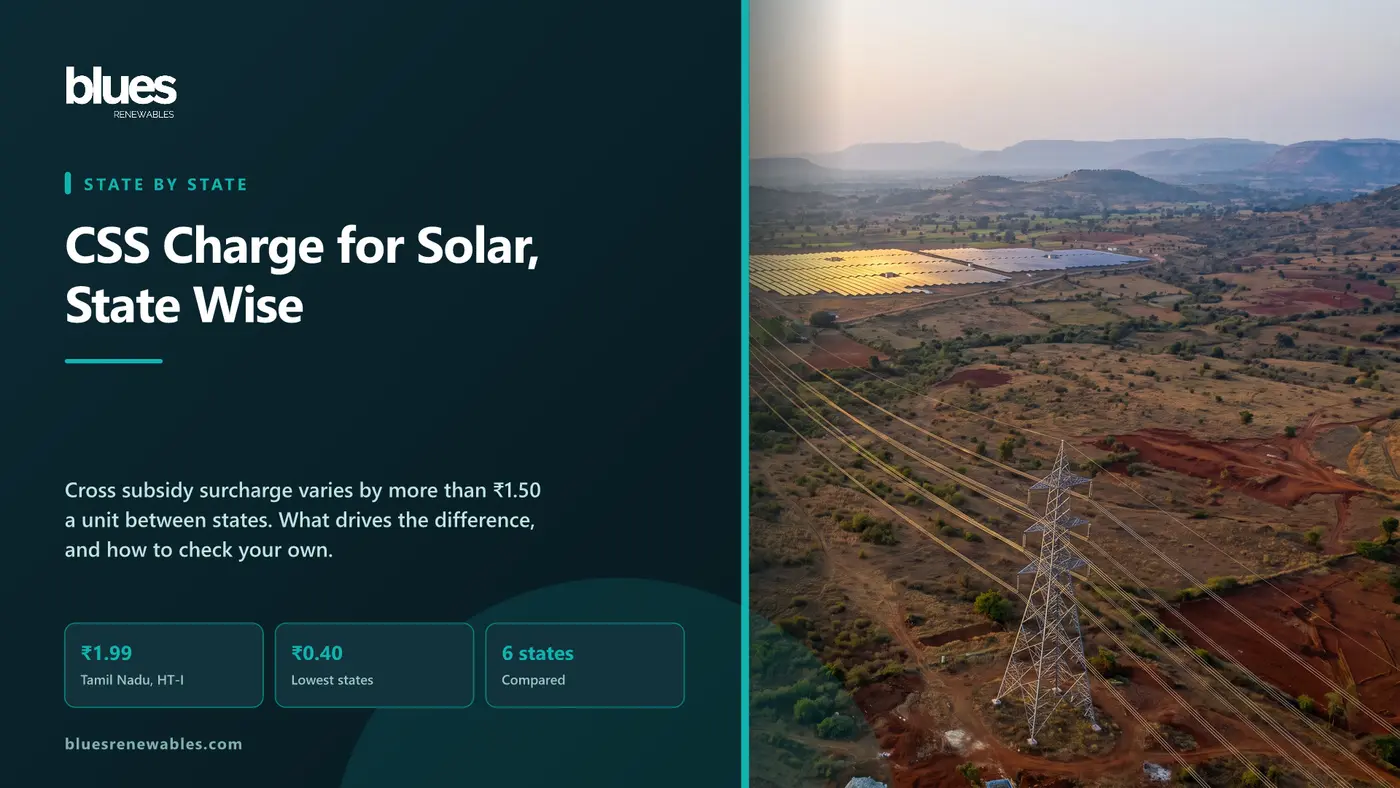
Move the same solar plant across a state border and its power can cost ₹1.50 more per unit. The panels do not change. Nor does the factory. Only the CSS charge for solar, which every state sets for itself, changes.
For a business running plants in several states, or choosing where to put the next one, that gap is a genuine input into the decision. Yet most published comparisons contradict each other, sometimes by more than a rupee.
So this guide does three things. First, it gives the current figures and says plainly which ones come from a regulator's own order. Second, it explains what actually drives a state's rate up or down. Third, it shows you how to look up your own state in about twenty minutes, rather than trusting a table that ages badly.
Key takeaways
- The CSS charge for solar is the cross subsidy surcharge, a per unit levy on open access consumers compensating the utility for subsidy contribution it loses when they leave its supply.
- Tamil Nadu is ₹1.99 per unit for an HT industrial consumer in FY 2025-26, taken directly from TNERC's tariff order.
- Karnataka is around ₹2.08, Maharashtra roughly ₹1.60 to ₹2.11, while Gujarat, Rajasthan and Andhra Pradesh sit broadly between ₹0.40 and ₹1.00.
- Four inputs drive the difference: the retail tariff, the utility's power purchase cost, the wheeling charge, and the 20 percent Tariff Policy cap.
- The cap binds in most states, which is why the calculated surcharge and the payable surcharge rarely match.
- In every state, captive and group captive consumers pay zero. The state comparison only matters for third-party open access.
What is the CSS charge for solar
CSS stands for cross subsidy surcharge. Section 42(2) of the Electricity Act 2003 allows a state commission to levy it on consumers who take open access, so the distribution utility recovers the cross subsidy contribution those consumers stop making once they buy power elsewhere.
Each state commission applies the same national Tariff Policy formula, but feeds it that state's own tariffs and costs. Hence the wide variation. For the mechanics and a full worked example of what cross subsidy in solar power means, see the sections below.
Two things hold true everywhere, however. Only third-party open access attracts the charge, and a cap limits it to 20 percent of the consumer category's tariff.
CSS charge for solar, state wise
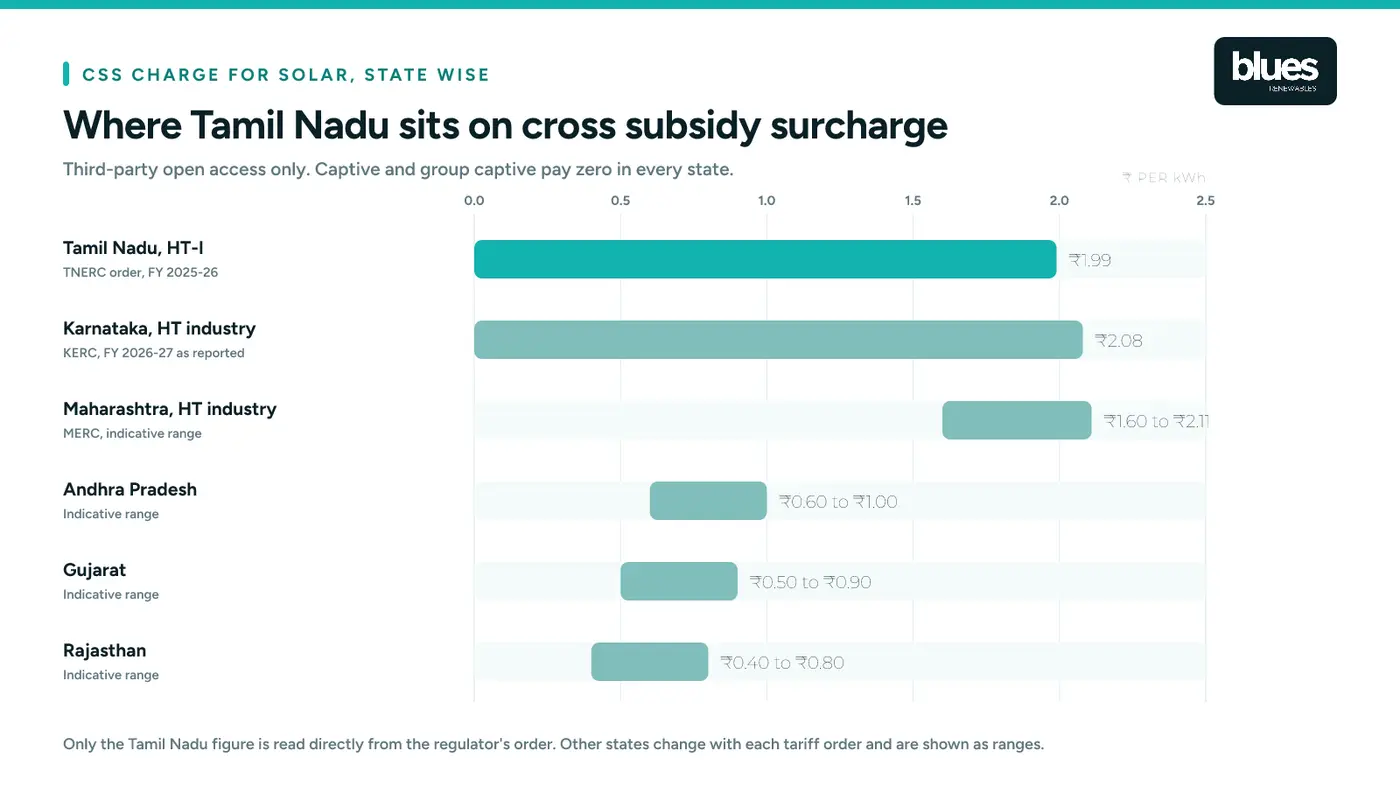
- Tamil Nadu - Cross subsidy surcharge, HT industry: ₹1.99 per unit, Basis: TNERC Tariff Order No.6 of 2025, FY 2025-26
- Karnataka - Cross subsidy surcharge, HT industry: About ₹2.08 per unit, Basis: KERC, FY 2026-27, as reported
- Maharashtra - Cross subsidy surcharge, HT industry: ₹1.60 to ₹2.11 per unit, Basis: MERC, indicative range
- Andhra Pradesh - Cross subsidy surcharge, HT industry: ₹0.60 to ₹1.00 per unit, Basis: Indicative range
- Gujarat - Cross subsidy surcharge, HT industry: ₹0.50 to ₹0.90 per unit, Basis: Indicative range
- Rajasthan - Cross subsidy surcharge, HT industry: ₹0.40 to ₹0.80 per unit, Basis: Indicative range
A caution about this table. Only the Tamil Nadu figure is read directly from the regulator's own order, where it appears as ₹1.99 for HT-IA with the underlying formula inputs published alongside. The others are drawn from industry reporting and are shown as ranges because published secondary sources disagree with each other, sometimes by more than a rupee. Before pricing a contract, check the current tariff order for the state in question. A table like this is a starting point for comparison, not a basis for a commitment.
The pattern is nonetheless stable and useful. Tamil Nadu, Karnataka and Maharashtra sit at the expensive end for third-party open access. Gujarat and Rajasthan sit at the cheap end. That is precisely why third-party PPAs are common in Gujarat and rare in Tamil Nadu, where the same buyers use group captive structures instead.
What drives a state's CSS high or low
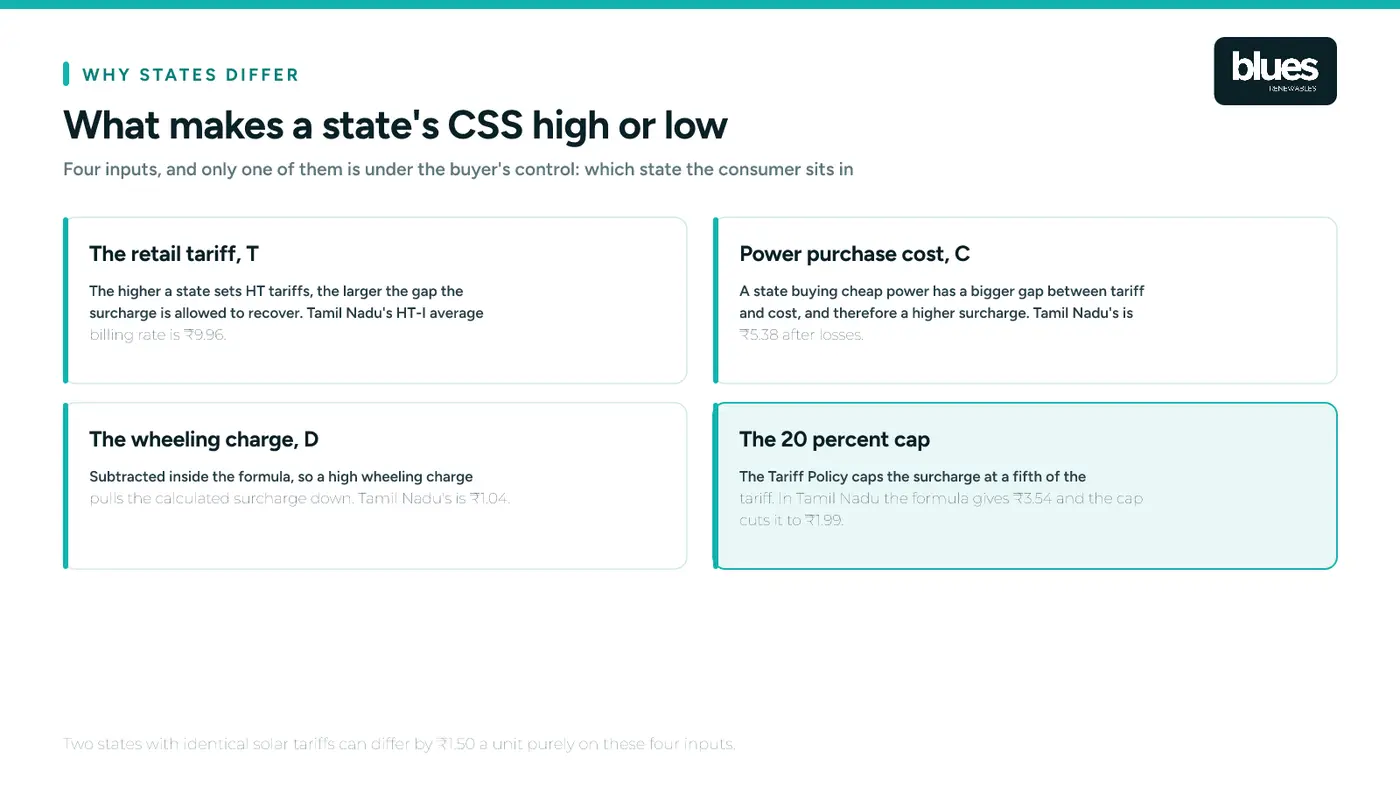
The formula is S = T − [C ÷ (1 − L) + D + R], capped at 20 percent of T. Four inputs move the answer.
The retail tariff, T. Where a state sets HT tariffs high, the surcharge can recover a larger gap and the 20 percent cap sits higher too. Tamil Nadu's HT-IA average billing rate, for example, is ₹9.96.
The power purchase cost, C. A utility buying cheap power has a wider gap between what it charges industry and what supply costs it, producing a larger calculated surcharge. Tamil Nadu's is ₹5.38 after grossing up for losses.
The wheeling charge, D. This is subtracted inside the formula, so a state with high wheeling charges has a lower calculated surcharge. Tamil Nadu's ₹1.04 wheeling charge pulls the surcharge down by exactly that much.
The 20 percent cap. In Tamil Nadu the formula produces ₹3.54 and the cap cuts it to ₹1.99, a reduction of 44 percent. Where the cap binds, the underlying formula stops mattering and the surcharge becomes simply one fifth of the tariff.
That last point is the most useful shortcut available. In a state where the cap binds, you can estimate the surcharge as 20 percent of the HT tariff without knowing anything about the utility's power purchase costs.
What protects you once you have signed
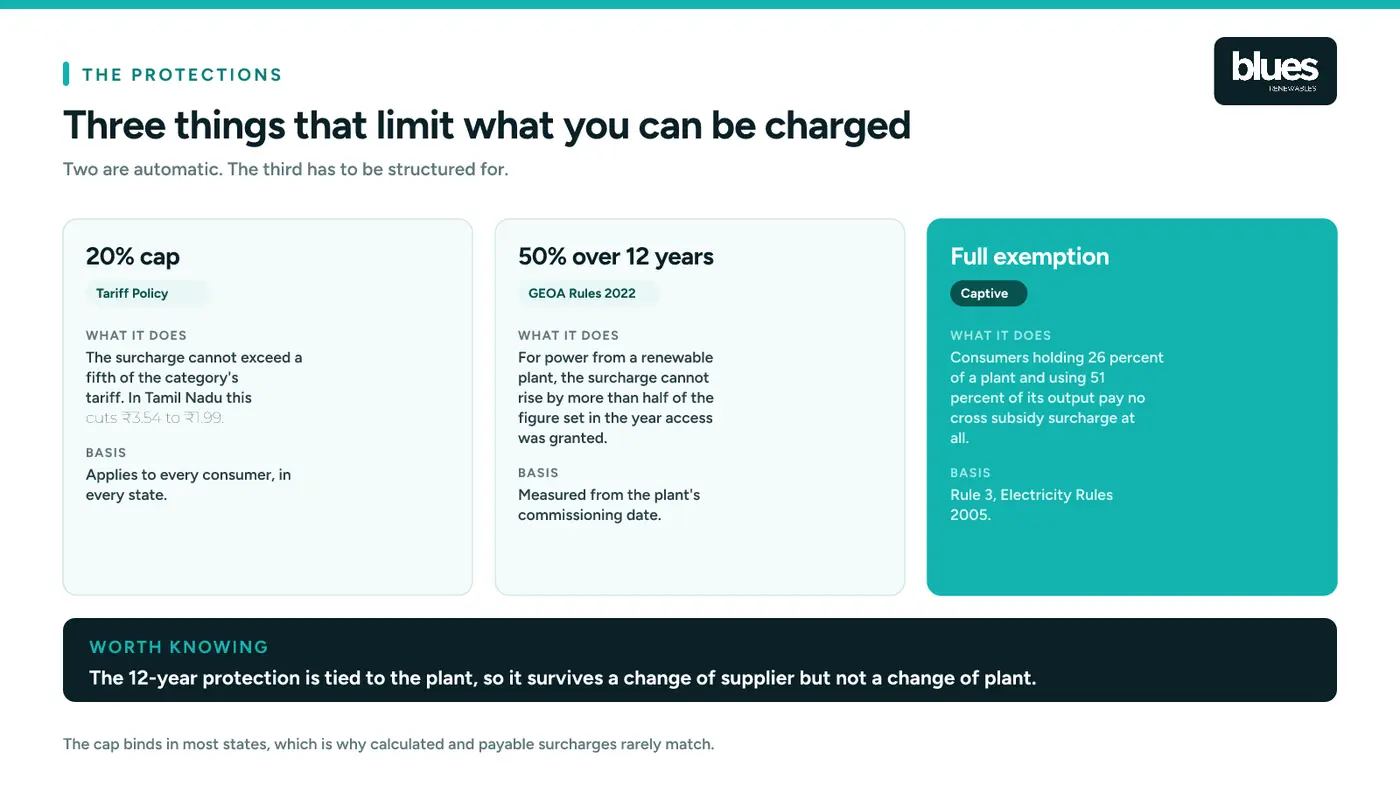
Three provisions limit exposure.
A 20 percent cap applies universally under the Tariff Policy.
Next comes the 12-year escalation limit, from the Green Energy Open Access Rules 2022. For 12 years from a renewable plant's commissioning, the surcharge cannot rise by more than 50 percent of the figure fixed in the year open access was granted. Because it attaches to the plant rather than the contract, it survives a change of supplier but not a change of plant.
Captive exemption removes the surcharge entirely. In every state, a consumer holding at least 26 percent of a plant and consuming at least 51 percent of its output pays nothing.
How to check your own state properly
Secondary tables age badly. The reliable method takes twenty minutes.
Find the current retail tariff order on your state commission's website. It will be titled something like "Determination of tariff for distribution", with an order number and date.
Look for the open access charges section. In TNERC's Tariff Order No.6 of 2025 you will find it at paragraph 2.4, headed "Other charges", carrying a table of approved wheeling charges and cross subsidy surcharges by consumer category.
Read the figure for your own category, not the headline one. A commercial consumer and an industrial consumer in the same state face different surcharges: in Tamil Nadu, ₹2.57 against ₹1.99.
Check the additional surcharge separately. It is usually a distinct order, often re-determined every six months. Tamil Nadu's moved from ₹0.54 to ₹0.10 within a year.
Check the effective date. Multi-year tariff frameworks publish figures for future years that are not yet in force. Tamil Nadu's schedule shows ₹2.06 for FY 2026-27, which is the number widely quoted online but is not what is payable today.
Who actually subsidises whom
TNERC's Tariff Order No.6 of 2025 puts numbers on it. The cost of supplying a unit, being the power purchase cost grossed up for network losses, is ₹5.38. Against that, the average billing rate by category is:
- HT-IA industries, IT services - Average billing rate: ₹9.96, Above cost of supply: ₹4.58
- HT-IIA government institutions, hospitals - Average billing rate: ₹10.93, Above cost of supply: ₹5.55
- HT-IIB private educational institutions - Average billing rate: ₹12.28, Above cost of supply: ₹6.90
- HT-III and V commercial, EV charging - Average billing rate: ₹12.87, Above cost of supply: ₹7.49
- HT-IV temporary supply - Average billing rate: ₹17.52, Above cost of supply: ₹12.14
Every one of those categories pays roughly double the cost of supplying it or more. Domestic and agricultural consumers sit on the other side of the line, agriculture in Tamil Nadu being supplied free. The gap is funded by the categories in the table.
That is cross subsidy. It is a deliberate policy choice, not an accounting error, and it is why an industrial consumer leaving the system is a fiscal problem for the utility rather than merely a lost customer.
How the cross subsidy surcharge is calculated
The Tariff Policy prescribes the formula:
S = T − [ C ÷ (1 − L) + D + R ]
where T is the tariff for the consumer category, C the weighted average power purchase cost, L the system losses, D the wheeling charge, and R any per unit adjustments.
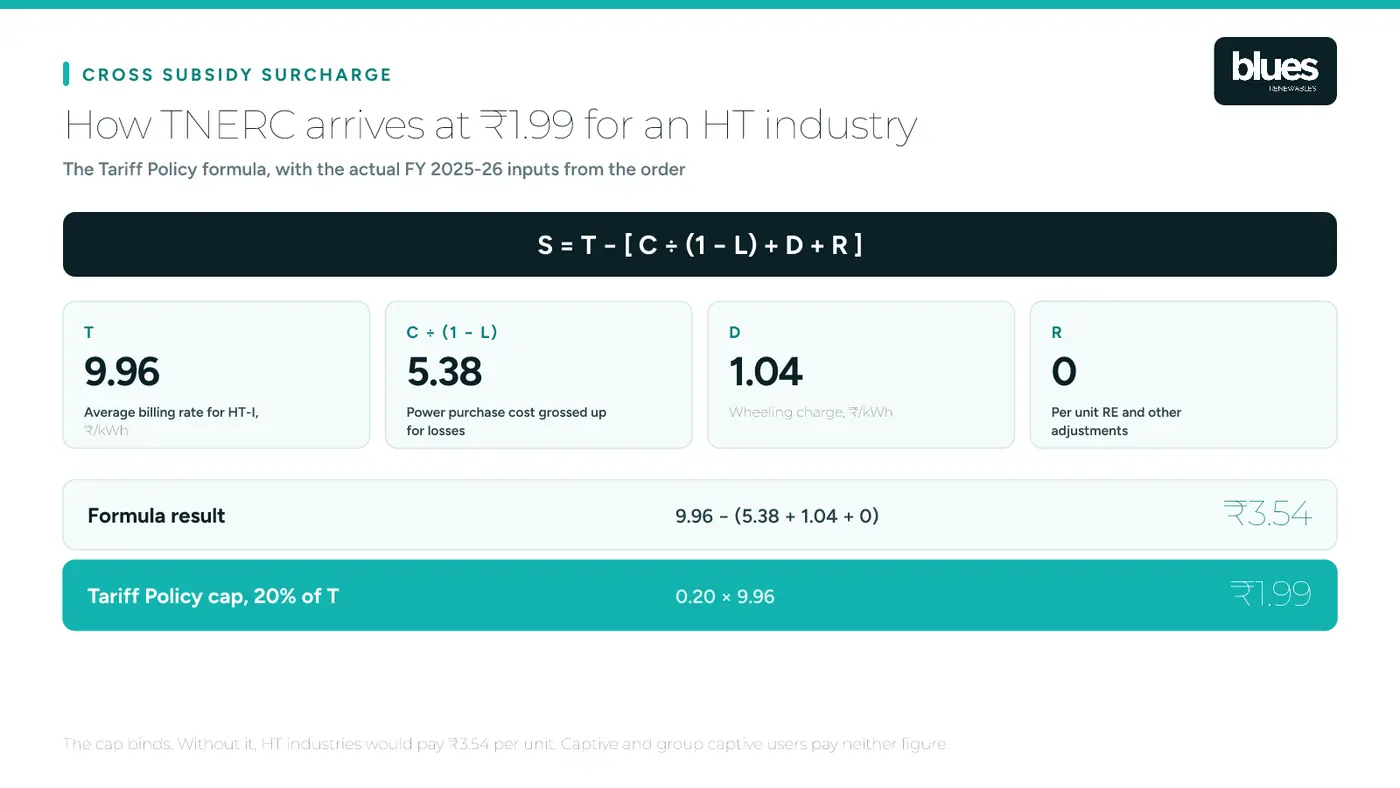
For an HT-IA industry in Tamil Nadu in FY 2025-26 the inputs published in the order are T = 9.96, C ÷ (1 − L) = 5.38, D = 1.04 and R = 0. That gives:
9.96 − (5.38 + 1.04 + 0) = ₹3.54 per unit
The Tariff Policy then caps the surcharge at 20 percent of the applicable tariff. Twenty percent of ₹9.96 is ₹1.99, and that is what an HT industry actually pays. The cap binds, and it binds hard: without it the surcharge would be 78 percent higher.
This is worth understanding because it explains something counter-intuitive. A state with high industrial tariffs does not necessarily have a high surcharge, because the cap scales with the tariff but so does the formula. What matters is the gap between tariff and cost of supply relative to the tariff itself.
Cross subsidy surcharge by consumer category
Because the cap is a percentage of each category's own tariff, the surcharge differs across categories even though the cost of supply is identical.
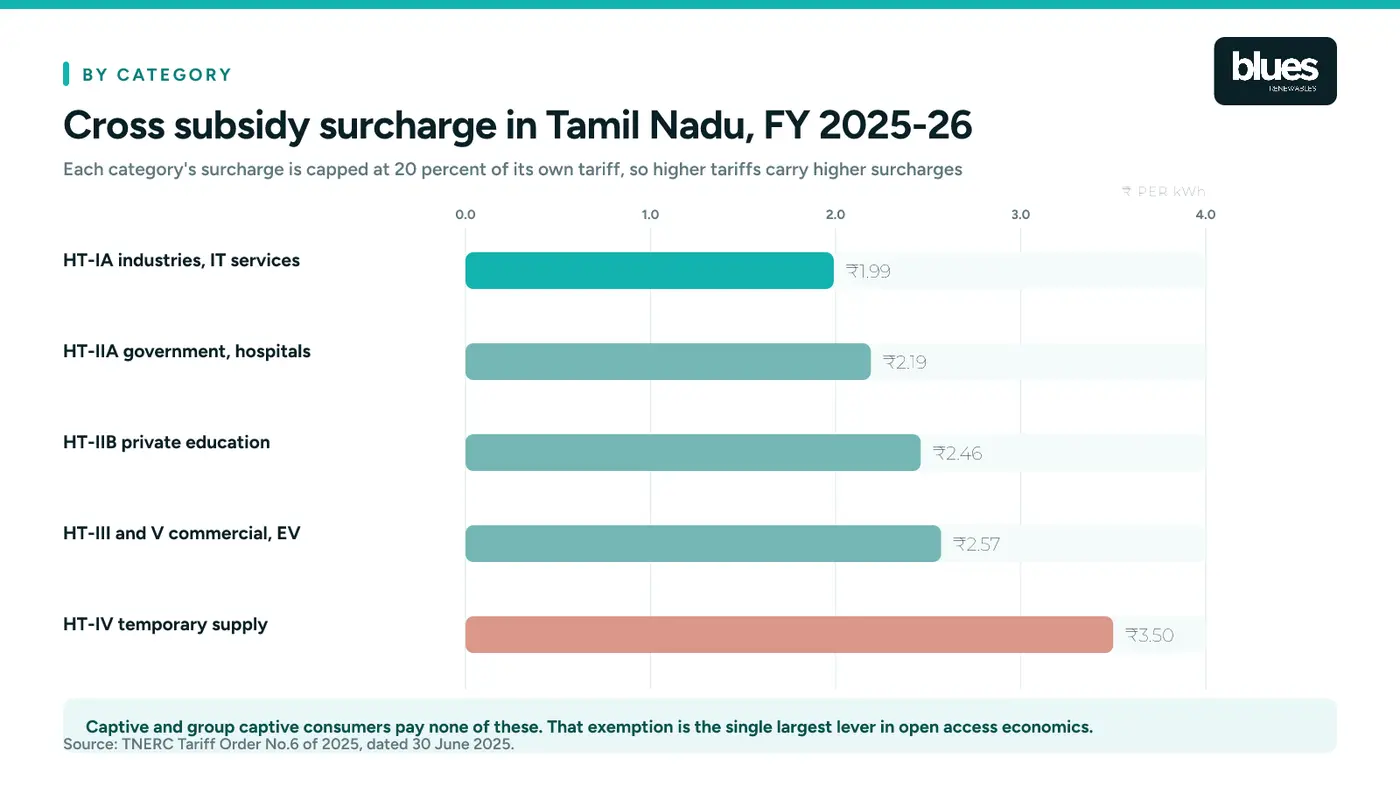
- HT-IA industries, IT services - Cross subsidy surcharge, FY 2025-26: ₹1.99 per unit
- HT-IIA government educational institutions, hospitals - Cross subsidy surcharge, FY 2025-26: ₹2.19 per unit
- HT-IIB private educational institutions - Cross subsidy surcharge, FY 2025-26: ₹2.46 per unit
- HT-III and HT-V commercial, EV charging - Cross subsidy surcharge, FY 2025-26: ₹2.57 per unit
- HT-IV temporary supply - Cross subsidy surcharge, FY 2025-26: ₹3.50 per unit
A private school or a commercial showroom therefore faces materially worse third-party open access economics than a factory does, on the same plant and the same wires. For those categories, the captive structures are not an optimisation, they are the only route that works.
How to avoid it legally
This exemption is no loophole. Rather, it reflects the structural distinction the Act draws between buying power and generating your own.
Under Rule 3 of the Electricity Rules 2005, a plant is captive if the consuming entities hold at least 26 percent of the equity and consume at least 51 percent of the generation in a financial year. Meet both and the consumption is captive, not a purchase, and no cross subsidy arises to be recovered.
That is worth ₹1.99 plus the ₹0.10 additional surcharge, about ₹2.09 per unit in Tamil Nadu today. On a 2 MW load consuming 10 million units a year, it is ₹2.09 crore annually. The mechanics are set out in what a captive solar power plant is, and the multi-consumer version in who can use power from a group captive solar plant.
Frequently asked questions
What is the CSS charge for solar? CSS is the cross subsidy surcharge, a per unit charge on open access consumers under Section 42(2) of the Electricity Act 2003. It compensates the distribution utility for the cross subsidy contribution lost when a large consumer buys power from someone else. It applies to third-party open access only.
What is cross subsidy in solar power? Cross subsidy is the premium industrial and commercial consumers pay above their cost of supply so domestic and agricultural consumers can pay below it. When such a consumer buys solar through open access, the cross subsidy surcharge recovers the contribution the utility loses.
What is the CSS charge for solar state wise? It varies with each state's tariff order. Tamil Nadu is ₹1.99 per unit for HT industry in FY 2025-26. Karnataka is around ₹2.08 as reported for FY 2026-27, Maharashtra roughly ₹1.60 to ₹2.11, and Gujarat, Rajasthan and Andhra Pradesh broadly ₹0.40 to ₹1.00. Check the current order before pricing anything.
Which state has the lowest CSS for solar? Among the major open access markets, Rajasthan and Gujarat are consistently at the low end, commonly quoted between ₹0.40 and ₹0.90 per unit. This is one reason those states have deeper third-party open access markets than Tamil Nadu.
Why is CSS different in every state? Because each state commission applies the same Tariff Policy formula to its own tariffs, power purchase costs and wheeling charges. States with high industrial tariffs and cheap power purchase have larger calculated surcharges, subject to the 20 percent cap.
Is the CSS charge the same for all consumers in a state? No. It is capped at 20 percent of each category's own tariff, so categories with higher tariffs face higher surcharges. In Tamil Nadu it ranges from ₹1.99 for industry to ₹3.50 for temporary supply.
Can I avoid the CSS charge? Yes, by using a captive or group captive structure rather than a third-party purchase. A consumer holding at least 26 percent of the plant and consuming at least 51 percent of its output pays no cross subsidy surcharge in any state.
What is the cross subsidy surcharge in Tamil Nadu? ₹1.99 per unit for HT industrial consumers, set in TNERC Tariff Order No. 6 of 2025 for FY 2025-26. It is the one figure in this comparison read directly from a regulator's own order rather than from industry reporting. Group captive structures that clear the 26 percent ownership and 51 percent consumption tests avoid it altogether.
Where this fits
Comparing states only matters when you buy third party. Structure the deal as captive instead, and the surcharge falls to zero everywhere. The state question then shrinks to wheeling, transmission and solar resource.
For the wider framework, read what open access solar is. To price the network charges, read solar power wheeling charges in TANGEDCO. And for the route that removes the surcharge altogether, read what a captive solar power plant is.
Blues Renewables has installed solar across Chennai since 2020. Because the CSS charge for solar state wise shifts with every tariff order, we work from the current Tamil Nadu order rather than a published table, and model it against your own bill and consumer category.
Call +91 98841 07170 to check the CSS charge for solar in your own state against your latest bill.
Sources
- Tamil Nadu Electricity Regulatory Commission, Tariff Order No.6 of 2025 dated 30 June 2025, paragraph 2.4.2
- Electricity Act 2003, Section 42(2)
- Tariff Policy, cross subsidy surcharge formula and 20 percent cap
- Ministry of Power, Electricity (Promoting Renewable Energy Through Green Energy Open Access) Rules 2022
- State-level figures for Karnataka, Maharashtra, Gujarat, Rajasthan and Andhra Pradesh from industry reporting, shown as ranges pending confirmation against current orders