Solar Power Wheeling Charges in TANGEDCO: 2026 Rates Explained
Learn what solar power wheeling charges in TANGEDCO cost, how they differ from TANTRANSCO transmission charges, and why a capacity charge hits solar hardest.


Ask five people what solar power wheeling charges in TANGEDCO actually cover and you will get five answers. Most will be wrong.
Wheeling is not a surcharge. It is not a penalty. Nor does a captive structure avoid it. Put simply, it is rent for wires, and every open access consumer pays it however the deal is structured.
The confusion has a real source, though. Two sets of wires carry your power, owned by two different companies, and each bills you a completely different way. TANGEDCO charges per unit. TANTRANSCO charges per megawatt per day. That second method quietly costs solar projects more than wheeling itself does.
In this guide you will find the current rates for both, a clear split of where one network ends and the other begins, the concession that applies to intra-state solar, and a table showing exactly how much the capacity-based charge adds per unit at realistic solar output.
Key takeaways
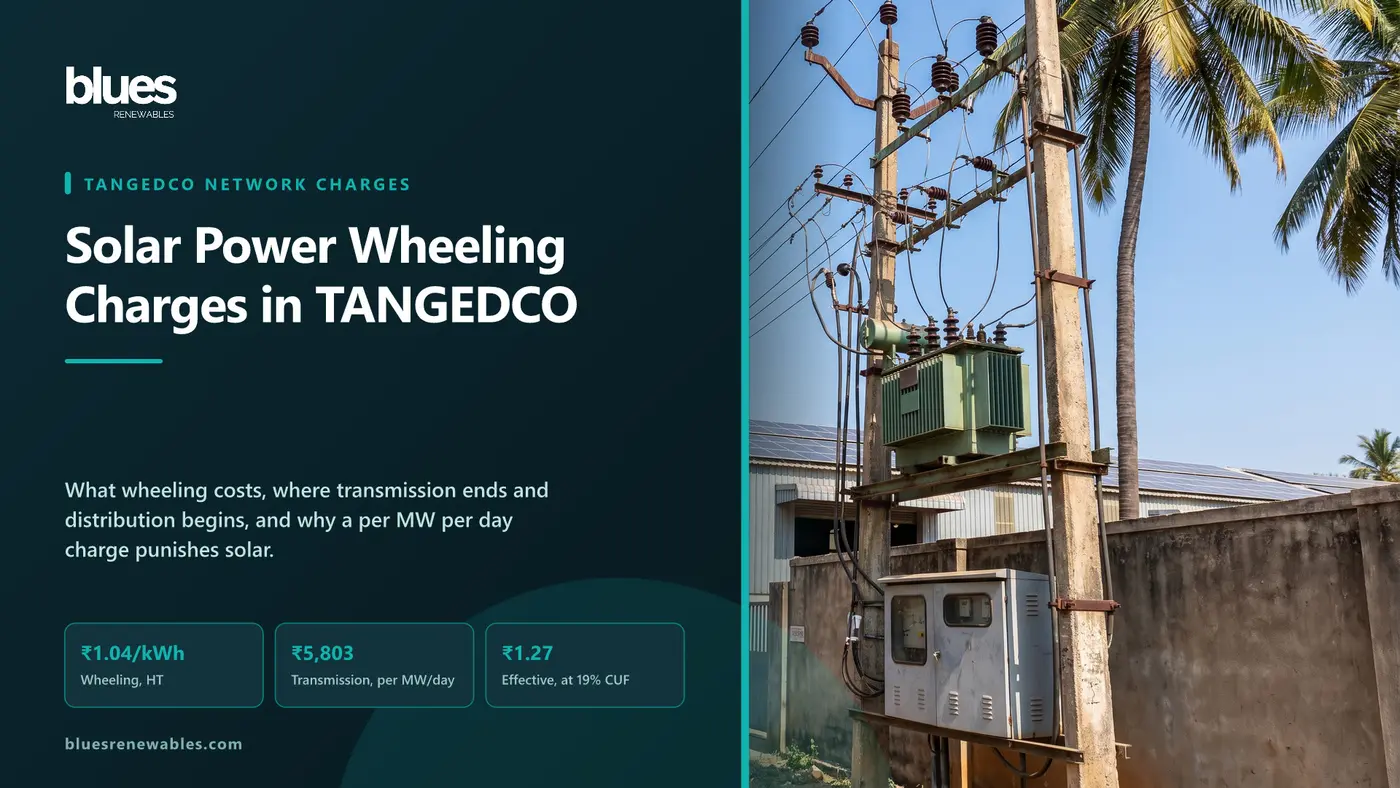
- TANGEDCO's wheeling charge is ₹1.04 per unit for HT consumers and ₹1.60 for LT in FY 2025-26, from TNERC Tariff Order No.6 of 2025.
- Wheeling pays for the distribution network. Transmission pays for TANTRANSCO's high-voltage grid, and they are separate charges with separate owners.
- Transmission is charged on capacity, not energy: ₹5,803.47 per MW per day for long-term access, or ₹241.81 per MW per hour for short term.
- That capacity basis penalises solar. At 19 percent capacity utilisation the transmission charge works out to about ₹1.27 per unit, more than the wheeling charge.
- TNERC applies a concession on both for intra-state renewable transactions. Inter-state and power exchange purchases do not qualify.
- Captive status does not exempt you. Wheeling and transmission are payable by every open access consumer, however the deal is structured.
What are solar power wheeling charges in TANGEDCO
Wheeling charges are what you pay the distribution licensee, TANGEDCO, now formally TNPDCL, for carrying electricity across its distribution network. The journey runs from the point where the transmission grid hands power over, to your own meter. For HT consumers in Tamil Nadu the rate sits at ₹1.04 per unit in FY 2025-26, set by TNERC in Tariff Order No.6 of 2025.
Why does the charge exist? Because the distribution network is a real asset with real costs. TNERC's order shows the working: an apportioned network cost for HT of ₹10,210.46 crore, divided by HT sales of 19,690 million units, gives ₹1.04. LT lands higher, at ₹1.60, since the low-voltage network costs more per unit delivered.
What wheeling charges mean on an electricity bill
The term works the same way outside Tamil Nadu, so it is worth stating plainly. Wheeling charges mean the fee for using somebody else's distribution wires to move electricity from where it is generated to where it is consumed. The name comes from the idea of wheeling power across a network you do not own.
On an electricity bill the charge shows up in two different ways. If you buy power from a source other than your distribution company, through open access, captive or group captive, the wheeling charge is billed to you separately for the use of the network. If you are an ordinary tariff consumer, the same cost is already inside your tariff rather than printed as a line of its own, which is why most domestic bills never name it.
Three things hold true in every state. It is charged per unit delivered, it is set by the state electricity regulator rather than negotiated, and it is payable whatever the commercial arrangement behind the power. Wheeling losses are a separate deduction on top of it, covered further down.
Wheeling and transmission are not the same charge
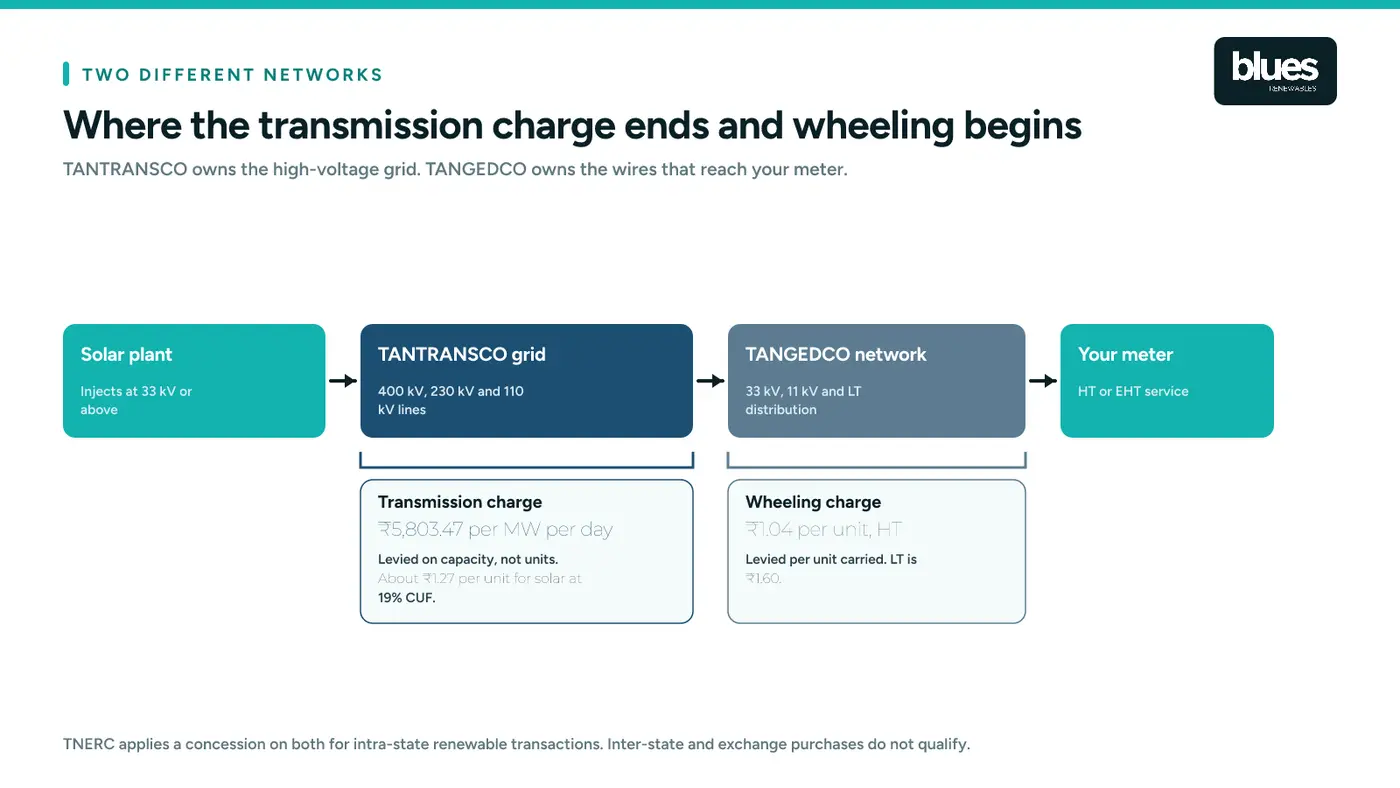
Power from a solar plant crosses two networks on its way to a factory.
TANTRANSCO's transmission network carries it at high voltage, 400 kV, 230 kV and 110 kV, from the generating station to a substation near the load. This is billed as a transmission charge.
TANGEDCO's distribution network takes it from that substation at 33 kV, 11 kV or LT to the consumer's meter. This is billed as a wheeling charge.
Both are payable. Neither is affected by whether the arrangement is third party, captive or group captive: the wires are used either way. This is the point most commonly missed when people say group captive "avoids the charges". It avoids the surcharges, which are a different thing entirely, covered in what cross subsidy in solar power means.
The current TANGEDCO and TANTRANSCO figures
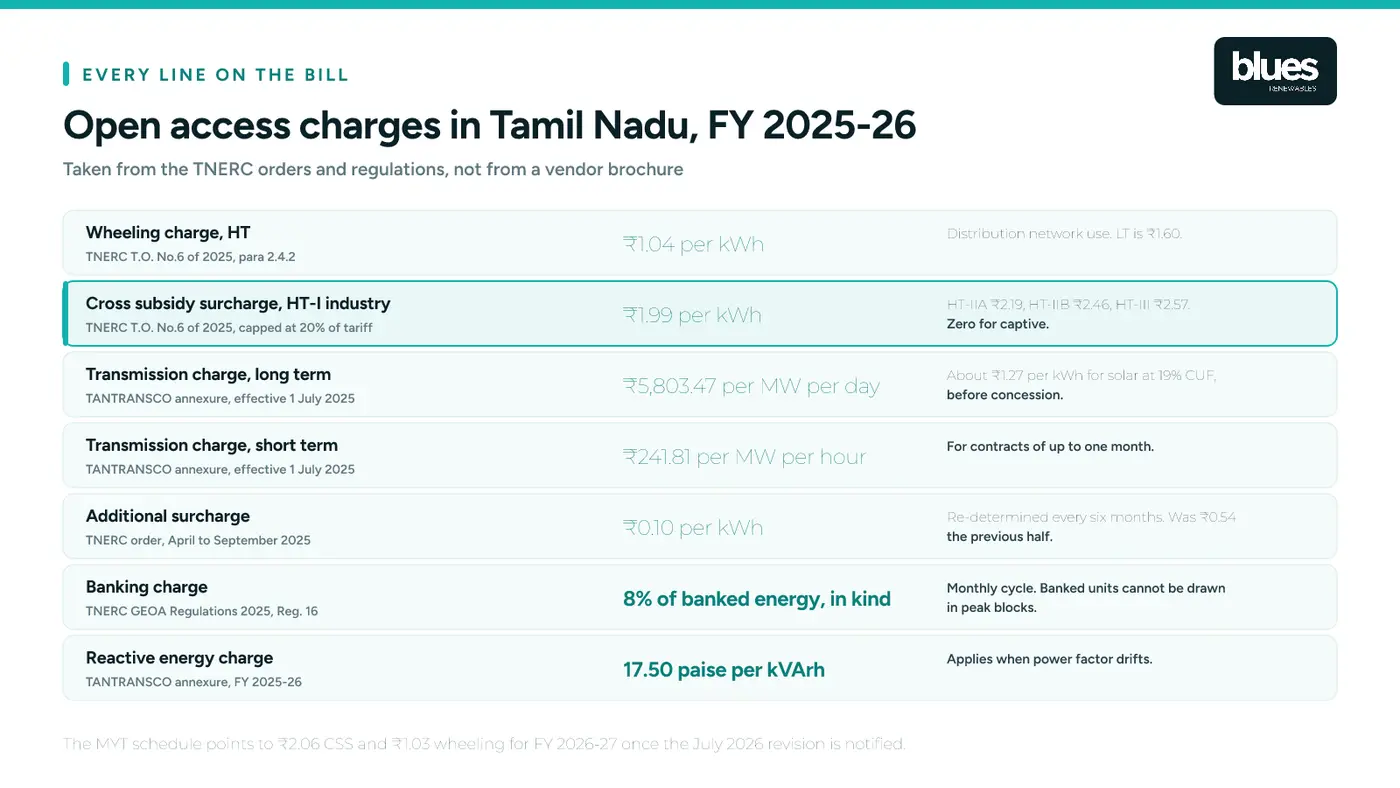
- Wheeling charge, HT - Rate, FY 2025-26: ₹1.04 per unit, Levied by: TANGEDCO, Basis: Per unit delivered
- Wheeling charge, LT - Rate, FY 2025-26: ₹1.60 per unit, Levied by: TANGEDCO, Basis: Per unit delivered
- Transmission charge, long term - Rate, FY 2025-26: ₹5,803.47 per MW per day, Levied by: TANTRANSCO, Basis: Per MW of contracted capacity
- Transmission charge, short term - Rate, FY 2025-26: ₹241.81 per MW per hour, Levied by: TANTRANSCO, Basis: Per MW per hour
- Reactive energy charge - Rate, FY 2025-26: 17.50 paise per kVArh, Levied by: TANTRANSCO, Basis: On reactive energy drawn
The multi-year schedule points to a wheeling charge of about ₹1.03 for FY 2026-27, a marginal reduction, once the July 2026 revision is notified.
Why the transmission charge hurts solar
This is the part that surprises finance teams reading their first open access model.
The transmission charge is levied on contracted capacity, at ₹5,803.47 per MW per day, regardless of how many units actually flow. A generator running around the clock spreads that charge across a great many units. Solar cannot. Generating for six or seven effective hours a day, it spreads the same charge across very few.
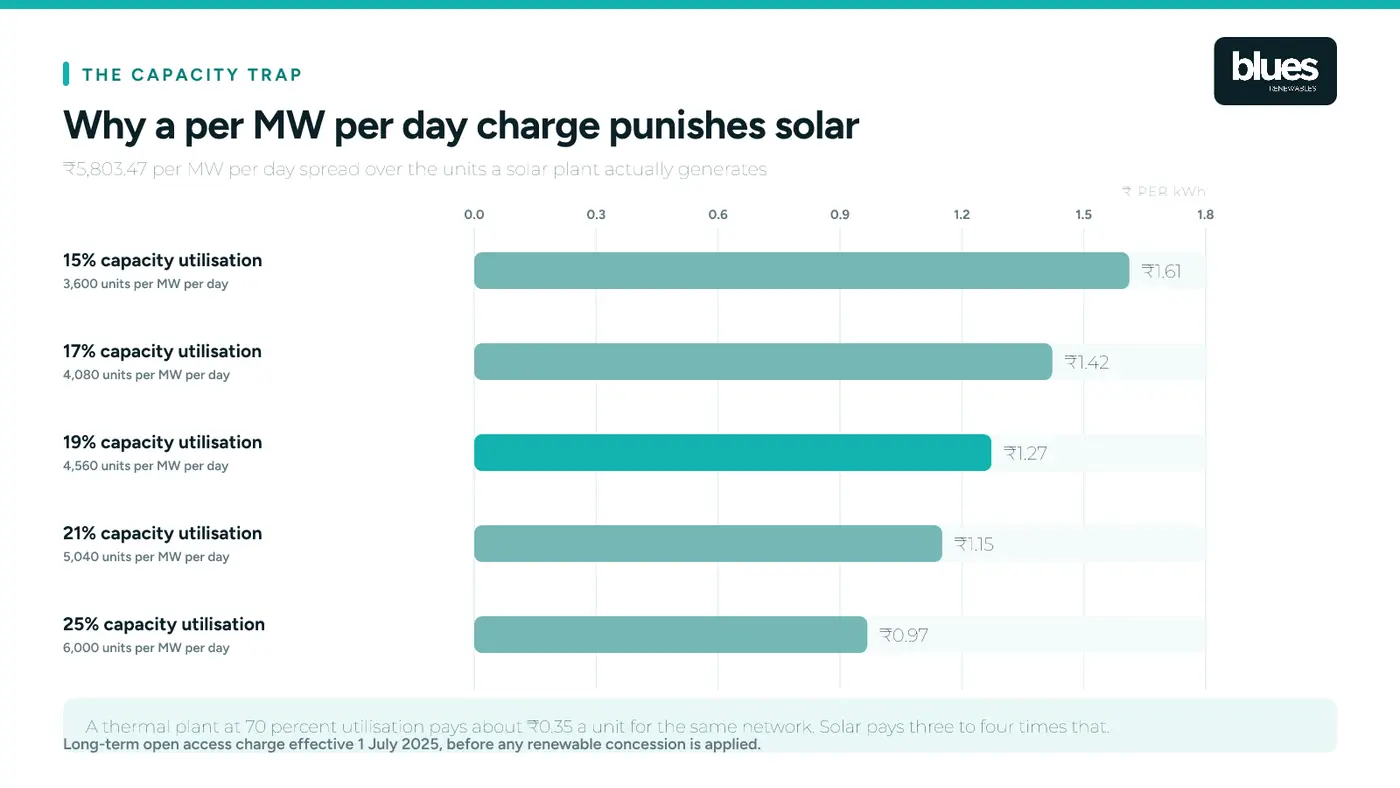
- 15 percent - Units per MW per day: 3,600, Transmission charge per unit: ₹1.61
- 17 percent - Units per MW per day: 4,080, Transmission charge per unit: ₹1.42
- 19 percent - Units per MW per day: 4,560, Transmission charge per unit: ₹1.27
- 21 percent - Units per MW per day: 5,040, Transmission charge per unit: ₹1.15
- 25 percent - Units per MW per day: 6,000, Transmission charge per unit: ₹0.97
At a realistic Tamil Nadu solar capacity utilisation of 19 percent, the transmission charge is about ₹1.27 per unit, more than the wheeling charge, even though the plant only uses the transmission network for part of the day. A thermal plant at 70 percent utilisation pays about ₹0.35 for exactly the same network.
Two practical consequences follow. First, do not accept a transmission charge quoted per unit without knowing what capacity utilisation it assumes. A model built on 25 percent will understate the charge by 30 paise against a realistic 19 percent. Second, the capacity you contract matters as much as the energy you buy. Contracting more transmission capacity than the plant can use is money spent on nothing.
The concession, and its limits
TNERC has historically softened these charges for renewables. Its solar tariff orders have applied a 50 percent concession on transmission, wheeling, and scheduling and system operation charges. Moreover, the Green Energy Open Access Regulations 2025 explicitly retain concessional transmission and wheeling charges.
The regulations attach one important condition. Regulation 15 provides that consumers receiving green energy "through interstate transaction / Power Exchange shall not be eligible for concessional transmission / wheeling charges for the use of intrastate transmission network / distribution network". The commission's stated reasoning is to promote renewable generation inside Tamil Nadu and to manage inter-state transmission corridor constraints.
In practical terms, a Tamil Nadu plant serving a Tamil Nadu consumer keeps a concession worth roughly ₹1.15 per unit against the same power bought from another state or through an exchange. That is a substantial structural advantage for building inside the state, and it is often larger than the tariff difference that tempts buyers to look outside it.
One caveat worth stating plainly: the concession is confirmed by the regulations, but the exact 50 percent figure comes from reporting of TNERC's solar orders rather than from the tariff order text itself. Confirm the current percentage against the applicable order before it goes into a financial model.
What else sits on the network bill
Beyond wheeling and transmission, Regulation 15 lists standby charges, applicable when a consumer cannot schedule contracted power and falls back on the utility, reactive energy charges where power factor drifts, and SLDC fees, scheduling and system operation charges and deviation settlement charges. Under the Green Energy Open Access Rules 2022, standby charges cannot exceed 10 percent of the energy charges applicable to the consumer's tariff category.
Energy losses are separate again and are deducted in kind rather than billed: transmission and wheeling losses are adjusted as per the relevant tariff order, and they typically remove several percent of what the plant injects before it reaches the meter. Rooftop systems at your own premises carry a different charge again; see network charges on rooftop solar in Tamil Nadu.
Frequently asked questions
What are solar power wheeling charges in TANGEDCO? ₹1.04 per unit for HT consumers and ₹1.60 for LT in FY 2025-26, set by TNERC in Tariff Order No.6 of 2025. It is what TANGEDCO charges for carrying power over its distribution network from the transmission handover point to your meter.
What is the difference between wheeling and transmission charges? Wheeling pays TANGEDCO for the distribution network, charged per unit. Transmission pays TANTRANSCO for the high-voltage grid, charged per MW of contracted capacity per day. Both apply to an open access transaction.
How much is the TANTRANSCO transmission charge? ₹5,803.47 per MW per day for long-term open access and ₹241.81 per MW per hour for short-term, effective 1 July 2025. For a solar plant at 19 percent capacity utilisation the long-term charge works out to about ₹1.27 per unit.
Do captive or group captive consumers pay wheeling charges? Yes. Captive status exempts a consumer from the cross subsidy surcharge and the additional surcharge, not from wheeling or transmission. Those are payable by every open access consumer because the wires are used either way.
Is there a concession on wheeling charges for solar? Yes, for intra-state renewable transactions. TNERC's solar orders have applied a concession on transmission, wheeling and scheduling charges, and the 2025 regulations retain it. Power bought from another state or through a power exchange does not qualify.
Does rooftop solar attract wheeling charges? No. A rooftop system under net metering does not move power between sites over the utility's network, so no wheeling or transmission charges arise. This is one of the main reasons rooftop is cheaper per unit than open access.
Will wheeling charges go up? The multi-year schedule points to ₹1.03 for FY 2026-27, marginally lower than the current ₹1.04. Wheeling charges track network cost and HT sales volumes, so they move slowly compared with surcharges, which can change every six months.
Where this fits
Nobody escapes wheeling and transmission. Even so, for a third-party buyer they are the smaller half of the problem, because the cross subsidy surcharge runs to nearly twice the wheeling charge.
For the whole framework, read what open access solar is. To see which charge you can legally avoid, read what a captive solar power plant is. And if your own roof can carry the load, none of these charges arise at all, which is where most of the factories we work with start, under industrial solar in Chennai.
Blues Renewables has installed solar across Chennai since 2020. Because solar power wheeling charges in TANGEDCO depend on your voltage level and contracted capacity, we model them against your own connection rather than quoting a generic per unit figure.
Call +91 98841 07170 to see your solar power wheeling charges in TANGEDCO priced against your contracted demand.
Sources
- Tamil Nadu Electricity Regulatory Commission, Tariff Order No.6 of 2025 dated 30 June 2025, paragraph 2.4.2, approved wheeling and network charges for FY 2025-26
- TANTRANSCO, Annexure on transmission charges to be collected from 1 July 2025, LTOA and STOA charges and reactive energy charges
- TNERC, Terms and Conditions for Green Energy Open Access Regulations 2025, Regulation 15
- Ministry of Power, Electricity (Promoting Renewable Energy Through Green Energy Open Access) Rules 2022, standby charge cap