What Is a Captive Solar Power Plant? The 26 and 51 Percent Rules
Learn what a captive solar power plant is, how the 26 and 51 percent tests work, and discover why captive status saves about ₹2.09 per unit in Tamil Nadu.


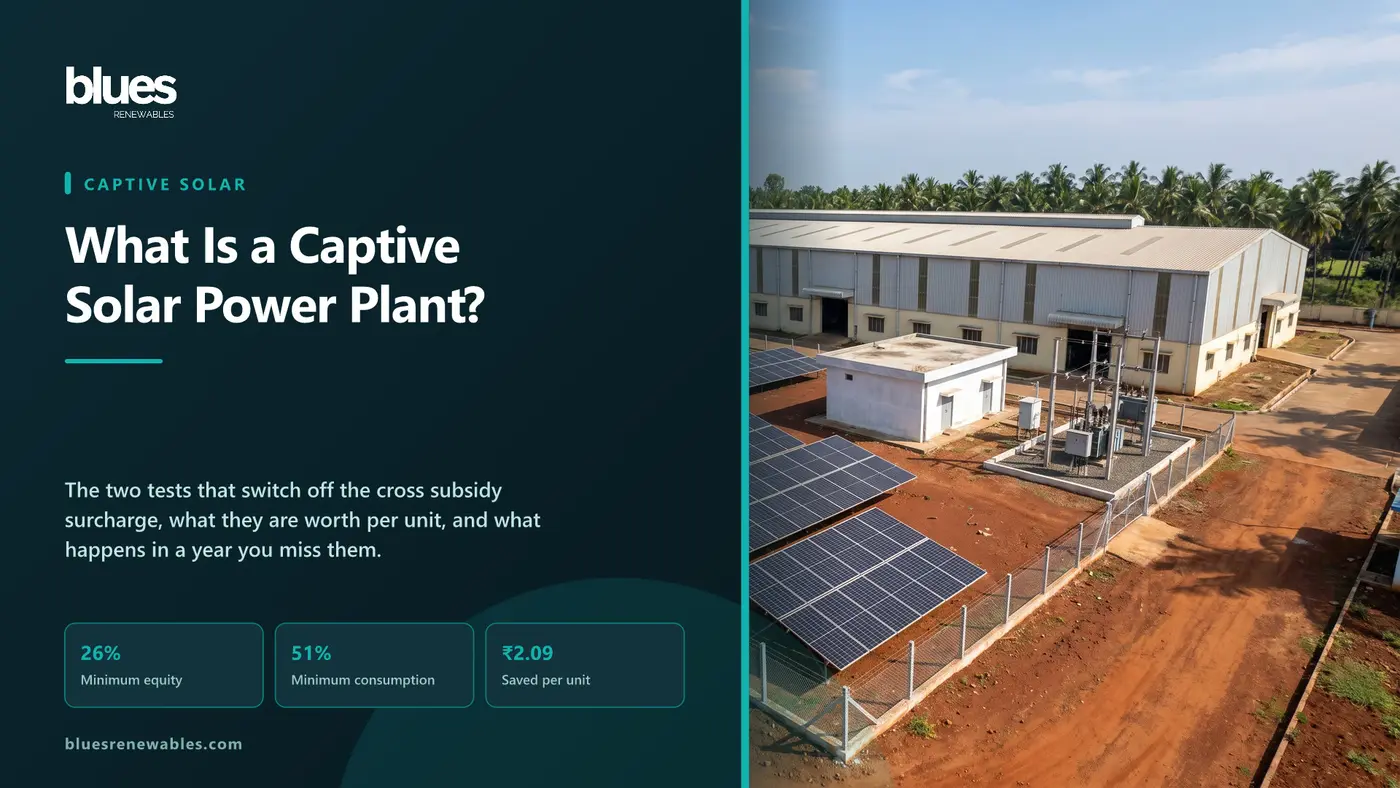
One line in the Electricity Rules 2005 is worth roughly ₹2 a unit to an Indian factory. It decides when a power plant counts as your own rather than someone else's, and it turns on just two numbers: 26 and 51.
Clear both and a captive solar power plant carries no cross subsidy surcharge and no additional surcharge. Miss either, even for a single financial year, and the regulator treats the whole year's generation as non-captive. The surcharge then lands on all of it, retrospectively.
So the stakes are asymmetric, and worth understanding properly. This guide covers what the two tests require, what captive status is actually worth per unit, what causes plants to fail, and when the structure is not worth its complexity.
Key takeaways
- A captive solar power plant is one where the consuming entities hold at least 26 percent of the equity and consume at least 51 percent of the electricity generated, under Rule 3 of the Electricity Rules 2005.
- Both tests must be met in every financial year. They are annual, not one-time.
- Captive status exempts the consumption from cross subsidy surcharge and additional surcharge, worth about ₹2.09 per unit in Tamil Nadu at current rates.
- It does not exempt wheeling or transmission charges, which are payable by every open access consumer.
- Section 9 of the Electricity Act gives a captive plant an automatic right of open access, with no minimum load threshold.
- Failing either test converts the entire year's generation to non-captive, and the surcharge applies to all of it.
What is a captive solar power plant
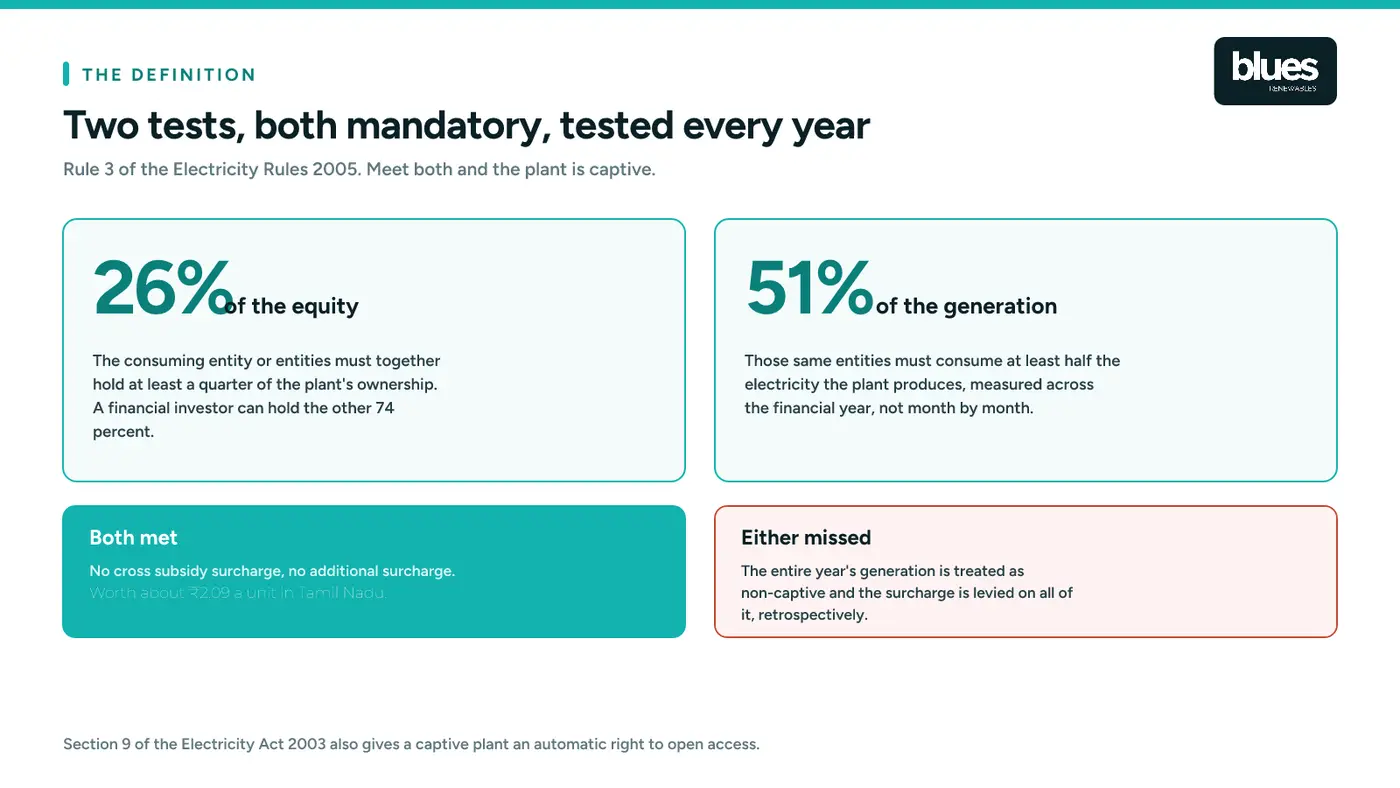
A captive generating plant is one set up primarily to supply electricity to the person or persons who own it. For solar, that means a plant whose output goes to its own shareholders rather than being sold on the open market. The legal definition is in Rule 3 of the Electricity Rules 2005, and it has two requirements that must both be satisfied in each financial year.
The 26 percent ownership test
Together, the consuming entities must hold not less than 26 percent of the ownership of the plant. This threshold is what makes captive structures financially accessible, because no company has to fund a whole solar plant to earn captive treatment. Just over a quarter will do, while a financial investor or developer holds the remaining 74 percent.
Consider a 5 MW plant costing around ₹20 crore. A 26 percent stake works out at roughly ₹5.2 crore, spread across however many consumers participate. That is a very different proposition from funding the entire plant.
The 51 percent consumption test
Those same entities must also consume not less than 51 percent of the electricity generated, measured across the year. Selling the remaining 49 percent to the grid or to others is fine, provided the majority of output reaches its owners.
That word "annual" carries weight. A month of low production during the monsoon, or a plant shutdown, does not break captive status on its own. Falling below 51 percent across the full financial year does.
What captive status is worth
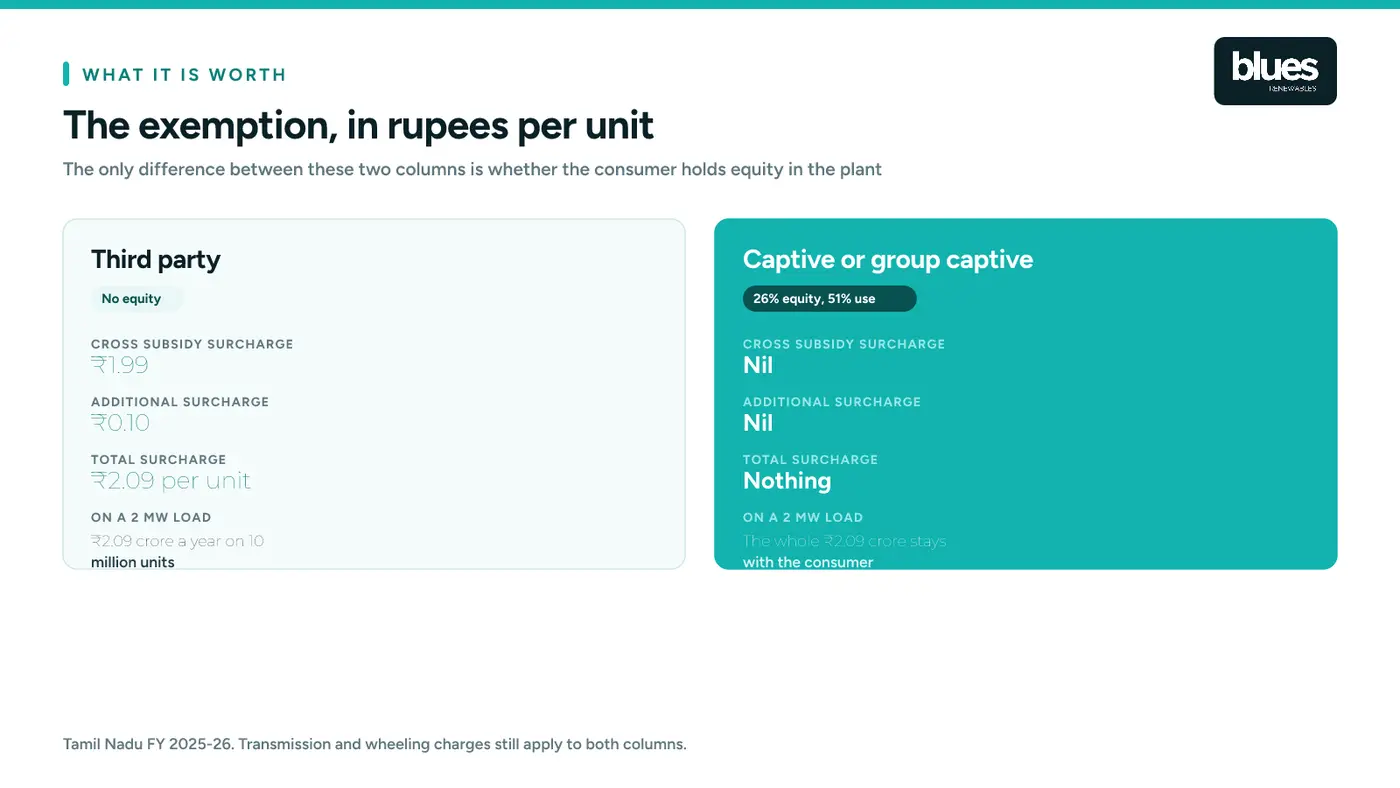
A captive consumer is exempt from the cross subsidy surcharge and the additional surcharge. In Tamil Nadu in FY 2025-26 that is ₹1.99 plus ₹0.10, about ₹2.09 per unit.
On a 2 MW load consuming 10 million units a year, that is ₹2.09 crore a year. Over a 25-year plant life, before any escalation, it is well over ₹50 crore. This is the entire economic case for holding equity rather than signing a power purchase agreement.
- Cross subsidy surcharge - Third party: ₹1.99, Captive: Nil
- Additional surcharge - Third party: ₹0.10, Captive: Nil
- Wheeling charge - Third party: ₹1.04 before concession, Captive: ₹1.04 before concession
- Transmission charge - Third party: Payable, Captive: Payable
Note what is not exempt. Wheeling and transmission charges apply either way, because the power still crosses TANGEDCO's and TANTRANSCO's networks. Those are covered in solar power wheeling charges in TANGEDCO.
Captive status also carries a procedural benefit. Section 9 of the Electricity Act 2003 grants anyone who has built a captive generating plant a right to open access. On top of that, the Green Energy Open Access Rules 2022 impose no minimum load on captive consumers at all, while other consumers face a 100 kW national floor and 63 kVA in Tamil Nadu.
What happens if you fail the test
This is where captive structures go wrong, and the consequence is severe enough to design around.
If the consuming entities fail to consume 51 percent of the plant's generation in a financial year, the entire year's generation is treated as non-captive. The cross subsidy surcharge is then levied on all of it, retrospectively. It is not pro-rated, and it is not limited to the shortfall.
Consider a 5 MW plant generating around 80 lakh units a year in Tamil Nadu. A surcharge of ₹1.99 across the whole year's output produces a bill near ₹1.6 crore. Worse, it arrives after the fact, for a year already closed in the accounts.
Three things cause it in practice:
- A production slowdown at one of the consuming units, so consumption drops while generation carries on.
- A plant performing better than modelled, which sounds like good news yet raises the 51 percent bar in absolute terms.
- A change in the consuming entity, through merger, sale or restructuring, that disturbs the ownership side of the test.
The defence is to design with margin. Structure for 60 percent consumption rather than 51, monitor monthly rather than annually, and build take-or-pay obligations into the shareholder agreement so no single member's shortfall can put everyone's status at risk.
Captive by one company, or by several
A captive plant can be owned by a single consumer or by a group. Where several consumers participate, usually through a special purpose vehicle, it is called group captive, and an additional rule applies: each member must consume in proportion to its shareholding, within a permitted variation of 10 percent.
Group captive is how most commercial and industrial open access solar in Tamil Nadu is actually built, because it lets a mid-sized factory access the exemption without funding 26 percent of a large plant alone. The proportionality mechanics, and who is allowed to draw power from such a plant, are covered in who can use power from a group captive solar plant.
When captive is not the right answer
Captive structures involve equity on your balance sheet, a shareholder agreement, an annual compliance test and a 25-year commitment. Three situations argue against them.
Your roof can carry the load. A rooftop system attracts none of these charges and needs none of this structure. Only when the roof runs out does open access arithmetic begin.
You want the asset off the balance sheet. A RESCO or OPEX arrangement lets a developer own and operate a system on your own roof while you buy the units, with no equity and no captive test. The comparison is in CAPEX vs OPEX and RESCO solar.
Your consumption is uncertain. If your load might halve in three years, the 51 percent test becomes a liability rather than a benefit.
Frequently asked questions
What is a captive solar power plant? A solar plant where the consuming entities hold at least 26 percent of the ownership and consume at least 51 percent of the electricity generated, measured in each financial year, under Rule 3 of the Electricity Rules 2005. Its consumption is exempt from cross subsidy surcharge and additional surcharge.
What is the 26 51 rule for captive power? It is the two-part test defining captive status: 26 percent minimum ownership by the consuming entities and 51 percent minimum consumption of the plant's annual generation. Both must be satisfied together, every year.
What is captive power generation? Generating electricity for your own consumption rather than for sale. A captive power plant is one whose output its owner uses, and under the Electricity Rules 2005 it counts as captive only where the consumer holds at least 26 percent of the ownership and consumes at least 51 percent of the annual generation. Solar is one fuel such a plant can run on; the same rules cover diesel, gas and wind.
What are the benefits of a captive solar power plant? Exemption from cross subsidy surcharge and additional surcharge, worth about ₹2.09 per unit in Tamil Nadu, plus an automatic right of open access under Section 9 of the Electricity Act with no minimum load threshold.
Does a captive plant pay wheeling charges? Yes. Captive status exempts the surcharges only. Wheeling and transmission charges apply to every open access consumer because the power still uses the utility's network.
What happens if a captive plant fails the 51 percent test? The entire year's generation is treated as non-captive and the cross subsidy surcharge is levied on all of it, retrospectively. It is not pro-rated to the shortfall.
Can a captive solar plant be located away from the factory? Yes. That is the normal arrangement. The plant is sited where land and solar resource are good, and the power is delivered through open access. Captive status depends on ownership and consumption, not on physical proximity.
Is there a minimum size for a captive solar plant? There is no regulatory minimum load for captive consumers under the Green Energy Open Access Rules 2022. In practice, the cost of the SPV, agreements and compliance means captive structures rarely make sense below about 1 MW of consumption.
Where this fits
Captive answers the obvious question the cross subsidy surcharge raises: can you avoid it legally? You can. The mechanism is structural rather than clever.
To understand the surcharge itself, read what cross subsidy in solar power means. For the wider framework, read what open access solar is.
Blues Renewables has installed solar across Chennai since 2020, for homes, schools, businesses and factories. For an industrial buyer we always start with the roof, then model whether a captive solar power plant earns its complexity against your actual consumption. Sometimes it clearly does. Often the roof gets you most of the way there first, as we set out under industrial solar in Chennai.
Call +91 98841 07170 to find out whether a captive solar power plant fits your load, and what it would save.
Sources
- Electricity Rules 2005, Rule 3, definition of captive generating plant
- Electricity Act 2003, Sections 9 and 42
- Tamil Nadu Electricity Regulatory Commission, Tariff Order No.6 of 2025 dated 30 June 2025
- TNERC orders on additional surcharge for open access consumers, April 2025
- Ministry of Power, Electricity (Promoting Renewable Energy Through Green Energy Open Access) Rules 2022