Who Can Use Power From a Group Captive Solar Plant? Rules Explained
Only shareholders can use the power. A buyer with no equity is a third party whatever the contract says, and the 26 and 51 percent tests must both hold.



Only shareholders. That is the short answer to who can use power from a group captive solar plant, and it surprises a lot of businesses hoping to simply sign up as a customer.
A group captive plant is not a club you buy power from. Instead it is a company you must own part of, and your share of the electricity tracks the size of your stake.
That constraint is the entire point. It makes the arrangement captive rather than a sale, which is precisely why the cross subsidy surcharge falls away. Draw power without equity and you are a third-party buyer whatever the contract calls you, paying the surcharge in full.
Below you will find how the SPV is put together, how much equity you actually need, how the proportionality rule works with a worked example, and what happens to everyone else when one member falls short.
Key takeaways
- Only shareholders in the plant can consume its power on a captive basis. A consumer with no equity is a third-party buyer regardless of contract wording.
- The consuming shareholders must together hold at least 26 percent of the equity and consume at least 51 percent of the annual generation. A developer or investor typically holds the remaining 74 percent.
- Each member must consume in proportion to its shareholding, within a variation of 10 percent either side.
- The tests are annual and collective. One member's shortfall can put the whole plant's captive status at risk, which is why shareholder agreements carry take-or-pay obligations.
- Group captive is the dominant structure for C&I solar in Tamil Nadu because the surcharge exemption is worth about ₹2.09 per unit.
- Failing the test converts the whole year's generation to non-captive, with the surcharge levied retrospectively on all of it.
Who can use power from a group captive solar plant
Power from a group captive solar plant may be used only by the entities that hold equity in the plant, in proportion to their shareholding. The arrangement is governed by Rule 3 of the Electricity Rules 2005, which requires the consuming entities to hold at least 26 percent of the plant's ownership and to consume at least 51 percent of the electricity it generates, with each member consuming in proportion to its share.
A business that wants power from such a plant therefore has one route: buy into it. There is no arrangement under which a non-shareholder draws captive power.
How the structure is put together
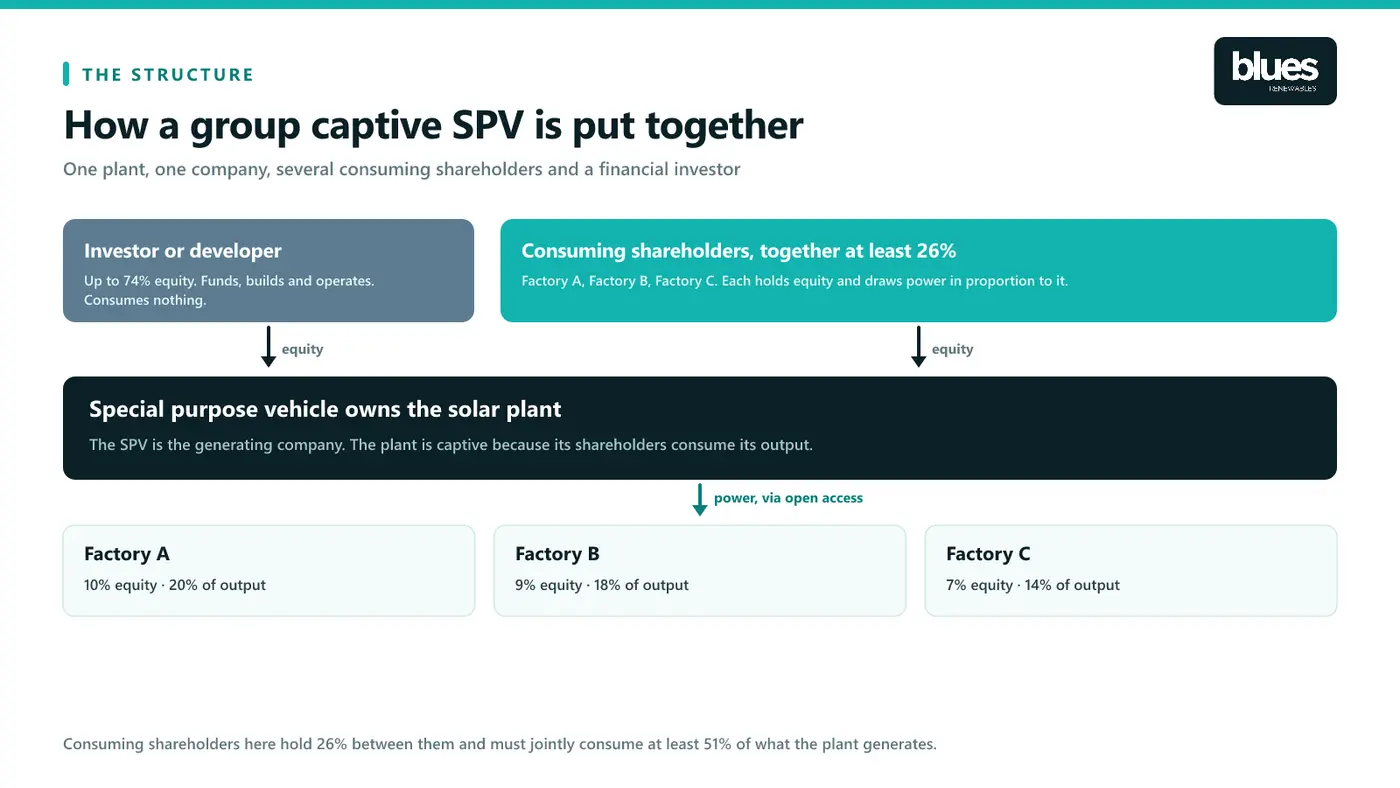
Almost always, a group captive plant sits inside a special purpose vehicle, a company formed specifically to own and operate it.
The investor or developer takes up to 74 percent of the SPV's equity. It funds the bulk of the project, builds it, then operates and maintains it, while consuming none of the power itself.
The consuming shareholders take at least 26 percent between them. These are the factories, hospitals, hotels or commercial buildings that will actually use the electricity. Each holds a slice sized to the consumption it wants.
The SPV is the generating company. Its plant is captive because its own shareholders consume its output. The power reaches each consumer through open access over TANTRANSCO's and TANGEDCO's networks, and each consumer pays wheeling and transmission charges on it, as covered in solar power wheeling charges in TANGEDCO.
This is why a mid-sized factory can participate at all. Rather than funding a 26 percent stake in a whole plant alone, it takes a stake sized to its own consumption, alongside other consumers doing exactly the same.
The proportionality rule
The 26 and 51 percent tests are collective. Layered on top is a rule that stops members free-riding on each other.
For a plant held by an association of persons, each member must consume the plant's output in proportion to its shareholding, within a permitted variation not exceeding ten percent.
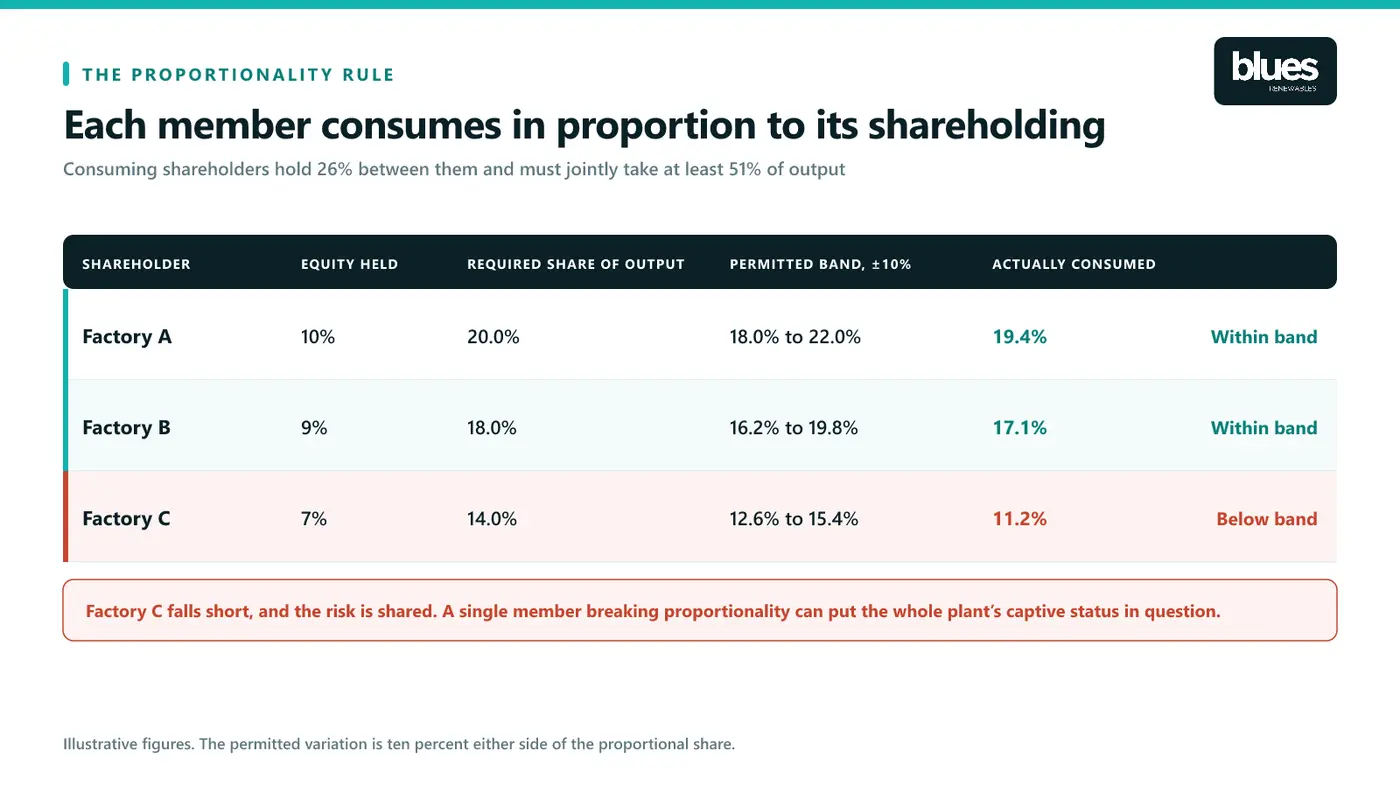
Take a plant where consuming shareholders hold 26 percent between them and must jointly consume 52 percent of output. Say Factory A holds 10 percentage points of that equity. Its proportional share of output is therefore twice its equity share, or 20 percent, and it must land between 18.0 and 22.0 percent.
- Factory A - Equity held: 10%, Required share of output: 20.0%, Permitted band: 18.0% to 22.0%, Actual: 19.4%, Outcome: Within band
- Factory B - Equity held: 9%, Required share of output: 18.0%, Permitted band: 16.2% to 19.8%, Actual: 17.1%, Outcome: Within band
- Factory C - Equity held: 7%, Required share of output: 14.0%, Permitted band: 12.6% to 15.4%, Actual: 11.2%, Outcome: Below band
Factory C has fallen short. Does that jeopardise only its own captive treatment, or the whole plant's status? Courts have wrestled with the question, and the answer turns partly on whether an association of persons or a company-form SPV holds the plant.
In 2021, APTEL held that an SPV is not an association of persons, so the proportionality requirement applies to associations rather than to SPV shareholders. Draft amendments would extend proportionality to all captive generators, including SPVs, but they have not come into force.
The prudent assumption when structuring is that proportionality applies. Design for it and be wrong, and you end up with a slightly conservative allocation. Assume it away and be wrong, however, and you face a retrospective surcharge on a full year of generation.
What happens when a member falls short
If the consuming shareholders together fail the 51 percent test in a financial year, the entire year's generation is treated as non-captive and the cross subsidy surcharge is levied on all of it, retrospectively.
For a 5 MW plant generating around 80 lakh units a year in Tamil Nadu, that is a bill in the region of ₹1.6 crore for a year already closed. The exposure is shared, which is what makes the shareholder agreement the most important document in the arrangement.
Three provisions do the real work in a well-drafted agreement.
- Take-or-pay obligations, so a member consuming below its band still pays as though it had.
- Monthly monitoring and reporting, so any drift shows up in month three rather than month twelve.
- Reallocation rights, so when one member's consumption drops, the others can absorb the slack and keep the collective test satisfied.
Design for headroom as well. Structuring for 60 percent collective consumption, rather than the bare 51 percent, leaves room for a slow quarter without breaching anything.
What it is worth
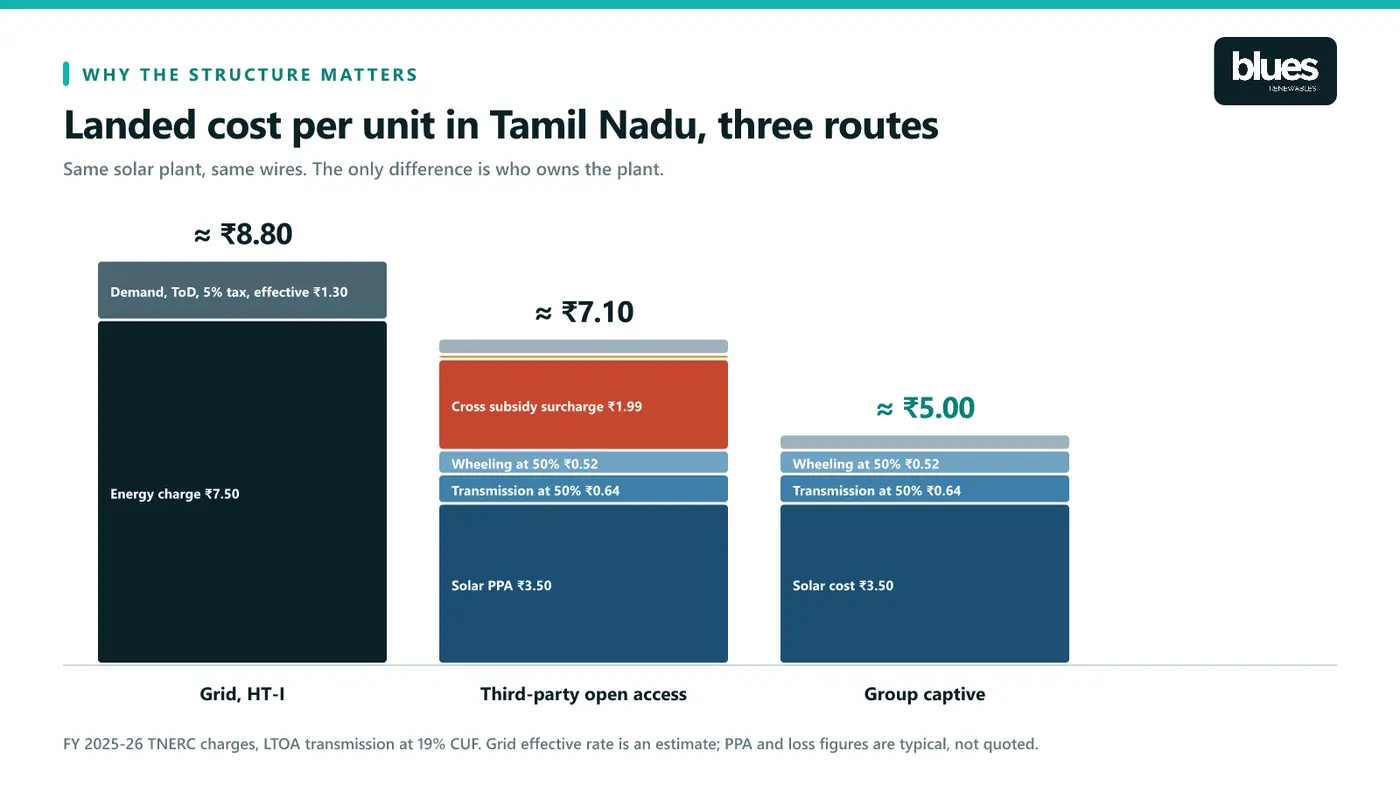
The exemption from cross subsidy surcharge and additional surcharge is worth about ₹2.09 per unit in Tamil Nadu at FY 2025-26 rates. Modelled against the alternatives, using the same solar tariff and the same network charges:
- Grid supply, HT-I - Indicative landed cost: ₹8.50 to ₹9.50
- Third-party open access - Indicative landed cost: about ₹7.10
- Group captive - Indicative landed cost: about ₹5.00
The entire gap between the second and third rows is the surcharge. Nothing else differs: same plant, same wires, same tariff.
Who should not join one
Group captive suits a business with stable, predictable consumption, a load too large for its own roof, and the appetite to hold equity for 25 years.
It suits three situations far less well. Where consumption might change materially, the 51 percent test turns from benefit into liability. Where you want the asset off your balance sheet, a RESCO or OPEX arrangement on your own roof works better, as compared in CAPEX vs OPEX and RESCO solar. And where your roof could carry most of the load anyway, a rooftop system attracts none of these charges and none of this structure.
Frequently asked questions
Who can use power from a group captive solar plant? Only the entities holding equity in the plant, and each in proportion to its shareholding. The consuming shareholders must together hold at least 26 percent of the plant and consume at least 51 percent of its annual generation. A consumer without equity is a third-party buyer and pays the full cross subsidy surcharge.
Can I buy power from a group captive plant without investing in it? Not on a captive basis. You would be a third-party purchaser, paying the cross subsidy surcharge and additional surcharge, about ₹2.09 per unit in Tamil Nadu. The exemption exists precisely because captive consumers own the plant.
How much equity do I need in a group captive plant? Enough that the consuming shareholders together hold at least 26 percent, and enough that your own share is proportional to the power you intend to draw within a 10 percent band. In practice your stake is sized to your consumption rather than chosen independently.
What is the proportionality rule in group captive? Each member must consume the plant's output in proportion to its shareholding, within a permitted variation of ten percent either way. A member holding twice another member's equity is expected to consume roughly twice as much.
What happens if one member does not consume its share? If the collective 51 percent test fails, the entire year's generation is treated as non-captive and the surcharge is levied on all of it retrospectively. Well-drafted shareholder agreements manage this with take-or-pay obligations and reallocation rights.
Is group captive better than a third-party PPA? In Tamil Nadu, usually yes, because the surcharge exemption is worth about ₹2.09 per unit against a third-party structure. It costs more in complexity, equity and compliance. In states with low cross subsidy surcharge the gap narrows considerably.
Can a group captive plant be in a different district or state? A different district within the state is normal. A different state is possible but loses the concessional intra-state transmission and wheeling charges under TNERC's regulations, which is a material disadvantage in Tamil Nadu.
What is the group captive policy in India? It is not a scheme you apply to. The rules sit in the Electricity Rules 2005: users must together hold at least 26 percent of the equity in the generating company and consume at least 51 percent of the electricity in proportion to their shareholding. Meet both and the cross subsidy surcharge falls away. Miss either in a financial year and it applies to that whole year's generation.
Where this fits
Group captive is simply the multi-consumer version of a captive plant. For the underlying definition and the two tests, read what a captive solar power plant is. For the surcharge it avoids, read what cross subsidy in solar power means. For the framework it sits inside, read what open access solar is.
Blues Renewables has installed solar across Chennai since 2020, for homes, schools, businesses and factories. We start with your roof, because those units carry no charges at all. Then, if your load runs beyond what the roof can cover, we model whether joining a group captive solar plant is worth its complexity, and how much equity your consumption would actually justify. What to look for in a partner is covered under solar EPC companies in Chennai.
Call +91 98841 07170 to find out whether you could use power from a group captive solar plant, and how much equity your load would justify.
Sources
- Electricity Rules 2005, Rule 3, definition of captive generating plant and the proportionality requirement for associations of persons
- Electricity Act 2003, Sections 9 and 42
- Appellate Tribunal for Electricity, 2021 decision on the application of proportionality to special purpose vehicles
- Tamil Nadu Electricity Regulatory Commission, Tariff Order No.6 of 2025 dated 30 June 2025
- TNERC, Terms and Conditions for Green Energy Open Access Regulations 2025