TNEB Solar CFA vs Non-CFA: Which Application Route Should You Choose?
CFA is the subsidy route on the TNEB solar portal, non-CFA is the direct route with no subsidy. Who must use which, what differs, and how to decide.

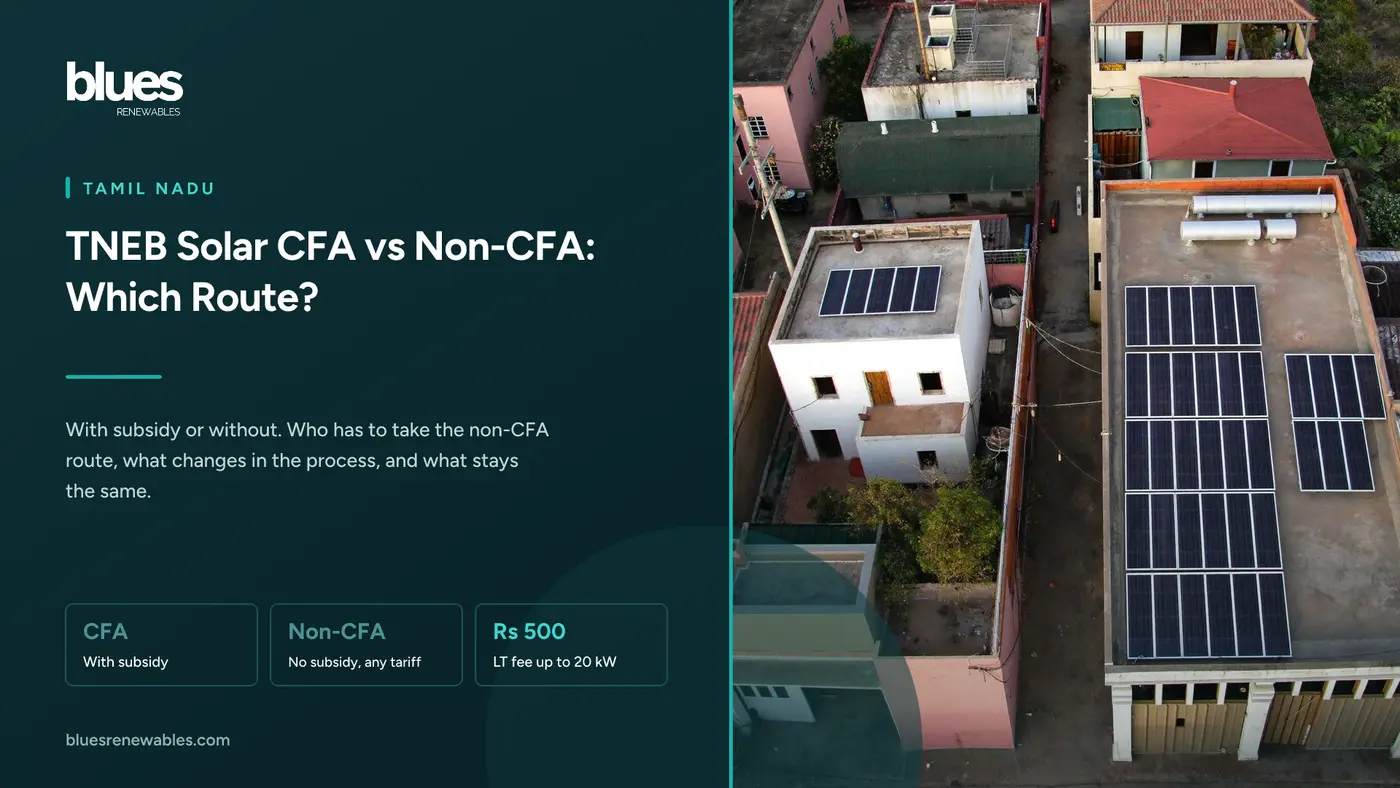
Open the TNEB solar portal and the first decision is not the panel or the installer. It is a menu choice: apply with subsidy, or without. Older TANGEDCO circulars call the two buttons CFA and non-CFA.
CFA stands for Central Financial Assistance, the central subsidy now paid through PM Surya Ghar: Muft Bijli Yojana. On a 3 kW home it is worth ₹78,000, and since September 2026 Tamil Nadu adds ₹22,000 on top, so the CFA route can return ₹1,00,000. The non-CFA route returns nothing, but it is open to every tariff, accepts non-DCR modules and skips the national portal.
For a home of 1 to 5 kW the subsidy wins easily. For a business there is no choice at all. For larger homes the arithmetic is closer than it looks.
Key takeaways
- CFA means subsidy, non-CFA means none. Both routes end in the same DISCOM inspection and the same bi-directional meter.
- Only homes and housing societies can take CFA. Shops, offices, schools, factories and every HT consumer apply non-CFA.
- CFA is worth up to ₹1,00,000 on a home in 2026: ₹78,000 central plus a ₹22,000 state top-up that is paid only on the CFA route.
- CFA carries conditions: a national PM Surya Ghar portal application first, a vendor registered there, DCR modules, and ownership of the system.
- Non-CFA is a direct application on the TNPDCL portal with your consumer number, at a registration fee of ₹500 for LT systems up to 20 kW.
- Treat the choice as final. We have found no provision to claim CFA later for a system commissioned without it.
What CFA and non-CFA mean on the TNEB solar portal
Tamil Nadu's distribution utility, TANGEDCO until the 2024 restructuring and now the Tamil Nadu Power Distribution Corporation (TNPDCL), takes every grid-connected rooftop application through its Unified Solar Rooftop Portal (USRP), subsidised or not. Both names still appear on bills and forms.
The Central Financial Assistance comes from the Ministry of New and Renewable Energy (MNRE). A December 2021 TANGEDCO circular told LT consumers to click "Apply Online - CFA" to apply with subsidy and "Apply Online - Non-CFA" to apply without it. Today's portal words the same options as "Apply for Solar rooftop (with subsidy)" and "Apply for other than PMSGY Scheme (With out Subsidy for all Tariff)". The labels changed; the CFA and non-CFA split did not.
Who has to use which route
The CFA route is for:
- Homes on a domestic tariff that own the system, use DCR modules and install through a vendor registered on the national portal. Coverage runs to 10 kW, with the subsidy capped at 3 kW worth. Our PM Surya Ghar eligibility guide covers the detail.
- Group housing societies and RWAs, for common facilities, at ₹18,000 per kW up to 500 kW. The portal lists these as "Domestic Common services". See solar for apartments in Chennai.
The non-CFA route is for:
- Every non-domestic LT consumer: shops, offices, schools, clinics and workshops, up to sanctioned load and 150 kW on an LT service. See the solar capacity limit in Tamil Nadu.
- HT consumers such as larger factories, who apply online to their circle Superintending Engineer. Businesses get no capital subsidy but can claim accelerated depreciation.
- Homes that already took a solar subsidy, which PM Surya Ghar excludes.
- Homes installing more than 10 kW.
- Homes using non-DCR modules, or an installer not registered on the national portal.
- Homes on a lease or RESCO arrangement, where the developer owns the plant.
Adding capacity has its own portal option, "Apply for Solar Additional Load". We could not confirm officially whether a home that took CFA on 1 or 2 kW can claim more for added capacity up to the 3 kW cap, so plan an expansion as unsubsidised unless your section office says otherwise.
How the two processes differ
The real CFA vs non-CFA difference is how many systems your application passes through.
On the CFA route, you register on pmsuryaghar.gov.in, generate a TNPDCL reference number against that registration on the USRP, submit the scheme application and pay the charges. Later you upload the DCR undertaking, vendor agreement and site photos. The CFA reaches your bank 30 to 45 days after commissioning; it is never deducted from the invoice. Our PM Surya Ghar subsidy guide walks through each step.
On the non-CFA route, you go straight to the USRP, enter your consumer number with region code and confirm an OTP. The portal FAQ lists two documents, a bill receipt and an applicant photo. There is no national portal account, no DCR undertaking and no subsidy claim.
What stays the same either way:
- Feasibility: waived up to 3 kW, done by the DISCOM above that.
- Inspection: by the utility's engineer up to 10 kW, and by the Chief Electrical Inspector (CEIG) above 10 kW.
- Metering: set by your tariff, not your route. Domestic consumers get net metering, settled annually; other LT consumers get net feed-in at a tariff TNERC fixes. See the TANGEDCO net metering application.
Non-DCR does not mean unlisted. MNRE has stated that rooftop systems outside PM Surya Ghar remain under its approved list of models and manufacturers (ALMM), so ask for listed modules on a non-CFA system too.
CFA vs non-CFA at a glance
- Who can use it - CFA (with subsidy): Domestic consumers up to 10 kW; housing societies for common facilities, Non-CFA (without subsidy): Every tariff, including commercial, industrial and HT
- Subsidy - CFA (with subsidy): ₹30,000 for 1 kW, ₹60,000 for 2 kW, ₹78,000 at 3 kW and above, plus the state top-up of up to ₹22,000, Non-CFA (without subsidy): None
- Vendor rule - CFA (with subsidy): Vendor registered on the PM Surya Ghar national portal, Non-CFA (without subsidy): No scheme registration rule; installation must still meet safety and inspection standards
- Modules - CFA (with subsidy): DCR (made in India cells and modules), Non-CFA (without subsidy): DCR or non-DCR, ALMM listed
- Where you apply - CFA (with subsidy): National portal first, then the TNPDCL USRP, Non-CFA (without subsidy): TNPDCL USRP directly; HT consumers apply online to the circle Superintending Engineer
- Fees - CFA (with subsidy): LT registration fee: ₹500 up to 20 kW, plus ₹100 per extra 20 kW up to 150 kW; meter charges extra, Non-CFA (without subsidy): Same LT fee; HT ₹5,000 plus GST up to 500 kW, ₹10,000 plus GST up to 999 kW
- Time - CFA (with subsidy): 6 to 10 weeks from survey to commissioning, then 30 to 45 days for the subsidy, Non-CFA (without subsidy): Same DISCOM stages, without the national portal steps or the subsidy wait
The arithmetic: when the subsidy is worth taking
For a home, the CFA vs non-CFA decision comes down to the DCR premium. DCR modules run about ₹8 to ₹11 per watt more than non-DCR, so the premium grows with system size while the subsidy stops at 3 kW.
- 3 kW - DCR premium: ₹24,000 to ₹33,000, Central plus state subsidy: ₹1,00,000, Net gain from CFA: ₹67,000 to ₹76,000
- 5 kW - DCR premium: ₹40,000 to ₹55,000, Central plus state subsidy: ₹1,00,000, Net gain from CFA: ₹45,000 to ₹60,000
- 8 kW - DCR premium: ₹64,000 to ₹88,000, Central plus state subsidy: ₹1,00,000, Net gain from CFA: ₹12,000 to ₹36,000
- 10 kW - DCR premium: ₹80,000 to ₹1,10,000, Central plus state subsidy: ₹1,00,000, Net gain from CFA: about minus ₹10,000 to plus ₹20,000
The table assumes DCR modules across the whole system and today's prices. The state top-up covers only the first 1 lakh homes registered on the PM Surya Ghar portal from 5 August 2026; without it, subtract ₹22,000 from every row. On either route you pay the full price upfront. Current prices are on our solar panel price in Chennai page.
A short decision guide
Most readers can settle CFA vs non-CFA in one line:
- A home of 1 to 5 kW that you own: CFA.
- A home of 6 to 10 kW: usually CFA, but compare a DCR and a non-DCR quote against the table.
- A home above 10 kW, one that already took a subsidy, or a leased system: non-CFA.
- A shop, school, office or factory: non-CFA, with a depreciation claim.
- Apartment common areas: CFA, through the society or RWA.
- An installer not registered on the national portal: change installers, or accept non-CFA. Our PM Surya Ghar vendor list guide shows how to check.
Frequently asked questions
What does CFA mean in TNEB solar?
CFA stands for Central Financial Assistance, the MNRE subsidy for residential rooftop solar. On the TNEB solar portal it now means the PM Surya Ghar route: ₹30,000 per kW for the first 2 kW, ₹18,000 for the third, capped at ₹78,000.
What is a non-CFA application in TANGEDCO solar?
It is a direct rooftop application to TNPDCL, formerly TANGEDCO, without any subsidy. It is open to all tariffs, and it is the only route for commercial, industrial and HT consumers.
Can a business or factory apply under CFA?
No. PM Surya Ghar covers residential consumers and housing societies only. Businesses apply non-CFA and can claim accelerated depreciation.
Does the Tamil Nadu state top-up apply to non-CFA systems?
No. G.O.(Ms) No. 102 pays it to domestic consumers registered on the PM Surya Ghar portal, and the state portal says it is released only after the central CFA is credited. That also appears to exclude homes that opt out under MNRE's "Give It Up" option.
Can I switch from non-CFA to CFA after installation?
We have found no provision for it. CFA needs a national portal application, a registered vendor and DCR modules from the start. The USRP has an "Apply for Scheme change" option, but we could not confirm what it covers, so settle CFA and non-CFA before you apply.
Is non-CFA faster?
It has fewer steps. The DISCOM stages are the same: in our experience, inspection and metering take 4 to 8 weeks on either route.
Where this fits
For the subsidy options in the state, start with solar subsidy in Tamil Nadu and the new Tamil Nadu state solar subsidy. For the CFA steps, see the PM Surya Ghar subsidy guide. For the meter itself, see the TANGEDCO net metering application.
Blues Renewables has installed rooftop solar across Chennai and Tamil Nadu since 2020, on both the CFA and non-CFA routes, for homes, schools, businesses and factories. We handle the national portal and TNPDCL paperwork, tell you plainly which route pays for your roof, and include two years of free maintenance.
Call +91 98841 07170.
Sources
- TNPDCL Unified Solar Rooftop Portal, accessed 29 September 2026: the current with-subsidy and without-subsidy options, the Additional Load and Scheme change options, the "Domestic Common services" category, residential coverage up to 10 kW, and the state top-up being released after central CFA with no second application
- TNPDCL Unified Solar Rooftop Portal FAQ, accessed 29 September 2026: the two application pathways, the 150 kW LT ceiling, feasibility waived up to 3 kW, CEIG inspection above 10 kW, and registration documents
- TNPDCL, PM Surya Ghar application flowchart published on the USRP: national portal registration, TNPDCL reference number generation and the DCR undertaking and vendor agreement uploads
- TANGEDCO Chief Engineer/NCES, salient features of TNERC Order No. 8 of 2021, 30 December 2021: the "Apply Online - CFA" and "Apply Online - Non-CFA" buttons, LT registration fees, net metering for domestic consumers and net feed-in for other LT consumers
- TANGEDCO Per (CMD) Proceedings No. 198, 14 September 2023: online HT rooftop applications to the circle Superintending Engineer and HT registration fees
- Government of Tamil Nadu, Energy (E1) Department, G.O.(Ms) No. 102, 19 September 2026: state top-up amounts, eligibility from 5 August 2026 registration, the 1 lakh consumer limit, the ₹50 crore allocation and TEDA disbursement by DBT
- Press Information Bureau, March 2025, "PM Surya Ghar: India's Solar Revolution": eligibility, including the exclusion of households that have availed another solar subsidy
- MNRE PM Surya Ghar guidelines, June 2024: CFA rates, the housing society rate, the DCR and registered vendor conditions, and freedom to use non-DCR modules without CFA
- Saur Energy, 9 June 2026: MNRE's "Give It Up" option and the statement that rooftop installations outside PM Surya Ghar remain under ALMM rules
- Deccan Chronicle, 15 August 2026: the national portal application sequence for Tamil Nadu and the DCR requirement for subsidy
- Blues Renewables project data, 2026: DCR price premium, CFA timelines, and inspection and metering durations