Is PM Surya Ghar Free? What "300 Units of Free Electricity" Actually Means
PM Surya Ghar does not give you 300 free units. It subsidises panels that make them. What you pay, how many units your roof produces in Tamil Nadu, and why the bill is not zero.

The scheme's full name is PM Surya Ghar Muft Bijli Yojana, and "muft bijli" means free electricity. So it is fair that the first question most people ask is whether the government gives households 300 free units a month.
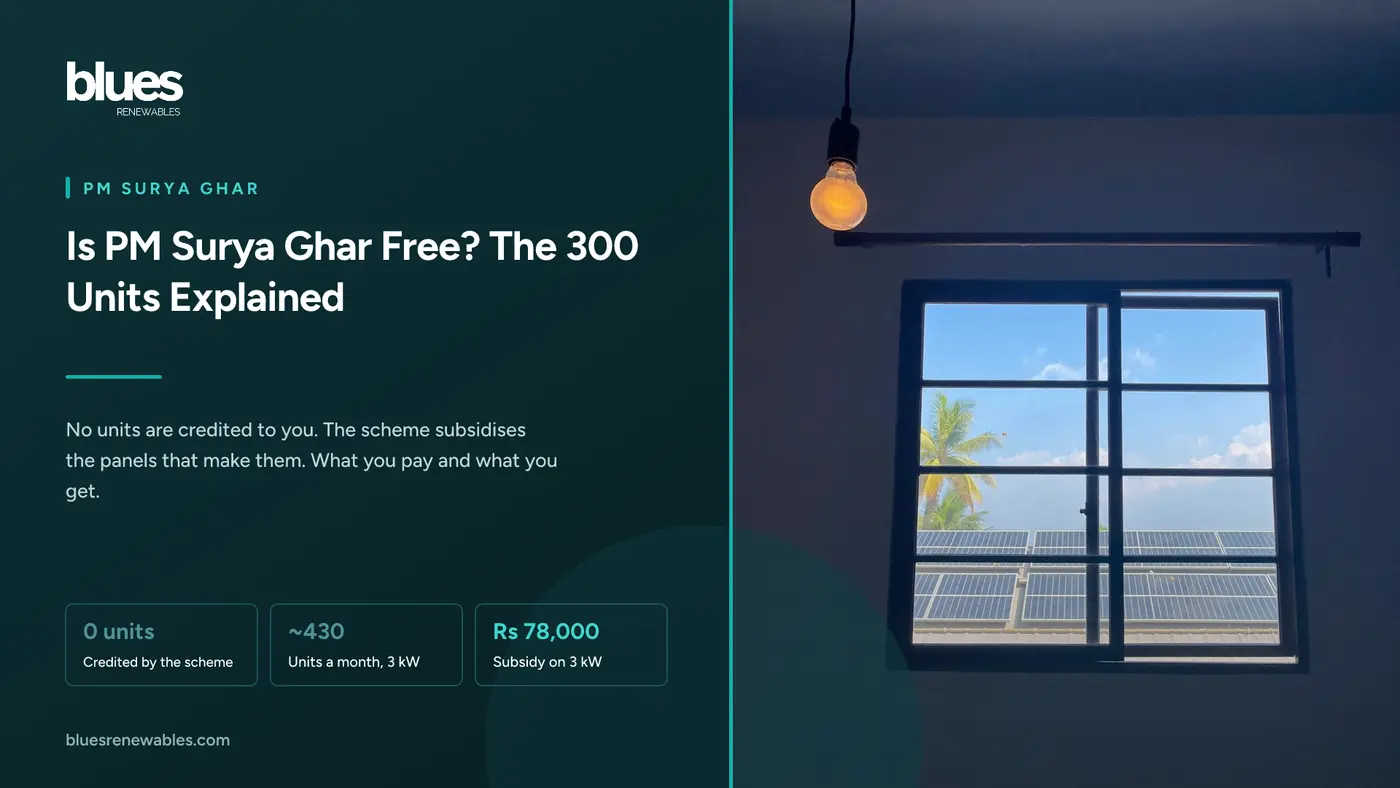
It does not, and the difference matters when you are budgeting. PM Surya Ghar subsidises the cost of solar panels on your roof. The panels then produce electricity, and that electricity costs you nothing to use. The "300 units" is roughly what a well-sized rooftop system can produce, not an allowance anyone credits to your account.
This guide explains where the 300 figure comes from, what you actually pay, and how many units a system really produces in Tamil Nadu.
Key takeaways
- There is no free allowance of units. The scheme's stated aim is to "help provide free or low-cost electricity up to 300 units per month" by installing rooftop solar.
- You pay for the system, less the subsidy: ₹30,000 for 1 kW, ₹60,000 for 2 kW, and ₹78,000 for 3 kW and above.
- The free units are the ones your panels produce. A 3 kW system in Chennai produces about 430 units a month; 2 kW produces about 290.
- Your bill will not be zero. Fixed charges remain, and months of low generation still draw from the grid.
- Net metering settles over the year, so summer surplus offsets monsoon shortfall.
Where "300 units" comes from
The number is in MNRE's guidelines, as one of the scheme's objectives: to help provide free or low-cost electricity to one crore households, up to 300 units of electricity per month, by installing rooftop solar.
Read that carefully. The electricity is free or low cost because your own panels generate it. The government's contribution is the subsidy on the panels, paid once. Nobody meters 300 units into your connection each month, and a household that installs nothing receives nothing.
Is PM Surya Ghar free? What you actually pay
The system is not free. You pay the installed cost, and the central subsidy reduces it:
- 1 kW - Central subsidy: ₹30,000, What a system produces in Chennai: about 145 units a month
- 2 kW - Central subsidy: ₹60,000, What a system produces in Chennai: about 290 units a month
- 3 kW - Central subsidy: ₹78,000, What a system produces in Chennai: about 430 units a month
The generation figures use the roughly 1,730 units per kW a year a well-installed system produces in Chennai. For what the rest of the system costs, see solar panel price in Chennai and the 2 kW and 3 kW price pages.
The subsidy is paid into your bank account after the DISCOM inspects the system, not deducted at the start. So you need the full amount upfront, or a loan. See solar loan EMI in Tamil Nadu.
How many units do you get free?
The units you get free are the units your system produces and you use. In Tamil Nadu that depends on three things.
System size. The table above. To produce about 300 units a month you need a little over 2 kW; a 3 kW system comfortably exceeds it.
The season. Generation falls in the northeast monsoon from October to December and peaks in the dry months. Our guide to solar generation in the monsoon shows the pattern.
How much you use while the sun is up. Under net metering, units you export in the day offset units you import at night, so timing matters less than people think, but it still affects how the year settles.
Why your electricity bill will not be zero
Even with enough panels to cover your consumption, three things keep a bill on the table:
- Fixed charges are billed on your sanctioned load and do not depend on how much you consume.
- Low-generation months draw more from the grid than the panels supply.
- Settlement is annual. Surplus from good months offsets shortfall in poor ones, but the year is settled as a whole.
Our full guide to why your electricity bill is not zero after solar walks through a real Tamil Nadu bill.
So is it worth it if it is not free?
For most homes, yes, and the reason is the subsidy. On a 3 kW system, ₹78,000 is a large share of the installed cost, and the electricity the panels produce offsets units you would otherwise buy at your slab rate. Our guide to calculating solar payback shows how to work out the number for your own bill.
What it is not is money for nothing. Anyone offering "free solar" with no cost to you is either describing a lease or loan, or not telling the truth.
Frequently asked questions
Is PM Surya Ghar free?
No. The scheme subsidises the cost of rooftop solar: ₹30,000 for 1 kW, ₹60,000 for 2 kW and ₹78,000 for 3 kW and above. You pay the rest. The electricity your panels then produce is free to use.
Does PM Surya Ghar give 300 units of free electricity every month?
No. 300 units a month is the scheme's stated aim for what rooftop solar can provide. No units are credited to your account; they come from your own panels.
How many kW do I need for 300 units a month?
In Chennai, a little over 2 kW. A 2 kW system produces about 290 units a month and a 3 kW system about 430, averaged over the year.
Why is my bill not zero after installing solar under PM Surya Ghar?
Fixed charges remain, low-generation months draw from the grid, and net metering settles over the year as a whole.
Is there any scheme that installs solar for free?
Under PM Surya Ghar's main component you fund the system and receive a subsidy. Separate models, where a third party owns the system, are handled under different guidelines and are not free either; you pay through a tariff or rent instead.
What is the difference between 150, 200 and 300 units free?
Those figures appear in various state schemes and advertisements. Under PM Surya Ghar, the units you get depend only on the size of your system and your roof. Check any claimed free-unit figure against the scheme's actual rules.
Where this fits
For how to apply, see the PM Surya Ghar subsidy guide. To confirm you qualify, see PM Surya Ghar eligibility. To size a system to your bill, try our solar calculator.
Blues Renewables sizes every system to the household's real consumption, not to a headline number, and shows the expected units and the remaining bill on the quote. Send us two recent electricity bills and we will tell you what you can realistically save.
Call +91 98841 07170.
Sources
- Ministry of New and Renewable Energy, Guidelines for PM-Surya Ghar: Muft Bijli Yojana, on the scheme objective of free or low-cost electricity up to 300 units per month, the CFA amounts, and release of CFA after DISCOM inspection
- Blues Renewables generation records, Chennai rooftops, for about 1,730 units per kW a year