





Home / Commercial solar / Commercial solar cost per kW
Commercial solar · Cost per kWCommercial Solar Cost per kW, from 10 kW to 1 MW
Commercial rooftop solar in Chennai costs about ₹37 to ₹58 a watt installed in 2026, including 8.9% GST. A 10 kW system starts at about ₹5.8 lakh, a 100 kW plant costs ₹41 to ₹47 lakh, and a 500 kW plant costs ₹1.85 to ₹2.1 crore.
The price per watt falls as the plant grows, because the fixed part of every project is spread over more panels. Below you will find every size from 10 kW to 1 MW, what Tamil Nadu changes at 10, 150 and 999 kW, and the payback worked on four real tariff categories, so you can test any quote line by line.
Get an itemised proposalCall +91 98841 07170Commercial solar prices at a glance
- 10 kWabout ₹58 a watt
- 100 kW₹41 to 47 a watt
- 500 kW₹37 to 42 a watt
- GST on turnkey EPC8.9%
- Units per kW a yearabout 1,600
- Roof per kW80 to 100 sq ft
Chennai on-grid rooftop, turnkey, 2026. Prices include 8.9% GST unless marked ex-GST.
Commercial solar prices by size, 10 kW to 1 MW
Turnkey on-grid rooftop prices for Chennai in 2026, from Blues Renewables' published bands. Each size links to its own page with a worked payback.
Units a year use the Chennai district yield of about 1,600 units per kW (about 4.4 a day). Other districts fall between 1,550 and 1,700. Roof area assumes 80 to 100 sq ft of shade-free roof per kW. The 1 MW figure is a ground-mount price and excludes land.
Each price covers modules, inverters, mounting structure, DC and AC cabling, earthing and lightning protection, the generation meter, CEIG and TNPDCL liaison, installation, commissioning and two years of maintenance. After that, an annual maintenance contract is optional.
Why the price per kW falls from ₹58 to ₹37 a watt
Part of every project costs about the same whatever its size: survey and design, CEIG approval, TNPDCL paperwork, the generation meter, earthing, lightning protection, mobilising a crew and commissioning. On a 15 kW system that block is spread over 15,000 watts. On a 500 kW plant it is spread over 5,00,000 watts, so each watt carries far less of it.
Larger plants also build more efficiently: bigger inverters cost less per kW, and a crew moves faster across one open factory roof than around the water tanks of a small building.
The curve flattens above 150 kW. That is where a plant moves to HT supply, and HT-side equipment adds cost that an LT plant never carries. This is why 200 kW and 250 kW share one band of ₹39 to ₹44 a watt. The 1 MW figure is a ground mount excluding land, so it is not a like-for-like step down from a 500 kW roof.
What moves a price within its band
- Roof type. Metal sheet roofs cost less per kW than RCC roofs that need an elevated structure.
- Module type. DCR modules cost about ₹8 to ₹11 a watt more than non-DCR modules.
- Inverter brand.
- Structure height.
- Cable runs to your LT panel or HT yard.
- HT-side equipment above 150 kW.
- Roof repairs needed before panels go up.
Ex-GST or incl-GST: the 8.9% rule and input tax credit
Solar power devices carry 5% GST from 22 September 2025 under CBIC Notification 9/2025-Central Tax (Rate). A turnkey solar EPC contract is valued as 70% goods at 5% and 30% services at 18%. That gives 0.70 × 5% + 0.30 × 18% = 8.9% on the whole contract. Before the cut the same sum gave 13.8%, so any quote still adding 13.8% is out of date.
A GST-registered business claims that 8.9% back as input tax credit. Its real cost is the ex-GST figure. A 100 kW plant at ₹41 to ₹47 lakh with GST costs a registered business ₹37.6 to ₹43.2 lakh. A school, trust, clinic or home without GST registration pays the full figure. Our guide to GST on solar power plants shows how the invoice should be split.
Ask every bidder to show both numbers. Comparing one firm's ex-GST price with another's incl-GST price makes a quote look 9% cheaper than it is.
Panel cost versus system cost: where ₹45 a watt goes
Modules are the only part with a public benchmark: JMK Research put non-DCR modules at about ₹14.3 to ₹14.9 per Wp ex-works in Q4 2025. On a system priced at ₹45 a watt with GST, about ₹41 before GST, the panels are roughly a third of the money. The rest turns panels into a safe, approved, metered plant.
DCR modules, made with Indian cells, cost about ₹23 to ₹26 a watt. Businesses get no central subsidy that would require them, so commercial plants normally use non-DCR modules. If a quote specifies DCR, it should say so and price the premium openly.
- Inverters. Tamil Nadu counts plant capacity on the AC side, so the inverter rating decides your feed-in tier, your fee band and whether CEIG applies.
- Mounting structure. Rails on metal sheet, or elevated steel on RCC.
- DC and AC cabling, set by distance to your LT panel or HT yard.
- Earthing and lightning protection.
- Metering and approvals. The generation meter, CEIG inspection and TNPDCL liaison.
- Installation, commissioning and two years of maintenance.
- GST at 8.9% on the whole contract.
Our proposals itemise each line, so you compare like with like.
What Tamil Nadu changes at 10 kW, 150 kW and 999 kW
Three lines in the TNERC rooftop rules decide how a business plant is metered, approved and paid. Capacity is counted on the AC side.
Your plant cannot exceed your sanctioned load or contracted demand, and never 999 kW, so check the capacity limit against your sanctioned load first. LT applications up to 150 kW go through the TNPDCL rooftop portal (USRP). Between 112 and 150 kW of demand you give TNPDCL space for a distribution transformer. Above 999 kW, net feed-in stops and TNPDCL approves parallel operation with reverse power relays instead, which is why larger buyers look at captive solar or open access.
Net feed-in pays exports in money, not units. Credit carries forward, and on 31 March you choose payment or carry-over. That makes self-use the whole game. On LT V a unit you use saves ₹10.45, a unit you export earns ₹3.37, and both pay the ₹1.60 network charge. Our explainer on net metering versus net feed-in covers the billing, and the network charge guide covers the charge, which is currently levied but under challenge in the Madras High Court.
Subsidy for commercial solar: what a business actually gets
Businesses do not get PM Surya Ghar, a residential scheme, and Tamil Nadu has no current electricity-tax exemption for solar. A business gets tax relief instead, and industry gets some help on charges.
- GST input credit. A registered business recovers the 8.9% GST.
- Accelerated depreciation. 40% a year on the written-down value, under Section 32 and the 40% block for solar power generating systems.
- LT IIIB industrial relief for 2026-27. The state pays half the network charge, so you pay ₹0.80 a unit, and the 25% peak surcharge drops to 15% with a smart meter, or nil without one.
- Housing societies. ₹18,000 per kW for common facilities up to 500 kW, capped at 3 kW per house. See solar for apartments.
Depreciation worked on a ₹1 crore ex-GST plant used for 180 days or more in its first year: ₹40 lakh in year one, ₹24 lakh in year two and ₹14.4 lakh in year three. Used for under 180 days, year one falls to ₹20 lakh. A manufacturer can add 20% additional depreciation (₹20 lakh) in year one under Section 32(1)(iia). A company on the Section 115BAA regime loses that extra 20% but keeps the 40%.
Depreciation only helps a business with taxable profit, and your CA should model it against your own return. Our posts on what accelerated depreciation is and how to calculate it go further, and the solar plant subsidy guide covers every scheme by buyer type.
Payback on real Tamil Nadu bills: LT V, LT IIIB, HT I and HT III
Annual saving = (self-used units × your energy tariff) + (exported units × feed-in tariff) − (total generation × network charge). The table applies it to four real tariff categories under TNERC Tariff Order 6/2025, at 1,600 units per kW, with the self-use share stated for each.
Payback is before depreciation and uses the ex-GST price, which suits a GST-registered business. Without registration, use the incl-GST price and the payback stretches by about 9%.
Solar cuts the energy charge only: the LT fixed charge and the HT demand charge of ₹608 per kVA a month stay. The figures also ignore the 25% peak surcharge from 6 to 10 am and 6 to 10 pm; solar covers part of the morning window, so real savings run slightly higher. LT IIIB has the lowest tariff but pays half the network charge, which keeps it close to LT V. HT III pays back fastest: a ₹9.40 tariff against a ₹1.04 network charge.
Gross metering rarely beats net feed-in on a busy site. The 300 kW HT I factory would sell all 4,80,000 units at ₹3.10 for ₹14,88,000 a year: about half what net feed-in saves. Run your own numbers in the commercial solar ROI calculator, or see how factories use it on our industrial solar page.
Metal sheet, RCC or ground mount: how the roof moves the price
Allow 80 to 100 sq ft of shade-free roof per kW. A 100 kW plant needs about 8,000 to 10,000 sq ft, which sets the size limit on many sites before the sanctioned load does.
Metal sheet roofs
The cheapest roof per kW, common on factories and warehouses. Rails clamp to the sheet or purlins. We check purlin condition and sheet age first, because replacing a tired roof is a repair that adds to the price. Solar for warehouses covers this roof type in detail.
RCC roofs
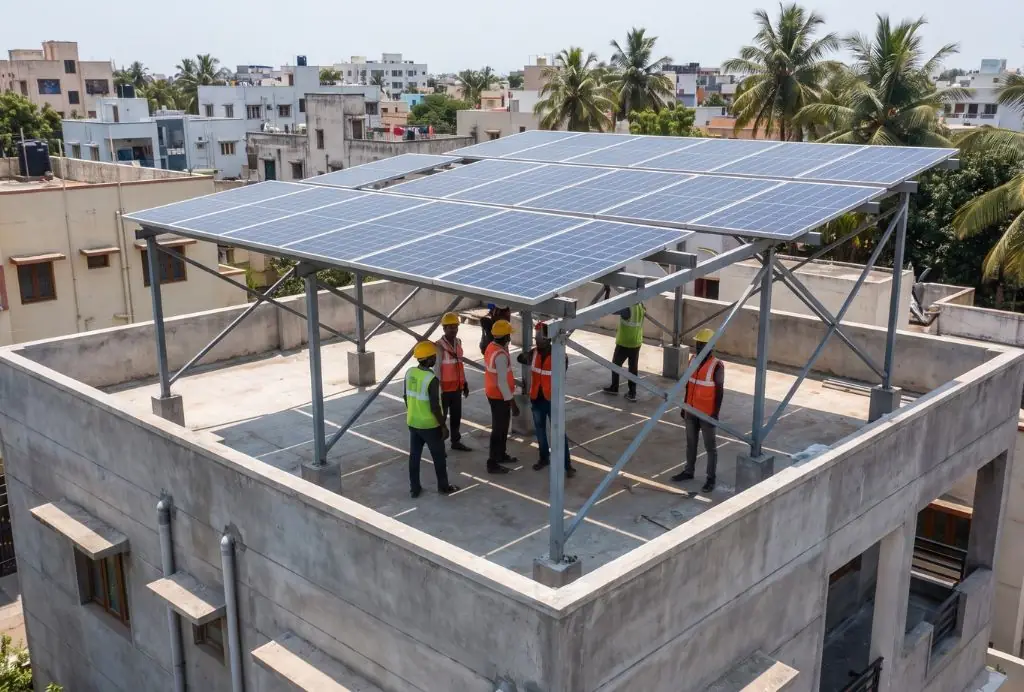
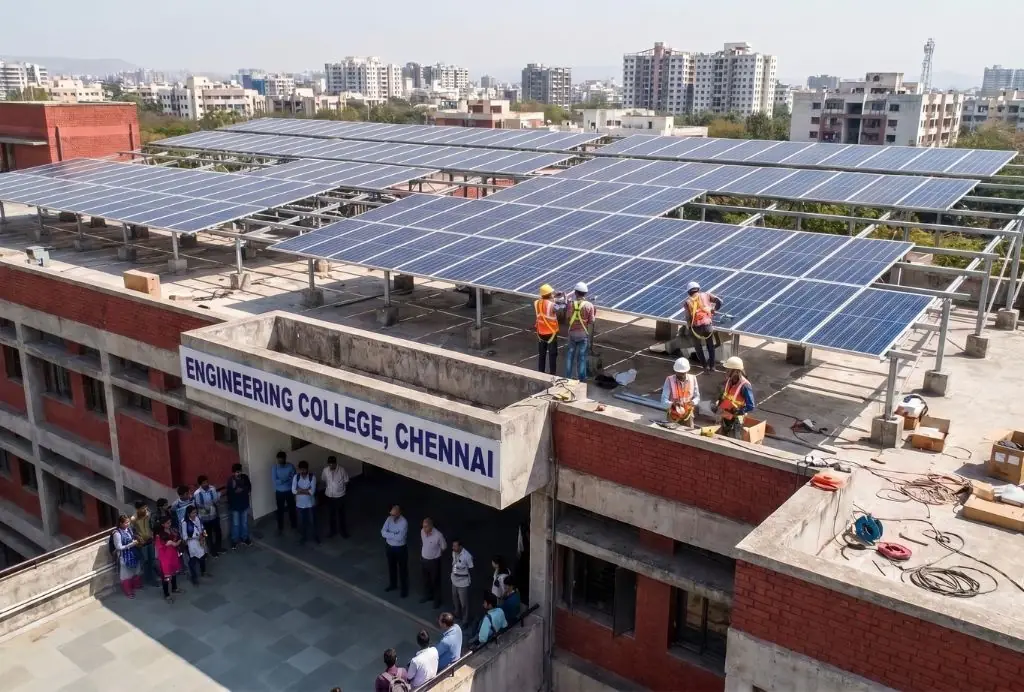
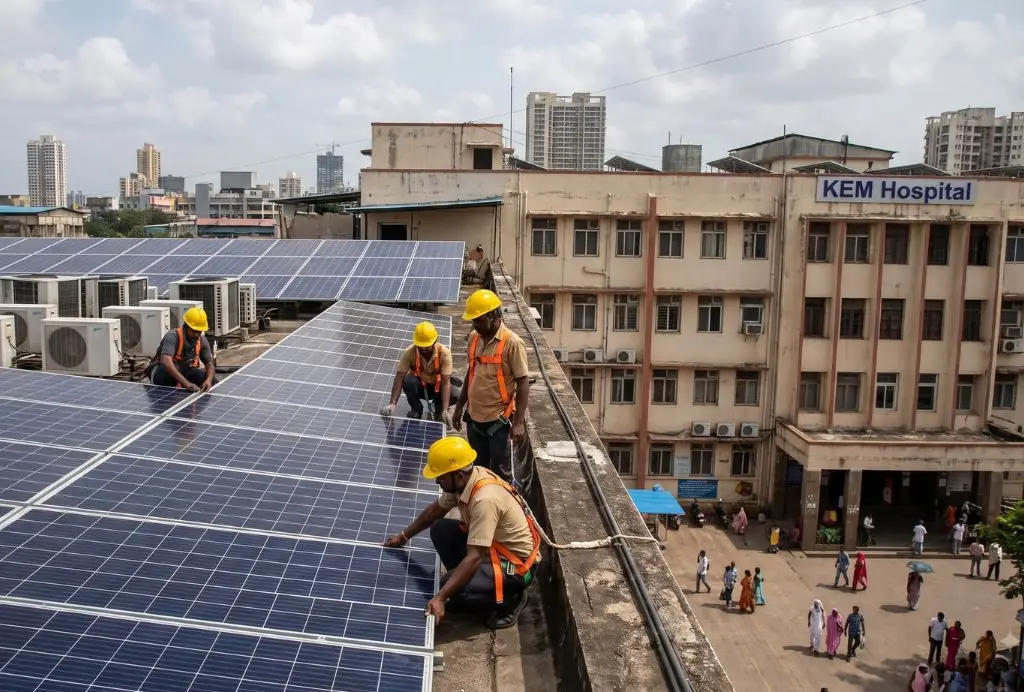
Common on offices, schools, hospitals and hotels. An elevated structure keeps the roof usable and clears water tanks, but more steel and height cost more per kW, and it must be designed for Chennai's coastal wind.
Ground mount
Where roof area runs out, a ground mount on spare land takes over. That is the basis of the 1 MW price, which excludes the land.
CAPEX, loan or RESCO at each size
Our CAPEX versus RESCO comparison sets out each model in full. Here is how they fall by size.
- 10 to 50 kW. Mostly CAPEX or a short bank loan for the solar plant. Paybacks of three to four years on a commercial tariff make outright ownership the cheapest route.
- 50 to 150 kW. CAPEX with accelerated depreciation suits a profitable business. A loan spreads the cost when cash is better used elsewhere.
- 151 to 999 kW. All three models are live. A RESCO arrangement suits hospitals, trusts and firms that cannot use depreciation, because they pay only for the units the plant delivers.
How to read a commercial solar quote per watt
Divide the total by the DC capacity in watts to get the per-watt price, then check that the quote is pricing the same plant as the others:
- Is the total with or without 8.9% GST? Is GST shown as one composite line?
- Module make, wattage, DCR or non-DCR, and panel count.
- Inverter make and AC rating, which sets your feed-in tier and fee band.
- Structure type and height, and whether roof repairs are included.
- Generation meter, CEIG approval and TNPDCL liaison included, or left to you.
- Cable lengths, earthing and lightning protection named, not lumped together.
- Years of maintenance included, and the AMC price after.
A quote far below the band usually drops one of these lines. Our checklist on whether your solar quote is too high works through a real one, and the commercial solar page explains how we deliver a plant from survey to CEIG.
Other commercial sizes
Commercial solar cost, common questions
What is the cost per kW of commercial solar in 2026?
In Chennai, an on-grid commercial rooftop plant costs about ₹37,000 to ₹58,000 per kW installed, including 8.9% GST. Small 10 to 20 kW systems sit at the top of that range and 500 kW plants at the bottom. A 100 kW plant costs ₹41,000 to ₹47,000 per kW.
Is commercial solar cheaper per kW than home solar?
Per watt, larger systems cost less: about ₹58 a watt at 10 kW against ₹44 to ₹50 at 50 kW. But a business gets no PM Surya Ghar subsidy. It gets GST input credit and accelerated depreciation instead, which often matter more on a large plant.
What is included in the per kW price?
Modules, inverters, mounting structure, DC and AC cabling, earthing and lightning protection, the generation meter, CEIG and TNPDCL liaison, installation, commissioning and two years of maintenance. Roof repairs and HT-side equipment above 150 kW are priced separately where needed.
Do businesses get a solar subsidy in Tamil Nadu?
No subsidy is paid on a commercial plant. Businesses claim 40% accelerated depreciation and GST input credit. LT IIIB industries also pay only half the network charge in 2026-27. Housing societies get ₹18,000 per kW for common facilities.
What is the payback period for commercial solar in Tamil Nadu?
With strong daytime use, about 3 to 4 years before depreciation. Our worked examples give 3.2 to 3.6 years on LT V, 3.3 to 3.8 on LT IIIB, 3.6 to 4.1 on HT I and 3.0 to 3.4 on HT III. Lower self-use stretches it, because exports earn only ₹3.10 to ₹3.61 a unit.
Does net metering apply to commercial solar in Tamil Nadu?
No. Net metering is for homes only. Shops, offices and factories use net feed-in: imports are billed at your tariff and exports are credited in money at ₹3.37 a unit for 11 to 150 kW or ₹3.10 for 151 to 999 kW.
Can a business install solar with no upfront investment?
Yes, through a RESCO or OPEX agreement, where a developer owns the plant and you pay per unit. It suits larger plants and owners who cannot use depreciation. Smaller systems usually pay back fast enough that owning them costs less.
How long do TNPDCL and CEIG approvals take?
Above 10 kW, TNPDCL must complete a feasibility study within 15 working days of registration and approve within 5 working days after that. CEIG then inspects and approves the plant before it is commissioned.
Get a per-watt proposal for your premises
Send your recent electricity bills and the site location. We size the plant to your daytime load, price it line by line, and work the payback on your own tariff category.
Blues Renewables is an owner-operated solar EPC in Guindy, Chennai, installing across Tamil Nadu with its own crews since 2020. Commercial projects include two years of maintenance.
An engineer calls back within one working day. We use your bill only to size the system and never pass your details on.
Sources
Blues Renewables price bands for Chennai rooftop installations, October 2026: all installed prices on this page.
TNERC Suo-motu Tariff Order No. 6 of 2025, 30 June 2025, effective 1 July 2025: LT V ₹10.45, LT IIIB ₹8.25, HT I ₹7.50 and HT III ₹9.40 a unit, ₹608 per kVA demand charge, time-of-day peak surcharge, and network charges of ₹1.60 (LT) and ₹1.04 (HT) a unit. TNERC Tariff Order 6/2025
TNERC Order No. 4 of 2026, 27 April 2026, Provisional Tariff Subsidy Order FY 2026-27: 50% network charge subsidy for LT IIIB (₹0.80 paid) and the LT IIIB peak surcharge relief. TNERC Order 4/2026
TNERC Grid Interactive Solar PV Energy Generating System Regulations 2021, notified 7 October 2021, and TNERC Order No. 8 of 2021, 22 October 2021: net feed-in for non-domestic consumers, gross metering at 151 to 999 kW, feed-in tariffs of ₹3.61, ₹3.37 and ₹3.10, generation meter above 10 kW, capacity cap, registration fees and feasibility timelines. TNERC GISS Regulations 2021
TNERC Consolidated Distribution Code, amended up to 31 March 2024, Regulation 26(1)(b): LT supply up to 150 kW demand, with transformer space from 112 to 150 kW.
Ministry of Power, Electricity (Rights of Consumers) Amendment Rules 2024, 22 February 2024: no feasibility study up to 10 kW; above that, a study within 15 days or the proposal is deemed feasible.
Government of Tamil Nadu, G.O. Ms. No. 98, Energy Department, 14 October 2024: Electrical Inspector (CEIG) approval before commissioning any generating unit above 10 kVA.
CBIC Notification No. 9/2025-Central Tax (Rate), 17 September 2025, in force 22 September 2025: 5% GST on solar power devices; with the 70:30 valuation rule, 8.9% on a turnkey EPC contract.
Income-tax Act 1961, Section 32, and Appendix I to the Income-tax Rules 1962: 40% written-down value depreciation on solar power generating systems, half rate if used under 180 days, 20% additional depreciation for manufacturers under Section 32(1)(iia), not available under Section 115BAA.
JMK Research, module prices Q4 2025: non-DCR modules ₹14.32 to ₹14.88 per Wp ex-works. IEEFA, late 2025: DCR modules about ₹23 to ₹26 per W.
Ministry of New and Renewable Energy, PM Surya Ghar: Muft Bijli Yojana: residential only; ₹18,000 per kW for housing society common facilities up to 500 kW, capped at 3 kW per house.