Solar Panel Mounting Structure: Types, Height and Cost (Tamil Nadu, 2026)
Solar mounting structure guide for Tamil Nadu: RCC, elevated, ballast and tin shed types, materials, Chennai wind load, tilt, height and cost per kW.

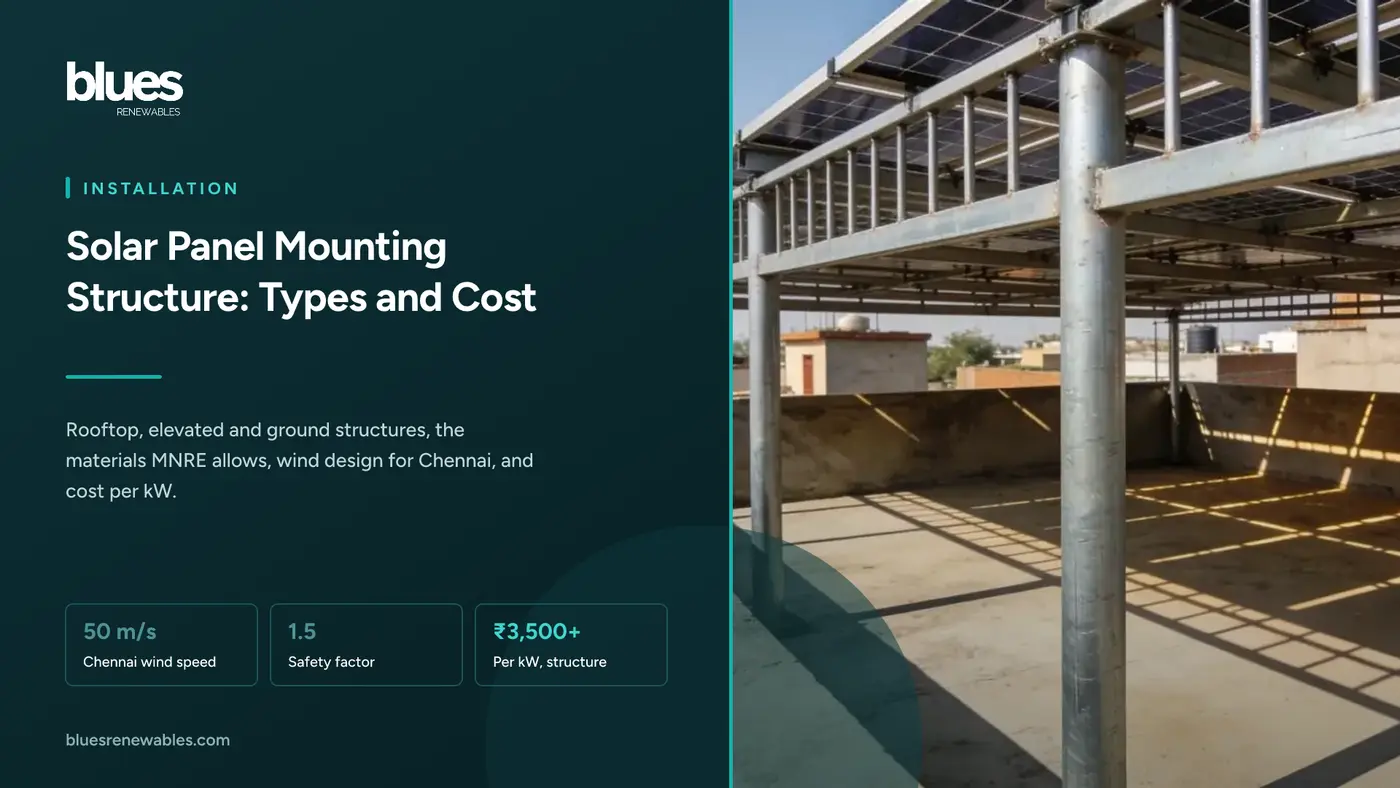
Chennai's basic wind speed under IS 875 Part 3 is 50 metres a second, which is 180 km/h. Several state rooftop specifications still ask for only 150 km/h. Wind pressure rises with the square of speed, so a 180 km/h gust pushes about 44% harder.
The frame is one of the cheapest parts of a rooftop system, and the part most often cut to win a quote, because nobody sees the difference until a cyclone arrives.
This guide covers the types of solar mounting structure used on Tamil Nadu roofs, the parts and materials, how high and at what angle to mount panels, what wind design means here, and what a structure costs per kW. Ground-mount projects are covered separately on our ground mount solar page.
Key takeaways
- Design for 50 m/s, not 150 km/h. IS 875 Part 3 gives Chennai a 50 m/s basic wind speed, and MNRE requires structures to suit the local wind zone with a safety factor of at least 1.5.
- MNRE now allows four materials: hot-dip galvanised iron, hot-dip galvanised mild steel, aluminium and, since May 2026, ZAM alloy. Mild steel is preferred for raised structures.
- Height changes the steel, not just the look. MNRE's specification steps up base plates from 5 mm to 10 mm as clearance rises from under 1 m to over 3 m.
- Structure-only listings run about ₹3,500 to ₹7,000 per kW (typical market range, Oct 2026), only a small share of a home system's price.
- Ask for the design. A proper installer can show the wind speed, section sizes, galvanising standard and foundation method in writing.
What a solar panel mounting structure is, part by part
A solar structure, or module mounting structure (MMS), holds the panels at a fixed angle and carries their weight and wind forces into the roof. Its parts:
- Base plate - What it does: Spreads the load onto the roof or pedestal, MNRE minimum (elevated, 300 to 1,000 mm clearance): 5 mm thick
- Column (leg) - What it does: Carries the frame up from the base, MNRE minimum (elevated, 300 to 1,000 mm clearance): 2 mm lip section or 3 mm C-channel, at least 70 x 40 mm
- Rafter - What it does: Sloping member that sets the tilt, MNRE minimum (elevated, 300 to 1,000 mm clearance): 2 mm lip section or 3 mm C-channel, at least 70 x 40 mm
- Purlin - What it does: Horizontal rail the panels clamp onto, MNRE minimum (elevated, 300 to 1,000 mm clearance): 2 mm lip section, at least 60 x 40 mm
- Bracing - What it does: Stops the frame racking sideways, MNRE minimum (elevated, 300 to 1,000 mm clearance): 2 mm thick
- Clamps - What it does: Hold the panel frames; mid clamps between panels, end clamps at the edges, MNRE minimum (elevated, 300 to 1,000 mm clearance): Aluminium
- Fasteners - What it does: Bolt it all together, MNRE minimum (elevated, 300 to 1,000 mm clearance): Module fasteners SS 304; others SS 304 or HDG grade 8.8; 12 mm bolts leg to rafter, 10 mm rafter to purlin
- Foundation - What it does: Anchors the structure, MNRE minimum (elevated, 300 to 1,000 mm clearance): Anchor fasteners or J-bolts into an RCC pedestal
These are MNRE's PM Surya Ghar rooftop minimums. A quote that says only "GI structure" tells you none of this.
Types of solar mounting structures
RCC roof, low-rise structure
The most common choice on a Chennai terrace: a fixed-tilt frame a short height above the slab, on concrete pedestals or anchored to the roof. It uses the least steel and catches the least wind, but the space underneath is lost.
Elevated solar structure
Raises the panels high enough to walk or dry clothes underneath, so the terrace stays usable. It needs heavier sections, thicker base plates and stronger foundations, and MNRE prefers mild steel for it. It costs more for real reasons.
Ballast type solar structure
Holds the frame down with weight instead of bolts, so the waterproofing is never drilled. MNRE's specification calls for a non-invasive ballast design, 70 to 150 mm clearance above the roof for cooling and cleaning, and reinforced M25 concrete blocks. The catch on this coast is weight: the roof must carry enough concrete to resist cyclone uplift.
Tin shed or metal sheet roof structure
Common on factories, warehouses and poultry sheds. MNRE's specification says the structure follows the slope of the shed, either flat to the sheet if it faces south or tilted for more output, with at least 100 mm clearance, riveted to the purlins, and every member at least 2 mm thick.
Ground mounting structure
For open land and factory yards; see ground mount solar.
Solar carport structures
Long-span elevated canopies over parking, mostly at offices and factories.
How high should a solar structure be?
MNRE's specification groups rooftop structures by ground clearance, and the steel gets heavier at each step:
- 300 to 1,000 mm (minimum) - MNRE base plate: 5 mm, Column: 2 mm lip or 3 mm C-channel, 70 x 40 mm
- 1,000 to 2,000 mm (medium) - MNRE base plate: 6 mm, Column: 2 mm lip or 3 mm C-channel, 80 x 50 mm
- 2,000 to 3,000 mm (maximum) - MNRE base plate: 8 mm, Column: 2.6 mm square (50 x 50) or rectangular (60 x 40) hollow section, or 3 mm C-channel
- Over 3,000 mm (super elevated) - MNRE base plate: 10 mm, Column: 2.9 mm square (60 x 60) or rectangular (80 x 40) hollow section, with 4 mm cross bracing
MNRE marks the three taller bands "for reference only" and sets a 500 mm minimum clearance for a single row of panels in portrait. Walking under the low edge comfortably puts you in the 2,000 to 3,000 mm band.
Foundations follow the roof. If drilling is allowed, MNRE calls for at least 12 mm anchor fasteners, 100 mm long, in an RCC pedestal of at least 400 x 400 x 300 mm in M20 concrete. If not, J-bolts of at least 12 mm diameter and 300 mm length are set in blocks bonded to the slab. Either way, each fixing must be sealed properly, which our guide to solar panel roof leakage explains.
Solar structure material: galvanised steel, GI, aluminium or ZAM
MNRE's specification sets the material standards. Steel must meet IS 2062:2011 and its galvanising must comply with IS 4759. Aluminium must be alloy AA6063 T6, protected by coating or anodising. In May 2026 MNRE added ZAM (zinc, aluminium and magnesium coated steel) as a fourth option, provided it meets IS 18513:2023.
- Hot-dip galvanised mild steel - Standard MNRE cites: IS 2062:2011 steel, IS 4759 galvanising, Where it fits: Elevated and RCC structures; MNRE's preference for raised frames
- Hot-dip galvanised iron - Standard MNRE cites: IS 4759 galvanising, Where it fits: General rooftop structures
- Aluminium - Standard MNRE cites: AA6063 T6, anodised or coated, Where it fits: Tin sheds, light roofs, rails and clamps
- ZAM coated steel - Standard MNRE cites: IS 18513:2023, Where it fits: Allowed for PM Surya Ghar since May 2026
Galvanising microns. MNRE's current specification points to IS 4759 and EN 1461 for the minimum zinc coating, with tests for coating mass and adhesion, rather than one micron figure. Older state specifications asked for at least 80 microns (Chhattisgarh's CREDA) or 120 microns (Manipur's MANIREDA, 2018). A Chennai structure maker lists 650 grams per square metre, which it equates to 80 to 90 microns. Ask for the coating thickness in writing and the test report.
GI vs hot-dip galvanised. "GI structure" in a quote often means pre-galvanised channel, coated as sheet before cutting and drilling. Hot-dip galvanising coats the finished part, cut edges and bolt holes included. In Chennai's salt air, those edges are where rust starts.
Fasteners and clamps. MNRE asks for SS 304 or hot-dip galvanised bolts, aluminium clamps, and metals compatible with the aluminium panel frames, so they do not corrode each other.
Wind load in Chennai: designing for 50 m/s
IS 875 Part 3 maps Chennai at a basic wind speed of 50 m/s, or 180 km/h. MNRE requires the structure to withstand its zone's wind speed with a safety factor of at least 1.5, and holds the installer responsible for wind damage during the guarantee period. Some older state documents set a flat 150 km/h, which is 41.7 m/s and well below Chennai's figure.
A worked example: how hard the wind pulls
IS 875 converts wind speed to pressure with a simple formula: design pressure equals 0.6 times the design wind speed squared. Taking Chennai's 50 m/s and setting the height, terrain and topography factors at 1.0 for a simple illustration:
- Pressure = 0.6 x 50 x 50 = 1,500 newtons per square metre
- A 550 W panel covers about 2.27 x 1.13 m, roughly 2.57 square metres
- With a net pressure coefficient of 1.0, the uplift on one panel is about 1,500 x 2.57 = 3,860 newtons, close to 390 kg of force
That panel weighs 27.5 kg, so in a design gust the structure holds down roughly 14 times its weight. The real coefficient depends on tilt, roof height and where the panel sits in the array, so the true figure can be lower or higher. That is why a structure needs a calculation, not a rule of thumb.
What a solar structure design calculation should show
A competent installer can show you:
Basic wind speed (50 m/s for Chennai) and the IS 875 factors applied for height, terrain and topography
Pressure coefficients used for the tilt and array layout
Dead load of panels and structure
Checks on each member and connection, with the 1.5 safety factor
Foundation or ballast check against uplift and sliding
A drawing with section sizes, thicknesses and fastener grades
Tilt angle for a Chennai roof
Chennai sits at about 13 degrees north, and panels here usually face south at 10 to 15 degrees. MNRE asks for the angle that captures the most sunlight, and allows a lower one where it fits more capacity and the plant still meets its performance ratio.
A lower tilt catches less wind and needs less space between rows; some tilt helps rain wash dust off the glass. For row spacing and panel count on your roof, use the solar panel size calculator.
Solar structure price per kW in Tamil Nadu (2026)
Structure-only prices listed by manufacturers in October 2026 give a typical market range:
- RCC rooftop structure, 15 degree tilt, hot-dip galvanised (VRM Structures, Chennai) - Listed price: ₹5,000 per kW, Approx. per kW: ₹5,000
- 2 x 3 rooftop set, 3 to 5 ft, hot-dip galvanised (VRM Structures, Chennai) - Listed price: ₹15,000 per set, Approx. per kW: About ₹4,500 with six 550 W panels
- 2 x 3 elevated set, 8 to 10 ft, hot-dip galvanised (VRM Structures, Chennai) - Listed price: ₹17,900 per set, Approx. per kW: About ₹5,400 with six 550 W panels
- 3-row rooftop set, 5 kW, hot-dip galvanised (VRM Structures, Chennai) - Listed price: ₹35,000 per set, Approx. per kW: ₹7,000
- Rooftop GI structure kits (two sellers, Odisha and Greater Noida) - Listed price: ₹3.50 to ₹3.80 per watt, Approx. per kW: ₹3,500 to ₹3,800
These are ex-factory material prices, without foundations, transport, erection, waterproofing or design, and elevated frames add the most of those. No maker we checked publishes an installed price for an elevated frame, so ask for it as a separate line.
In context: on a 3 kW home system at about ₹2,10,000 before subsidy, a ₹5,000 per kW structure is about ₹15,000, roughly 7% of the price. Saving a few thousand rupees there is a poor trade on a cyclone coast. Is your solar quote too high explains how to read a structure line in a quotation.
Solar structure HSN code and GST
Steel structures fall under HSN 7308 and aluminium under 7610. Bought on their own, structures are taxed at 18%: in January 2022, Rajasthan's Appellate Authority for Advance Ruling held that iron structures for solar panels are not solar power devices and fall under 7308 at 18%. Inside a turnkey solar contract, the 70:30 rule brings the whole system to an effective 8.9%. Our guide to GST on solar power plants covers the rules.
Checklist: what to ask your installer about the structure
Design wind speed: 50 m/s (180 km/h) for Chennai.
Material and standard: IS 2062 steel with IS 4759 galvanising, AA6063 T6 aluminium, or IS 18513 ZAM.
Coating thickness, with a test report.
Section sizes against MNRE's minimums for your height.
SS 304 fasteners on the module clamps.
Foundation method and how each fixing is sealed.
A drawing of height, tilt and layout before work starts.
Frequently asked questions
Which solar mounting structure is best for a house in Chennai?
For most RCC terraces, hot-dip galvanised steel designed for 50 m/s wind: low-rise if you do not need the space underneath, elevated if you do.
What is the price of a solar panel structure per kW?
Manufacturer listings in October 2026 put structure-only prices at about ₹3,500 to ₹7,000 per kW. Foundations, erection and extra height cost more, so compare itemised quotes.
How high should an elevated solar structure be?
MNRE groups elevated structures from 300 mm to over 3,000 mm of clearance. To walk under the panels comfortably, you need the 2,000 to 3,000 mm band.
Is GI or aluminium better for a solar structure?
Hot-dip galvanised steel is stronger and MNRE's preference for raised frames; aluminium is lighter and suits tin sheds. Pre-galvanised GI channel is the weakest choice near the sea, because its cut edges are uncoated.
What wind speed should a solar structure withstand in Chennai?
50 m/s, or 180 km/h, which is Chennai's basic wind speed under IS 875 Part 3, with MNRE's minimum safety factor of 1.5 on top. A 150 km/h rating is below that.
What is the HSN code for a solar mounting structure?
7308 for iron or steel structures and 7610 for aluminium. Sold on their own, structures attract 18% GST.
Does a ballast structure work on a Chennai roof?
Yes, if the slab can carry the weight. Ballast avoids drilling, but resisting cyclone uplift takes a lot of concrete, so it needs a slab load check and a wind calculation.
Where this fits
For the rest of the system, see solar power plant components and rooftop solar components and wiring. For land-based projects, see ground mount solar. For prices, see solar panel price in Chennai, commercial solar cost per kW and solar panel price by wattage. For the installation itself, see how to install solar panels on your home.
Blues Renewables designs and installs rooftop solar across Tamil Nadu, for homes from 3 kW upwards and for apartments, businesses and factories. Every structure we install is hot-dip galvanised and designed for the coastal wind speed, and our quotations state the structure type, height, section sizes and design wind speed in writing. Low-rise or elevated, RCC or metal sheet, we survey the roof first and include two years of free maintenance.
Call +91 98841 07170.
Sources
- Ministry of New and Renewable Energy, Technical Specifications for rooftop solar plants (PM Surya Ghar national portal), section 3, Module Mounting Structure: permitted materials, IS 2062:2011, IS 4759 and EN 1461, AA6063 T6, SS 304 fasteners, wind zone design with 1.5 safety factor, ballast, tin shed and elevated structure categories with base plate and section minimums, foundation hardware, tilt guidance, material test standards
- Energetica India, 25 May 2026: MNRE amendment adding ZAM alloy (IS 18513:2023) as a fourth permitted structure material, with mild steel still preferred for raised structures
- Bureau of Indian Standards, IS 875 (Part 3):2015, Wind Loads on Buildings and Structures: basic wind speed of 50 m/s for Chennai and the formula design pressure = 0.6 x design wind speed squared
- Chhattisgarh State Renewable Energy Development Agency (CREDA), minimum technical specifications for SPV plants: 80 micron galvanising and 150 km/h wind rating
- Manipur Renewable Energy Development Agency (MANIREDA), Guidelines for Grid Connected Rooftop Solar Power Plant, May 2018: 120 micron galvanising and 150 km/h wind rating
- VRM Structures India Private Limited, Chennai, product listings viewed 4 October 2026: structure prices, 650 GSM (80 to 90 micron) galvanising, 180 km/h rating, 15 degree tilt RCC structure
- IndiaMART listings viewed 4 October 2026: rooftop GI structure kits at ₹3.50 per watt (Greater Noida) and ₹3.80 per watt (Odisha)
- Waaree Energies, official store listing for 550 Wp M10 Mono PERC module, viewed 4 October 2026: 2,272 x 1,133 mm, 27.5 kg
- Rajasthan Appellate Authority for Advance Ruling, Order No. RAJ/AAAR/04/2021-22, 11 January 2022 (Utsav Corporation, solar water pumping systems): iron structures for solar panels classified under heading 7308 at 18% GST, not as solar power devices
- GST Council, rate change effective 22 September 2025, and the 70:30 valuation rule for solar power generating systems: effective 8.9% on turnkey contracts