CEIG Approval for Solar in Tamil Nadu: When You Need It, Process and Timeline
When a Tamil Nadu solar plant needs CEIG approval, the 10 kVA rule behind it, the inspection steps, documents, fees, timelines and the usual causes of delay.

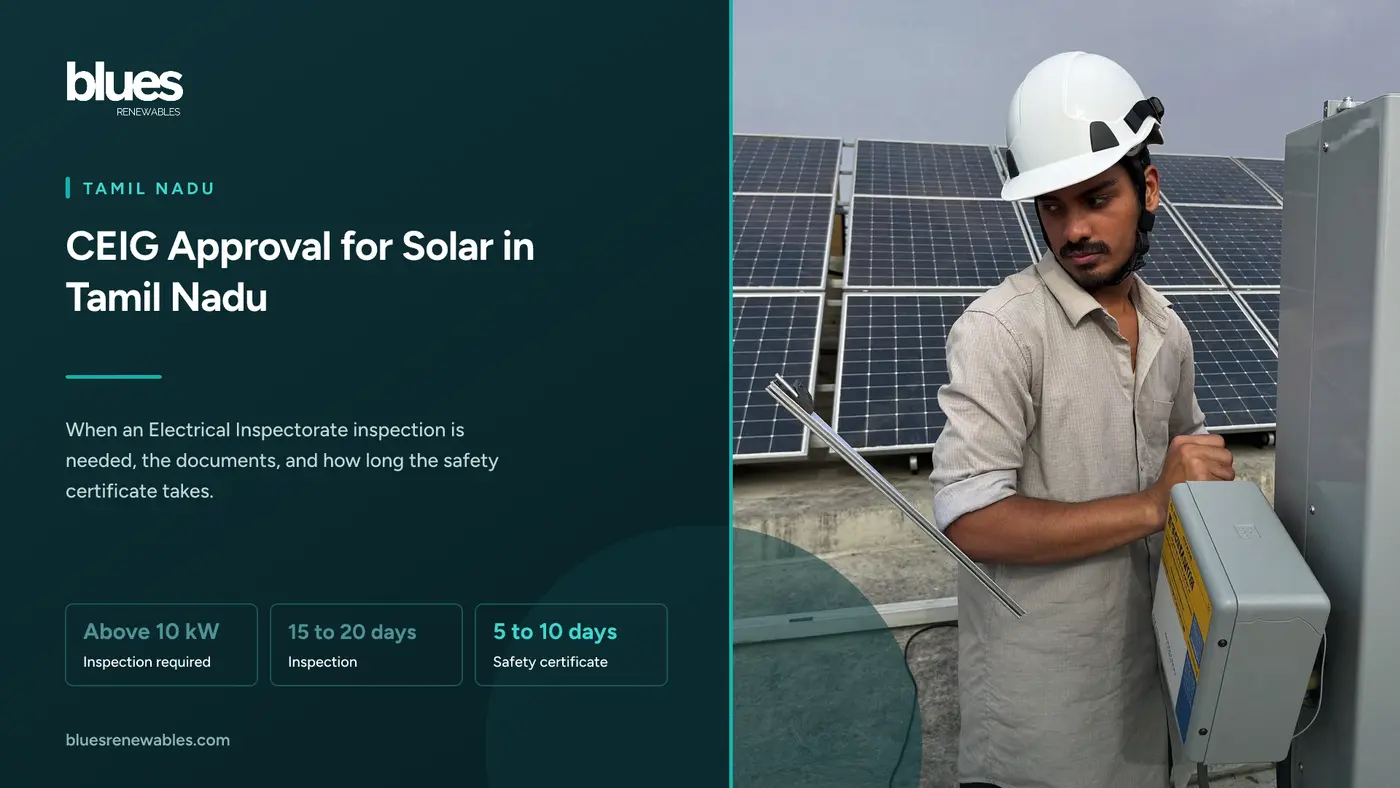
On 14 October 2024, the Tamil Nadu Energy Department set 10 kVA as the size above which any generating unit, solar included, must be inspected by the Electrical Inspector before commissioning. That one line in G.O.Ms. No. 98 is why a 10 kW rooftop plant goes straight to the TNPDCL meter, while an 11 kW plant waits for a government safety inspection first.
For a factory, school, apartment common service or large home, that inspection is often the step nobody schedules. TNPDCL will not fit the bidirectional meter without it, so a missing document or a failed earthing test delays every unit of savings.
This guide covers CEIG approval only: who needs it, what the inspectorate checks, the documents, the published fees and timelines, and what usually goes wrong. It does not re-explain the TNPDCL net metering application, which has its own guide.
Key takeaways
- CEIG stands for Chief Electrical Inspector to Government. In Tamil Nadu that office heads the Tamil Nadu Electrical Inspectorate (TNEI), part of the state Energy Department.
- The trigger is above 10 kVA, from G.O.Ms. No. 98 of 2024. TNPDCL's portal FAQ states the same line as "above 10 kW". At or below it, the TNPDCL Assistant Executive Engineer inspects the plant instead.
- The approval comes before the meter. TNPDCL installs the bidirectional meter only after it receives the inspection report.
- The published timeline is about 20 to 30 working days. TANGEDCO's operating procedure allows 15 to 20 working days for the CEIG inspection and 5 to 10 for the safety certificate.
- Most delays are paperwork or protection defects. A missing completion report, an unlicensed contractor, poor earthing or no lockable isolator each mean a defect report and a second visit.
What CEIG approval for solar means in Tamil Nadu
CEIG approval is the safety clearance the Tamil Nadu Electrical Inspectorate gives a solar plant before it can run in parallel with the grid. The legal basis is Regulation 34 of the Central Electricity Authority (Measures relating to Safety and Electric Supply) Regulations, 2023. It says generating units, renewable ones included, must be inspected by the Electrical Inspector before commissioning if they exceed a capacity the state notifies. Tamil Nadu notified 10 kVA.
"CEIG approval" is shorthand. The officer who actually inspects depends on size. TNEI's published procedures put installations up to 630 kVA with the Electrical Inspector, 630 to 2,500 kVA with the Senior Electrical Inspector, and above 2,500 kVA with the Chief Electrical Inspector. For almost every rooftop plant, the inspection is done by the Electrical Inspector's office for your division, but people and TNPDCL letters still call it CEIG approval.
Did the 2023 CEA rules bring in self-certification?
Only for periodic checks. The same October 2024 order lets installations up to 650 V be self-certified through a Chartered Electrical Safety Engineer: every five years for homes, every three years for other consumers. Commissioning a new generating unit falls under Regulation 34 instead, so a 415 V rooftop plant above 10 kVA still needs the inspector's visit first.
kW or kVA?
The order says 10 kVA and the TNPDCL FAQ says 10 kW. At unity power factor they are the same, but if your design sits right at the line, check the inverter's rated AC output in kVA on its datasheet.
Who needs CEIG approval
- Home, 3 to 10 kW - CEIG inspection?: No, Who inspects: TNPDCL AEE/O&M, Notes: Generation is assessed from the inverter or 21% CUF, no generation meter needed
- Home above 10 kW - CEIG inspection?: Yes, Who inspects: Electrical Inspector, Notes: Generation meter at your cost, lower feed-in band
- Apartment common service above 10 kW - CEIG inspection?: Yes, Who inspects: Electrical Inspector, Notes: Usually LT, applied through USRP
- Shop, office, school or factory on LT above 10 kW - CEIG inspection?: Yes, Who inspects: Electrical Inspector, Notes: LT solar is capped at 150 kW
- HT consumer, 151 to 999 kW - CEIG inspection?: Yes, Who inspects: Electrical Inspector or higher, by size, Notes: Applied through CE/NCES; safety certificate needed before synchronisation
TNPDCL's portal FAQ says it installs the bidirectional meter once it receives the inspection report, and its model feasibility letter tells the consumer to return after installation with CEIG approval where required. For HT plants, the 2021 circular says the SE/NCES synchronises the plant only once the safety certificate is produced.
What else changes above 10 kW
Crossing 10 kW does more than add an inspection. Under TNERC Order 8 of 2021:
- Safety inspection - Up to 10 kW: TNPDCL AEE, Above 10 kW: Electrical Inspector (CEIG)
- Generation meter - Up to 10 kW: Not required, Above 10 kW: Mandatory, with demand recording, at applicant's cost
- Check meter - Up to 10 kW: Not required, Above 10 kW: Installed by TNPDCL above 20 kW
- Feed-in tariff band - Up to 10 kW: ₹3.61 per unit (1 to 10 kW), Above 10 kW: ₹3.37 per unit (11 to 150 kW)
- Domestic network charge - Up to 10 kW: 20% of the charge, Above 10 kW: 75% of the charge
If a home design comes out at 11 or 12 kW, it is worth asking whether 10 kW does the job. Our 10 kW solar price guide and the post on network charges show the numbers. The total also cannot exceed your sanctioned load, covered in the sanctioned load limit guide.
The CEIG approval process, step by step
For LT plants above 10 kW (most rooftop jobs):
TNPDCL application and feasibility. Apply on the TNEB solar portal and receive feasibility approval.
Installation by a licensed contractor. TNEI requires the work to be done by a licensed electrical contractor, supervised by a person holding a certificate of competency under Regulation 31.
Application for inspection. Submit the completion report, equipment list and fee under TNEI's procedure for medium voltage generators above 10 kW. The documents are listed below.
Inspection. The consumer, the supervisor who signed the completion report and the contractor must be present with their licences and test instruments.
Defect report and rectification. Fix the listed defects and send an item-wise rectification report.
Approval. When the report is accepted, approval under Regulation 34 is issued.
TNPDCL meter. You inform TNPDCL; it inspects, fits the bidirectional meter and commissions the service.
For HT plants, TNEI adds drawing approval before erection (site plan, substation layout, single line diagram, earthing design) and a safety certificate after it, both filed online on the Tamil Nadu Single Window Portal.
TNEI publishes no solar-specific page or separate "TNEI portal" for solar. Its site lists only the HT services as online, so ask your divisional Electrical Inspector's office how LT solar inspections are filed.
Documents typically required
Based on TNEI's published procedures and checklists:
- Request letter for inspection (on letterhead for businesses)
- Contractor's work completion report in the IS 732 format
- Appointment order and consent letter of the competency certificate holder
- Equipment list with ratings, purchase invoices and, for HV equipment, test certificates
- TNPDCL load sanction or feasibility letter, and a copy of the meter card or bill
- Owner's no objection certificate if the connection is in someone else's name
- Fee challan
- For HT: item-wise compliance with the drawing approval conditions
CEIG approval timeline
- Inspection date given - Responsibility: CEIG and TNPDCL, Published limit: Within 7 days of request, Source: TANGEDCO Annexure I
- Inspection by CEIG - Responsibility: CEIG, Published limit: 15 to 20 working days, Source: TANGEDCO Annexure I
- Safety certificate - Responsibility: CEIG, Published limit: 5 to 10 working days, Source: TANGEDCO Annexure I
- Intimation to install meter - Responsibility: Consumer, Published limit: 7 to 10 working days, Source: TANGEDCO Annexure I
- TNPDCL inspection, meter, commissioning - Responsibility: TNPDCL, Published limit: 15 to 20 working days after CEIG approval, Source: TANGEDCO Annexure I
TNEI's own HT safety certificate procedure is tighter: queries within 7 days, a defect report within two working days of the visit, and the certificate within 7 working days of an accepted rectification report. Annexure I adds that a joint CEIG and TNPDCL inspection can cut the timeline sharply. All of these are maximums, and every defect report adds a cycle, so a clean first inspection matters most.
Fees: what is published and what is not
TNEI cites G.O. (Ms.) No. 30, Energy (B1) Department, dated 1 April 2002, as the basis for its fees, which are charged by equipment. The fee schedule TNEI publishes for safety certificate inspections does not have a separate line for solar plants. It does set:
- A minimum inspection fee of ₹1,000
- A re-inspection fee of 50% of the total amount
- Medium voltage generators from ₹500 (up to 25 kVA) to ₹2,500 (above 500 kVA)
Whether your inverter is charged as a medium voltage generator or as other equipment is the inspectorate's call, and we could not find a published rule on it. Ask for the challan amount before you pay, and budget for the re-inspection fee in case of defects.
Separately, TNEI lists solar PV inverters under its generator registration for electricity tax (Form A1, ₹2,000 up to 500 kVA). That is not the safety approval, and we could not verify how the 2025 electricity tax Act treats rooftop solar, so confirm it with the inspectorate.
Common reasons for rejection or delay
Most come from the protection rules in TANGEDCO's 2021 circular.
- No automatic isolation. The plant must disconnect when the grid fails or voltage goes out of range.
- No lockable isolator. TNPDCL staff must be able to lock an isolating switch, besides the inverter's own disconnect.
- Missing fuses, breakers or isolators on the DC and AC sides of the inverter.
- Weak earthing or surge protection, judged against CEA standards.
- Battery or DG back-feed. Backup power must not reach the grid, which matters with a hybrid inverter.
- Paperwork gaps: no IS 732 report, no competency certificate holder's consent, or an unlicensed contractor.
- No generation meter. Premises with several plants need one per inverter set.
- Lapsed permission. A plant not energised before the approval expires must be revalidated.
Frequently asked questions
What is the full form of CEIG?
CEIG stands for Chief Electrical Inspector to Government. In Tamil Nadu, the CEIG heads the Tamil Nadu Electrical Inspectorate under the Energy Department, with its head office in Chennai.
Is CEIG approval needed for a 10 kW solar system in Tamil Nadu?
No. The requirement starts above 10 kVA under G.O.Ms. No. 98 of 2024, and TNPDCL's FAQ says above 10 kW. A 10 kW plant is inspected by the TNPDCL Assistant Executive Engineer.
How long does CEIG approval take for solar?
TANGEDCO's operating procedure allows 15 to 20 working days for the inspection and 5 to 10 for the safety certificate. Each defect report adds a rectification round.
What is the CEIG fee for a solar plant in Tamil Nadu?
TNEI has not published a solar-specific fee. Its published schedule sets a ₹1,000 minimum inspection fee and a 50% re-inspection fee, with medium voltage generators charged by kVA. Confirm the challan amount with the inspectorate.
Does a home with 5 kW of solar need CEIG approval?
No. Homes at or below 10 kW are inspected by TNPDCL before the meter is fitted.
Who applies for CEIG approval, the owner or the installer?
The application is in the owner's name, but the licensed electrical contractor prepares the completion report and the competency certificate holder must sign it. Most owners leave the filing and follow-up to their installer.
Is there an online CEIG portal for solar in Tamil Nadu?
HT drawing approvals and safety certificates go through the Tamil Nadu Single Window Portal. TNEI publishes no separate solar portal, so ask your divisional Electrical Inspector how LT solar inspections are filed.
Where this fits
CEIG approval is one stage of the TNPDCL connection. The full sequence, the meters and what to do when TNPDCL is slow sit in the TANGEDCO net metering application guide. The application and uploads are covered in our TNEB solar portal walkthrough. If you are adding panels and might cross 10 kW, read TNEB solar additional load. For the billing choice that changes above 10 kW, see net metering vs net feed-in, and for the generation meter, TNEB solar meter reading. Businesses should start with our commercial solar page.
Blues Renewables designs and installs rooftop solar across Tamil Nadu from our Guindy, Chennai base. For plants above 10 kW we build to the protection rules the inspector checks, supply the generation meter, prepare the completion report through our licensed team, and follow up with the inspectorate and TNPDCL until the meter is fitted. Every system includes two years of free maintenance from commissioning. Call +91 98841 07170.
Sources
- Government of Tamil Nadu, Energy (C2) Department, G.O.Ms. No. 98, 14 October 2024, Tamil Nadu Government Gazette Extraordinary No. 335, published on tnei.tn.gov.in, viewed 1 October 2026: 10 kVA threshold for inspection of generating units under Regulation 34; 650 V notified voltage for self-certification; periodic inspection intervals
- Central Electricity Authority, Measures relating to Safety and Electric Supply Regulations, 2023, Gazette of India, viewed 1 October 2026: Regulation 34 wording, definitions of notified voltage and self-certification, Regulation 32 self-certification process
- Tamil Nadu Electrical Inspectorate, procedure pages for drawing approval, safety certificate, inspection and safety certificate, and MV generator inspection under Regulation 34, last updated 25 July 2026, viewed 1 October 2026: approving authority by kVA, licensed contractor and competency certificate rules, documents, defect and rectification steps, revalidation, process times
- Tamil Nadu Electrical Inspectorate, Online Services and FAQ pages, viewed 1 October 2026: online HT services on the Single Window Portal, generator registration including solar PV inverters, Form A1 fee
- Tamil Nadu Single Window Portal, "Safety Certificate from TNEI" and "Drawing Approval from TNEI" procedure documents, viewed 1 October 2026: document checklists, fee schedule including ₹1,000 minimum and 50% re-inspection fee
- TNPDCL, Unified Solar Rooftop Portal FAQ, viewed 1 October 2026: AEE inspection up to 10 kW, CEIG above 10 kW, meter installed after inspection report, CEIG compulsory above 10 kW, 150 kW LT limit
- TANGEDCO Technical Branch, salient features of TNERC Order 8 of 2021, signed 30 December 2021: generation and check meter rules, feed-in bands, network charge shares, protection requirements, HT synchronisation on safety certificate, Annexure F feasibility letter, Annexure G inspection report, Annexure I timelines